On November 30, 1986, in a house in Del Mar, California, a 69-year-old man sat by the phone. The curtains were drawn, and lung cancer had stripped away most of his weight and nearly all of his voice. The phone rang. On the other end was the woman he had married exactly 46 years earlier, on the same date, at the Byram River Beagle Club in Greenwich, Connecticut.
She was 75 now, and they had been divorced for more than 26 years. She told him she loved him, and he could barely answer. Two days later, Desi Arnaz was dead. The public had known them as Lucy and Ricky Ricardo, the couple who proved an American marriage could be funny, warm, and indestructible.
Forty-four million people had watched their television family welcome a baby, the Library of Congress preserved the show, and museums rebuilt their living room. But the real marriage had ended in a Santa Monica courtroom in 1960, long before the final phone call. Their two children, Lucie and Desi Arnaz Jr. , had spent their entire lives inside the widening distance between the family America loved and the household that actually existed.
Lucille Ball was born in 1911 in Jamestown, New York. Her father died of typhoid fever when she was three, and her mother remarried and left Lucille and her younger brother with their step-grandparents. The household was strict and strained, and what Lucy carried out of it was a deep need for stability and a discipline sharpened by a childhood without it. She left Jamestown at 15, studied drama in New York, was told she had no talent, and spent more than a decade in Hollywood moving through chorus lines, B movies, and studio contracts that kept her employed but never made her important.
Desi Arnaz was born in 1917 in Santiago de Cuba, into privilege his father’s position as mayor, land, cattle, and political standing. The 1933 revolution swept it all away, and the family fled to Miami with nothing. At 16, the son of privilege became a Cuban immigrant in Depression-era Florida, cleaning bird cages and doing odd jobs. He taught himself music, took up the conga drum, built a reputation in the Miami nightclub scene, and eventually reached Hollywood.
Both were shaped by loss, hers by deprivation, his by sudden collapse, and those drives would build an empire together while making a household nearly impossible. They met in 1940 on the set of Too Many Girls. He was 23 and she was 28, and the attraction was immediate and overpowering. They eloped on November 30, 1940.
The marriage carried a structural problem from the start: Lucy wanted safety, home, and routine, while Desi wanted movement, expansion, and scale. For the first ten years they lived mostly apart, Desi touring with his band and Lucy working in Hollywood. Lucy suffered miscarriages during that period, and the pain deepened her conviction that a real family was what she needed most. That desire is what made I Love Lucy possible.
The show, which premiered on CBS on October 15, 1951, was invented partly to solve the problem of the marriage itself by keeping Lucy and Desi on the same set, in the same city, on the same schedule. The premise was autobiographical: a bandleader married to a zany American wife in a New York apartment. CBS executives resisted a Cuban leading man opposite their red-headed star and questioned whether the American public would accept an interracial couple. Lucy and Desi took a live vaudeville act on the road, the audience response settled the argument, and Desilu Productions was formed.
Desi’s decision to shoot on 35mm film with a three-camera setup in front of a live studio audience preserved the episodes in a quality that made them re-runnable and syndication-ready for decades. He negotiated ownership of the negatives and understood, earlier than almost anyone in the industry, that the real fortune in television lay in owning, not just performing. The show became the most watched in America. More than 44 million people tuned in to the episode where Lucy told Ricky she was pregnant, a larger audience than watched Dwight Eisenhower’s inauguration the following day.
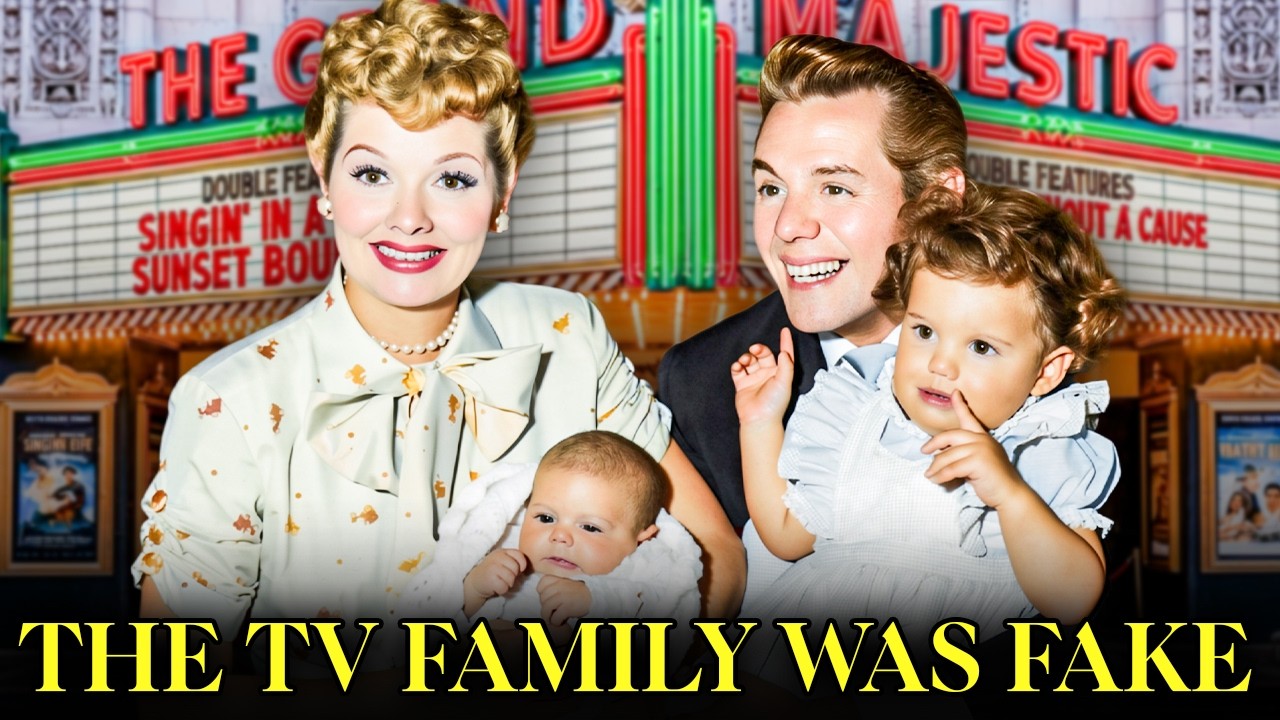
Their first child, Lucie Desiree Arnaz, was born on July 17, 1951, weeks before the show’s premiere. Their second, Desi Arnaz Jr. , was born on January 19, 1953, the same night CBS aired the episode in which Lucy Ricardo gave birth to little Ricky. The cesarean was scheduled to coincide with the broadcast, and more than 44 million viewers watched.
Newspapers ran the fictional birth alongside the real one. From his first day alive, Desi Jr. was both a child and a storyline, a product as much as a son. Inside the empire, the real marriage was fraying.
Desi drank, habitually and then heavily. He was unfaithful, in a pattern well known in the industry and devastating to the woman who had built her career around the image of a happy marriage. Lucy had filed for divorce once already, in 1944, four years into the marriage, but they reconciled and she withdrew the filing. The crisis had been absorbed, the public image survived, and the underlying damage went untreated.
The children felt the arguments, the absences, and the difference between the family on the screen and the family in the kitchen. The last Lucy-Desi Comedy Hour aired on April 1, 1960. The reruns had entered their permanent cycle, and the public still believed in a couple that had privately already lost each other. In March 1960, one day after Desi’s 43rd birthday, Lucille Ball filed for divorce in Santa Monica Superior Court, citing mental cruelty.
The divorce was finalized on May 4, 1960, and the children, Lucie then eight and Desi Jr. seven, began moving between their mother’s house and their father’s while the country kept watching a family that no longer existed. Within two years, Lucy bought out Desi’s share of Desilu, becoming the first woman to run a major television production studio in Hollywood. She ran it, approving budgets and programs that included The Untouchables, Mission Impossible, and Star Trek, and in 1967 sold the company for $17 million.
She remarried in 1961, wedding Gary Morton, a comedian who gave her steadiness rather than chaos. Desi remarried in 1963, moving to Del Mar, where he bred horses, played golf, and cooked elaborate Cuban meals, settling into a quieter life that never fully contained his restlessness. Desi Jr. formed a rock band, Dino, Desi and Billy, in the mid-1960s, and was famous for being young and for being born.
In 1968, both children joined their mother on Here’s Lucy, playing her on-screen children for six seasons, performing family warmth under studio lights while the original family unit had already failed. By the mid-1970s, Lucie pursued theater and music with real seriousness, and in 1980 married Laurence Luckinbill. Desi Jr. struggled through the 1970s with tabloid attention and substance use, entering treatment in 1981 at 28.
The father’s alcoholism had helped dissolve the marriage, and now the son was confronting the same disease. In 1985, Desi’s second wife, Edith Mack Hirsch, died of cancer. Alone in Del Mar, no longer able to outrun what he had avoided for decades, Desi Arnaz finally entered a treatment program under a pseudonym. In one meeting, surrounded by strangers, he stood up and said, “I am an alcoholic.
” Lucie would later call that moment one of her proudest memories of her father. The son had helped the father reach the admission, and the daughter held it as the family’s finest hour. But the honesty came late. After treatment, Desi was diagnosed with lung cancer, and the disease moved quickly.
Then came November 30, 1986, the anniversary of the wedding. Lucille called Desi in Del Mar and told him she loved him. The call was private, not long, and the bond beneath the failed marriage had survived the failure. Two days later, Desi Arnaz died at 69.
On April 26, 1989, Lucille Ball suffered a heart attack at her home in Beverly Hills, days after open-heart surgery, and died that morning at 77. The public mourning was enormous. In less than three years, Lucie and Desi Jr. had lost both parents while the reruns kept playing and the image of the happy couple continued untouched.
Lucie became the family’s primary steward. In 1993 she produced and narrated Lucy and Desi: A Home Movie, built from home footage and family recollections, showing the warmth and the wreckage without flinching. She spoke publicly with the earned clarity of someone who had lived inside the story, and she built a career grounded in her own talent. Desi Jr.
chose the opposite path, withdrawing from public life and settling eventually in Boulder City, Nevada, with his wife, the dancer Amy Bargiel. He kept the family name but refused to perform it. The cultural afterlife continued to grow. In 2021, Aaron Sorkin wrote and directed Being the Ricardos, a dramatization that Lucie later said contained inaccuracies.
In 2022, Amy Poehler directed the documentary Lucy and Desi, drawing on home movies and interviews to offer the family’s own perspective. The real story, as always, lived somewhere between the dramatized version and the family document. The Lucy-Desi Museum in Jamestown kept welcoming visitors who knew the Ricardos but not the Arnazes, and the reruns played on, permanent, young, and beloved, while the children kept living beside a happier version of their own past. Lucie Arnaz is 74 and remains publicly active, performing and curating the family archive.
Desi Arnaz Jr. is 73 and lives quietly in Nevada. The image remains, and the real family had to keep going after the credits rolled.