In the summer of 1863, a captured Confederate soldier in Tennessee told his Union guards that a man could load his gun once and shoot all week long. They laughed at first, but the laughter faded as they realized he was not exaggerating. He was describing something they had never seen before, and the shock of that discovery would travel all the way up the chain of command, unsettling even officers who had spent years under fire. For the first two years of the war, the entire architecture of infantry combat rested on a single mechanical reality: the muzzle-loading rifled musket.
The Springfield Model 1861 in the North and the British Enfield in the South were the standard weapons. Firing one was not a single motion but a long sequence of steps. A soldier tore the paper cartridge with his teeth, poured powder down the barrel, inserted the bullet, rammed it tight with a ramrod, cocked the hammer, and placed a percussion cap. Only then was the weapon ready to fire again.
A well-trained man could complete that cycle three times a minute under ideal conditions, but the battlefield was never ideal. Powder smoke filled the barrel, hands trembled, and comrades fell all around. The actual rate of fire dropped far below the theoretical number. That reloading interval was more than a technical detail.
It was the cornerstone of tactical doctrine. Commanders lined their men in ranks because the few seconds after one side fired and before the other could answer created a window for an offensive move or a flanking maneuver. Soldiers internalized that rhythm. Veterans later described it as something the body learned even when the mind was paralyzed by fear.
A man could feel the interval between volleys without counting, and that instinct became a psychological anchor in the chaos of battle. It was precisely this rhythm, reinforced through dozens of clashes, that the repeating rifle would shatter. The weapon most soldiers had never seen until 1863 was the Spencer repeating rifle, followed by the Henry. The Spencer carried seven metallic cartridges in a tubular magazine in the stock.
Instead of the long multi-step loading process, a soldier simply worked the lever, ejected the empty casing, and chambered a new round. A trained man could fire between fourteen and twenty rounds a minute. The Henry, developed by Benjamin Tyler Henry, carried sixteen cartridges and could sustain an even higher rate of fire. The real innovation was the metallic cartridge, which combined powder, primer, and bullet in a single unit.
It was faster, and it was also reloadable from a prone position. A soldier with a Spencer could stay low in tall grass or behind a trench, never exposing himself to stand and load. Rain and moisture, which ruined paper cartridges, had far less effect on sealed metallic ammunition. What emerged was not just a faster gun but a weapon that radically changed what a single soldier, company, or regiment could do on the battlefield.
The first major clash where Confederate officers had to account for this weapon was the Battle of Hoover’s Gap in Tennessee in June 1863. Colonel John Wilder had equipped his mounted infantry brigade with Spencer rifles largely on his own initiative, partly out of his own pocket, because the army bureaucracy moved too slowly for him. When his men faced Confederate forces defending the gap, they produced such a continuous and dense volume of fire that experienced Confederate officers had no framework to interpret it. Standard doctrine taught that the volume and pattern of incoming fire could roughly reveal the size of an opposing force.
At Hoover’s Gap, that calculation collapsed. Confederate commanders systematically overestimated the force facing them, in some cases by multiples of the actual number. Their decisions, whether to attack, commit reserves, or attempt a flank, were made on assessments of enemy strength that the new weapon had entirely corrupted. Wilder’s brigade held its position against a force that, by any previous tactical calculation, should have crushed it.
The psychological impact was as profound as the tactical one. Soldiers who had fought at Shiloh and Stones River described the fire they faced that day as ceaseless. For two years, men on both sides had developed an intuitive grasp of an engagement’s rhythm, an unspoken reassurance that the most dangerous moment would be brief and followed by a silence. The Spencer-carrying Union troops eradicated that silence.
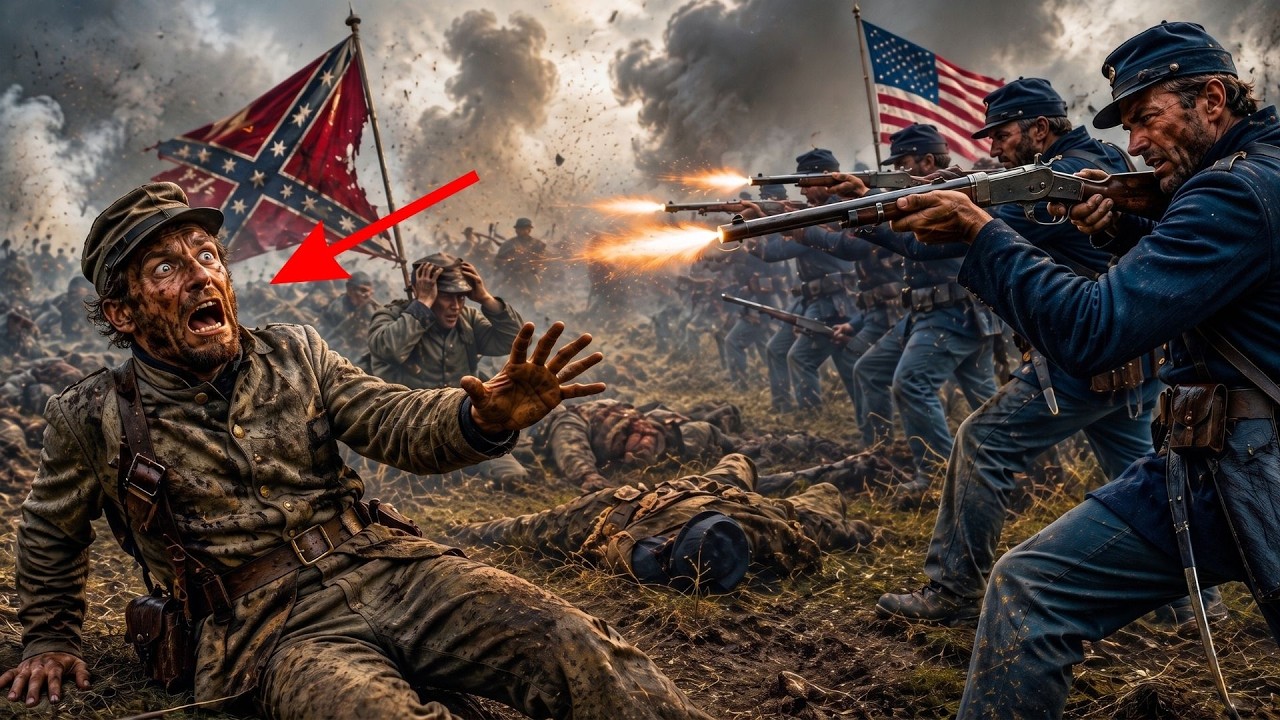
Confederate testimony repeatedly described the fire not as a series of volleys but as a continuous wall. The saying attributed to Confederate soldiers, that a man could load once and fire for days, spread until it became a legend within the Army of Tennessee. It was exaggeration, but the exaggeration hid something real. A natural question emerges: if this weapon was so effective, why was every Union soldier not carrying one by 1864?
The answer lies with James Ripley, the chief of ordnance for the Union Army. Ripley harbored a deep resistance to repeating weapons, and that resistance shaped procurement policy for years. He was genuinely concerned that soldiers with repeaters would expend far more ammunition, straining a supply chain already stretched across enemy territory. He feared green troops would waste rounds.
He also distrusted new technology and preferred the proven Springfield. Whatever the mix of legitimate logistical concern and stubbornness, Ripley used his position to delay repeating rifle procurement. Abraham Lincoln personally intervened. He had a genuine curiosity about firearms and tested weapons on the White House lawn.
After witnessing a demonstration of the Spencer, he was convinced of its value and applied direct presidential pressure to accelerate its adoption. Ripley was removed from his post in September 1863, and procurement accelerated. But it came too late to equip more than a small fraction of Union infantry before the war ended. The limited numbers shaped the shock.
Repeating rifles were not distributed evenly. They were concentrated in cavalry units and specially equipped mounted infantry brigades like Wilder’s. The vast majority of Union infantry still carried muzzle-loading muskets. Confederate soldiers accustomed to the predictable rhythm of combat could suddenly, without warning, face a Union unit that broke every rule they had internalized.
There was no way to know beforehand which units carried these weapons. The impact intensified precisely because it was unpredictable. The cost of the weapons and their ammunition was another factor. Metallic cartridges were more expensive to manufacture than paper ones, and equipping an entire army with Spencer rifles meant weighing tactical advantage against a federal budget and a supply chain never designed for such rates of consumption.
Some soldiers, particularly cavalrymen with more flexibility in purchasing their own weapons, bought Henry rifles with their own money, a sign of how clearly the value was understood at the soldier level even when institutional procurement lagged. By 1864, the tactical balance in cavalry combat had shifted noticeably. Earlier in the war, Confederate cavalry had a well-deserved reputation for superior horsemanship and aggressive instincts, inflicting humiliating defeats on their Union counterparts. At the Battle of Yellow Tavern in May 1864, where Confederate cavalry commander Jeb Stuart was mortally wounded, Union cavalry under Philip Sheridan dismounted and opened carbine fire with an intensity Confederate veterans described as fundamentally different from anything they had previously encountered from that branch.
Stuart was killed by a revolver bullet, but the clash became the symbol in Confederate memory of how profoundly the balance of cavalry combat had changed. The Confederacy never produced a repeating weapon in significant numbers because it lacked the industrial infrastructure to manufacture metallic cartridges at scale. Reliable brass or copper casings required precision manufacturing capacity that the antebellum South had never developed. A few armories attempted to copy captured Spencers and Henrys, but none came close to Union production volume.
Confederate soldiers who captured a Spencer often possessed a weapon they could use only until their captured ammunition ran out. Then it became a useless piece of metal. Ordinance officers described captured repeaters as prized loot that soldiers abandoned within weeks. In the dense woods of the Battle of the Wilderness in May 1864, the effects were clearly recorded.
Confederate soldiers advancing through the tangled terrain encountered isolated pockets of Union troops firing from concealed positions. The continuous fire coming from what was assessed as small detachments led to overcautious advances, delayed attacks, and in some documented cases, full retreats from terrain they could have taken. The unfamiliar gunfire turned real-time decision-making into a genuine tactical disadvantage. Confederate officers who survived these encounters tried to adapt.
They taught their men to recognize Spencer-carrying units by the movement of the lever and the distinct sound of metallic cartridges. Some commanders pushed reconnaissance further ahead to assess enemy strength before committing to an assault. Others developed a counter-tactic of closing to close combat as quickly as possible, reasoning that a rapid bayonet charge might reach the enemy before the ammunition advantage became decisive. The tactic was risky, but it reflected active thinking rather than paralysis.
By the war’s final year, George Armstrong Custer’s Spencer-carrying cavalry brigade offered the clearest example of what the weapon could achieve. At the Battle of Sailor’s Creek in April 1865, during the final week of Lee’s retreat toward Appomattox, Custer’s cavalry helped envelop and destroy a significant portion of Lee’s remaining army, cutting off roughly a quarter of the Army of Northern Virginia’s effective strength. Lee’s surrender days later became functionally inevitable. Confederate soldiers captured in that clash described the volume of continuous fire they faced as overwhelming.
The road from Hoover’s Gap to Sailor’s Creek traces something larger than a single weapon’s history. It traces the industrial and technological gap that had existed since the beginning of the war and widened with each passing year. The Spencer and Henry rifles did not win the war alone, but they show how a production and logistical advantage transformed into something the frontline soldier experienced not as a statistic but as genuine fear. The repeating rifle introduced an element of unpredictability into a battlefield experience that soldiers had spent years learning to predict.
That unpredictability accumulated from battle to battle, turning into terror. Confederate soldiers at Gettysburg, Chickamauga, and the Wilderness were not unusually cowardly men. Many had survived clashes that would break less resolute soldiers. What the repeating rifle did was erode the confidence they had built in what fighting should sound and feel like.
The soldier’s saying from 1863 survived for a century and a half not because it was literally true, but because beneath the exaggeration, it captured a real and shattering realization: their armies, their government, and all their industrial capacity could no longer keep pace with what they were facing.