On October 7, 1780, Patrick Ferguson, one of the finest marksmen in the British Army, stood on a rocky ridge in South Carolina and watched roughly 900 frontier riflemen surround his position. Ferguson had invented his own breech-loading rifle, personally trained more than a thousand loyalist militiamen to fight with bayonets and discipline, and spent months terrorizing the Carolina backcountry. He had never lost a battle. Sixty-five minutes later, he was dead, his army destroyed, and the American Revolution had been saved by men with no uniforms, no formal training, and no orders from anyone in the Continental Army.
In the summer of 1780, the American cause in the South looked finished. The British had shifted their entire strategy, believing the southern colonies were full of loyalists who would rise up and fight alongside the redcoats given the chance. In May, General Sir Henry Clinton sailed south with over 14,000 troops and a fleet of warships. His target was Charleston, the wealthiest city in the southern colonies.
The American defenders, roughly 5,000 Continentals under General Benjamin Lincoln, held out for weeks, but British artillery pounded the city, supply ships could not get through, and smallpox broke out. On May 12, Lincoln surrendered the entire garrison. It was the largest American surrender of the war and remained the worst American military disaster until Bataan in 1942. The British were not finished.
Lord Charles Cornwallis, left in command of the Southern theater, pushed inland with aggressive confidence. He established a chain of fortified posts, encouraged loyalist families to arm themselves, and gave rebel sympathizers a choice between swearing allegiance to the crown and losing everything they owned. On August 16, at Camden, Cornwallis met the hastily assembled Southern Continental Army under General Horatio Gates. The American militia broke almost immediately, and the Continentals who stood were overwhelmed.
Nearly a thousand Americans were killed or captured. Gates fled the battlefield on horseback and did not stop riding for nearly sixty miles. After Camden, organized American resistance in the South effectively collapsed. This was the situation into which Patrick Ferguson stepped.
A thirty-six-year-old Scottish major, ambitious and ruthless in exactly the way Cornwallis needed, Ferguson commanded the loyalist militia on Cornwallis’s western flank. His job was to recruit Tories, arm and train them, and suppress rebel activity in the backcountry while Cornwallis drove north toward Virginia. Ferguson was exceptionally good at it. He moved fast, striking Patriot homesteads and supply depots before local militia could respond, and gave rebel sympathizers a simple choice: swear loyalty to the crown or watch your farm burn.
For months, it worked. By late September, Ferguson had pushed deep into western North Carolina with roughly 1,100 loyalist militiamen. He was the only British regular among them. He had turned farmers and shopkeepers into disciplined soldiers, and he believed they were ready for anything.
Then Ferguson made the mistake that cost him everything. He sent a message across the mountains to the settlements along the Watauga, Nolichucky, and Holston rivers, in what is now eastern Tennessee. These were the Overmountain Men—farmers, hunters, and Indian fighters who had carved their existence out of the wilderness and answered to no colonial government. Ferguson’s message was blunt: if the settlers did not cease their opposition to the crown, he would cross the mountains himself, hang their leaders, and lay waste to their settlements with fire and sword.
The threat had the opposite of its intended effect. The Overmountain Men took it as a declaration of war. Word spread like brushfire. Colonel Isaac Shelby, a twenty-nine-year-old militia leader, rode to the home of Colonel John Sevier with a simple proposition: gather every fighting man they could find and go after Ferguson first.
Sevier agreed on the spot. On September 25, the Overmountain Men assembled at Sycamore Shoals on the Watauga River. Roughly a thousand men came from settlements scattered across hundreds of miles of wilderness. Colonel William Campbell brought 400 Virginians.
Shelby brought 240 from Sullivan County. Sevier brought another 240. Colonel Charles McDowell brought about 160 refugees already driven from their homes by Ferguson’s loyalists. There was no chain of command, no supply line, no artillery, and no plan beyond one objective: find Patrick Ferguson and destroy him.
Before they marched, a Presbyterian minister named Samuel Doak addressed the assembled militia and ended his sermon with a phrase from the Old Testament: “The sword of the Lord and of Gideon. ” The men took it as their battle cry. Then they crossed the mountains. The march was brutal.
The men rode and walked through Blue Ridge passes in late September rain and autumn cold, over narrow, muddy trails that were little more than animal traces. They had no tents, carried mostly parched corn and dried meat, and some had no shoes. At night they slept on the ground in wet hunting shirts, unable to light fires. Two men deserted during the crossing, and one reportedly tried to warn Ferguson.
Whether the warning ever reached him is still debated, but Ferguson knew something was coming. He just did not know how many or how fast. These men were not marching because someone ordered them to. There was no draft, no enlistment bonus, no pension.
Every one of them had chosen to be there because Ferguson had personally threatened their families, their homes, and their way of life. They also knew each other—neighbors, relatives, church members, hunting partners. When Shelby told his men to follow him across the mountains, they followed because they had known him for years and trusted him. As they pushed east, they picked up reinforcements.
Colonel Benjamin Cleveland joined with 350 men from Wilkes and Surry counties. By October 6, the combined force had swelled to roughly 1,400 men, but Ferguson was moving, and they were not sure where he was. That evening, the Patriot colonels held a council of war at Cowpens, a cattle-grazing area in South Carolina. They selected 900 of their best horsemen and sent the rest to follow behind.
The 900 would ride through the night, close the distance, and find Ferguson before he could escape or receive reinforcements. It was a gamble. If the intelligence was wrong or the horses gave out, 900 exhausted men would be stranded deep in hostile territory with no support. The night ride was miserable.
It rained steadily, the trails turned to mud, and men fell asleep on their horses. By dawn the rain stopped, but a thick fog clung to the valleys. On the morning of October 7, they learned from local scouts and a captured loyalist that Ferguson had made camp on King’s Mountain, a narrow, flat-topped ridge about sixteen miles south of the North Carolina border. It rose only about sixty feet above the surrounding terrain and stretched roughly 600 yards.
Ferguson believed it was defensible. He reportedly told his officers that God Almighty himself could not drive him from it. In reality, it was a death trap. The Patriots arrived around three in the afternoon.
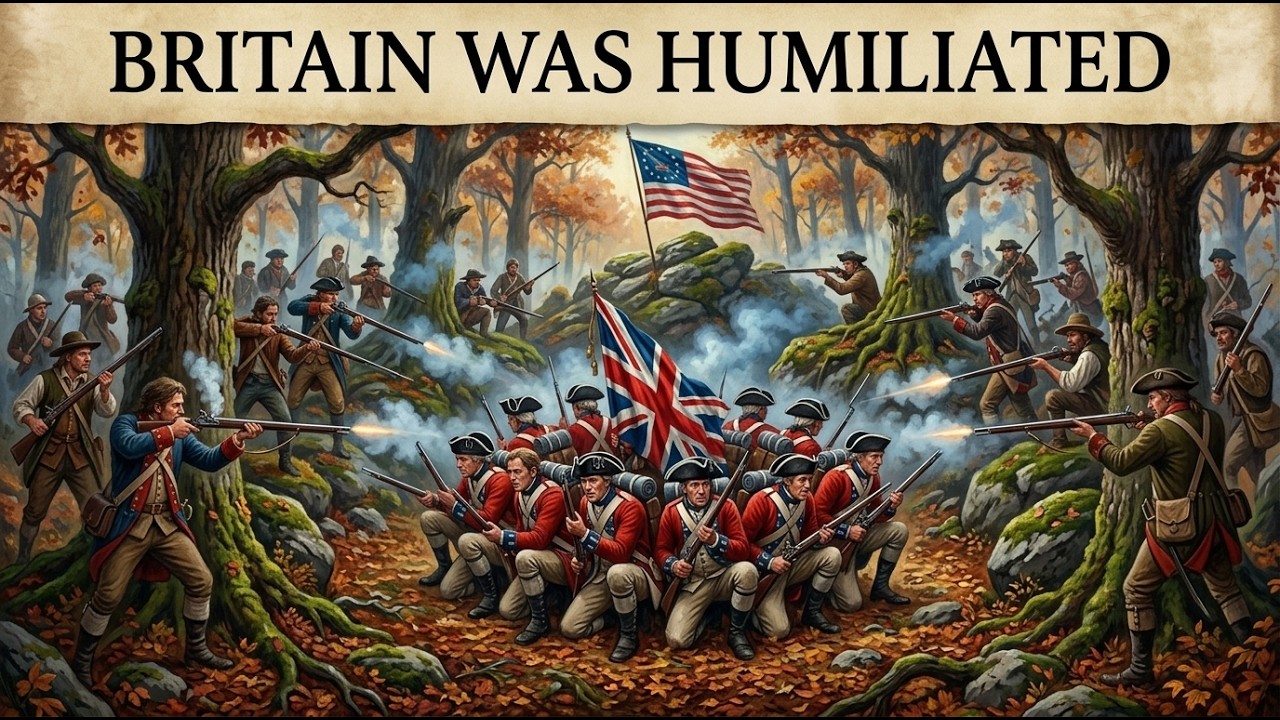
They dismounted, tied their horses, and formed columns. There was no elaborate plan—they simply agreed to surround the mountain and attack uphill simultaneously. At roughly 3:15, the attack began. These were men who had spent their lives hunting in the Appalachian wilderness.
They understood cover and how to move quietly through dense forest, and they carried long rifles, accurate at ranges a smoothbore musket could not dream of matching. Ferguson’s loyalists were armed primarily with muskets effective to maybe eighty yards. The mathematics of the engagement were devastating before the first shot. The Patriots came up from every direction.
Ferguson’s loyalists responded as trained, launching bayonet charges down the slopes. At first, these charges worked. The frontiersmen had no bayonets and fell back into the trees, but they did not run. They melted into the forest, reloaded, and came back up.
Every time Ferguson’s men charged downhill, they gained ground temporarily but exposed themselves to rifle fire from the other sides. It was like trying to push water uphill. The fighting was close, savage, and relentless, the mountain shrouded in gun smoke. The loyalists began to waver, trapped on the summit, taking fire from every angle, watching their officers fall.
Ferguson rode back and forth on horseback, blowing a silver whistle to rally his men, wearing a checkered hunting shirt that made him impossible to miss. Patriots later said they deliberately targeted the officer on horseback. He had his sword shot from his hand, and kept fighting. A ball cut his sash.
Another struck his hat. He kept riding. For roughly forty-five minutes, the situation on the summit grew increasingly hopeless. White flags began to appear.
Ferguson rode over and cut them down with his sword, refusing to surrender to men he reportedly called a band of bandits. Sometime around four in the afternoon, Ferguson made his last decision. Gathering a few officers, he attempted to break through the Patriot lines on horseback, hoping to cut his way to freedom and ride for Cornwallis. He never made it.
Multiple rifle balls struck him almost simultaneously. His foot caught in his stirrup as he fell, and his horse dragged his body across the rocky ground before stopping. Patrick Ferguson was dead. With Ferguson gone, the remaining loyalist officers raised the white flag for the final time.
The battle had lasted roughly sixty-five minutes. Ferguson’s force of approximately 1,100 suffered 290 killed, 163 wounded, and 668 captured. Not one organized unit escaped. The Patriots lost 28 killed and 62 wounded.
Nine hundred untrained frontiersmen had surrounded a fortified hilltop position, attacked uphill from every direction, and annihilated the entire enemy force in just over an hour. The aftermath was ugly. Many Patriots had seen their homes burned and their neighbors killed by loyalist raiders, and some surrendering loyalists were shot or bayoneted after throwing down their weapons. Colonel Campbell eventually restored order.
In the days that followed, a hasty field court-martial tried thirty-six captured loyalists and found them guilty. Nine were hanged before the executions were called off, partly because some officers objected and partly because word arrived that a British force might be approaching. When Cornwallis received word of Ferguson’s destruction, he was stunned. Ferguson’s force had been protecting his western flank, and now that flank was gone, along with 1,100 trained soldiers he could not replace.
Cornwallis halted his advance and retreated south to Winnsboro, South Carolina, where he stayed for nearly three months. The British southern campaign, unstoppable after Charleston and Camden, ground to a halt overnight. Loyalist recruitment across the Carolinas collapsed. Men who had considered joining the British cause decided to stay home, and men who had already sworn allegiance quietly switched sides or disappeared.
At the same time, Patriot morale surged. After months of catastrophic defeats, King’s Mountain proved the British could be completely destroyed. The delay gave the Continental Congress time to appoint a new commander for the Southern theater: General Nathanael Greene, arguably the most talented strategic mind in the Continental Army. Greene arrived in December 1780 and began a campaign of maneuver and harassment that slowly bled Cornwallis dry.
He understood he did not need to win pitched battles—he just needed to keep the British chasing him while partisan leaders tore apart the loyalist support structure behind enemy lines. The three months Ferguson’s defeat cost Cornwallis were three months the American cause desperately needed. Thomas Jefferson later called King’s Mountain “the turn of the tide of success” in the South. The sequence that followed seemed almost inevitable in hindsight: Cornwallis’s stalled campaign led to Cowpens and Guilford Courthouse, and his desperate march north into Virginia ended at Yorktown, where Washington and the French trapped him in October 1781, exactly one year after King’s Mountain.
Most Americans have never heard of the battle. But on that October afternoon in 1780, 900 men with long rifles proved that free people fighting for their own land and their own families could defeat a professional army. That was no longer just an idea.
It was a fact.