On the morning of April 7, 1862, Union officer Lew Wallace stood on the bluffs above Pittsburgh Landing and watched something he would spend the rest of his life struggling to describe. Across the open fields below, thousands of men in gray and butternut were coming at the federal lines at a run. Not a measured, disciplined advance, not the shoulder-to-shoulder choreography of West Point, but loose clusters of men screaming something that was not quite a word and not quite a sound, something Wallace later wrote had no equivalent in any language he had ever heard. His men, veterans who had already taken fire at Fort Donelson, broke before the Confederates even reached them.
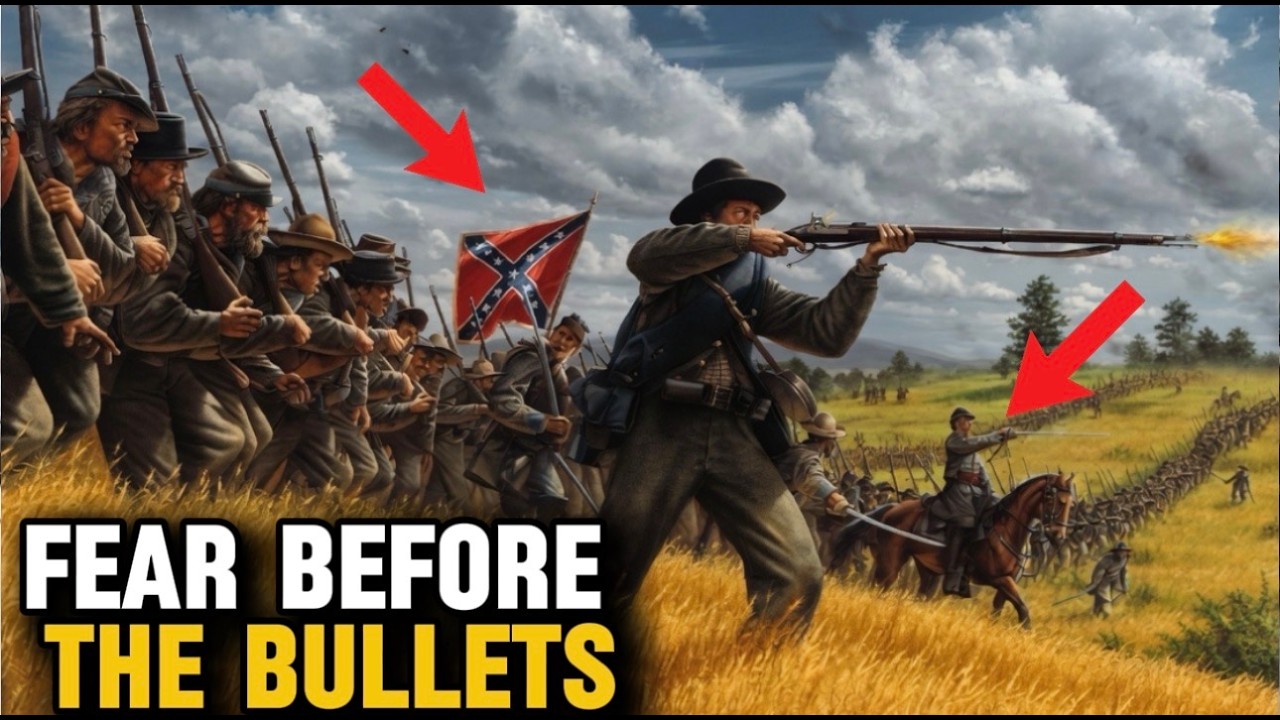
That scream, that run, that particular way of covering open ground became one of the most debated and dissected phenomena of the entire war. Generals wrote about it in their memoirs. Surgeons cataloged its physiological effects on the men who heard it. Union soldiers from New England to Ohio described the same involuntary reaction: a cold that started in the stomach and moved outward, a loosening in the legs, an inability to think clearly.
Some described it as the sound of something inhuman. Others said it was more frightening than the artillery. A few admitted they ran simply because of the noise, before a single bullet had come near them. What made it worse was that it never quite became familiar.
Veterans at Chickamauga in 1863 and the Wilderness in 1864 described their gut reaction in terms that would not have been out of place at First Bull Run. To understand what made it different, you have to go back to the society that produced it. The Antebellum South was, in ways northern contemporaries frequently underestimated, a martial culture. Not in the romantic sense that Lost Cause mythology would later construct, but in a hard practical sense.
A significant portion of Confederate soldiers came from rural backgrounds where hunting was not a hobby but a method of obtaining food. Men who grew up shooting squirrels from tall pines at fifty yards, who tracked deer through swampy bottomland at dawn, who learned before adolescence how to move quietly through dense undergrowth, carried a physical relationship with weapons and terrain that their urban northern counterparts often lacked. A factory worker from Lowell, Massachusetts, had never fired a rifle before enlisting. A farmer from rural Mississippi likely had.
Marksmanship and comfort with firearms shaped Confederate infantry tactics at the most basic level. When Confederate commanders ordered a charge, the men executing it were not simply running toward the enemy in blind faith. They were reading terrain in real time, using cover instinctively, moving the way they had moved through woods their entire lives. This is partly why Confederate charges so often succeeded in wooded or broken terrain: the men advancing were operating in an environment they understood in their bones.
But the physical background only explains part of it. The deeper root was cultural and centered on a concept historians have documented extensively but rarely examine in the context of battlefield behavior: the Southern code of honor. Honor in the antebellum South was not a vague aspiration. It was a social operating system.
A man’s honor was his reputation for courage, his standing in the community, his willingness to absorb or deliver violence in defense of his name or his family’s name. The duel was its formal expression, but it shaped behavior at every level of society. Boys were raised with the explicit understanding that backing down from a confrontation was worse than dying in one. The stigma of cowardice, of being known among your neighbors as a man who flinched, was genuinely worse in the social calculus of that world than death.
Death was an acceptable outcome. Cowardice was not. When those men put on Confederate gray and stepped onto battlefields, they brought that calculus with them. They were not fighting in an abstract or anonymous environment.
They were fighting alongside men from their own counties, their own towns, sometimes their own families. The 18th Mississippi Infantry was full of men who had grown up together, gone to the same churches, courted each other’s sisters. When the order came to charge, a man was not deciding in isolation whether to advance. He was deciding in front of every person whose opinion of him had ever mattered.
The social weight of that moment was enormous, and it pushed men forward into fire that by any rational calculation should have stopped them. Union commanders noticed this repeatedly. After Second Bull Run, federal officer John Pope wrote a frustrated assessment of his enemy in which he essentially described them as immune to the kind of attrition logic that governed his own tactical thinking. The Confederates, he noted, did not behave as if they were weighing their odds.
They advanced as if the question of whether to advance was already settled before they left the tree line. That observation points to something modern military psychologists would recognize immediately: pre-commitment in combat behavior. The Confederate soldier, in many cases, had already committed to the charge before the battle began, not on the field, but in the society that raised him. The actual moment of the charge was not a decision point.
It was an execution. This does not mean Confederate soldiers were fearless. Fear is a biological response, and no cultural conditioning eliminates it entirely. What it meant was that they had unusually powerful mechanisms for overriding fear: the threat of social death, the presence of men they knew, the momentum of group movement, and layered over all of it, the rebel yell itself.
The yell has been analyzed from every angle. Phonetically, it bore no resemblance to Union battle cries, which were typically shouted words: hurrahs, forward, names of commanders. The rebel yell was not a word. It was a high, wavering, cascading shriek that survivors consistently described as difficult to reproduce and impossible to fully explain.
Confederates who were asked about it later in life often said they could not quite recall how it sounded anymore, only how it felt to make it. It came from somewhere below the chest, they said. It was involuntary. That involuntary quality is significant.
Screaming during exertion elevates adrenaline, lowers the perception of pain, and creates a neurological state that is genuinely difficult to interrupt. Men running and screaming in unison are men who have neurologically committed to movement. The act of making the sound was part of what made the charge happen, not just an accompaniment to it. The men who led these charges were, in many cases, personally exemplifying the behavior they demanded.
Confederate officer culture was categorically different from its Union counterpart in this respect. Confederate generals, particularly in the war’s first two years, led from the front, not as a gesture but as a method. Albert Sidney Johnston rode into the fighting at Shiloh in the first hours of April 6 and was killed directing attacks personally. John Bell Hood led his Texas Brigade in person at Gaines’ Mill.
Nathan Bedford Forrest charged into and out of enemy formations more times than his staff thought remotely appropriate for a general officer. Stonewall Jackson pushed his men and himself to physical limits that bordered on cruelty. This leadership style was constitutive of how Confederate infantry charged. When men in the ranks saw their commanders in front of them advancing into the same fire they faced, the usual distinction between what was being asked and what was being shared collapsed.
The charge became not a command from above but a collective movement in which rank temporarily dissolved. Officers and enlisted men were doing the same thing, facing the same risks, dying in the same way. The tactical expression of all this was what Confederate commanders came to call the principle of the offensive: the belief that attacking was almost always better than defending, regardless of the numerical situation. The Confederacy had fewer men, fewer factories, fewer railroads, fewer of everything except territory and will.
By rational calculus, the smart strategy was to defend, but his generals at the operational and tactical level could not stop attacking. Robert E. Lee is the most famous example, but he was not anomalous. Hood was constitutionally incapable of a defensive posture and wrecked the Army of Tennessee in the fall of 1864 trying to replicate in the Western Theater what he had seen Lee do in Virginia.
Braxton Bragg, widely considered the worst senior Confederate commander, still attacked at Chickamauga with a ferocity that nearly destroyed the Army of the Cumberland. Even Joseph Johnston, the most defensively minded senior Confederate commander, fought sharp offensive engagements while conducting his deliberate retreat toward Atlanta. The preference for the offensive had real consequences for how charges were executed. Confederate infantry attacks were on average faster than their Union counterparts.
Union forces typically advanced at what drill regulations called the quick time, roughly 110 steps per minute, in tight formation with dressing maintained. Confederate attacks often began at quick time and accelerated into a run far earlier than Union doctrine prescribed. The idea was to close the distance before the defending force could deliver its full rate of fire. Every yard covered at a run was a yard covered under less accumulated fire.
The speed was not recklessness; it was a calculated attempt to compress the killing zone. The spacing was also different. Confederate infantry, particularly by mid-war, developed a much looser formation. Men spread out, used available cover, and moved more like skirmishers than a parade ground line.
This emerged partly from necessity: tight formations were catastrophic in the face of rifle musket fire at ranges the Napoleonic system had not anticipated, but it also reflected the instincts of men comfortable moving individually through terrain. The result was a charging formation that was harder to break by artillery because it offered fewer mass targets, while still generating enough collective momentum to hit an enemy line with decisive force. The Battle of Gaines’ Mill on June 27, 1862, showed what this looked like at its best. Lee had been assaulting the Federal position on Turkey Hill for hours with piecemeal attacks that achieved nothing except casualties.
Late in the afternoon he committed Hood’s Texas Brigade and Law’s Brigade in a coordinated assault across a front of nearly a mile. The Texans crossed Boatswain’s Swamp under fire, reformed partially on the far bank, and came up the slope at a run through an artillery and rifle barrage that by every rational analysis should have destroyed them. They broke the federal line completely. At dusk the Union right in front of Richmond collapsed, and George McClellan began a retreat that would not stop for seven days.
The charge worked through a combination of speed, psychological momentum, the shattering effect of the yell at close range, and the physical conditioning of men who had spent their lives running through exactly this kind of terrain. The Battle of Chancellorsville in May 1863 produced perhaps the most studied Confederate charge of the entire war. Stonewall Jackson’s flanking march on May 2 is taught in military academies as a masterpiece of operational maneuver. When Jackson’s corps rolled out of the tree line into the right flank of Oliver Howard’s 11th Corps, the attack was massive, fast, howling, delivered by approximately 30,000 men who had been marching since before dawn and who still hit the federal flank with a violence that turned a corps-size formation into a crowd in roughly forty minutes.
Pennsylvania conscripts were not poorly trained; some regiments had excellent records. What they could not overcome was the combination of complete tactical surprise and a Confederate charge stripped down to its essential components: speed, noise, aggression, and the will to keep advancing after the first casualties. Confederate units at Chancellorsville were still moving forward after taking twenty percent casualties in the opening minutes. Union units in similar circumstances typically halted and began returning fire, which was tactically rational but ceded the initiative entirely to the attacker.
Jackson understood this dynamic with a clarity that bordered on obsession. His constant demand to move quickly, to give the enemy no time to think, to press them, was not the impatience of a reckless man. It was a precise theory of how to defeat a larger, better equipped army. If you took away the enemy’s time to organize, to think, to direct fire, to reinforce weak points, you negated much of the material advantage he held.
The Union Army eventually found an answer, and it was not a tactical one. It was an engineering one. By 1864, federal infantry had developed a near instinctive practice of fortifying any position they held for more than a few hours. Troops who stopped moving picked up axes and spades.
Log breastworks, headlogs, abatis, interlocking fields of fire. The Confederate charge did not suddenly become less aggressive or less committed. It ran into an enemy that had decided at the institutional level to remove the conditions that made the charge effective. At the Battle of Franklin in November 1864, Hood sent six divisions across two miles of open ground against entrenched Federal positions.
It was not a display of Confederate tactical virtue; it was a demonstration of what the doctrine cost when applied unchanged to a war that had fundamentally changed around it. In a single afternoon the Army of Tennessee lost six general officers killed and the irreplaceable core of its assault capability. The charge that had broken Federal lines from Gaines’ Mill to Chancellorsville met at Franklin the wall it could not climb. What it left behind was a set of accounts that remain unlike almost anything else.
The memoirs, the letters, the regimental histories, the regimental histories, they circle back to the same moments, the same images: the tree line erupting, the sound coming before the men, the ground between the armies shrinking faster than seemed possible. A Union sergeant named Rice Bull, who fought through multiple campaigns in the Eastern Theater, wrote after the war that Confederate charges were a different category of experience entirely, not because of what they might do to him physically, but because of what they did to his ability to think. The question of why has occupied historians for more than a century and a half, and the honest answer is that it does not reduce to a single factor. The rebel yell alone did not produce it.
The cultural background alone did not produce it. The officer class alone did not produce it. What produced it was a convergence: individual marksmanship, honor culture’s pre-commitment mechanism, command from the front, tactical speed, and a psychological weapon that operated on the nervous system before the brain could intervene. Put them all together in the same formation moving across the same ground and you get the thing Lew Wallace watched from the bluffs at Pittsburgh Landing and spent decades failing to describe.
Near the end of his life he stopped trying to describe the mechanics and wrote instead about the quality of it. He said he had not been watching men attack. He had been watching men arrive at something they had already decided long before the battle began was going to happen. The battle, he wrote, was almost incidental.
The decision had already been made. However you judge those men, they were not fighting the way anyone had fought before on this continent. They were fighting the way they lived, and for a long time, on a great many fields, that was enough.