On July 12, 1979, Carmine Galante sat in the rear patio of Joe and Mary’s Italian-American Restaurant on Knickerbocker Avenue in Bushwick, Brooklyn, a cigar clamped between his teeth. He was waiting for dessert and coffee, flanked by two young Sicilian bodyguards. At 2:45 in the afternoon, three masked men pushed through the restaurant and opened fire with shotguns and handguns. Galante’s own cousin, the restaurant owner Giuseppe Turano, was killed instantly.
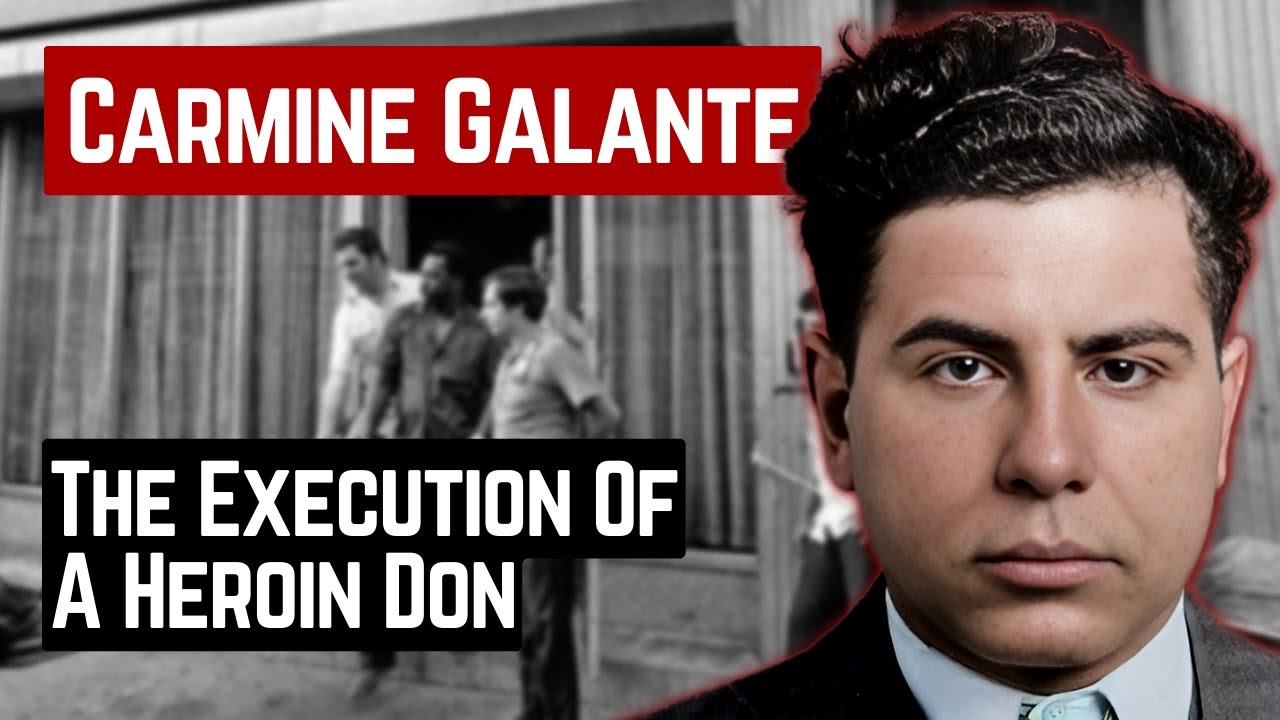
A second companion, Leonardo Coppola, died on the spot. Galante himself was thrown from his chair by the shotgun blast, dead where he landed, the cigar still held in his mouth. His bodyguards, Baldassare Amato and Cesare Bonventre, were unharmed. Witnesses saw them walk calmly behind the gunmen as they left, joining a getaway car waiting in front of the restaurant.
They made no attempt to chase the shooters. No attempt to retaliate. They were, as investigators would later conclude, part of the plot themselves. Carmine Galante’s death ended a criminal career that spanned nearly six decades.
He was born Camillo Galante in East Harlem on February 21, 1910, the son of Sicilian immigrants from Castellammare del Golfo. By the age of ten he was already in trouble with the law and was sent to reform school. He dropped out of school in the seventh grade. His criminal record reaches back to 1921, with entries for robbery, assault, larceny, and alcohol violations.
In 1930, he was arrested for armed robbery of a restaurant, an incident that police believed was a payroll heist. During the robbery, a police officer, Walter De Castilla, tried to apprehend him. In the shootout that followed, Galante killed the officer. He was released for lack of evidence.
On December 24, 1930, he and three other men attempted the armed robbery of a truck and wounded two children in the process. He pleaded guilty to attempted robbery and was sentenced to twelve and a half years in Sing Sing prison. A psychiatric report from January 1931 classified him as having the mental age of a fourteen-year-old, noted an IQ of 90, and described him as emotionally dull. He was released on parole in 1939.
By the 1940s, Galante was doing work for the Genovese crime family, which was then known as the Luciano family. He had built a reputation for brutality that made everyone afraid of him, whether in prison or on the street. According to later accounts, he carried out at least one major hit for Vito Genovese, the murder of Carlo Tresca. Tresca was an Italian-American newspaper editor and labor organizer who had become a leading public opponent of fascism and had even been reported to Benito Mussolini as an enemy of the fascist movement.
On January 11, 1943, shortly after Galante reported to his parole officer, Tresca was shot and killed at Fifth Avenue and 15th Street. Police found the abandoned getaway car, and its license plate matched a vehicle seen near the scene. Galante was arrested as a suspect, but there was not enough evidence to charge him with the murder. He was returned to prison only on a parole violation.
No one was ever charged with Tresca’s murder, though Galante is widely regarded as the gunman. By the late 1930s and into the 1940s, Galante had risen steadily within the Bonanno crime family. Joe Bonanno promoted him to consigliere and put him in charge of the family’s narcotics network. He was present at the famous Appalachian meeting in 1957, held at the New York home of Joseph Barbara, though he escaped to Italy before state police made arrests.
That same year, after the Palermo Mafia summit reached an agreement with the Sicilian clans to flood America with heroin, Galante served as Bonanno’s primary advisor. Fluent in Italian, French, and Spanish, he became the Mafia’s top representative in Europe for multimillion-dollar drug deals. In 1958 Galante, Vito Genovese, and 35 others were indicted on narcotics conspiracy charges. Galante went into hiding.
Genovese was sentenced to fifteen years in prison in April 1959. Galante was picked up by New Jersey state troopers in June 1959 but released on $100,000 bail. In 1960, he was indicted again, this time on federal charges of running a gang that imported drugs from Canada. He surrendered voluntarily in May 1960.
The first trial collapsed when the jury foreman broke his back in a mysterious fall down a flight of stairs in an abandoned building in the middle of the night. Following the first trial, defendants were released on increased bail, and several defense attorneys were allowed to withdraw. Repeated postponements followed, as defendants claimed they could not find legal representation despite the means to post bond. A second trial resulted in Galante’s conviction in 1962.
He was sentenced to twenty years in federal prison and fined $20,000. Galante maintained his status even inside prison. A small group of Bonanno inmates looked after his needs. He paid $250 every month in bribes for prime cuts of meat for himself and his inner circle.
Informers later told investigators that Galante promised his jail mates he would restore the Bonanno family to its former glory, which had been in flux since Joe Bonanno’s forced retirement in the mid-1960s. The family had no commission-approved ruler, and Galante considered himself the rightful heir. He was paroled in 1974 after serving twelve years. His ambition and murderous instincts did not take long to resurface.
Philip Rastelli, who had been made interim boss, stood in his way. Rastelli was convicted of extortion and began serving a six-year sentence. Galante, who had served as Bonanno’s consigliere and virtual underboss, refused to acknowledge Rastelli’s authority. While on parole, he posed as a legitimate businessman and even opened a dry cleaning store in Little Italy.
He increased his cash flow by expanding drug trafficking operations with Sicilian exporters, a move that alarmed New York’s ruling crime bosses. They proclaimed him persona non grata. By the beginning of 1977, Galante was considered one of the leading Mafia figures in New York City. But his parole was revoked in March 1978 for mingling with other Bonanno mobsters, and he was returned to prison.
In 1979, a judge ruled the parole revocation wrongful and ordered his release. While Galante appeared to hold the upper hand, Rastelli had resources Galante did not see. From prison, Rastelli dispatched supporters to petition the Mafia commission for approval to eliminate Galante. Without hesitation, approval was granted.
Police surveillance had already noticed a steady stream of visitors arriving at Rastelli’s cell at the federal penitentiary in Lewisburg, Pennsylvania. Among the visitors were important Bonanno members and one soldier who was not well known to the media at the time, Joseph Massino. Massino was one of Rastelli’s emissaries. Galante, meanwhile, was planning his own move.
In the late 1970s, he allegedly planned the murders of at least eight members of the Gambino family, with whom he had a rivalry, in order to take over a major drug trafficking business. With Carlo Gambino dead since 1976, Galante had his eyes set on the title of boss of bosses. The message he sent to the other crime families was clear: who among you is going to stand up to me? In the months before his death, he had been using Sicilian gunmen for his jobs.
The two he trusted most were Baldassare Amato and Cesare Bonventre, both in their late twenties. On July 12, 1979, the three masked shooters who entered Joe and Mary’s restaurant were Russell Morale, who shot Galante; Bruno and Delicate, who shot Turano and Coppola; and Dominic Trinchera, who stood guard inside. Joseph Massino, along with several others, waited in a car outside as backup. Soon after Galante’s assassination, Massino was elevated to capo, a clear sign that the Rastelli regime was in control.
Galante died on the floor of a Brooklyn restaurant, his cigar still in his mouth, the ambition for absolute dominance unfinished. His killing restored order within the Bonanno family and sent a message across New York’s underworld that even the most feared men could be eliminated with commission approval. The man who had wanted to become boss of bosses never learned which of his friends had been sent to take his place.