In 1971, the top-selling malt liquor in America came not from a brewing giant with a coast-to-coast fleet of trucks, but from a single brewery in Baltimore, Maryland. The company was best known for a one-eyed cartoon mascot and a slogan about pleasant living. It was not Anheuser-Busch, not Schlitz, not Miller. It was National Brewing Company, and its weapon was a can called Colt 45.
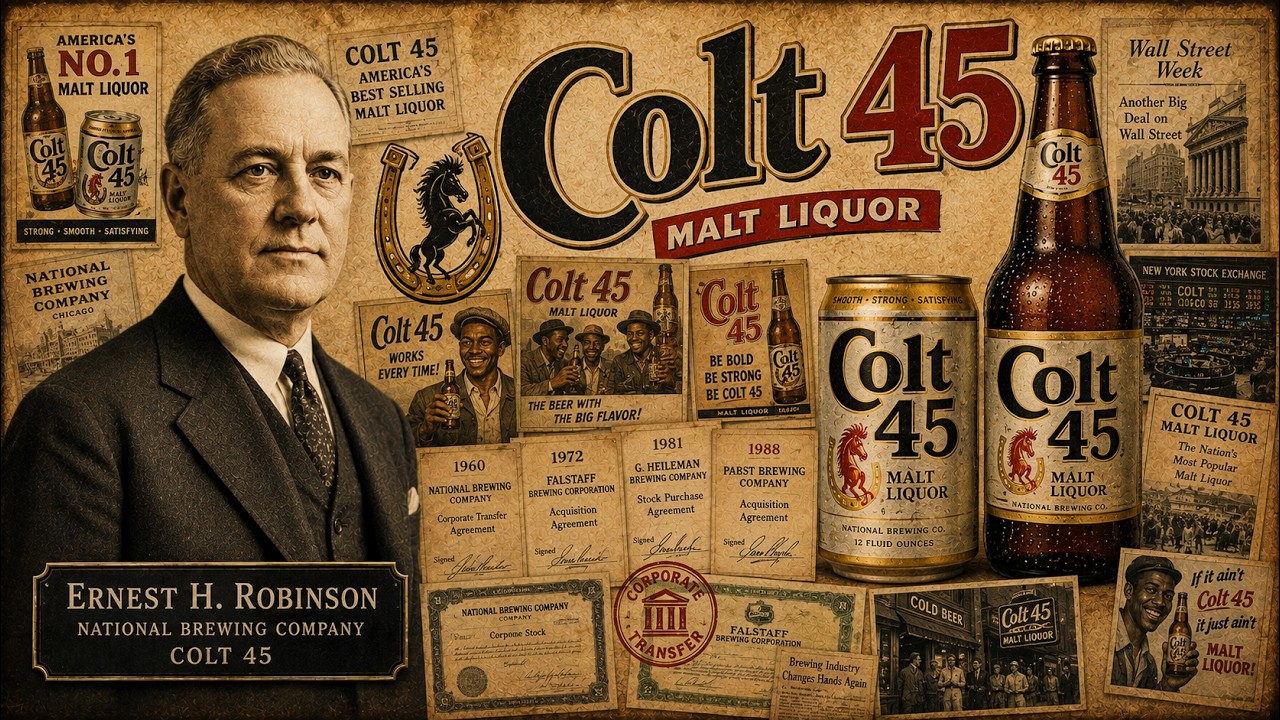
The name sounded like a gun, but it was actually a football jersey number borrowed from a Baltimore Colts running back, wrapped in a label built for maximum kick and minimum apology. For a decade, this small independent outsold companies fifty times its size, without their money, their reach, or their factories in a dozen states. Then it disappeared, not the drink itself, but the company that made it. The story begins in Baltimore in 1885, when National Brewing Company opened its doors.
Founded by members of the Strauss family, it became the largest brewery in the state within a generation. The city already had breweries on nearly every corner of its working-class neighborhoods, but National’s real weapon was not its beer. It was its salesmen. A well-trained fleet walked into every tavern and corner store in Baltimore City in person, week after week, building a loyalty a billboard could not buy.
The product they sold was National Bohemian, and by the mid-1960s, it held a fifty-one percent share of the Maryland market. The face of that dominance was Mr. Boh, a one-eyed, mustachioed mascot who first appeared on the bottle label in the 1930s and became an animated television star in the 1960s. The slogan beside him, the land of pleasant living, became so embedded in local identity that it was eventually adopted as Maryland’s unofficial state motto.
National’s success invited ambition. In the 1950s, it started buying its way outward, acquiring the Altes Brewing Company of Detroit in 1954 and the Marlin Brewing Company of Orlando in 1956. By the start of the 1960s, however, the real war was at home. Anheuser-Busch and Joseph Schlitz began expanding aggressively into Baltimore, bringing advertising budgets National could not match dollar for dollar.
Leading National’s marketing was a man named Dawson Farber, who understood the arithmetic immediately. National Bohemian was not going to survive a straight fight against Budweiser and Schlitz on their terms. So Farber looked for the one lane the giants had not occupied. At the time, malt liquor was barely a category at all.
A single national brand, Country Club, held the space almost by default. Farber’s instinct was not to chase the upscale, aspirational image the big brewers were selling. He wanted something blunter, built around a simple, honest promise: more kick for the same money. He commissioned a label with a bucking horse and a horseshoe, visual shorthand for exactly the sensation he was trying to sell.
The name came almost as an afterthought, borrowed from a local sports hero. It would turn out to be one of the most consequential naming decisions in American beverage history. The arithmetic was simple enough for any drinker to do in his head at the counter. A malt liquor delivered a stronger kick than a standard lager at a price close enough to make the trade an easy one.
That single equation did more marketing work in 1963 than any jingle could have. The bet paid off immediately. By 1964, barely a year after Colt 45’s launch, the Baltimore brewery was producing roughly one million barrels annually and employing approximately nine hundred people. A regional brewer with a cartoon mascot and a hometown following was now shipping a national product built on a formula the big three had not bothered to compete for.
Throughout most of the 1960s and into the 1970s, Colt 45 was marketed toward a suburban, white-collar, middle-class demographic, positioned as a curious, slightly eccentric departure from the ordinary can of beer. The campaigns of this era leaned into quirk and mystery rather than swagger. That repositioning, the one history remembers, was still years away. In 1979, G.
Heileman Brewing Company of Wisconsin purchased Colt 45 and almost immediately began shifting the brand’s marketing focus. The suburban positioning was retired. In its place came a new strategy built around black celebrity and urban identity. Through high-profile partnerships with actor Billy Dee Williams and comedian Redd Foxx, Colt 45 established itself as the leading malt liquor brand in America.
In 1980, Williams became the face of a long-running campaign built around a new tagline, Works Every Time. Williams brought a suave sex appeal that many men across racial lines aspired to, and the brand leaned into it completely. But that tagline also made the brand infamous. The advertising drew sustained criticism for a phrase widely interpreted as suggesting the malt liquor could be used to get women intoxicated quickly.
Community activists from Missouri to Michigan pushed back publicly against billboards bearing Williams’ image, arguing the phrase carried a meaning far darker than a simple product endorsement. Researchers at UCLA and elsewhere found that malt liquor marketing disproportionately targeted minority consumers. A 2005 study published in Alcoholism, Clinical and Experimental Research found that malt liquor drinkers in Los Angeles were more likely to consume larger quantities of alcohol and more likely to be homeless, unemployed, or receiving public assistance compared to drinkers of other alcohol types. While Colt 45 rose, the company that made it was losing the war that actually decided its future.
Anheuser-Busch and Schlitz had arrived with a strategy no regional brewery could counter. One Anheuser-Busch advertising executive told a National representative plainly, “We’re going to price you out of business rather than market you out of business. ” National’s brewing capacity was less than a quarter of what the large Midwestern breweries could produce, and that scale let the giants manufacture beer at a cost National simply could not match. Pabst overtook National Bohemian as Maryland’s bestselling beer in 1970.
Budweiser passed it as well by 1975. Across the decade, Maryland-brewed beers collapsed from more than eighty percent of the in-state market to roughly thirty percent. National tried to answer at scale, producing 2. 2 million barrels a year across its network by 1974, but scale bought only a little time.
The Detroit brewery closed in early 1974, the Miami plant followed in early 1975. One product kept the company’s revenue from collapsing entirely. Colt 45 was still selling, still bringing in the volume that let National keep its Baltimore plant running past the point most of its neighbors had shut their doors. In 1975, National signed a licensing agreement with a British firm to begin producing Colt 45 in England, carrying the brand across the Atlantic for the first time.
That same year, National succumbed to a larger competitor, acquired by Carling Brewing Company in a deal described at the time as a merger. The Hofberger family, who had run National for generations, sold their beer business for more than sixteen million dollars. Gerald Hofberger stayed on to lead the newly formed Carling National Breweries, but the decisions from that point forward would not be made in Baltimore. In 1978, the Highlandtown plant, the brewery that had made Colt 45 since its very first can, closed its doors.
Production shifted to a facility in nearby Halethorpe. In 1979, ownership changed again when Carling O’Keefe sold the brand to G. Heileman. Heileman did not stop at reviving Colt 45.
It wanted a stronger malt liquor to sell alongside it, something that leaned even harder into potency as the selling point. The result was a high-alcohol brand called Powermaster, and the backlash arrived almost immediately. Chicago priest Father Michael Pfleger led public opposition, organizing a threatened boycott aimed not at Powermaster itself, but at Colt 45, as leverage to force the company’s hand. It worked.
In July 1991, the boycott was called off only after the Bureau of Alcohol, Tobacco, Firearms, and Explosives persuaded Heileman to pull Powermaster from the market entirely. Heileman’s grip on Colt 45 did not last much longer. The company was already sliding toward insolvency. In 1994, the private equity firm Hicks Muse bought the company for three hundred million dollars.
Colt 45 was no longer owned by a brewer. It was a line item in a leveraged buyout. Two years later, Hicks Muse sold Heileman to the Stroh Brewery Company, which assumed the outstanding debt. That same year, the Halethorpe plant, the last facility anywhere near Baltimore still brewing Colt 45, shut down for good.
Colt 45 would never again be brewed within miles of where it was born. On December 20, 1996, five days before Christmas, the Halethorpe brewery went silent for the last time. Stroh Brewing Company eliminated 430 jobs. There was no ceremony, just a company memo.
Among those affected was John James, who had followed his own father into the National Brewing Company’s Canton plant before the 1975 merger with Carling carried him out to Halethorpe. He had just bought a house the year before. A 54-year-old worker put it plainer than any executive statement could: “This is the sixth time we’ve been through this. We’ve learned to take it in stride.
” The labels once brewed at Halethorpe did not disappear. They simply moved. The Halethorpe facility itself stood empty for years before it was finally demolished by 2006. Colt 45 did not disappear.
It is still made today, brewed under contract for Pabst Brewing Company at several different plants across the country. What it lost was not its shelf space. It lost the right to call anywhere its own. The company that built it died, and the name kept working for whoever bought it next.
Drive into Baltimore’s Brewers Hill neighborhood today, and you will know you have arrived the same way locals have for generations, by looking up. The one-eyed winking face of Mr. Boh still glows atop the old National Brewery tower, the very building where Colt 45’s first cans rolled off the line in 1963, now converted into offices and apartments. Nearly ninety percent of all National Bohemian sold today is still sold in Maryland, a hometown loyalty that has outlasted three brewery closures and four corporate owners.
Colt 45 was never outsold by a better product. No rival malt liquor ever out-innovated it into irrelevance. What beat Colt 45 was not a competitor’s can. It was a balance sheet.
The product worked, and the marketing worked, sometimes too well. What failed over and over was not the beer in the can but the capital structure underneath the company that made it. National did not lose the taste test. It lost the war of who could survive selling beer at a loss the longest.
And in that war, the biggest company always outlasts the best one. The company is gone, the building found a second life, and the can is still cold, still selling, still carrying a name that started as a tribute to a football player and became something much bigger than anyone at a small Baltimore brewery ever planned for.