On a March afternoon in 1905, guests packed into two adjoining Manhattan townhouses on East 76th Street, their sliding doors thrown open to create one long room. The occasion was a wedding: Eleanor Roosevelt, twenty years old, was marrying her fifth cousin once removed, Franklin Delano Roosevelt. The date had been chosen not for the couple but because President Theodore Roosevelt, Eleanor’s uncle, would be in the city for the St. Patrick’s Day parade.
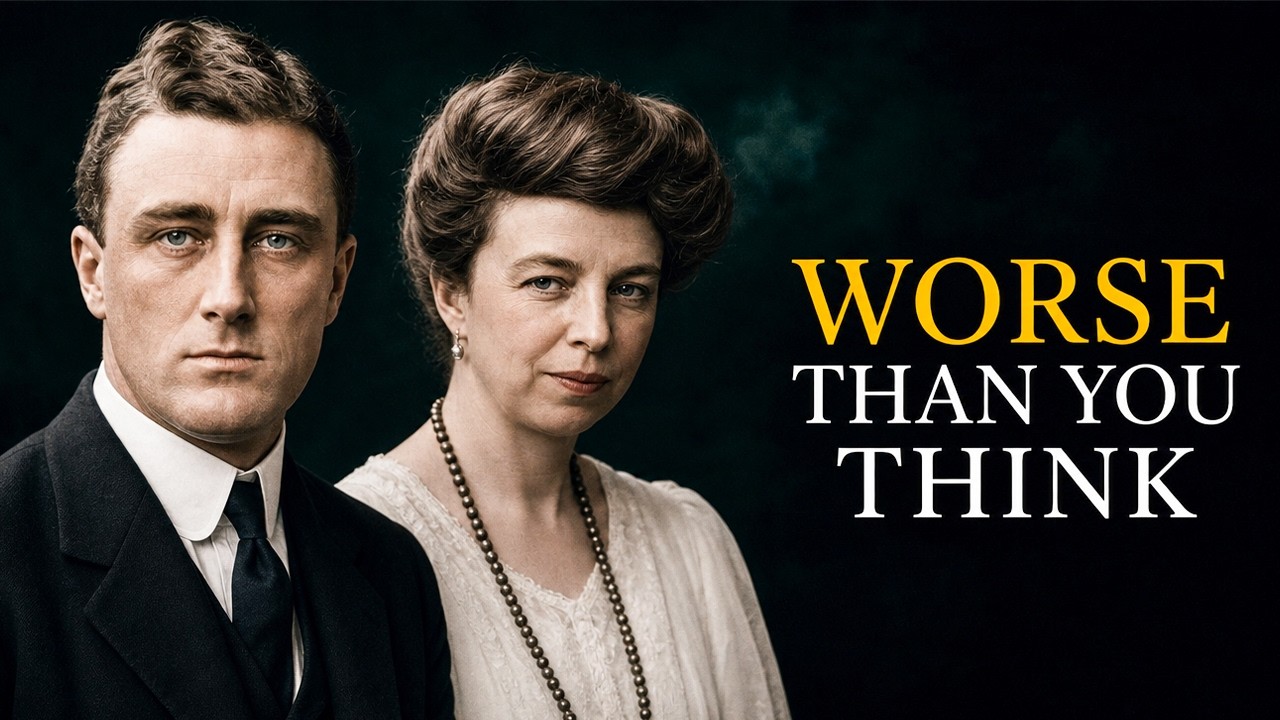
The president was giving the bride away. When the ceremony ended, he delivered a few cheerful words about keeping the name in the family, then walked into the library where refreshments were laid out. The guests followed him—all of them. The bride and groom were left standing alone in the room where they had just been married.
No one planned it as symbolism, but it was remarkably accurate. That marriage would produce six children, a presidency that lasted twelve years, and a public legend of partnership so durable it still shapes American politics. It would also, in a private sense, cease to be a marriage at all. Eleanor had entered the world at a disadvantage.
Her mother, Anna Hall Roosevelt, one of the celebrated beauties of New York society, had nicknamed her “Granny. ” Eleanor wrote decades later about the sense of being a plain, solemn child in a household organized around style. Her mother died of diphtheria in December 1892, when Eleanor was eight. Her younger brother died the next year.
Her father, Elliott, was charming and adored by his daughter but was an alcoholic whose family managed him quietly and at a distance. He died in August 1894. Eleanor, nine years old, was not taken to the funeral. She kept his letters her entire life, building out of them a version of her father that was gentle and romantic and largely untrue.
Preserving a beautiful account of a man who had failed her was, in a real sense, her first professional skill. The other formative influence came in England. From 1899 to 1902, she attended Allenswood, a school outside London run by Marie Souvestre, a formidable French woman who discussed politics at dinner and expected girls to hold opinions. Souvestre singled Eleanor out, traveled with her, and corrected her thinking.
Eleanor later called those the happiest years of her life. She returned home at seventeen because her grandmother insisted she come out into society, trading the one place where she was interesting for a New York debut season she dreaded. Franklin Roosevelt began courting her in the summer of 1902, after encountering her on a train heading up the Hudson. He was tall, easy, and socially fluent; she came with Theodore Roosevelt attached.
He wrote about her in his diary in code. She saw in him the first person who had ever made her feel chosen. He proposed in November 1903, and she said yes. Then his mother went to work.
Sarah Delano Roosevelt was a widowed, wealthy woman with one child. She demanded the engagement be kept secret for a year and then took Franklin on a Caribbean cruise without Eleanor in the hope that distance would end it. It did not. The engagement was announced in December 1904.
Eleanor, instead of resenting Sarah, courted her, writing that she wanted her future mother-in-law to learn to love her a little. The couple married in someone else’s house, amid a guest list of society and Roosevelts. Eleanor wore her mother’s rose point lace. Sarah gave them a house, an address she could reach.
She bought a pair of adjoining townhouses on East 65th Street, lived in one, and the couple in the other, with sliding doors connecting them on several floors. She had chosen it, furnished it, and paid for it. Springwood, the Hyde Park house history associates with Franklin, belonged to Sarah until her death in 1941. Franklin’s income was substantially an allowance.
Not long after moving in, Eleanor sat down at her dressing table and broke down. Franklin found her crying. She told him—in her own account, in her own memoir—that this was not her house, that she had not helped plan any of it, and that nothing in it was hers. He was baffled and suggested she would be fine in a little while.
Six children arrived in ten years: Anna in 1906, James in 1907, a first Franklin Jr. in 1909 who died before his first birthday, Elliott in 1910, a second Franklin Jr. in 1914, and John in 1916. Sarah hired the nurses and paid for them.
Their son James later wrote that his grandmother told the children outright that their mother had only borne them and that Sarah was their real mother. Eleanor herself described those years as being a spectator in her own life, doing what was expected, developing no taste of her own. Then Franklin entered politics. He won a state senate seat in 1910, and in 1913 Woodrow Wilson made him assistant secretary of the Navy.
They moved to Washington, and the wife who had been decorative in New York discovered she was useful. She made the calls, ran the dinners, learned who mattered in which department, and did it well enough that people noticed. In 1914, needing help with correspondence, she hired a young woman from an old Maryland family whose father had drunk the money away. Lucy Mercer was beautiful, mannered, Catholic, and broke.
She came three mornings a week for about thirty dollars a month, sitting on the floor of the Roosevelt drawing room sorting invitations. Eleanor liked her. Everyone liked her. When Eleanor took the children to Campobello in the summers, Lucy stayed in Washington, where the work was.
Washington in 1917 was a small town at war, and the small town noticed things. Alice Roosevelt Longworth, Theodore’s daughter and a professional observer of weakness, began seating Franklin next to Lucy at dinners. Others in that circle noticed the two of them driving in Virginia. A friend mentioned to Eleanor that she had seen Franklin out with a lovely lady.
Eleanor did not follow it up. In the summer of 1917, Lucy went into the Navy as a yeoman and was discharged a few months later at the request of the department where Franklin worked, then placed on a civilian payroll in his own office. That is a documented personnel decision. In September 1918, Franklin returned from an inspection tour of the European front carried off a ship on a stretcher, stricken with influenza and pneumonia during the epidemic killing tens of thousands that autumn.
He was taken to his mother’s house on East 65th Street. Eleanor unpacked his luggage. The letters were in it. She offered him a divorce.
He did not immediately refuse it. Then two people intervened, neither with any interest in Eleanor’s happiness. Sarah Delano Roosevelt made a financial argument: if Franklin left his wife and five children, he would not see another dollar of her money, and he would not see Hyde Park. Lewis Howe made the other argument, colder and more persuasive.
Howe was a former newspaperman who had attached himself to Franklin years earlier with the fixed conviction that this man could be president. He told Franklin what a divorce would do in 1918—not the moral judgment, but the arithmetic. Divorced men did not get nominated. A Catholic mistress would inflame the problem.
And Lucy Mercer was a devout Catholic; marrying a divorced man with five children meant leaving her church. Franklin stayed. The terms, as far as the record allows, were that he would break with Lucy entirely. He did not.
Eleanor moved out of the arrangement emotionally and never moved back. A line she wrote afterward, quoted by her later biographer Joseph Lash from her papers, described the bottom dropping out of her particular world in 1918. But she did not become bitter and small. She became busy.
She took a room at the Navy Department for cafeteria work, visited shell-shocked men at the Naval Hospital that no one else was visiting, and successfully lobbied for money to improve the ward. Her first political victory was pried out of the federal government by a woman just humiliated in her own house. Then a secretary arrived and stayed. Marguerite LeHand joined the 1920 vice-presidential campaign as a typist and never left.
After Franklin’s polio diagnosis in August 1921, she ran his office, his schedule, and effectively his household when Eleanor was elsewhere. Sarah’s plan for her crippled son was to bring him home to Hyde Park and let him be a gentleman of leisure, an invalid with a view of the river—the same instinct the family had used on Eleanor’s father, removing the damaged man from public view and paying for the removal. Eleanor and Howe went to war over it and won. She nursed Franklin through the acute months herself, learning the catheters and the massage.
Howe moved into the East 65th Street house to keep Franklin’s name alive, and he pushed Eleanor out to do the appearing—speak at Democratic women’s meetings, chair the finance committee, go to the state convention. He edited her speeches, told her to stop laughing nervously at the ends of sentences, and taught her how to talk to reporters. He built an operator. By 1922 she was on the Women’s Trade Union League and the Democratic State Committee.
She drove herself around New York. In 1925, she and two friends, Nancy Cook and Marion Dickerman, needed somewhere to be. Franklin gave them a piece of land two miles from his mother’s house along the Val-Kill Creek, sketched the cottage, and handled the builders. He called it the honeymoon cottage in a letter—a joke about the three women, or the most revealing thing he ever wrote about his own marriage, or possibly both.
The deed gave the women lifetime use. A husband built his wife a separate house on his own property within walking distance of where his mother presided. It was generous. It was also a permanent arrangement of separate addresses.
In 1928 Franklin was elected governor of New York, and in 1930 reelected by the largest margin in the state’s history. Eleanor did not want him to be president. She said so to friends at the time and wrote it afterward. For her, the White House meant the end of any personal life she had built: the teaching job, the house, the factory, the newspaper column forming in her head.
On election night in November 1932, a reporter noticed that the new first lady looked like someone attending a funeral. Four months later, at the inauguration, a car was parked along the route with a woman inside watching the swearing-in. Franklin had arranged it. Lucy Mercer—by then Lucy Mercer Rutherford, married in 1920 to a wealthy widower thirty years her senior—had never actually gone away.
The mechanics of the breach were not romantic. They were administrative. Lucy’s calls went through the White House switchboard under the name Mrs. Paul Johnson.
She was driven in government cars. She was at Warm Springs and at Hyde Park. The Secret Service knew, the staff knew, and Franklin’s official schedule recorded her visits under that name. Eleanor did not know.
There was no sophisticated arrangement between worldly adults. There was a wife who had been told it ended and a husband who used the machinery of the federal government to make sure it had not. By then Eleanor had her own life, and it was not small. Beginning March 6, 1933, two days after the inauguration, she held press conferences admitting only women reporters, forcing every wire service and paper in the country to keep a woman on staff to get the first lady’s news.
She held 348 of them over twelve years. From December 1935 she wrote a syndicated column six days a week called My Day, and she wrote it herself, continuing for twenty-six years after Franklin’s death. She flew to the coal fields of West Virginia and Puerto Rico, and in 1943 to the South Pacific, where Admiral Halsey said she had done more good than any other visitor. She resigned from the Daughters of the American Revolution in 1939 over Marian Anderson and announced it in her column.
At the 1940 Democratic convention in Chicago, with delegates in open revolt over Henry Wallace as the vice-presidential nominee, Franklin sent her out alone to calm the floor. She spoke for a few minutes, said this was no ordinary time, and the nomination held. Then there was Lorena Hickok, who quit the Associated Press because she had lost the ability to cover Eleanor objectively, moved into a White House bedroom across from hers, and exchanged some 3,300 letters with her over thirty years. The letters were ardent, and historians remain divided on how to read them.
What matters is that Eleanor kept them. The girl who kept her father’s letters and made him better than he was grew up and did the same for her husband on a national scale. This time she kept the ones that complicated it. The final betrayal involved their daughter.
Anna Roosevelt Boettiger moved into the White House in 1944 to help her father, who was dying and did not admit it. His blood pressure was catastrophic, and the cardiologist’s findings were kept from the public and largely from him. Anna managed his evenings, and at her father’s request, she began arranging the dinners at which Lucy Rutherford was a guest. She agonized, she wrote later, and she did it.
She knew exactly what her mother would feel if she found out. Eleanor found out on April 12, 1945, in Warm Springs, Georgia, after Franklin died there of a cerebral hemorrhage, with Lucy in the cottage. Also present was the painter Elizabeth Shoumatoff, working on a watercolor portrait Lucy had commissioned. Lucy and Shoumatoff were driven away within hours, before Eleanor arrived.
Over the following days Eleanor learned the rest: that the visits had gone on for years, that the switchboard had handled the calls, that Lucy had watched the 1933 inauguration from a car he sent, and that her own daughter had been setting the table. She went to Warm Springs and came back on the funeral train. At Hyde Park, in front of the country, she was composed. She never confronted Anna publicly, never spoke of Lucy to reporters, did not correct anyone.
In 1949 she published This I Remember, covering exactly these years and exactly this marriage, without once using the name. That silence was the most consequential decision of the story, and it was not weakness. It was the family method she had watched work on her father, applied by the person it had been used against, for her own reasons: the boys’ careers, the memory of a president who had just won a war, and a legend she had spent twelve years building. Franklin had designed the first presidential library in American history at Hyde Park, sketching the plans himself and arranging for his papers to open on terms he set.
After his death, Eleanor gave the library her papers too—the columns, the correspondence, and the Hickok letters, deposited with instructions that kept them sealed. They opened in 1978, ten years after Hickok’s death and sixteen after Eleanor’s own. She put the evidence that most complicated her own myth inside the building her husband built to control his, sealed it long enough that no one alive could be hurt by it, and destroyed not a page. The affair reached the public in 1966 through Jonathan Daniels, who had worked in the Roosevelt White House and had a documentary conscience.
Eleanor died on November 7, 1962, having outlived Franklin by seventeen years, chaired the commission that drafted the Universal Declaration of Human Rights, and been buried beside him in the Rose Garden at Hyde Park under a single plain white marble stone with no inscription but the names and the dates. Franklin designed the stone and specified the plainness. In the end, the marriage was not a romance with a documented expiration date in September 1918, nor a fraud. It became a working partnership between two extraordinarily capable people who could not live in the same emotional room and who kept a coalition intact because both wanted what the coalition produced.
She told a friend near the end of his life that he might have been happier with a wife who was wholly uncritical, and that she was never able to be that, and so he found it elsewhere. That was about as close as she came to a verdict. The girl who kept her father’s letters and made him better than he was grew up and did the same for her husband on a national scale, then filed the contradicting evidence in his library and let the lock run out.