In February 1972, Air Force One descended through the winter skies into Beijing, and Richard Nixon stood at the absolute apex of his presidency. The opening of China, the forced negotiations with the Soviet Union, the command of the American executive branch—it all appeared impenetrable. Yet buried deep in the most fiercely guarded vaults of the intelligence community remained a single variable from his past, one that the FBI had spent years monitoring and suppressing. Her name was Marianna Liu, and she had known Nixon long before he consolidated power, in ways that the carefully manufactured mythology of his presidency could never survive.
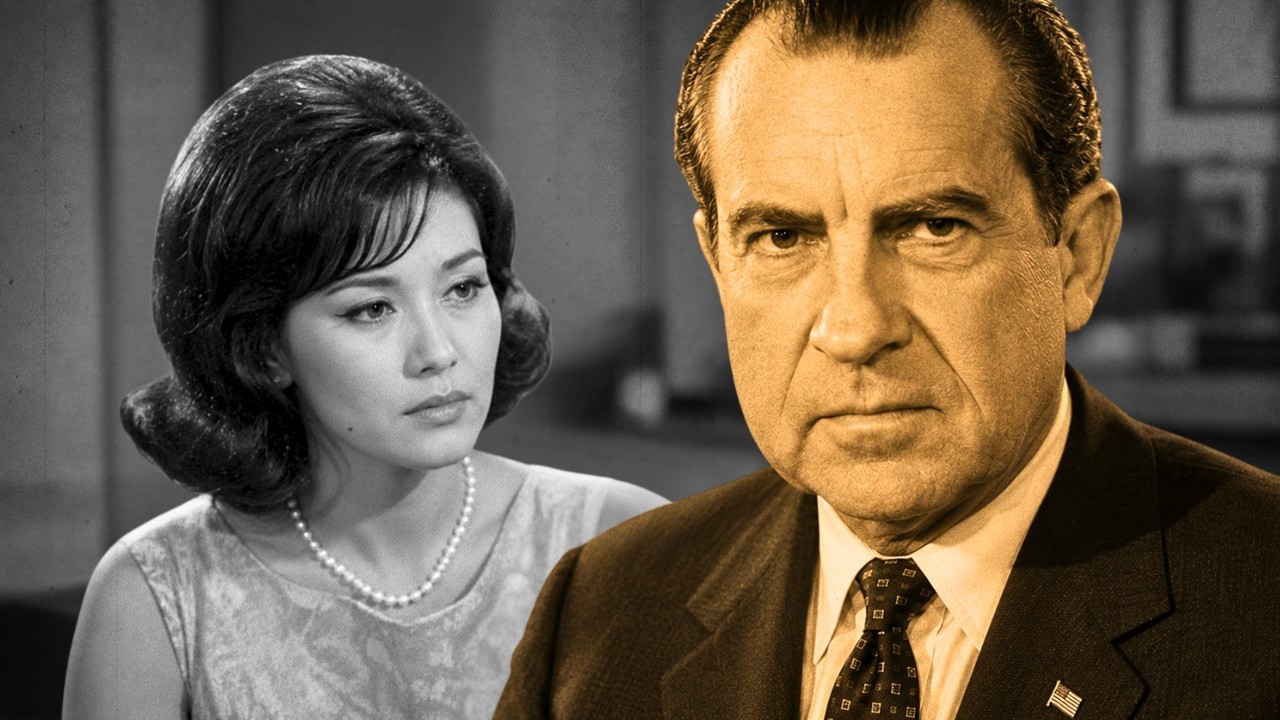
The relationship began in 1958, in the opulent, politically charged atmosphere of the Hong Kong Hilton. Nixon was entering what would become his political wilderness years. He had served as Eisenhower’s vice president, the relentless attack dog of the administration, but was soon to face a razor-thin defeat by John F. Kennedy.
Isolated and plotting an improbable resurrection, he traveled the globe as a diplomat and corporate lawyer, operating far from the suffocating constraints of the American press. It was in this world of expatriate luxury and international high society that he met Liu, a sophisticated hostess whose elegance and sharp intelligence commanded immediate attention in a city that served as the premier intelligence-gathering hub of the Cold War. Their connection did not remain a standard diplomatic courtesy. It deepened into a clandestine relationship, a hidden anchor for a man consumed by political exile and resentment of the American elite.
In the mid-twentieth century, the international movements of a high-ranking American political figure were never entirely private. The FBI, operating under the paranoid, unchecked mandate of J. Edgar Hoover, initiated comprehensive classified surveillance. The affair was no longer private; it became a permanent state record.
Declassified FBI files, Hoover’s secret counterintelligence memos, immigration logs, and field-agent reports from the Hong Kong consulate documented everything: recurring visits to her residence, the exchange of expensive gifts, quiet dinners away from the press pool, and discreet high-level interventions made on her behalf regarding United States residency visas. The meticulous bureaucratic documentation created a permanent record that defied any future denial. As the late 1960s approached, Nixon maneuvered for his ultimate political resurrection. The nation was in trauma, reeling from the assassinations of Martin Luther King Jr.
and Robert Kennedy, torn apart by Vietnam War protests. Nixon ran on a strict law-and-order platform, promising a return to traditional values and moral stability. His inner circle of advisers, ruthless hyperpragmatic strategists who viewed politics strictly as a battlefield, assessed the situation with clinical precision. The Republican base would never accept a presidential candidate linked to a foreign national under active counterintelligence scrutiny.
A single leaked memo from Hoover’s desk to a sympathetic journalist could end the campaign overnight. The ultimatum was binary, devoid of emotional consideration: choose the woman who offered solace during the bitter wilderness years, or choose the Oval Office. Nixon chose the presidency. The separation was executed with chilling bureaucratic precision.
There was no public acknowledgement, no closure. Liu was systematically decoupled from his life. Her access was revoked, her presence erased from official schedules and campaign diaries. She was discarded without hesitation to protect the structural integrity of the Nixon mythos.
As he ascended to the peak of global authority, she retreated into an existence defined by enforced silence. In a profound geographic irony, she was quietly permitted to settle in Whittier, California, placing her blocks from Nixon’s childhood home. The proximity offered zero access, serving only as a stark daily reminder of the invisible wall between them. From that distance, she watched as the man she had intimately known directed the secret bombing of Cambodia, negotiated arms control treaties with Soviet premiers, and ultimately engineered his own spectacular collapse during Watergate.
She witnessed the deep-seated paranoia she had seen in private metastasize onto the national stage, consuming his presidency, his staff, and his reputation. She watched as the operatives who had likely orchestrated her removal were indicted and marched into federal prison. Her silence was not born of peaceful resignation. It was corrosive, enforced compliance.
She understood the unspoken rules of engagement with the national security state. Any public revelation of their history would trigger swift retaliation from a paranoid executive branch and its loyalist intelligence directors. The FBI maintained its quiet vigilance, ensuring the radioactive secret remained dormant. On April 22, 1994, Richard Nixon died.
The days that followed were defined by a grand state funeral in Yorba Linda, California, with eulogies delivered by sitting and former presidents, all projecting a unified front of institutional continuity. The tributes detailed his legislative maneuvers, the creation of the EPA, his enduring marriage to Pat Nixon, and his partial rehabilitation. Liu was completely absent from the proceedings, omitted from official biographies and ignored by establishment historians. She had been surgically deleted from the authorized narrative of the 37th president of the United States.
Only in the twilight of her life did that change. Facing her own mortality, with the intelligence directors who had monitored her long dead and the political machine that demanded her silence dismantled, the calculus of fear shifted. With nothing left to protect, she chose to preserve her unvarnished truth. She engaged in quiet, late-career interviews and cooperated with independent investigative researchers operating outside the perimeter of the Nixon Foundation.
It was not an act of explosive tabloid vengeance but a calculated preservation of reality. She detailed the private conversations in Hong Kong, the surveillance she endured in California, and the psychological toll of being a hidden fixture in the life of a man consumed by power. Her testimony transformed heavily redacted FBI surveillance logs into a coherent human narrative, locking the unredacted truth into the permanent historical record. Nixon loyalists and protective biographers moved quickly to defend the legacy.
They argued the relationship was platonic, a standard diplomatic courtesy. They attacked the lack of explicit photographic evidence of physical intimacy and dismissed the researchers as sensationalists attempting to smear a deceased president. But the physical evidence proved too resilient. The timelines lined up perfectly with Nixon’s unexplained travel deviations in Asia.
The volume of declassified FBI surveillance, the panicked memos routed directly to Hoover regarding her immigration status, and the precision of Nixon’s hotel logs created an undeniable web of data that could not be explained away. The record confirmed exactly what the intelligence community had always feared: Liu was a central hidden reality in the life of the man who became president. The timeline of her life reveals the cost of entering the orbit of absolute ambition. 1958, a deep monitored connection with Nixon in Hong Kong during his exile; the 1960s, a hidden anchor during his international travels, leaving a permanent paper trail of surveillance and bureaucratic interventions; the late 1960s, systematic discard as he sanitized his history to secure the presidency; the 1970s, corrosive silence in Whittier under constant surveillance during the Imperial Presidency and Watergate; 1994, complete erasure from the historical record following his death; and late life, defiance, ensuring her permanent re-entry into the narrative.
From a cold-blooded tactical perspective, the calculation by his fixers was entirely correct. A scandal involving a foreign national under FBI scrutiny would have annihilated his path to the White House. The isolation of Liu was viewed not as cruelty but as structural necessity. But the human consequence was an absolute betrayal.
She spent the majority of her life watching the man she knew intimately sacrifice her identity and her history to protect his fragile paranoid public image. Her final quiet preservation of the record proved that while a president can command the military, order wiretapping of enemies and attempt to rewrite the laws of a nation, he cannot permanently dictate the final historical record. He won the White House, but he fundamentally failed to bury the woman who understood the deepest secrets of his ascent.