For nearly fifty years, one woman held the keys to the private life of one of the twentieth century’s most famous faces. She had the letters. She had the diaries. She had photographs no one else had ever seen.
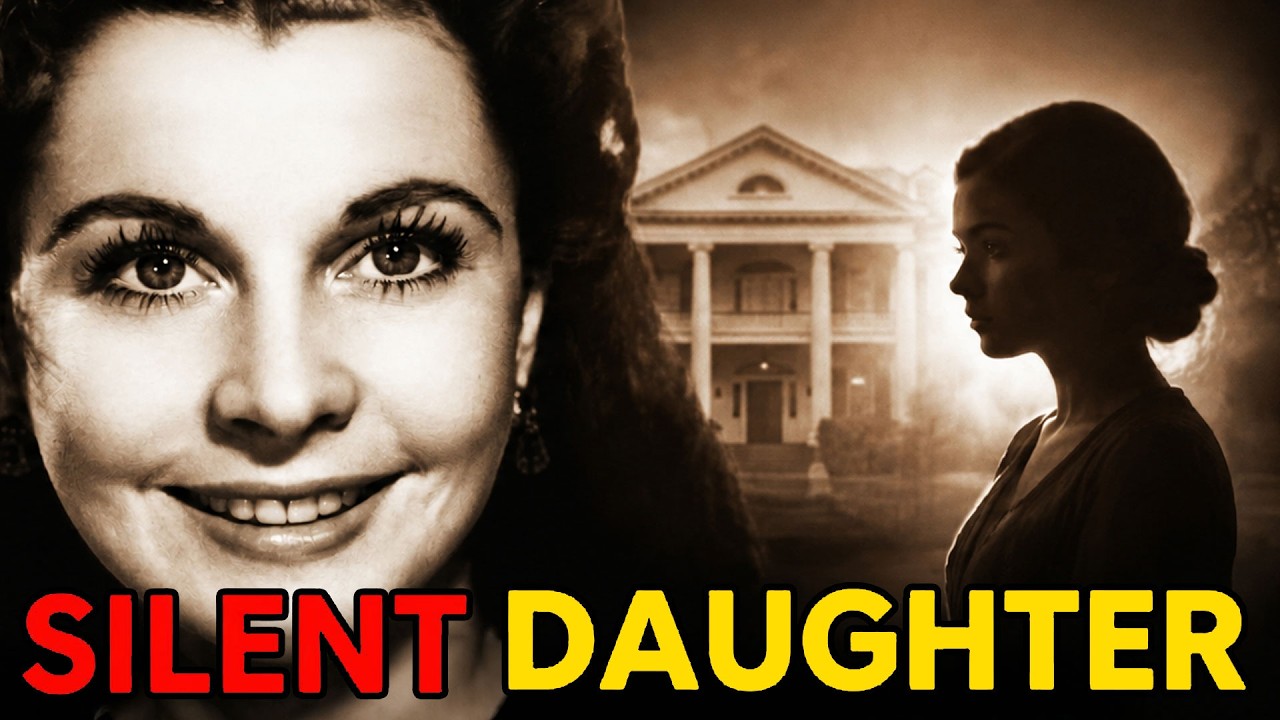
And for almost half a century, she said nothing. No memoirs, no interviews, no appearances in documentaries. While books were written about her mother, films were made about her, and strangers built entire careers analyzing her, this woman simply remained silent. Her name was Susan Farrington, and her mother was Vivien Leigh, the two-time Academy Award winner, Scarlett O’Hara herself, the most photographed woman in the British Empire.
But behind that icon was a daughter the world barely knew existed. And her silence was not an absence of a story. It was the most deliberate act of her entire life. Before there was a daughter who would lose her mother’s attention, there was a mother who had already learned what it meant to be pushed away.
Vivien was born in Darjeeling, India, in 1913, the only child of a British stockbroker and his Catholic wife. At just six years old, she was put on a ship alone and sent to a convent boarding school in England, the Convent of the Sacred Heart in Roehampton. Her parents remained an ocean away for most of her childhood. It is not difficult to see how that shaped her.
Vivien became exceptionally skilled at poise, charm, and performance, and far less practiced at the quiet, unglamorous work of steady attachment. She learned early that love could be intense and then simply absent, and that lesson would repeat itself. Only the next time, she would not be the child learning it. She would be the mother teaching it.
In 1932, at nineteen, Vivien married a lawyer named Herbert Leigh Holman. Ten months later, their daughter Susan was born, a month premature, after a very difficult birth. For most new mothers, this would be the beginning of a story. For Vivien, it felt like an interruption of a story that had already begun.
She had just started her acting studies at the Royal Academy of Dramatic Art in London. In a private letter written shortly after the birth, she described her newborn daughter as thin and admitted that the thought of feeding her for several months felt, in her own words, quite depressing. Within months, a nanny took over responsibility. Vivien returned to her career.
A succession of paid helpers followed. Although a French maid named Daisie Cougle became more of a real maternal presence in little Susan’s life than her mother ever was. This is not a story about a woman who did not love her child. It is colder and more complicated than that.
This was a woman who loved the idea of her daughter from a comfortable distance, while building a life in which actually raising her had no place. Vivien’s rise was rapid and total. After the success of the play The Mask of Virtue in 1935, she went from unknown to star overnight. Then, in 1937, she met Laurence Olivier on the set of Fire Over England.
What followed was not a whim. It was an affair that destroyed both of their existing marriages and became the driving force of the rest of their lives. By 1939, Vivien Leigh was the most famous woman on earth, having just won the Oscar for Best Actress for Scarlett O’Hara. Meanwhile, Susan was six years old, living quietly with her father, while her mother’s life had moved somewhere else entirely, a place where Susan did not truly belong.
Vivien’s fame continued to grow. Her role as Susan’s mother continued to shrink. The tabloids did not just cover the affair. They fed on it.
Every column analyzing Vivien and Olivier’s love story made Susan’s ordinary childhood more public property. Nor was she the only child caught in that wreckage. Olivier had a son named Tarquin from his first marriage, a boy going through an almost identical experience of watching his parents’ marriage collapse in front of the cameras. It is a strange note in an already strange story.
Two children, both damaged by the same headline romance, would eventually form a genuine friendship that lasted longer than any of the marriages involved. Sometimes the only people who understand what you have lost are the ones who lost it with you. When war broke out, seven-year-old Susan was sent across the ocean to Vancouver, Canada, to live with her grandmother, Gertrude. She did not see her mother again for years.
And here the story takes its cruelest turn. In 1940, Vivien finally divorced Susan’s father and married Olivier. A divorce and remarriage the Catholic Church did not recognize at the time. In that same period, the publicity surrounding it pursued Susan even in Canada.
Her convent superior decided she could no longer keep the daughter of divorced parents under her roof, and Susan was quietly moved to a day school instead. Consider what that truly meant for a child of that age. Susan had divorced no one. She had married no one.
She had committed no fault at all. Yet she was the one who bore the consequences, uprooted again by decisions made entirely by the adults around her. Two years later, in December 1942, the producer David O. Selznick had an idea.
He wanted to cast Susan as the young Jane in a new version of Jane Eyre, capitalizing on her mother’s fame. Susan’s father said no, that was absolutely impossible. In its own way, that refusal was an act of protection. Leigh Holman refused to make his daughter an appendage to her mother’s stardom before she had any chance to become anything else.
In 1944, while filming Caesar and Cleopatra, Vivien, who was pregnant with Olivier’s child, slipped on the polished studio floor during a scene and lost the baby. Many historians point to that moment as the true beginning of Vivien’s collapse. What is understood now, through modern medical knowledge that was not available then, is that she was most likely suffering from an undiagnosed bipolar disorder. A condition that would have completely changed how she was treated, and perhaps the course of her entire life, had anyone identified it.
Instead, her moods swung between manic energy and devastating depressive breakdowns, which Olivier documented with silent horror in his private letters. By 1953, it became impossible to hide. On the set of Elephant Walk, Vivien suffered a complete nervous breakdown. She had to be sedated and flown home for electroconvulsive therapy.
Susan was nineteen. She learned of her mother’s breakdown the way the rest of the world eventually did, through her father, through the headlines, through the public record. It was the first time she had to absorb her mother’s illness as a matter of public record. And it set the pattern for how she would handle every difficult fact about Vivien for the rest of her life: quietly, privately, without comment.
In 1957, Susan married an insurance broker named Robin Farrington. She built what her childhood had never given her: stability. A safe home, three sons, a life that ran on routine instead of headlines. While her mother’s marriage to Olivier finally collapsed in 1960, exhausted by years of illness and a second devastating miscarriage in 1956 that Vivien had hoped would repair the relationship, Susan continued building her own world, one that simply did not depend on her mother’s presence.
The contrast is worth noting. Vivien Leigh spent her life chasing intensity, love, fame, applause, crisis. Her daughter spent her adult life quietly building the exact opposite. A life in which nothing happened.
For Susan, monotony was not a failure of ambition for something greater. It was the entire point. It is also worth noting that building this quieter life did not mean cutting every tie to the world she came from. At her 1957 wedding, both her biological father and Olivier were present, side by side.
A rare moment of unity between two men who under ordinary circumstances had no reason to stand in the same room. Her friendship with Tarquin, formed years earlier over their shared experience of displacement, continued into adulthood and was one of the few threads connecting her old life to her new one. Susan was not erasing her past. She was simply deciding, for the first time, which parts of it she would keep, and on what terms.
Vivien Leigh died in 1967 at the age of fifty-three, from tuberculosis that had plagued her intermittently since the mid-1940s. She was found in her London flat after collapsing while trying to reach the bathroom. Susan handled the funeral arrangements herself, with the same quiet composure she had practiced her entire life. And when her mother’s estate passed to her, including a massive personal archive of letters, diaries, contracts, and photographs, she did something almost no one expected.
She hid it away. For the next forty-eight years, while unauthorized biographies piled up, while documentaries were made without her contribution, while public hunger to know the real Vivien Leigh never seemed to fade, Susan simply refused to participate. No book deals. No tell-all interviews.
No commentary. She had spent her entire life being introduced as someone’s daughter. She was not about to spend her retirement doing the same thing on camera. Then, in 2013, at seventy-nine, Susan made her decision.
She sold the entire Vivien Leigh archive to the Victoria and Albert Museum in London. It was not about the money. It was a final, deliberate handover. A decision to give her mother’s private papers to history itself, rather than to any biographer, journalist, or filmmaker who might shape the story for their own purposes.
It was the only time in fifty years she allowed the box to be opened, but on her terms, at the time of her choosing, to an institution rather than an individual. Susan Farrington died two years later, in 2015, at the age of eighty-one. There is a small detail worth noting. Her obituary did not begin with her mother’s name.
For the first time in print, in the very first line, Susan Farrington was simply herself. So why the fifty years of silence? This is the answer. Susan’s quiet was not an absence of a story.
It was the story itself. Every interview she refused, every book deal she turned down, was a small act of refusing to be reduced to a supporting character in someone else’s memory reel. Vivien Leigh spent her life watched, photographed, admired, analyzed, and ultimately diagnosed by people who had never met her. Her daughter spent her life making sure that at least one part of that story remained under her control, until the moment she decided it no longer needed to be a secret.
Vivien gave the world Scarlett O’Hara. But her daughter, who no one was watching, gave the story its quietest and perhaps most powerful ending: the choice to finally let go, on her own terms, of a silence she had held for nearly her entire life.