The German Fourth Army was freezing near Moscow in January 1942, outnumbered and exhausted after the failed assault on the Soviet capital. Temperatures had dropped to forty-two degrees below zero. Equipment seized up. The frozen ground made it impossible to dig proper defenses.
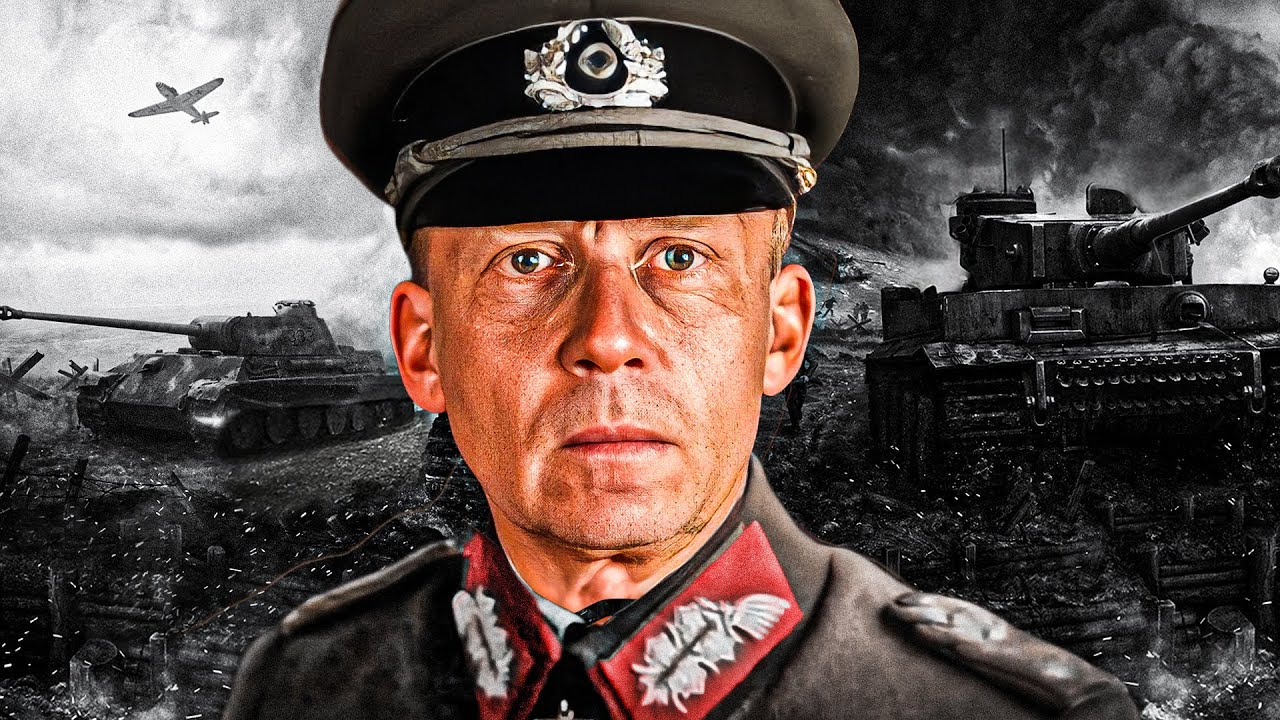
And General Gotthard Heinrici had just been given command of a force that was sometimes facing twelve Soviet soldiers for every German. Hitler had issued a strict no-retreat order, demanding that every position be held no matter the cost. Heinrici knew that conventional defensive tactics would simply get his army destroyed. He needed an approach that would satisfy Hitler’s orders while keeping his men alive.
What he developed in those brutal weeks would become known as elastic defense, a strategy that would define his reputation and shape the rest of his war. Heinrici’s path to that frozen command began decades earlier in the trenches of World War I. As a young German officer, he witnessed the devastating power of artillery and the futility of mass infantry attacks against well-prepared positions. Those experiences convinced him of the value of defense, of calculated retreats and well-timed counterattacks that could neutralize a numerically superior enemy.
While other German officers focused on rapid offensives, Heinrici studied past defensive campaigns and commanders who had fought successfully against larger forces. He was also an unusual figure in the Nazi military hierarchy. A devout Protestant who attended church regularly, he refused to join the Nazi Party. His religious faith and his independence made him unpopular with Hitler and with Field Marshal Wilhelm Keitel, who openly disliked him.
His wife Gertrude had a Jewish parent, which under Nazi racial laws classified their children as partly Jewish. Heinrici was granted a German blood certificate by Hitler himself, officially affirming the family’s Aryan status and shielding them from persecution. With the outbreak of World War II, his defensive expertise became increasingly valuable. Germany’s early victories masked vulnerabilities that would later prove fatal.
Heinrici knew how to make the most of limited resources and fight effectively against larger forces. On the Eastern Front, facing vast territories and the massive Soviet Army, his specialty was perfectly suited to the challenge. As historian Dr. Robert Citino put it, Heinrici’s emphasis on defensive warfare made him unusual among his peers, but this specialty proved crucial in Germany’s resistance to the Soviet counteroffensive.
When he took command of the Fourth Army on January 26, 1942, Heinrici was facing the full force of that counteroffensive. The Soviets were well prepared, determined, and advancing in great numbers. Heinrici allowed Soviet forces to break through his front line, then trapped them in carefully prepared kill zones. Once the attackers were entangled, he launched quick counterattacks to exploit weaknesses in their formations.
The strategy required perfect timing, coordination, and a deep understanding of how the Soviets fought. It also required convincing his own officers to trust a method that looked like surrendering ground to the enemy. And it required managing Hitler, who was always ready to interfere if he suspected anyone was retreating. Heinrici’s ability to predict Soviet movements was the key to his success.
He drew on prisoner interrogations, scout reports, and his own judgment to anticipate what the enemy would do next. That foresight allowed him to position his forces to maximum effect, making the most of limited resources. Under his command, the Fourth Army held out for ten crucial weeks against the Soviet onslaught. That time bought the German high command room to maneuver and kept the Eastern Front from completely collapsing at its weakest moment.
His flexible approach let him adapt to a constantly changing battlefield. He could move his forces quickly, countering disorganized Soviet attacks while keeping his defense intact. The results were stark. During the Battle of Königsberg in early 1945, the Soviets lost around sixty thousand men while the Germans lost twenty thousand.
The difference demonstrated how Heinrici’s defensive strategies kept his own forces alive while dealing heavy blows to the enemy. His success also raised difficult moral questions. By prolonging resistance, his tactics extended a war fought for a regime that committed terrible atrocities. That dilemma would come to define the final years of his career.
As the Eastern Front deteriorated, Heinrici faced a profound moral conflict. Hitler ordered a scorched-earth policy demanding the destruction of cities, food supplies, and infrastructure so that nothing would be left for the advancing Soviets. Heinrici recognized the devastation this would cause German civilians and soldiers alike. His religious beliefs and his sense of duty led him to question the orders.
He thought destroying civilian areas would cause needless suffering. So he began taking risks. When ordered to destroy the city of Smolensk before retreating in late 1943, he refused. The refusal temporarily cost him his command.
To avoid being caught again, he used clever tactics: delaying destructive orders, pretending to misunderstand them, or doing the bare minimum. It was a delicate balance of appearing to obey while secretly reducing the harm. By not destroying everything, he saved lives and kept important buildings and roads intact, protecting civilians from losing their homes and limiting the chaos of the German retreat. In a letter home, he voiced his doubts, asking whether the war’s enormous cost had really been necessary.
By April 1945, the Red Army was advancing toward Berlin. The Seelow Heights, a strategic position overlooking the marshy floodplains of the Oder River, formed the last major defensive line protecting the German capital. Heinrici, now in command of Army Group Vistula, knew the heights were crucial to slowing the Soviet push. He built three defensive lines on the heights, each taking advantage of the natural terrain.
The defenses channeled Soviet attacks into areas where German artillery and anti-tank weapons could do the most damage. He also flooded parts of the Oder River valley to slow the Soviet advance. The Battle of the Seelow Heights began on April 16, 1945, with a massive Soviet artillery barrage. Despite being outnumbered, Heinrici’s well-prepared defenses held at first.
German artillery, positioned in smart locations, targeted Soviet tanks as they struggled through the mud. Heinrici used a flexible defense plan, allowing his forces to fall back to backup positions when needed, saving men and equipment. For three days, his forces fought hard. But on April 19, the sheer weight of Soviet troops and equipment finally broke through the last defensive line.
On April 28, Field Marshal Wilhelm Keitel, chief of the German Armed Forces high command, noticed troops from the 7th Panzer Division and the 25th Panzergrenadier Division marching north instead of heading to Berlin as ordered. These units, part of General Walther von Manteuffel’s Third Panzer Army under Heinrici’s command, were being redirected to stop a Soviet breakthrough at Neuruppin. The move, made against Keitel’s and General Alfred Jodl’s orders, led to a heated confrontation when Keitel found Heinrici near Neuruppin on April 29. Heinrici was dismissed for refusing to prioritize saving Hitler.
Ordered to Berlin, he hesitated. Captain Helmuth Lang warned him that he might face the same fate as Erwin Rommel. Following Lang’s advice to delay, Heinrici instead surrendered to British forces in Plön on May 28, 1945. Gotthard Heinrici’s legacy as a military leader is complex.
He made major contributions to defensive warfare, especially the elastic defense strategy that helped German forces fight effectively against larger Soviet armies while saving resources and lives. British historian B. H. Liddell Hart described him as a small, precise man with a parsonal manner, respected for his tactical skills despite lacking charisma.
His ability to predict enemy moves and build strong defenses earned him the nickname the defensive wizard among his fellow soldiers. His record is not without moral complication. Despite being married to a half-Jewish woman, he supported some of the Nazi regime’s nationalistic policies, such as the concept of Lebensraum. He strongly disagreed with its racial policies and was disturbed by events like Kristallnacht, but he did not break with the regime.
Before Operation Barbarossa, he received the infamous Commissar Order and justified the summary execution of Soviet political commissars as a form of preventive terror to ease pressure on the front lines. Yet despite his loyalty to the military, he repeatedly defied scorched-earth orders, including refusing to destroy the historic city of Smolensk. His experiences raise enduring questions about military ethics and leadership. He sometimes disobeyed orders he considered too dangerous or destructive, even at personal risk.
His career illustrates the difficult balance military leaders face between following orders and doing what is right, and it challenges any simple understanding of what it meant to serve under the Nazi regime.