Vincent Astor inherited 87 million dollars on the morning the Atlantic Ocean took his father. He was twenty years old. The only person in the world he loved was dead, and the money had arrived to replace him. He married three times and had no children.
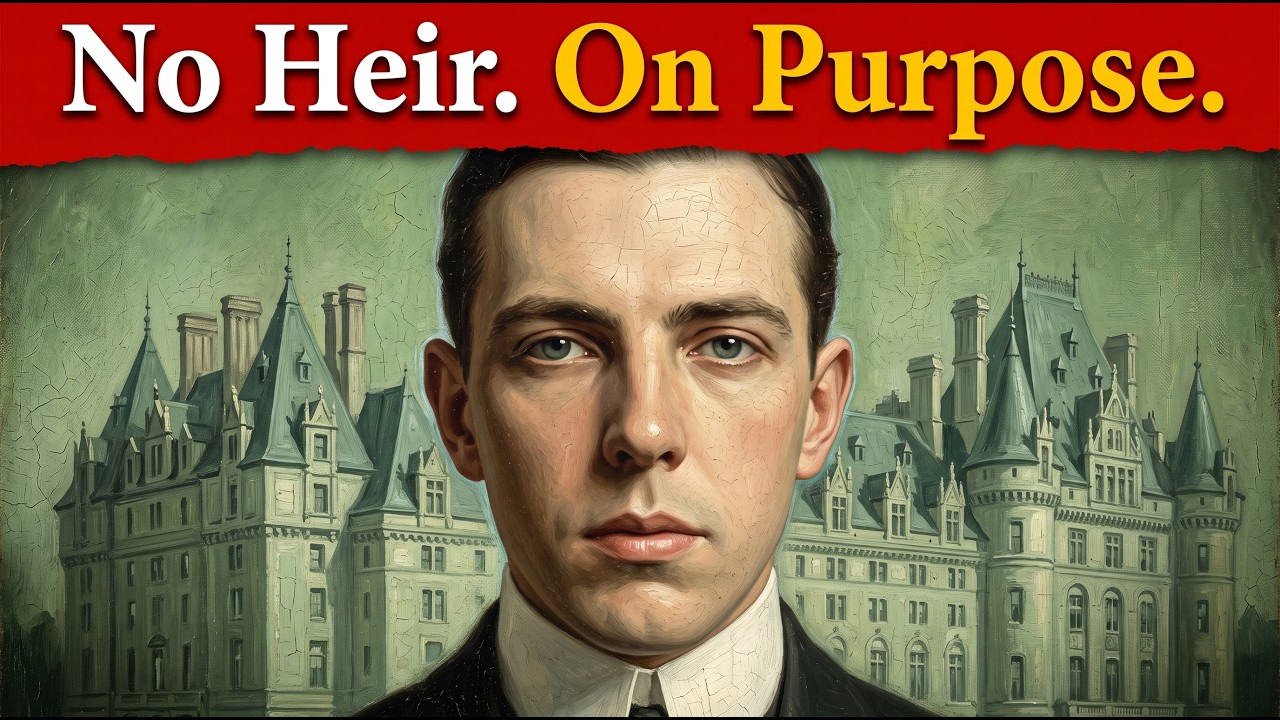
At his death, the last male heir of the American Astor line chose to give the fortune away forever. The question is why. This is not a story of a fortune that faded. The dynasty did not end in collapse but by a decision made by the man who carried the name.
The number requires context. Time magazine’s obituary, published on February 16, 1959, valued the inheritance at roughly 87,200,000 dollars. Adjusted for inflation according to the Consumer Price Index from the Bureau of Labor Statistics, that equals about 2. 9 billion dollars today.
Measured against average income, according to calculations by the economists at Measuring Worth, the figure approaches 20 billion dollars. That was the wealth inherited by a young man of twenty because his father boarded the Titanic. Every retelling of the Astor story says the same thing. Vincent was the amateur heir who squandered the money.
But the receipts say the opposite. The deeper correction is not financial. It is personal. John Jacob Astor IV, Vincent’s father, was not the cold, distant parent of legend.
Justin Kaplan, the Pulitzer Prize-winning biographer, wrote in the family history that Vincent adored his father and was adored in return. The cold side of the relationship was the mother. And the Titanic took the only person Vincent ever loved. The Astor fortune began with a German immigrant named John Jacob Astor, who arrived in the 1780s and turned the fur trade into the greatest real estate empire in American history.
Over a century, the Astors bought Manhattan and never sold it. By the Gilded Age, the name was the wealthiest in the country. By the time Vincent’s father inherited the family holdings, the estate controlled vast stretches of the city, and annual rental income was measured in the millions. John Jacob Astor IV was the heir who built things.
He commissioned the St. Regis Hotel on Fifth Avenue in 1904, spending 5. 5 million dollars on what the press called the finest hotel in the world. He filed patents.
He wrote a science fiction novel. And he loved his son. Vincent grew up on the family estate in Dutchess County, where the Astors were neighbors to the Roosevelts. The connection was so close that Franklin Roosevelt’s half-brother married Vincent’s aunt.
His mother, Ava Willing, was a different figure. She married John Jacob in February 1891, and the marriage lasted eighteen years. David Patrick Columbia, a historian of New York high society, described the household for the St. Regis Magazine.
During his childhood, Vincent was mistreated by his mother. National records concerning the Astor family use stronger language, describing Ava as terrifying and abusive. She reportedly called the boy stupid, clumsy, and heavy in appearance with big feet. Kaplan documented the other half of the picture.
Vincent adored his father, and his father adored him in return. The mother looked at her son and saw someone she had never wanted to exist. Vincent attended St. George’s School in Rhode Island and entered Harvard in the fall of 1911.
He was tall and thin, awkward in social settings, quick to anger, a young man who felt comfortable only at sea with his father. His parents divorced in November 1909. Two years later, John Jacob Astor IV married Madeleine Talmadge Force in September 1911. She was eighteen.
He was forty-seven. Society treated the age difference as a scandal. Vincent despised the marriage. But when his father asked him to be best man at the ceremony in Newport, Rhode Island, Vincent accepted.
That is what adoration looks like when love in a family has always been scarce. In the spring of 1912, John Jacob and Madeleine boarded the Titanic to return from their honeymoon in Europe. Consider what that ship carried for a twenty-year-old boy sitting in a Harvard dormitory. His father was the richest passenger aboard.
For Vincent, that fact meant something the rest of the world could not see. His father was the last living person who treated him as though he mattered. On the night of April 15, 1912, the ship sank. The father drowned.
Madeleine survived. She was five months pregnant. John Jacob’s body was found a week later, identified by the embroidered initials on his jacket. Everything Vincent Astor did for the rest of his life flowed from that loss.
Not from the money, the real estate, the social standing, or the magazine covers that followed. From the absence of the only person who looked at an awkward, confused, oversized boy and saw someone worth loving. That absence stood at the center of every decision Vincent made over the next forty-seven years. He was twenty when the telegrams arrived.
The press called him the millionaire boy, the richest boy in America. He left Harvard when the will was probated. That November, on the day Vincent turned twenty-one, the figures were settled. The estate totaled 87,200,000 dollars.
Vincent received 69 million of it, roughly eighty percent. His father’s young widow, Madeleine, received 100,000 dollars in cash and a five-million-dollar trust with a clause designed to control her from the grave. If she remarried, the trust reverted to Vincent. She remarried, lost the trust, and lived out her years in modest material circumstances.
His sister, Ava Alice, received a ten-million-dollar trust, and the son born four months after his father’s death received three million. Sixty-nine million dollars placed in the hands of a boy whose only source of love had died, left with a mother who called him worthless, holding a gold pocket watch recovered from his father’s body. Time magazine would later put him on its cover under the title Richest Boy. The title followed him.
So did the grief. Consider what Vincent now controlled. The Astor estate was not merely a bank account. It was a real estate empire stretching from Lower East Side tenements to Times Square, from Harlem to the commercial blocks along Fifth Avenue.
Hundreds of buildings, thousands of tenants, a system built by the first John Jacob Astor on a single principle. Buy land, lease it, never sell it. At age twenty, Vincent owned New York. He also inherited the St.
Regis Hotel his father had built, an estate in Dutchess County called Ferncliff spanning nearly three thousand acres, and memberships in twenty-nine clubs. Time counted the clubs in his obituary. Then he did something no Astor had ever done before. He began selling, block by block, building by building.
The family that had spent a century buying Manhattan and never giving up a single parcel began giving it away. The entire trajectory of the Astor enterprise reversed. For the first time in four generations, money was flowing out of New York real estate instead of into it. The selling was deliberate.
What the Astors owned in the Lower East Side was slums. The rents came from immigrant families packed into buildings that no Astor had inspected in decades. The Astor name was attached to every one of them. Under Mayor Fiorello LaGuardia in the 1930s, Vincent demolished the tenements by the dozen.
In their place he built eight five-story residential buildings for working families. A plot in the Lower East Side was sold to the New York City Housing Authority for less than half its market value. Valuable Harlem properties became children’s playgrounds. Vincent told people it was good business.
The national archives quote that phrase as his customary explanation for his philanthropy. But what Vincent was doing went beyond business. He was rewriting the terms of Astor wealth, one housing project at a time. Money was not the only thing Vincent could not keep.
He married Helen Dinsmore Huntington on April 30, 1914. She was from Dutchess County, a childhood acquaintance from the same world of old families and country estates. The marriage lasted twenty-six years. There were no children.
An illness early in the marriage left him unable to father children. That detail sits at the heart of everything that followed. Vincent Astor, the last male heir of America’s richest family, knew from the start of his first marriage that the line would end with him. There would be no son, no grandson, no fifth generation of Astors to carry the fortune forward.
The dynasty had a clock, and Vincent was the only one who could hear it ticking. The marriage to Helen ended in divorce in 1940. He married Mary Benedict Cushing the same year, one of the three Cushing sisters, daughters of the pioneering neurosurgeon Harvey Williams Cushing. The marriage lasted thirteen years.
There were no children. When the divorce came in September 1953, Mary reportedly agreed to help Vincent find a replacement. She remarried within a month. His third wife was Brooke Russell Marshall.
They married on October 8, 1953. Brooke had been divorced once and widowed once, with a talent for the kind of public philanthropy that turns money into purpose. The marriage lasted until Vincent’s death. There were no children.
Three marriages, zero heirs. A man who knew from age twenty-two that every dollar he directed, every building he bought, every name he carved in stone would eventually pass to someone outside the Astor family. The accounts run as follows. Vincent took control of 69 million dollars in 1912.
Over the next forty-seven years, he sold tenements, rebuilt the investment portfolio, and managed it effectively. In 1937, he merged his own magazine, Today, with the struggling News-Week and invested 600,000 dollars of capital alongside W. Averell Harriman. He became chairman of the board of what the world would know as Newsweek and held the position until his death.
He sold the St. Regis Hotel at a foreclosure auction on June 11, 1935, then bought it back for 590,000 dollars plus 300,000 for the furnishings. Within two years, the hotel was profitable again. Vincent kept it until his death, when it sold for 14 million dollars.
Admiral Byrd’s 1929 Antarctic expedition carried Astor money, and a mountain in Antarctica was named for his contribution. Vincent demolished the main mansion at Ferncliff and turned the estate into the largest apple farm in the state, complete with a small private railway on the grounds. When his will was probated after his death in 1959, the estate totaled 127,377,021 dollars. He had nearly doubled the fortune.
What Vincent Astor did with his time between those two numbers is the part of the story every family biography skips. Vincent did not spend those decades at dinner parties. He went to war. In December 1915, he joined the Naval Reserve as an ensign.
When the United States entered the First World War, he donated his yacht, the Nomahegan, valued at 250,000 dollars, to the United States Navy. He sailed it overseas in June 1917. The yacht engaged German submarines in the Atlantic. On one patrol in November of that year, the crew engaged a German submarine and probably damaged it, enough for the captain to receive the Navy Cross.
Vincent served as port officer at Royan, France, and was promoted to lieutenant before the war ended. He returned to New York in April 1919 aboard a captured German submarine. Between the wars, he did something stranger. In 1927, he founded an informal intelligence network called The Room.
It met monthly at a Manhattan house on East 62nd Street, and its membership included Kermit Roosevelt, J. P. Morgan, and Nelson Doubleday. Guest speakers ranged from polar explorer Richard Byrd to the novelist Somerset Maugham, himself a British intelligence officer.
After Franklin Roosevelt entered the White House in 1933, The Room passed economic and political intelligence directly to the president. Vincent and Roosevelt had been friends since childhood. They were neighbors in Dutchess County. Roosevelt’s half-brother married Vincent’s aunt.
When Roosevelt contracted polio, Vincent lent him the indoor pool at Ferncliff for hydrotherapy. He provided a private subway station beneath the Waldorf Astoria with an elevator that allowed Roosevelt to move from train to hotel unseen, helping conceal the president’s paralysis from the public. Roosevelt made five fishing trips aboard the Nomahegan, Vincent’s 264-foot yacht with eleven staterooms, a crew of forty-two, and a cruising range of 20,000 miles. Vincent used it for six scientific expeditions to the Galápagos Islands and published a daily newspaper aboard.
On the yacht, Vincent called the president Franklin. Roosevelt printed fictional stories in the newspaper as a joke. In February 1933, an assassin named Giuseppe Zangara opened fire on Roosevelt in a Miami park. Vincent was standing only fifteen feet away.
He rushed to the bleeding Chicago mayor Anton Cermak, held him in his lap, and stayed with him until help arrived. In 1938, Vincent sailed the Nomahegan to the Pacific on an intelligence mission for Roosevelt, gathering information about Japanese naval operations near the Marshall Islands, with Kermit Roosevelt aboard. When the Second World War broke out, Vincent volunteered at age fifty. Roosevelt appointed him area observer for New York, a position created specifically for him, to coordinate merchant ship convoys and intelligence operations from the city.
He was promoted to captain and donated the Nomahegan to the Coast Guard for the war effort. Vincent emerged from the war with a Navy commendation medal and a personal record that had nothing to do with his family name. Then he turned his fortune toward giving. In 1948, Vincent Astor founded the Vincent Astor Foundation.
Its charter stated a single purpose: the relief of human suffering. Money went to the New York Public Library. It went to the Metropolitan Museum of Art, which built the Astor Court, a replica of a Chinese garden, with his funding. It funded the Bronx Zoo’s Montefiore Building and financed the restoration of Bryant Park.
Almost all the money went to New York City, the city where the Astor fortune had been built, building by building, from the rents of people who lived in his family’s properties. The contrast with his ancestors was stark. They used money to decide who mattered, to write guest lists for velvet society, to build mansions and throw parties. Vincent used money to help people who would never appear on any guest list.
The fortune that had once built a wall between the rich and everyone else was now being spent voluntarily on the other side of that wall. Time recorded in its obituary a statement Vincent had once made when asked to clarify. It is unreasonable to assume that a man, merely because he is rich, is also useless. If you inherited a fortune built on slum rents collected from people who owned nothing, a fortune your father never had the chance to teach you to manage, what would you have done with it?
By the 1950s, Vincent Astor had reshaped the family name. He was no longer merely a New York landlord but the man who demolished slums and gave land to the city, the publisher of Newsweek, the naval officer who served two presidents and ran a private intelligence network. He was the man who married three times, produced no heir, and spent decades building a foundation that would outlast him. His health was failing.
He suffered from a heart condition that worsened over the years. In 1958, as he entered a theater in Poughkeepsie, New York, to watch A Night to Remember, a film about the sinking of the Titanic, Vincent suffered his first heart attack. The film dramatized the night his father died. Forty-six years after the sinking, the ship that had killed his father reached from the screen and stopped his heart.
Brooke, his third wife, became the partner Vincent had needed since the morning of April 15, 1912. She understood what Astor money could do if directed toward the right purpose, and she understood the price paid by the man who carried it. The great Astor mansions were already gone by then. The double mansion on Fifth Avenue, where the Mrs.
Astor of Gilded Age legend held her famous balls, had been demolished decades earlier. Temple Emanu-El stands on that ground today. The original Waldorf Astoria, the monument to the family feud that sent one branch to England, was demolished in 1929 to clear the site for the Empire State Building. By the time of Vincent’s death, almost no physical trace remained of the world the Astors had built.
Brooke Astor outlived her husband by nearly five decades. She died on August 13, 2007, at age 105. In her final years, her son from a previous marriage was convicted of grand larceny for plundering her estate while she suffered from dementia. The Astor name carried one more chapter of loss after Vincent’s death.
She was buried beside him in Sleepy Hollow Cemetery. Vincent Astor died on February 3, 1959, of a heart attack at his home at 120 East End Avenue in Manhattan. He was sixty-seven. He had signed his final will the previous June.
The bulk of the estate went to the Vincent Astor Foundation. Brooke received two million dollars as a direct bequest. Twenty-four other individuals shared 827,500 dollars among them. The main Ferncliff house was donated to Benedictine Hospital in Kingston, New York.
Then a challenger appeared, John Jacob Astor V and VI, Vincent’s half-brother, the son born four months after his father’s death following the Titanic sinking. He claimed Vincent had been mentally incompetent when signing the will. The settlement granted him 250,000 dollars from a fortune once compared to the wealth of nations. Jackie, as the family called him, put it in striking terms.
He said Vincent had the legal right, but not the moral right, to keep all the money. And here is the core buried beneath everything. Vincent Astor did not choose to have no children. An illness left him unable to father them.
Biographical literature treats this condition at length, though no primary medical sources confirm the details. What is beyond dispute is that Vincent knew from his early married years that the line would end with him. Consider what that knowledge does to a man holding the fortune Vincent held. Every investment was directed toward someone outside the family.
Every year of his stewardship brought the name one year closer to its end. Every noble gesture, every charitable grant, every decaying building replaced by a playground was shaped by that fact. Vincent was not building anything for the next generation. What he was doing, grant by grant and tenement by tenement, was ending the family name.
He could have adopted an heir. He could have appointed a relative. The trust structures the Rockefellers and DuPonts used to preserve their empires across five or six generations were available to him. Vincent watched those families build them.
The lawyers were there. The resources were there. He chose to build none of it. Instead, he founded a foundation and pointed it toward strangers.
The Vincent Astor Foundation, funded with 65 million dollars from his estate according to the Duke Center for Strategic Philanthropy, became the instrument for everything Vincent believed Astor money should do. Brooke Astor took the presidency and ran the foundation for nearly four decades. Under her direction, the foundation distributed between 175 and 195 million dollars before dissolving it in 1997, deliberately depleting the assets. Linda Gillies, the foundation’s longtime director, said the intention was always to spend everything.
Libraries, museums, hospitals, shelters for the homeless. Nearly every dollar stayed within the five boroughs, returning to the neighborhoods drained by Astor rents for over a century. That is the answer. Vincent Astor refused to continue the dynasty.
The Titanic took the only person who made the name seem worth carrying. What remained was a fortune attached to a title that gave Vincent everything the world could offer except a father, except a mother who wanted him, except a reason to believe passing on the money was worth the price. Three marriages could not fill the void left by one night in the Atlantic. Vincent looked at what four generations of Astors had built and decided the money would do more good in the hands of those who needed it than in preserving a name he had spent his life trying to escape.
There is a structural lesson beneath the personal one. The American Astor family never built a family office, a trust, or a holding company to pass the wealth intact. But Vincent’s case differs from that diagnosis. He had the money, the lawyers, and the precedents.
He watched the Rockefellers establish a family office. He watched the English branch of his family build a system of peerage, and he chose instead to build a charitable foundation and turn attention away from his name. There is a controlled experiment buried in Astor family history proving that what happened to the American branch was not inevitable. In 1891, William Waldorf Astor, the man who held the largest single share of Astor wealth, left America.
He took nearly 100 million dollars to England, became a British citizen, and began his climb toward the aristocracy. He bought Cliveden, one of the great English country houses, in 1893. Genealogical records of the royal families of Britain and Ireland list the stated price at 1. 4 million dollars, with an additional 6 million spent on improvements.
He bought Hever Castle, the childhood home of Anne Boleyn, in 1903 and restored it stone by stone. The Crown granted him the title Baron Astor in 1916 and Viscount Astor the following year. At the time, Americans mocked him. William Waldorf was considered a social climber who turned his back on the country that made his family rich.
But what no one saw was the structure he was entering. The British peerage system, whatever its flaws, was a centuries-old machine for preserving wealth in the hands of a single heir across generations. A viscountcy and its estates pass whole to the eldest son. Nothing is divided.
Nothing is distributed among competing children. William Waldorf Astor had not fled a family dispute. He had introduced his share of the fortune into the only system on earth designed to keep it intact. His son Waldorf, the second viscount, married Nancy Langhorne in 1906.
She became the first woman to take a seat in the British Parliament in 1919. The English Astors became a political family in a way the American branch never did. In 1942, the family gave Cliveden to the National Trust. The terms were exact.
Cliveden was preserved, placed beyond the reach of inheritance taxes and family divisions, with the family retaining the right to rent apartments within the house and continue living there until the 1960s. One legal maneuver ensured the estate survived as long as the Trust exists. Compare that to what was happening in New York at the same moment. Mansions faced the wrecking ball.
Leases were sold for cash. Wealth was divided with every death. In England, the same family, with the same blood, the same initial capital, and the same name, was doing the exact opposite. One family ran the experiment in both directions.
Hever Castle was sold in 1983 to Broadland Properties. The English branch was not immune to the pressures of the twentieth century. But the core of the fortune held. The current head of the English line, William Waldorf Astor III, the fourth Viscount Astor, was estimated at 278 million dollars by the Sunday Times Rich List in 2017.
He lives at Ginge Manor in Oxfordshire. Two branches, the same blood, the same initial capital. The American branch, initially wealthier and more prominent, produced a man who chose to dismantle the dynasty himself. The English branch, mocked at the time as a refuge for whiners, still holds the titles, still holds the wealth, still lives in the English countryside.
What the English branch did was what the first John Jacob Astor had done instinctively when he passed his wealth to one qualified son. But the English branch made it permanent. The peerage system repeats in every generation, forcing the estate to pass whole. No American Astor built anything like it.
Each generation divided the money further. Each death brought estate taxes. There is a cruel irony in the comparison. Americans fought a revolution to escape the machinery of aristocracy, inherited titles, and entailed estates that lock wealth inside a particular bloodline.
That same machinery, adopted by the branch that crossed the ocean in the other direction, is what kept the English Astors intact while the American line faded. The system the founders were proudest of escaping turned out to be remarkably good at one specific task. Vincent knew about the English branch and watched it preserve its wealth. He watched the Rockefellers build their structures.
The example, the resources, and the time were all before him. But he looked at the question of structure and gave a different answer. The dynasty had cost him his father. It had left him with a mother who saw nothing in him worth keeping.
It placed 87 million dollars in his hands at age twenty and gave him a name that opened every door in the country. None of those doors led to what he needed. He decided the kindest thing he could do for the Astor name was to give it up. The loneliest heir in America lost his father in the Atlantic and received a fortune in his place.
Vincent served in two wars. He ran an intelligence network for a president he called by his first name. A national magazine carried his name on its masthead. The slums were demolished and playgrounds built in their place for children whose parents paid the rent his family once collected.
Three marriages, and the hope of a biological heir buried before the first wedding ended. In the end, he took the fortune that arrived on the morning of his father’s drowning and gave it to the city from which that fortune had been drained dollar by dollar for over a century. They recovered a gold pocket watch from his father’s body in the North Atlantic in April 1912. Vincent carried it for twenty-three years.
Then, in 1935, he donated it as a christening gift to the infant son of his father’s secretary, a boy named William Dobbin. Not a relative. Not an Astor.
A child outside the bloodline, in whose hands the last memory of his father would outlive the name itself.