Two women married Howard Hughes, and both of them eventually left him. The first, Ella Rice, was a young woman from one of Houston’s most respected families, educated, poised, and genuinely warm. The second, Jean Peters, was an actress of considerable integrity who would endure a marriage that bore almost no resemblance to what most people would recognize as one. What those two marriages revealed was not just the difficulty of loving a driven man, but the specific cost of loving a man who was, in the end, incapable of sharing himself with anyone in a sustained and functional way.
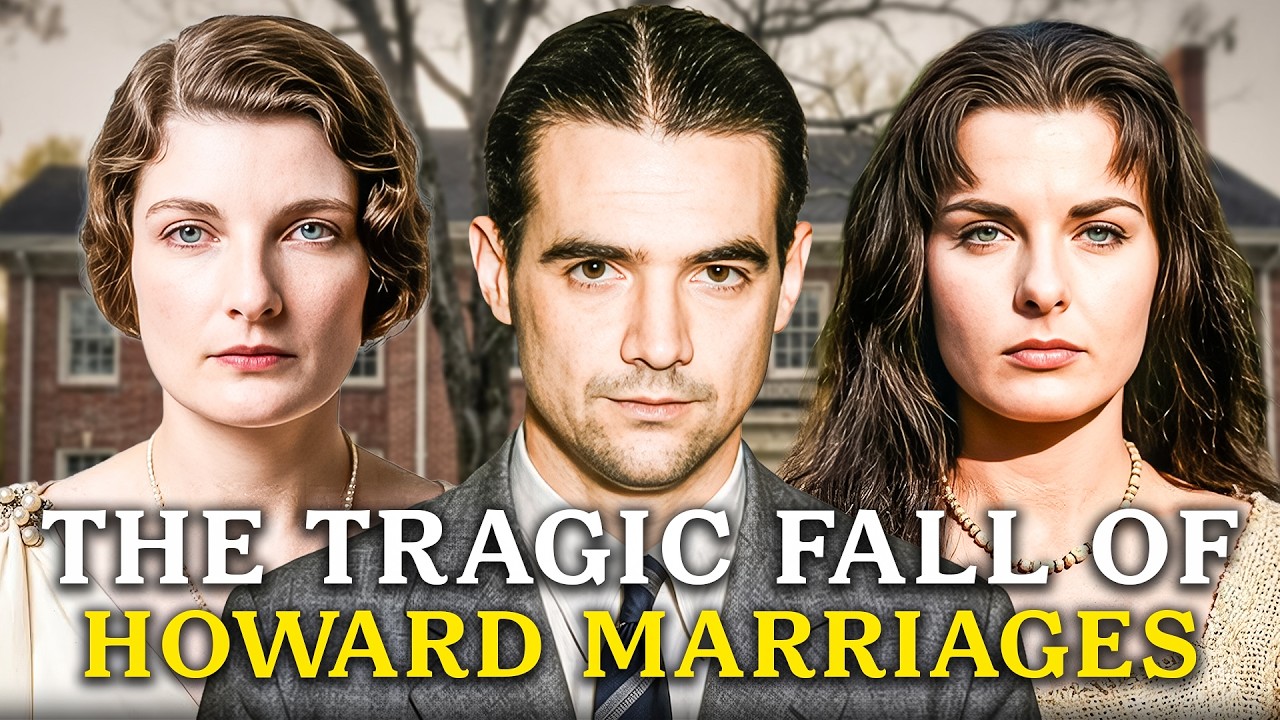
Ella Rice grew up in the same Houston social circles as Howard Hughes, and when they began spending time together, people in their world considered it a natural match. They married in 1925, when she was twenty-two and he was nineteen. On the surface, it looked like a solid beginning. But almost from the start, the life Ella had imagined and the life Howard was actually living were two completely different things.
Howard had inherited a considerable fortune after the early deaths of both his parents. His father had built the Hughes Tool Company around a revolutionary drill bit design essential to the oil industry, and the company generated enormous income. The inheritance gave Howard freedom from almost every kind of accountability. There was no employer, no board, no structure he had not chosen himself.
And almost immediately after the wedding, he began using that freedom in ways that left very little room for a marriage. Howard wanted to make movies, not watch them, so he packed up and moved to Los Angeles, pulling Ella along into a world she had no preparation for and no real interest in. He threw himself into filmmaking with an intensity that left almost no room for anything else, most notably the World War I aerial epic Hell’s Angels, which he began in 1927 and which consumed years of his life and millions of dollars before its release in 1930. Ella was essentially alone in a city that was not hers, waiting for a husband who was rarely present and growing more distant by the day.
Whispers circulated about Howard and the women he was spending time with, actresses and socialites from the sets of his films. Whether or not everything that was whispered was true, the pattern of behavior was consistent enough that people close to Ella began to worry for her. She stayed longer than most people expected, held by loyalty or perhaps the hope that the Howard she had married back in Houston was still somewhere inside the one she was living with now. But that Howard was becoming harder to find.
By 1929, she had had enough. She filed for divorce, citing a marriage that had simply stopped functioning as one. There was no dramatic courtroom confrontation. Howard did not contest it.
The divorce was finalized quietly. Ella remarried, remained in Texas, and lived far from the Hollywood orbit she had briefly occupied. She almost never spoke publicly about Howard Hughes again. After the divorce, Howard did not slow down.
The late 1920s and the 1930s were the years that built his legend. He set a world air speed record in 1935 in a plane he had designed himself. In 1938, he flew around the world in just under four days, breaking the previous record by more than half, and was celebrated with a ticker-tape parade through New York City. He acquired TWA, produced movies that drew enormous public attention, and was involved with a long succession of women, including Katharine Hepburn and Ava Gardner.
Both of them, in interviews given years later, described him in strikingly similar ways: brilliant, compelling, genuinely warm in moments, and ultimately impossible to build a stable life with. But the flying was leaving marks. In 1946, a crash in Beverly Hills was severe enough that the people who pulled him from the wreckage were not certain he would survive. He had been test flying an experimental reconnaissance aircraft, the XF-11, when the right propeller went into reverse pitch.
The plane tore through three houses before coming to rest in a field. His chest was crushed, his skull was fractured, and several ribs had punctured his left lung. Doctors described his condition that night as critical. The recovery took months and required levels of morphine and other medications that would later have consequences no one fully anticipated.
People who knew Howard before and after the 1946 crash often noted that something shifted after it. Not suddenly, but incrementally. The anxieties he had always managed began to expand. The need to control his environment became more pressing.
The fear of contamination, of illness, of things being out of his control grew into territory that had not been vulnerable before. By the 1940s, he was issuing detailed instructions to his staff about how to approach him, how to hand him things, how to open doors. He kept multiple open tissue boxes within reach at all times to use as barriers between his hands and surfaces he could not trust. He developed elaborate procedures around food, and if a step in the process was done incorrectly, the entire preparation would be discarded and started again.
The man who had once seemed to court danger now began organizing his entire existence around avoiding a different kind of threat, the invisible ones. This was the man Jean Peters would fall in love with. She was born in 1926 in a small town in Ohio, the daughter of a county agricultural agent. She won a talent competition at Ohio State University in 1946 that came with a screen test at 20th Century Fox, and the studio signed her.
She had a natural screen presence, dark-haired, direct, with a seriousness that set her apart. She was also, by every account, a person of considerable integrity, private, principled, and not easily impressed by wealth or status. Howard Hughes and Jean Peters met in 1946. He was forty.
She was twenty. What is often noted about their first meeting is that Howard did not approach Jean the way he approached business problems, with immediate, total force. He was patient. He pursued her with what people who observed it described as genuine feeling, attentive, focused, and determined.
Jean did not simply fall into his arms. She was careful. She maintained distance. She continued working.
And yet the connection persisted, on and off through the late 1940s and into the 1950s. In 1954, Jean married someone else, a film production manager named Stanley Ho. It was a quiet marriage, a reasonable choice made by a woman who understood what a stable life might look like. It did not last long.
Jean and Stanley divorced in 1955. Within two years of that divorce, Jean Peters would become Jean Hughes. On January 12, 1957, Howard and Jean were married in Tonopah, Nevada. The ceremony was so private that for a time there was genuine public uncertainty about whether it had taken place at all.
In some ways, the secrecy was appropriate, because the marriage that followed bore almost no resemblance to what most people would recognize as one. By the time he married Jean, Howard’s routines had become so particular, so rigid, so far removed from ordinary life that accommodating them required significant personal sacrifice from anyone who tried to be close to him. He spent stretches of time in rooms that were essentially sealed off from the outside world. Windows were covered.
Contamination was everywhere in his mind. Staff who entered had to follow a precise sequence, the way they held items, the way they moved through the room, the direction from which they approached him. Violations of these protocols, even accidental ones, could provoke reactions far out of proportion to what had occurred. What made the Hughes marriage particularly strange was the degree to which the two of them lived apart while technically remaining husband and wife.
Howard occupied hotels and private residences configured to his requirements. Jean lived more normally. In the later years of the marriage, they communicated significantly by telephone. Howard could be intensely present on the phone, attentive, engaged, sometimes tender, and then physically absent for weeks or months.
There were stretches when Jean reportedly had no idea where Howard was located. He moved between hotels and private compounds with a secrecy his staff maintained with practiced efficiency, and that staff, sometimes referred to as the Mormon Mafia because many of them were members of the Church of Latter-Day Saints, controlled access to Howard in ways that could effectively override even the wishes of the woman he had married. Jean had expressed, at various points in her life, an interest in having children. It was something she cared about.
It was also something the structure of her marriage made essentially impossible. Howard was in no condition to be a present father, and the household, to the extent the word even applied to his scattered hotel-based existence, was not a place where children could have been raised. There is a particular kind of loss that comes not from something being taken away, but from something simply never becoming available. The family she might have built in a different life was simply not accessible inside this one.
Howard’s use of painkillers, codeine in particular, had become severe by the 1960s. What had begun as medically necessary treatment after his crashes had become a serious dependency. His physical health was declining, and his already unconventional behavior was becoming more extreme. In 1970, Howard fired Robert Maheu, one of his most trusted lieutenants, abruptly and through intermediaries.
Maheu had essentially been running Hughes’ Nevada business operations while Howard remained in seclusion. Maheu’s departure and the legal battles that followed began pulling back curtains on the Hughes empire that had been very carefully kept shut, putting details about Howard’s health and the structure of power around him into the public record. In 1971, Jean Peters filed for divorce from Howard Hughes. She was forty-five years old.
She had been married to him for fourteen years. The filing was quiet, with no press conferences, no statements through publicists. The terms were settled privately, with Jean receiving a financial settlement whose specific figures were not made public. She gave almost no interviews about the divorce.
She did not write a book or go on television to describe what she had lived through. On the rare occasions she did speak about Howard, she was measured and in some ways generous, acknowledging that he had been a man of genuine feeling, someone capable of real connection. Howard Hughes lived another five years after the divorce. They were not good years.
He continued moving from hotel to hotel, the Desert Inn in Las Vegas, properties in the Bahamas, Nicaragua, London, Vancouver. He was carried from some locations in a state that alarmed the people who saw him. By the time he died on April 5, 1976, on a flight from Acapulco to Houston, ironically headed toward the city where his first marriage had begun, he weighed roughly ninety pounds. His arms bore the marks of years of injections.
The man who had once set world records in aircraft and been celebrated with a ticker-tape parade had arrived at the end of his life in a condition almost impossible to reconcile with the legend. Jean Peters remarried Stanley Ho, the same man she had briefly been married to before Howard, in the same year her divorce from Hughes was finalized. By the accounts of people who knew her in her later years, she was genuinely at peace. She lived in Southern California, spent her time in ways that had nothing to do with being Howard Hughes’ ex-wife, and died in 2000 at the age of seventy-three.
Ella Rice was the first person to test, at close range, whether Howard Hughes could sustain a genuine partnership with another human being. The answer she arrived at was clear enough that she did not need to explain it to anyone. She simply left, rebuilt, and never looked back. Jean Peters gave fourteen years of her life to a man who, for much of that time, was present primarily as a voice on the phone, a figure in a sealed room, a legend that had turned inward and consumed itself.
She was one of the most composed and capable women to move through the orbit of Howard Hughes, and even she could not find a way to make the marriage into something it was never going to be. The marriages of Howard Hughes are not just footnotes to his larger story. Stripped of the aircraft and the movie sets and the public myth, down to the level of what another person experienced when they tried to live beside him, they are in some ways the most honest record we have of who he actually was.
And what they experienced was loneliness.