The Hittite Empire did not fall in battle. The great gates of its capital stood open, the temples held nothing, and the state granaries had been scraped bare. The men who came for it walked into a corpse. The real death of this empire was never recorded by its enemies.
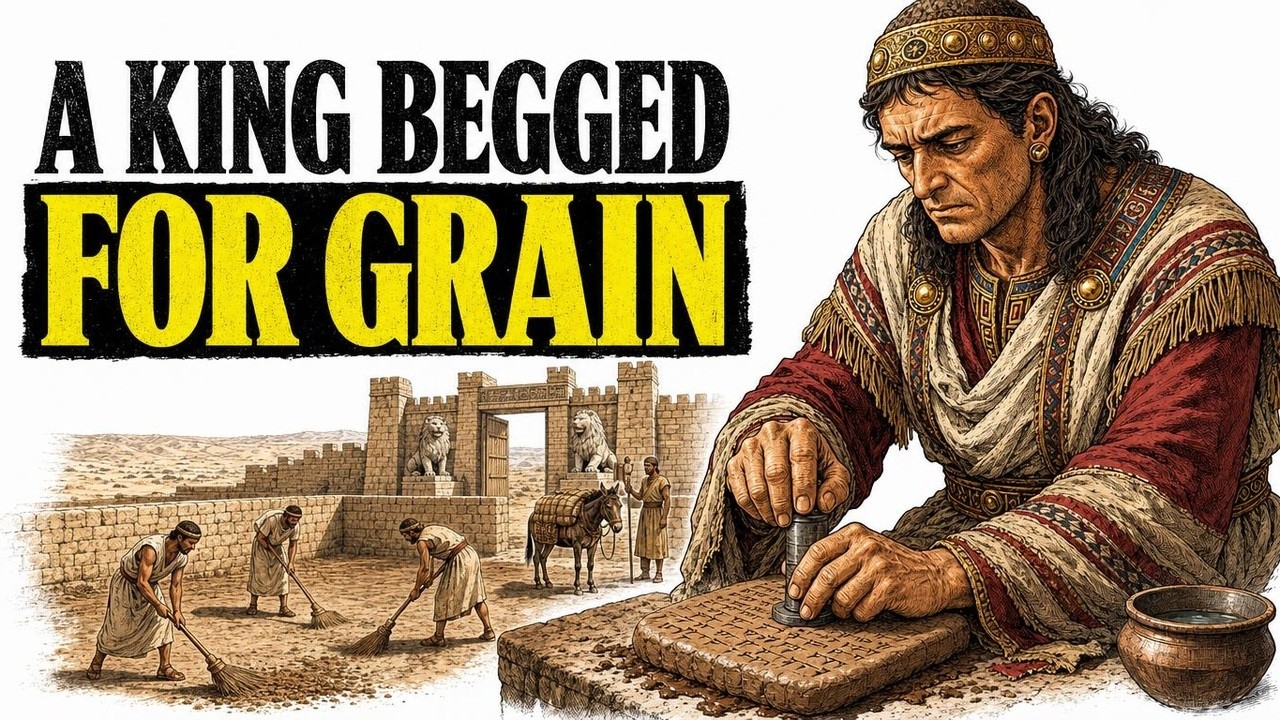
It was pressed into clay, into the last letters the Hittites sent one another as their world went dark. In the late Bronze Age, the Near East was not a scatter of kingdoms but a connected system running from the Greek mainland to the mountains of Iran. Egypt, Hatti, Babylon, and Assyria called one another brother on polished tablets, but that brotherhood was a fiction. It was a cartel held together by the fragile flow of goods: tin from Afghanistan, copper from Cyprus, gold from Nubia, and above all, grain.
The Hittite Empire sat at the heart of this machine. Its chariot corps was feared across the region, but its foundation was brittle. It was a predator that had to be fed constantly, more food and metal than its own land could produce. It lived only as long as every link in the chain held.
This is the story of how that machine seized, rusted, and stopped for good—not through the clash of armies, but through the silence of empty grain pits and the panicked ledgers of harbor officials watching the sea for ships that never came. To see the empire from the inside, one had to stand where its king stood, in the fortress city of Hattusa. Its outer walls ran five miles across broken rock, so steep that no army would attack uphill through it. Cut stone was stacked without mortar, fitted so tight that a knife blade could not slide between the courses.
At the Lion Gate, two beasts carved from solid stone roared with jaws frozen open. At the Sphinx Gate, the road narrowed into a corridor where anyone unwanted could be cut down before reaching the top. Every stone was an argument that this empire was permanent, that its kings were the chosen shepherds of the storm god. But the real power of the king was not held in the sword.
It was held in lumps of shaped mud. The clay tablet was the master technology of the Hittite state. In the scribal houses of Hattusa, tablets were made by the thousand, carrying treaties, orders, and grain ledgers across a network of roads with way stations. One such treaty, signed after the massive chariot battle at Kadesh in 1274 BC, bound Hatti and Egypt into a pact of mutual defense.
Tens of thousands of these tablets formed the state archives, the memory of the empire and its nervous system in one. The first sign that the machine was breaking did not come from any human hand. It came from a tree. Scientists studying the juniper beams of Bronze Age Anatolia found growth rings recording a drought without precedent, setting in around 1200 BC and lasting more than a generation.
Three years stood out as the sharpest, driest cluster in the entire record, falling in the last decade the empire existed. Lake sediment cores told the same story: pollen counts collapsing, salt rising where fresh water once stood. The Anatolian plateau had never been kind farmland, but for centuries the rain came just often enough to feed the cities, the priests, and above all the army. Now the rain stopped.
Harvests came in thin, then not at all. The great grain pits beneath Hattusa, dug to feed the city through any siege, were emptying and not refilling. The heart of the empire could no longer feed itself. The proof survives on a single tablet found not in Hattusa but in the archives of Ugarit, a great port on the Syrian coast.
It was a letter from the Hittite great king to his richest vassal, requesting an emergency shipment of some 450 tons of grain. The reason he gave was three words long: the grain was needed for life. Not for tribute, not for the temples—for life. The man on top of the world was telling a man beneath him that his people were starving.
Egypt recorded sending grain to keep the land of Hatti alive, a line inscribed in a temple as an act of charity from Pharaoh to a hungry ally. The most feared power in Anatolia was now a mouth Egypt fed out of pity. But the drought was not the last enemy. While the king waited for grain ships, another message moved toward his mountain.
It came from a governor posted on the western coast, reporting sightings of ships, unmarked and in numbers, showing on the horizon where no fleet was expected. Their purpose was unknown, and that was the worst part. From Ugarit came a letter carrying the same fear: a coastal king writing that enemy ships had been seen at sea, that his own fleet and troops were away in Hittite waters, that his towns lay open and undefended. To watch this empire die, one had to look not at those who ruled it but at those who fed it.
Ugarit was a city of ledgers, a place that lived not by the king’s decree but by the sea. It had invented its own alphabet, a short script of about thirty signs that a merchant could reach for when time was money. It was ruled by a working manager, a man who balanced books and kept ships moving. His name was Ammurapi, and he was the last king this city would ever have.
Ammurapi was caught in the teeth of a machine that had begun to grind backward. Ugarit was rich, so Ugarit paid. Grain moved north, taxes moved north, soldiers moved north. In return, the empire was supposed to keep the peace that made trade possible.
When the tablet landed on his desk demanding 450 tons of grain for life, Ammurapi read it as a knife held to his own people. That grain was next year’s bread for his dockhands, sailors, and farmers. Send it north and he starved the city that made him. Keep it and he defied the overlord his family had served for a hundred years.
It was a choice between two kinds of ruin. The fear could be read in the prices. Copper began to jump and sag as supply lines snapped. Tin all but vanished from the stalls.
A city that ran on bronze could not buy the tin to make it. Merchants refused to fund voyages. Ships sat at their moorings. Every sail on the horizon was now a question with two answers, and only one of them was trade.
And the city had no way to defend itself. The great king had called up the fighting men of his Syrian vassals and marched them north to fight his wars in Anatolia. The city’s own fleet had been requisitioned and sent far to the west to patrol the coast of Lycia. Ammurapi sat in a stripped city with no army on the walls and no ships in the water.
When he begged upward for orders, the reply came back from a senior Hittite official. No soldiers, no ships, no plan. The whole reply came down to two words: be firm. The king of Alashiya on Cyprus, an old trading partner, sent a warning: watch for twenty enemy ships, already put out from the coast.
Ammurapi wrote back, borrowing the words that give the whole collapse its shape. My cities have already been struck. Where are my troops? They are in the land of Hatti.
Where are my ships? They are in the land of Lycia. The country, he wrote, is left to itself. The last hours of Ugarit survive in one object.
In the ruins of the royal palace, archaeologists found the remains of a kiln. Inside sat a batch of tablets put in to bake at the moment the city was destroyed. They never came out for filing. The fire that was supposed to preserve them was the fire that took the city.
Around the palace lay bronze arrowheads scattered across the floors, a layer of ash and collapsed mud brick more than a meter thick, and hoards of gold buried in haste by people who meant to come back for them and never did. One tablet from that final batch was a draft letter from Ammurapi, written in a hurry: the enemy’s ships have come, my towns are burned, the country is left to itself. The letter never left the oven. The men it warned against were already inside the wall.
No one rebuilt on the mound. The name Ugarit dropped out of memory until a Syrian farmer’s plow struck an old stone tomb in 1928. Five hundred miles north, the ground at Hattusa told a stranger and quieter story than any massacre. Generations of excavators searched for the wreckage of a siege and found almost none of it.
Hattusa had not been stormed. It had been emptied. District by district, the people gathered what they could carry and walked out. The temples had been cleared of their cult statues.
The storerooms stood swept out to the floor. Then, once a quarter was stripped, it was burned—not the ragged scorching of a city fighting in its lanes, but a deliberate fire, section after section, a demolition carried out in order. This was an evacuation, not a conquest. The empire died the way a body dies when its organs quit one by one.
The people left because the state could not feed them and could not protect them. The sharpest proof was found under the rubble of the citadel: tens of thousands of tablets, the whole memory of a civilization, left behind in the dark. These clay slabs were the machinery of the state. But in the final accounting, when families decided what was worth the weight on their backs, the archives weighed nothing.
A sack of barley was worth carrying. A treaty was worth only the clay it was pressed into. Unless there was an army to make it true, a grain receipt was a lump of dried mud once the granary was bare. The people who had lived by those words knew it in their hands and their feet.
The flames that ruined the city baked its library hard enough to last another three thousand years. The inscription that fooled everyone for so long is carved into the temple walls at Medinet Habu, where Pharaoh Ramesses III recorded his war against a coalition he called the peoples of the sea. In his eighth regal year, around 1177 BC, he claimed to have met them at the mouth of the Nile and broken them. His inscription boasted that no land could stand before their arms, and named them one by one: Hatti, Kode, Carchemish, Arzawa, and Alashiya laid low in a single line.
For a long time that line was taken as the last word. But the ground at Hattusa turns that reading inside out. The Hittite state was gone before those ships ever touched its shore. The sea peoples did not kill it.
They arrived to pick at what was left—scavengers at a carcass, not the beast that brought it down. The machine had broken in sequence. First the sky changed, a drought that ran for decades cutting the ground out from under the state. That internal wound left the empire open to shocks it once would have shrugged off.
Raiders on the water choked the flow of metal. No copper, no tin, no bronze. No weapons, no plows, no tools. With no grain and no metal, there is no army, no bureaucracy, no priesthood, no king.
The whole apparatus that had taken five centuries to assemble came apart in less than a single lifetime. What followed was a darkness that settled over the region for centuries. The great web of trade and diplomacy simply stopped existing. Mycenaean Greece fell in the same span, its palaces burning.
The ability to write vanished from the region. In Greece, the script called Linear B was lost so thoroughly that when the Greeks learned to write again, they borrowed a new alphabet and started over. The Hittite language stopped being spoken. The name of the empire dropped out of the human record so completely that it survived only as a confusing line in the Hebrew scriptures, where the Hittites appear as some small local people.
The silence held for three thousand years. It broke only in the twentieth century when the diggers reached the archives and scholars set themselves to making the dead script speak. In 1915, the Czech linguist Bedřich Hrozný cracked the Hittite language, realizing that words for bread and water belonged to the same great family of tongues as Latin, Greek, and English. The Hittites had not been some alien people.
They were distant relations. Ammurapi’s last letter, the drought plea sealed with a beggar’s seal, the two cold words from the imperial official—all of it surfaced from the mud and was read aloud again for the first time in a hundred generations. The story they finally told about their own ending is not a tale of heroes at the gate. It is a warning that has not aged a day since 1200 BC.
Civilization is not an idea. It is a physical thing, a chain of supply, the steady movement of food and metal and energy from the places that have them to the places that need them. Break enough links in that chain and the tallest wall ever raised is worth nothing. The Hittites built five miles of stone across a mountain and carved lions to guard the gates.
None of it mattered once the grain stopped coming and the bronze ran out. When the ships stop sailing and the roads go quiet, even the greatest world can empty out, burn on a schedule, and vanish from memory. The lions still stand in the pass, mouths open on a road that leads to no city anymore, worn smooth by three thousand winters of that plateau wind.