Leslie Howard looked nothing like a man marked for death as he boarded the Douglas DC-3 in Lisbon on the afternoon of June 1, 1943. The fifty-year-old actor, the very image of the refined English gentleman, was returning home from a lecture tour in Spain and Portugal. With him was his friend and accountant, Alfred Chenhalls, a stout, balding man who, with his bowler hat and cigar, bore an uncanny resemblance to Winston Churchill. German spies at the terminal noted their departure as they had done all day, a fact that would later feed one of the most persistent mysteries of World War II.
Flight 777, a Dutch KLM aircraft operating under the British airline BOAC, had made the Lisbon-to-England run many times. Nicknamed the Ibis, it was a civilian flight, though by 1943 the skies over the Bay of Biscay were no longer safe. The plane had already survived a couple of close calls with German fighters. This time, hours into the flight off the coast of Galicia, eight German Junkers Ju 88 fighter-bombers swooped upon the unarmed airliner.
The attack was swift and merciless. The last radio message from the Ibis reported that it was being followed by unidentified aircraft. Then, silence. The plane crashed into the Atlantic in flames, killing all seventeen souls on board.
No bodies were ever recovered. Howard was born Leslie Howard Steiner on April 3, 1893, in Forest Hill, London, to an English mother of partial Jewish ancestry and a Hungarian Jewish immigrant father. He spent part of his childhood in Vienna before returning to England, where his father, a successful stockbroker, expected him to pursue a steady career and placed him in a bank. But Howard had been drawn to storytelling and the stage since his youth.
When Britain entered World War I in 1914, he enlisted, hungry for the adventure that so many of his generation craved. He was commissioned into the Northamptonshire Yeomanry, despite barely knowing how to ride a horse, but never reached the front lines. In 1916, he was invalided out with a condition then called neurasthenia, a term covering what today would be described as severe stress and trauma. As part of his recovery, a doctor advised him to take up acting to soothe his shattered nerves.
It proved prescient advice. The war also brought him love. On leave in London in the spring of 1916, he met Ruth Evelyn Martin. It was a whirlwind romance; after just three weeks, he proposed, and they married in a small country church in Colchester with only two cleaning ladies as witnesses.
Determined never to return to the bank, Howard threw himself into an acting career in 1918 with no formal training and few connections. He toured provincial companies, learning his craft one one-night stand at a time, often nearly broke. He once kept a single gold sovereign on a chain as a talisman, and legend holds that the day he put it on, he finally landed a decent part. He made his London stage debut in late 1918 and steadily gained notice through the early 1920s.
In October 1920, he crossed the Atlantic to try Broadway. His American debut was modestly successful, but by 1927, after roles in plays like The Green Hat and a hit farce called Her Cardboard Lover, he was an undisputed Broadway star. Behind the mild, dreamy demeanor lay fierce career determination and a dry wit. Asked if he found Hollywood an intellectual place, Howard quipped that he had tried it as a playground and found it excellent.
His elegant diction and stage-honed poise made him a natural for talking pictures, and Hollywood soon came calling. By the early 1930s he was dividing his time between Broadway and film sets. He earned an Academy Award nomination for the 1933 supernatural romance Berkeley Square. In 1934, he co-starred with Bette Davis in Of Human Bondage, and that same year played the title character in The Scarlet Pimpernel, the swashbuckling British adventure that became one of his most famous roles.
In 1936, he insisted that Warner Bros. cast his unknown stage co-star Humphrey Bogart as the gangster Duke Mantee in The Petrified Forest, telegramming the studio: “No Bogart, no deal. ” Bogart’s chilling performance launched his career, and he never forgot the debt; in 1952, he and his wife Lauren Bacall named their daughter Leslie in Howard’s honor. In 1939, Howard reached the summit of his film career with Gone with the Wind.
Though he felt miscast and too old at forty-six to play the dreamy Ashley Wilkes, the film shattered box office records and vaulted him to international fame. Privately, he was ambivalent about the role. Co-star Vivien Leigh said Howard was “a rather modern man, forced into a very romantic part. ” But audiences loved his portrayal.
If the film was a pinnacle of stardom, it also became his Hollywood swan song. Days before Britain declared war on Germany in late August 1939, Howard packed his bags and sailed home, walking out on a lucrative multi-picture contract and even forfeiting his Gone with the Wind royalties to secure his release. He was one of the first British stars to turn his back on American safety and return to a beleaguered homeland. His personal life during those years was complicated.
A passionate affair with co-star Merle Oberon while filming The Scarlet Pimpernel had nearly destroyed his marriage. By 1938, Howard was openly talking of leaving Ruth, but she refused to give him up without a fight and confronted both of them. Torn between passion and duty, he chose his family, and the affair cooled. The marriage survived, but was altered.
Back in Britain, Howard threw himself into the war effort. Over the enlistment age and unable to serve in uniform, he became a one-man propaganda machine. He gave radio broadcasts, wrote articles, toured military bases, and was recruited by the Ministry of Information to lend his star power to propaganda films. In 1941 he directed and starred in Pimpernel Smith, a witty adaptation of the Scarlet Pimpernel concept in which he played a mild-mannered professor who smuggles refugees out of Nazi Germany.
The film infuriated Nazi propaganda minister Joseph Goebbels, who reportedly fumed at its mocking tone. The following year, Howard co-produced, directed, and starred in The First of the Few, a patriotic biopic about R. J. Mitchell, the designer of the Spitfire fighter plane.
The film was a powerful boost to British morale. During the war, Howard began his deepest love affair, with Violet Cunnington, a beautiful blonde in her early thirties who worked as his secretary. She became his constant companion in London while Ruth and the children remained in the country, an arrangement carried out with Ruth’s reluctant knowledge. But in late 1942, Violet fell gravely ill with meningitis and died within days.
Howard was devastated, sinking first into depression and then into a mystical frame of mind, dabbling in spiritualism in hopes of reaching her. Friends worried his vital spark was dimming. His friend and accountant Alfred Chenhalls suggested a change of scene, and so arose the idea of a lecture tour in neutral Spain and Portugal in the spring of 1943. It was partly cultural diplomacy and partly a rest in sunnier climes.
The British Council invited him to give talks on film and drama. Howard was reluctant about the Spanish leg, where General Franco leaned toward the Axis. But Britain’s foreign secretary Anthony Eden personally urged him on, and Howard agreed. In May 1943 he arrived in Madrid as a cultural ambassador.
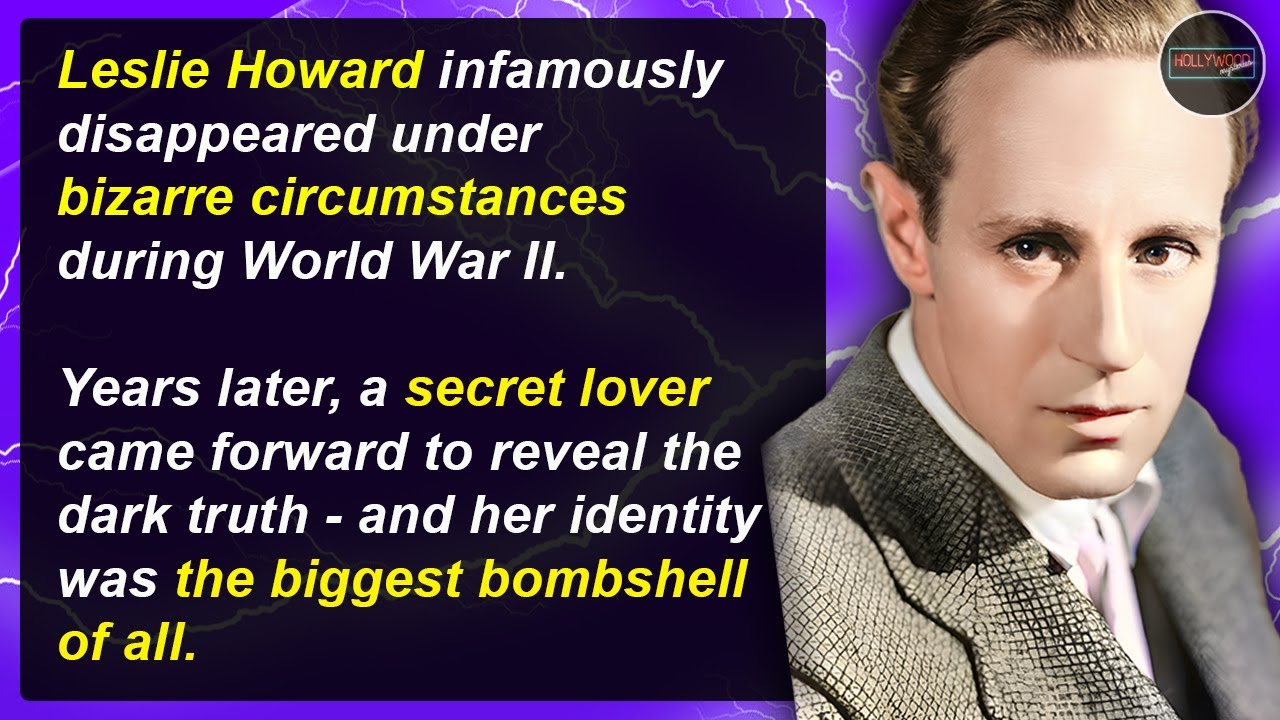
These final weeks would become the stuff of legend and conspiracy. Years later, Conchita Montenegro, an actress who had romanced Howard in Hollywood and was now married to a high-ranking Spanish diplomat, claimed on her deathbed in 2007 that Howard used her connections to arrange a secret meeting with Franco himself, imploring the dictator to keep Spain out of the war. She claimed Franco, a huge fan of Gone with the Wind, was swayed by Howard’s message. The story is unverified, but British officials were intensely interested in his trip, exchanging secret cables about it.
Howard also began a fling with a German baroness who ran the beauty salon at his Madrid hotel, and British intelligence sternly warned him she might be a Nazi spy. He did not heed the warning. By early June, the Allies were poised to invade Sicily, and Howard was eager to get home. He was originally booked on a flight for June 2, but switched to the June 1 flight at the last minute.
The plane was fully booked to accommodate him and Chenhalls, and two other passengers were bumped off. Some accounts say a priest about to board was suddenly called away, leaving exactly thirteen souls on the passenger list, an ominous coincidence. Theories about the attack abound. Churchill, who had been in North Africa and was expected to return via Lisbon around that date, wrote in his memoirs that he suspected the Germans may have believed he was aboard because of Chenhalls’s resemblance to him.
Another theory points to a passenger on a secret mission to buy tungsten for Britain, or to Wilfrid Israel, the Jewish activist who had overseen the Kindertransport and was a marked enemy of the Reich. And then there is the theory that Howard himself was the target. Howard’s son Ronald remained convinced that Goebbels ordered the hit to kill his father, the formidable propagandist and one of the most prominent figures of Jewish heritage in British film. But later historians who examined German and British archives concluded that the shootdown was likely an error in judgment, a chance encounter with German fighters ordered to harass any Allied-associated flights.
The exact reason has never been conclusively answered. In Britain, Howard’s death was felt as a national tragedy. The loss of this quintessentially English star at fifty was mourned deeply. Humphrey Bogart grieved his old friend for years and honored him by naming his daughter after him.
A plaque stands in his honor in London, and on a windswept cliff above the Atlantic in Galicia, Allied veterans erected a lonely stone monument where his plane went down. His daughter later wrote a memoir titled A Quite Remarkable Father, remembering a playful, tender man who loved poetry and cricket, who could be infuriatingly stubborn yet unfailingly generous. Leslie Howard lived in two worlds, the realm of light and make-believe and the realm of darkness and duty. The movies gave him fame, but his choices gave him honor.
That is his legacy.