In the spring of 1781, a band of American soldiers and militiamen faced a problem they could not solve. Before them stood a British fort perched atop an ancient Santee Indian burial mound rising roughly thirty feet above the flat South Carolina lowlands. The summit was ringed by stout wooden walls, and three rows of sharpened branches known as abatis jutted outward from the base. Every tree within musket range had been felled, leaving an open killing ground.
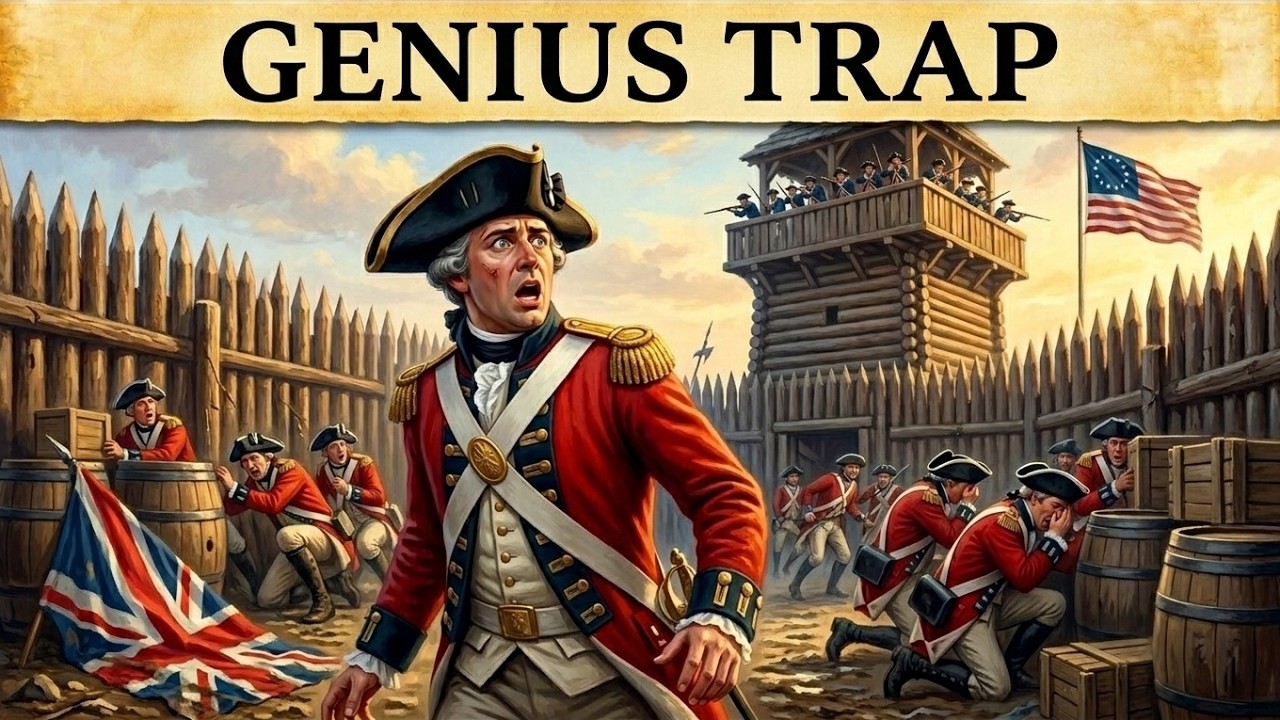
Inside the fort, a British garrison watched and waited, content simply to hold their ground until the Americans grew tired and left. The Americans had no cannons, no siege equipment, and supply lines in chaos. Some of their men were already deserting. Then on the night of April 22, they did something the British never expected.
They built a tower in a single night, and by sunrise the next morning the entire situation at Fort Watson had turned upside down. This is the story of how two of the American Revolution’s most resourceful commanders drew inspiration from ancient Roman warfare and used it to storm a British fort that was supposed to be unconquerable. South Carolina in early 1781 had been a disaster for the Patriot cause. The British captured Charleston in May 1780, taking more than five thousand Continental and militia troops prisoner in the worst American defeat of the entire war.
In August they crushed a second American army at Camden under General Horatio Gates, a rout so complete that Gates himself fled the battlefield and did not stop riding for some sixty miles. By the end of 1780, the British effectively controlled every major town and crossroads in South Carolina, holding a chain of fortified posts stretching from Charleston on the coast through Fort Watson, Fort Motte, and Fort Granby, and inland toward Camden and Ninety Six. On paper the colony belonged to King George, but holding the map and holding the ground were two different things. Major General Nathanael Greene took command of the exhausted southern army in December 1780.
Chosen personally by George Washington, Greene inherited a genuine catastrophe. His troops were starving, his supply lines barely existed, and his soldiers lacked shoes, coats, and ammunition. But Greene had something his predecessors lacked. He had a plan and the courage to execute it.
Greene divided his army, sending Daniel Morgan west while he moved east toward Cheraw. The gamble paid off. Morgan destroyed Banastre Tarleton’s forces at Cowpens in January 1781, one of the most complete American victories of the war. Then came the race to the Dan River, as Greene lured Cornwallis deeper into North Carolina stretching British supply lines until they snapped.
On March 15 the two armies collided at Guilford Courthouse. Cornwallis technically won, but his army was so battered that he limped to Wilmington just to survive. At this point Greene made the decision that would change the course of the war. Every conventional instinct called for chasing Cornwallis, who was wounded and retreating.
Greene instead saw something larger. Cornwallis had marched north, leaving the chain of British forts and supply posts across South Carolina exposed. These posts were not just dots on a map. They were the connective tissue keeping British control alive.
Supplies, ammunition, orders, and reinforcements flowed along the roads between Charleston and Camden, protected by fortified outposts at every major river crossing and ferry. Cut that chain, Greene reasoned, and the British garrisons inland would wither, since no army can hold territory it cannot supply. Greene turned his army south and headed straight for that chain. He dispatched Henry Lee’s Legion to link up with Francis Marion and gave them one mission: begin eliminating the forts.
Greene himself would march on Camden to keep the British field commander, Lord Rawdon, pinned in place and unable to reinforce the outposts. Fort Watson was the first link in that chain. Located along the Santee River near Lake Scott, roughly sixty miles northwest of Charleston, it had been ordered built by British Lieutenant Colonel John Watson Tadwell Watson in late 1780 or early 1781. The site was carefully chosen: an ancient Santee burial and ceremonial mound, an enormous earthwork the Santee people had probably raised sometime between 1200 and 1500 AD.
By the time of the Revolution the Santee had been driven out, many shipped to the West Indies as slaves during the Yamasee War decades earlier. The mound stood abandoned, rising above the flat terrain like a natural fortress. The British knew exactly what they had. They built a palisade of upright logs around the summit, then surrounded the slopes with three rows of abatis.
Any soldier attempting to climb the mound would have to break through successive ranks of sharpened stakes while being fired on from above with no cover at all. The British had made sure there was no cover, cutting down every standing tree within musket range and leaving only bare stumps across hundreds of yards of open ground. Lieutenant James McKay commanded the garrison with five officers, seventy-three provincial regulars, and thirty-six Loyalist militia, 114 men in all. They had provisions, ammunition, and access to fresh water from nearby Lake Scott.
Fort Watson was small, about twenty yards on each side, but it was built to hold. To take it, Greene needed men who could think differently. He had two of them. Francis Marion needs little introduction.
Born around 1732 in Berkeley County, South Carolina, he had first gone to sea at fifteen and nearly drowned. He fought against the Cherokee during the French and Indian War, learning guerrilla tactics that would define his military career. When Charleston fell in 1780, Marion was there, having broken his ankle weeks earlier leaping from a second-story window to escape a locked room where a host was forcing guests to drink. That broken ankle saved his life.
While more than five thousand Continentals marched into British captivity, Marion slipped into the swamps and began fighting. He gathered a ragged band of militiamen, farmers, and hunters who knew the lowland swamps like the backs of their hands. They struck British supply wagons, ambushed patrols, freed American prisoners, and vanished into the cypress groves before the redcoats could respond. The British sent their best cavalry officer, Lieutenant Colonel Banastre Tarleton, to hunt him down.
Tarleton chased him twenty-six miles through swamps over seven miserable hours before finally giving up, reportedly telling his men to forget Marion and hunt Thomas Sumter instead, because the devil himself could not catch that old fox. The nickname stuck. Marion became the Swamp Fox. The other commander at Fort Watson was Lieutenant Colonel Henry Lee III, known as Light-Horse Harry Lee.
Born to a Virginia planter family in 1756, he had originally intended to study law in England before the Revolution changed his plans. Commissioned a captain of cavalry in 1776, he quickly proved one of Washington’s boldest and most effective officers. His daring nighttime raid on the British fort at Paulus Hook, New Jersey in August 1779 earned him a gold medal from the Continental Congress, an honor received by only six others during the war. By 1780 Lee commanded his mixed force of cavalry and infantry known as Lee’s Legion.
At Greene’s personal request, Lee brought his Legion south to join the fighting in the Carolinas. In April 1781, with Greene’s instructions to join Marion and begin dismantling the forts, Lee had a single mission. The two men met at the Black River on April 14, 1781. Marion had roughly eighty militiamen with him, though reinforcements trickled in during the siege.
Lee brought his legion infantry, a company of Maryland Continentals under Captain Edward Oldham, and his cavalry under Captain John Rudolph. The combined force numbered about three hundred men. They marched to Fort Watson and arrived on April 15. Following customary practice, Marion and Lee sent a demand for surrender.
Lieutenant McKay refused outright. The siege began. Almost immediately the Americans ran into trouble. Their first plan was to cut off the garrison’s water supply.
The fort depended on fresh water from Lake Scott, and if the Americans could block access to the lake, the British would be forced to surrender within days. Marion’s men seized the watering point, cutting the path between fort and lake. But McKay had anticipated this. On April 18 his men dug a well inside the fort walls, tapping groundwater beneath the mound.
It was not excellent water, but it was enough to keep 114 men alive. The Americans’ best plan had just failed. With no artillery and the garrison self-sufficient for water, Marion and Lee were stuck. They could not storm the fort without climbing a thirty-foot mound through three rows of sharpened stakes under fire from above, which was suicide.
They could not starve McKay out because the well solved that problem. They could not bombard the fort, since they had no cannons. Greene had promised a cannon, but it never arrived. Time was running out.
Colonel Watson was in the field somewhere along the Santee with a force of about four hundred men. If he returned to relieve Fort Watson before the Americans captured it, Marion and Lee would find themselves trapped between the garrison ahead and a relief force behind. Meanwhile smallpox was spreading among Marion’s militiamen. Men were falling ill, and others simply left.
Militia service was voluntary, and these were farmers and hunters with families waiting at home. The longer the siege dragged on without results, the more men slipped back into the woods. For six agonizing days the two sides held their positions. Americans traded musket fire from beyond the open perimeter, and the British answered from behind their walls.
Neither side could inflict real damage. Marion’s men could not get close enough to threaten the fort, and McKay’s men could not come out without risking an ambush. It was a stalemate, and every passing day favored the British. Marion and Lee needed a breakthrough, and they needed it quickly.
Enter Hezekiah Maham. A South Carolina farmer born in St. Stephen’s Parish in 1739, Maham had served in the first Provincial Congress and had been fighting since 1776. He served at Savannah and Stono Ferry before joining Marion’s partisans after the fall of Charleston in 1780.
Known for a hot temper and stubbornness, he was a man quick to pick a quarrel. But the idea he brought to Marion and Lee outside Fort Watson was a stroke of genius. Maham proposed building a wooden tower, not a small lookout platform but a full siege tower made of green pine, tall enough to overlook the British fort’s walls, about thirty feet high. The structure would be a rectangular wooden cage, with notched logs stacked on top of each other like a giant set of building blocks, with a protected firing platform on top.
Snipers on that platform could look directly into the fort and shoot the defenders wherever they stood. The British would have nowhere to hide. The idea was not new in the history of warfare. The Romans had used siege towers thousands of years earlier, and medieval armies routinely built them.
But in America in 1781, no one built siege towers. This was a war of muskets, cannons, and trenches. Maham reached back centuries to the ancient world because it was the perfect solution to a stubborn problem. Marion approved the plan at once.
Parties were sent to search every nearby farm for axes, saws, and any cutting tools they could find. Then the work began. For days, work crews cut pine trees in the surrounding woods, hewing and shaping the logs out of sight of the British garrison. The men worked quickly, knowing every day carried the risk of Watson returning with relief forces.
The logs were cut, shaped, and stacked at a hidden assembly point out of British rifle range. The British inside Fort Watson could hear the sound of axes in the distance, but they did not understand what was being built. On the night of April 22, under cover of darkness, the Americans moved. Teams of soldiers carried the prepared logs from the woods and set them within effective firing range of the fort.
They worked in near silence, communicating in whispers and hand signals, while British sentries stared into the darkness and saw nothing. Log by log, timber by timber, the tower rose through the South Carolina night. Each notched beam was lifted into place and locked over the one below it, the rectangular structure climbing higher and higher. Green pine was heavy, still wet with sap, and the men strained under its weight.
But they kept working through the hours, rising to ten feet, then fifteen, then twenty. The firing platform was built at the top with wooden parapets on the side facing the fort to protect the marksmen who would soon stand there. The entire structure had to be sturdy enough to support several men and withstand enemy fire without collapsing. By the time the first gray light of dawn crept over the lowlands on April 23, 1781, the tower was complete.
Thirty feet of solid pine stood within musket range of Fort Watson, and the British garrison woke to a sight that must have stunned them. A company of selected marksmen, known in some accounts as McCotter’s sharpshooters, climbed into the fortified platform at the top. Below, a detachment of Maryland Continentals took position behind a pile of logs at the base for covering fire. The sharpshooters looked directly into Fort Watson.
Every British soldier inside the palisade was now visible and exposed. The firing began at dawn. A volley of precisely aimed rifle fire rained down from the tower into the fort. The British tried to return fire, but the sharpshooters in the tower had the advantage of height and the protection of the wooden platform.
Every time a defender appeared on the walls, he became a direct target. At the same time two assault groups rushed forward. One consisted of militia under Lieutenant Johnson; the other, infantry from Lee’s Legion. These were forlorn hopes, volunteer assault teams assigned the most dangerous task in any siege, the direct assault on the fortifications.
While the tower sharpshooters kept the British pinned down and unable to man the walls, the assault teams reached the abatis and began tearing through them. The sharpened stakes that had protected Fort Watson for months were ripped away. The British tried to resist, but they could not reach the walls without being fired on from above. Lieutenant McKay himself was wounded.
His men were crawling inside the fort looking for cover that did not exist. The British were trapped by the fort’s own engineering. The walls that had kept the Americans out now held the British inside, exposed to plunging fire from a position they could neither reach nor suppress. McKay realized his men could not defend the walls without standing, and standing meant death from above.
With the abatis being torn away and the assault teams pouring through the gaps, he had no options left. Continuing to fight meant watching his entire garrison killed one by one. Fort Watson surrendered that morning. The Americans captured five officers, seventy-three provincial regulars, and thirty-six Loyalist militia, the entire garrison, every man in it.
American losses for the entire siege were two killed and six wounded. The fort was dismantled and destroyed so the British could not use it again. Prisoners were sent across the Black River toward Greene’s supply depot. For a moment, consider what had just happened.
Two commanders with no artillery, dwindling supplies, and only six casualties had taken a fort that had repelled an American attack two months earlier when General Thomas Sumter tried to seize it in February and failed. Facing a problem considered impossible by conventional eighteenth-century military thinking, they solved it by building a medieval siege weapon overnight out of pine logs. The tower that Maham conceived and Marion approved did more than win Fort Watson. It created a template.
The same concept was used again at the siege of Augusta, Georgia, and again at Ninety Six, South Carolina later that same year. Military historians began calling these structures Maham Towers, and the name has endured for nearly 250 years. The fall of Fort Watson sent shockwaves through British positions in South Carolina. It was the first fortified British post in the colony retaken by Patriot forces since the British seized control in 1780.
The victory broke a vital link in the chain of communication and supply connecting Charleston to Camden. Without Fort Watson, the British could no longer move men, messages, and materials safely along the Santee River corridor. Marion and Lee moved within hours toward Richardson’s Plantation in the High Hills of Santee, already planning their next target. In the days that followed, Lee wrote to General Greene praising Marion, even requesting to serve under the Swamp Fox in some capacity.
Greene did not formally agree, but Lee and Marion continued fighting side by side in the weeks to come. They attacked Fort Motte on the Congaree River in May, using flaming arrows to set the fortified house alight and force the British to surrender again. They kept dismantling the supply chain position by position, fort by fort. The effect was cumulative and devastating.
Lord Rawdon, the British commander at Camden, managed to repel Greene’s direct assault at Hobkirk’s Hill on April 25, just two days after Fort Watson fell. On paper that was a British victory, but Rawdon knew what the loss of Fort Watson meant for his supply line. Without a safe passage to Charleston, Camden was a dead end. He evacuated the town in May, abandoning the inland linchpin of British control in South Carolina.
Fort Motte fell on May 12. Fort Granby surrendered on May 15. Augusta, Georgia fell in June. The British post at Ninety Six held out longer but was eventually evacuated as well.
One by one the chain linking the British interior to their coastal base at Charleston came apart. By the end of summer 1781, the British were confined to the area around Charleston, and the South Carolina interior had slipped entirely from their grasp. It all began because a quick-tempered South Carolina farmer named Hezekiah Maham looked at an old Indian mound topped by a British fort and thought about what the Romans would have done. The site of Fort Watson still exists today.
The Santee Indian mound stands within the Santee National Wildlife Refuge near Summerton, South Carolina. Nothing remains of the British palisade, the abatis, or the tower Maham built. The mound itself is the only survivor. Marion continued fighting until the British finally evacuated Charleston in December 1782.
He served in the South Carolina Senate after the war and helped draft the state constitution, dying in 1795 at his plantation Pond Bluff near Eutaw Springs. Lee became governor of Virginia and delivered the famous eulogy for George Washington, calling him first in war, first in peace, and first in the hearts of his countrymen. Maham received a promotion to lieutenant colonel in June 1781 and led his own regiment of light dragoons. Illness forced him to retire from service by the end of that year, and he died in 1789 at his plantation in Pineville, South Carolina.
The Maham Tower remained in use for the rest of the southern campaign, a weapon that cost nothing to build, required no specialized equipment, and could be assembled in a single night by men with axes and determination. The tower proved you did not need cannons to breach a fort. You needed height, and you needed riflemen.
And you needed someone willing to look at the problem from an angle no one else had considered.