In the final days of July 1944, in the hedgerow country south of Saint-Lô, a German battery commander lay on an earthen bank and watched an American tank approach down the road. He did not give the order to fire. Behind him sat four well-aimed guns with crews he trusted. He had destroyed Shermans before and knew exactly how it was done: let the first tank reach the bend where the road narrowed, strike its flank from two hundred yards, and the tanks behind would be trapped between hedgerows too thick to escape.
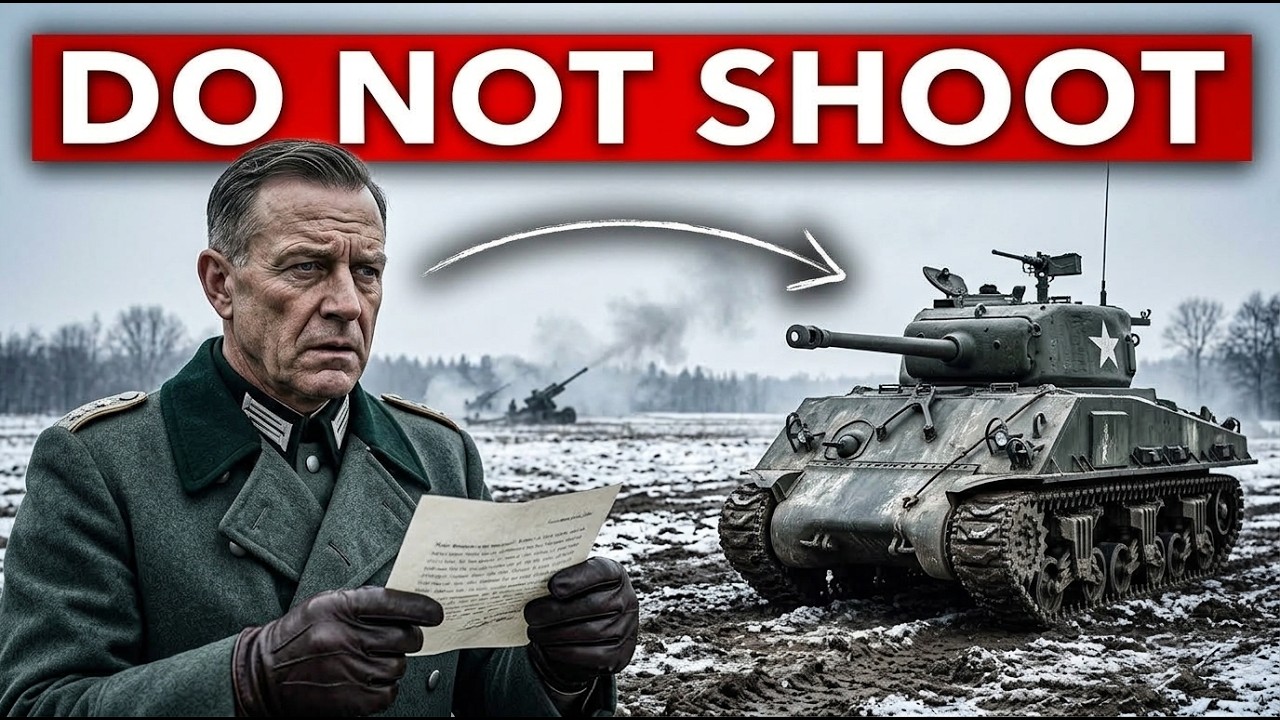
He was not afraid of a Sherman. He was afraid of this particular tank. It looked strange even from a distance. The barrel was too slender, it had no muzzle brake, and it did not move.
A tank commander scanning the ground worked his gun back and forth in search of targets. This tank stayed perfectly still, pointed straight ahead, like a gun that had forgotten its purpose. It also carried antennas, not one but three. He had been warned about this tank.
The instructions that reached him were not to destroy it. He was to hold his artillery fire, keep his crews from pulling the trigger, and let it pass. So he let it pass. He was a good officer obeying a good order, but that did not save him, his guns, or most of his men.
The reason he did not survive is the core of this entire story. By 1944 the German army had spent five years learning how to disappear. Bombed in the open in Poland and subjected to air attack in Russia, it drew the correct conclusion: anything a soldier could see, another soldier could kill. The German gunner became a specialist in non-appearance, better at it than anyone on the Allied side.
He dug pits for his guns and roofed them over. He cut hedges and tied branches to the barrel, replacing them before they wilted, because a withered branch made a straight line, and a straight line in the hedgerow meant a gun. He routed his approach tracks along existing farm lanes so wheel marks revealed nothing. He laid bags on the damp ground before the muzzle so the blast would not leave a pale scar in the grass that could be seen from the air.
He precomputed his ground coordinates so that when the moment came he could fire without ranging rounds, because ranging rounds were how a gun gave itself away. Above all, he held his fire. German fire discipline in Normandy was strict and deliberate. Artillery batteries were ordered to fire limited missions and then move: a few rounds and then gone.
Antitank crews were ordered to wait for the range that guaranteed a kill, not the range that merely allowed one. The entire doctrine rested on a bargain the German army made with itself: you have one moment of noise, so use it well. This was not cowardice. It was the professional judgment of the most highly trained gunners in Europe, and it had worked.
It had worked in France in 1940, in the desert, and in the bocage, where one well-hidden 88 or fortified PaK 40 could stop an American infantry company in a single field for a day and a half. That is why the order concerning the strange little tank made sense to every man who received it. If firing revealed your position, and this vehicle existed to force you to fire, the answer was obvious. Do not fire.
Let it pass. Now cross the hedgerow and stand where the Americans stood, because their problem was the exact mirror of the German solution. An American infantry company in Normandy did not usually stop because of a battle. It stopped because of a gun it could not locate.
Fire came from a hedgerow four hundred yards away. The ground showed no muzzle flash worth seeing in daylight, no smoke worth tracking, no target a soldier could shoot. Men fell, the company went to ground, the advance halted, and it stayed halted for hours. Everyone in every army had the same answer on paper: call for artillery.
The problem was what that phrase actually meant in most armies in 1944. A forward observer saw something. He passed it to his battery. The battery computed, fired one shell, waited, listened for the correction, adjusted, fired again, and walked the bombardment onto the target over several rounds and several minutes.
It was accurate in the end, but it was also a gradual announcement that fire was on its way. It was only one battery. Getting more than one battery onto the same target meant requesting permission from a higher commander, which meant explaining the target to a man who could not see it, which meant delay. And delay in that terrain meant the gun crew you had identified had simply withdrawn and gone.
The observer could normally get his own guns slowly and nothing else. The infantry had plenty of artillery behind it but no fast way to bring that power onto the hedge that mattered. The guns existed. The problem was the last four hundred yards of observation, and no number of shells solved that dilemma.
There had to be a way to put an expert eye at the front of the column and connect it directly to every gun in range. The answer was a tank made deliberately harmless. Take an M4 Sherman, thirty-three tons, five men, a 75mm gun, the standard American medium tank of the campaign. Now remove the gun.
The main weapon was taken out of the turret and replaced with a piece of tubing or shaped wood, painted and shaped to look like a real gun from a hundred yards. The space the gun left was filled immediately, because that was the point. Radios went in, more than one, because this vehicle had to speak to the infantry alongside it, the tanks around it, and the guns behind it, three different conversations on three different nets. Map boards, plotting equipment, field glasses, ranging circles, and code sheets followed.
The crew usually numbered four: a driver, a radio operator, a sergeant skilled at reading terrain, and a field artillery lieutenant whose job in that turret was not to fight anyone. His job was to observe. The Americans took the most-produced armored vehicle of the war, removed the thing that made it a weapon, and sent it to the front with the leading company anyway, into the exact places where tanks were shot at, carrying the same armor and unable to reply to any of it. It was, by a wide margin, the most destructive thing in the American arsenal.
To understand why, one must leave Normandy and return to a school on a windy plain in Oklahoma in the early 1930s. There, at the Field Artillery School at Fort Sill, a small group of officers spent the interwar years solving a problem every army faced and none had solved. Field artillery was mathematics, and those calculations were done at the guns. Each battery computed its own firing data for its own target, meaning that directing several batteries at one target was a slow and clumsy coordination.
The Americans moved the center of that calculation. They pulled the computing work off the gun line and put it in a single place, a fire direction center, with graphical firing tables, plotting boards, and trained men. The observer no longer told the battery how to shoot. He told the center what he saw and where he was, and the center computed for every gun under its control at once and sent each battery its own numbers.
Here is what that meant in practice. A division artillery battalion had twelve guns. A division had four such battalions, three light and one medium, for a total of forty-eight guns. Above the division level sat the corps artillery, independent battalions of medium and heavy guns that could be assigned wherever needed.
One lieutenant in a tank turret could call in twelve guns with a single radio transmission. If the target demanded it, he could call for thirty-six. If it demanded more, he could get a hundred guns or more. The Americans then did something ruthless: they calculated the time of flight from every battalion to the target and arranged the timing of the fire so every shell from every gun arrived in the same second.
No gradual fall of shells. No ranging rounds to warn anyone. The first thing soldiers on the ground knew about the mission was its complete arrival, all at once. The radios mattered too.
American armor and artillery used FM sets, which cut through electrical noise in a way AM could not, meaning a lieutenant in a moving tank could be heard clearly first time with the engine running. He said what he saw. He was heard accurately. The mathematics happened somewhere behind him.
Then the sky opened with fire. Now return the man to the turret, because the system was worthless without him. He rode in the third or fourth vehicle in the column, hatch open and head out, because terrain cannot be read through a vision block. On his knees was a map, and his entire professional value came down to how quickly he could look at a real hedgerow, a fold in the ground, or a church tower and translate it into coordinates accurate to a hundred yards or less.
Most of the time he was not looking for muzzle flashes; that was a target the Germans were trained never to give him. He read the ground itself. A hedge trimmed in a place no farmer would trim. Two wheel tracks leaving the road and leading nowhere.
A patch of brush a slightly different shade of green because it had been cut two days earlier. Diggings from an excavated position, thrown aside and covered, but not covered enough. A field with a gate wired shut while the grass in front of it was flattened. None of it made a sound.
None of it required the German to fire. All of it was visible to a trained man who had time to look, and the man in the turret had time, because his tank had nothing else to do. When he found the target, the call was brief. Battery or battalion, coordinates, description, shell type, then fire.
In a good unit with the target already registered for the day, the first shells arrived in two or three minutes. Two or three minutes from the moment a trained eye spotted a target until 150 pounds of steel descended from horizons the German could not see, fired from guns that had never been in his view and never revealed themselves. The German had not fired a single shot. Watch this work at scale twice.
In August 1944 at Mortain, the German army in the west launched its only real counterattack of the Normandy campaign. Four panzer divisions drove west to cut the American breakout at the neck. The fighting on Hill 317 above the town is remembered for the thirtieth infantry division holding there surrounded for days. What is less often told is what those men were doing.
Cut off on high ground overlooking roads the German columns had to use, they had observers with radios. Battalion after battalion of American artillery was directed down onto German armor and transport moving in the open below, invited by men who were themselves encircled and had no other option. A great deal of what broke the German attack was fire directed by surrounded men on a hilltop who had the observation. Then look to December 1944 on Elsenborn Ridge in the Ardennes, where the same lesson appears in larger letters.
The northern shoulder of the German offensive had to be broken there or the entire operation would have stalled from the first day. The American divisions on the ridge had behind them what the Germans had not adequately counted on: concentrated corps artillery, registered on the approaches, tied to a network of observers forward. The attacks came across open snow onto ground that had been surveyed and registered at leisure. The fire arrived without warning and without adjustment.
The guns behind that ridge fired tens of thousands of rounds during the defensive battle, and on the heaviest days the number exceeded ten thousand in a single day. German infantry and armor attacked again and again and were broken up before they closed, repeatedly, by fire from guns they never located. The German timetable died there in the first seventy-two hours. There is one more piece of evidence worth noting because it is the same story in the air.
American artillery also flew light observation aircraft, small unarmed planes, and gunners across the German theater learned to freeze beneath them and almost never shoot at them, for the same reason the man in the hedgerow held his fire. Two different vehicles, one on the ground and one above it, doing the same job and leaving the same silence beneath them. Return now to the German battery commander in the lane and watch the failure of the order that was supposed to protect him. He did what he was told.
He held his fire, and by doing so he denied the lieutenant in the turret the one thing an observer hunted. No flash, no smoke, no sound. As far as the sound of the battlefield was concerned, his four guns did not exist. The tank passed.
It never stopped and never turned. There was no reason to believe anything had happened at all. What happened was that a man trained at eye level spent ninety seconds looking at the field behind that hedgerow and noticed that the brush along a certain stretch stood out from the line by the width of a hand and that the grass at the entrance was ground down in a pattern no farm vehicle made. That was enough.
It was always enough. The observer did not need the German to fire, because he was not really listening. He was looking, and the German had sat motionless in front of him for three days doing the only thing a patient eye defeats entirely. Silence earned him nothing.
Silence meant simply that when the shells came, they came with no warning round, from four directions at once, onto a position that did not move because no one in it believed it had been spotted. That is the trap, and the German army walked into it with its eyes open, using its best doctrine executed with precision by professionals. Fire, and the counterfire comes. Do not fire, and the fire comes anyway moments later, by which time you have wasted the only chance you were ever going to get.
The judgment on this is not American boasting. It comes from the other side of the line in three forms. It comes from the prisoners. American interrogators recorded German soldiers in 1944 and 1945 describing artillery as the thing they feared most of all, ahead of fighter-bombers, ahead of tanks, ahead of anything the American infantry carried.
Some, trying to describe the scale of a time-on-target mission, insisted the Americans had self-loading guns, because no manually worked crew could do that in seconds. They were describing forty guns firing once; they thought they had heard one gun fire forty times. It comes from their own orders. German instructions on concealment and fire discipline in the west grew steadily stricter as the campaign progressed, for one reason: being spotted by the Americans had become a guaranteed path to death.
And it comes from their generals. German officers who later wrote about the western campaign returned again and again to the same conclusion. The Americans’ strongest weapon was their artillery, and what made it strong was not its weight but the speed and flexibility of the system directing it. The best gunners in Europe were beaten by computation, not by guns.
One honest note belongs in this story. No surviving German order names the American observation tank and forbids firing on it in those words. What exists is fire discipline instruction telling German crews to hold their fire and stay hidden, interrogation summaries in which German gunners explained that revealing a position invited immediate destruction, and the repeated behavior of German positions across every American sector refusing engagements they might have won. The order in this story is a reconstruction from those three things.
The logic behind it is documented; the specific piece of paper is not. The same applies to the commander in the hedgerow, who is a composite figure assembled from interrogation reports and unit histories rather than taken from a single file. The lane is real. The military doctrine is real.
The outcome happened in that country again and again. The individual is a symbolic stand-in. Nor was the vehicle magical, which matters more. It could not see through weather, and in the autumn of 1944 the weather in western Europe fought it for weeks at a time.
It could not solve the shell shortage, and that same autumn American artillery was heavily restricted, limited to a few rounds a day until ammunition improved. Observers found targets they were not permitted to fire at. In the Hürtgen Forest, on ground where no one could see anything beneath dense tree cover, the whole system went blind and American infantry paid a price too terrible to contemplate. The tank with the wooden gun was part of a machine that worked.
Where the machine broke down, it was simply thirty-three tons of steel with nothing in the turret. Set the two side by side, because that is the heart of it all. A German gunner, brilliantly trained, correctly hidden, doing exactly what five years of hard experience had taught him, holding his fire because firing meant death. And four Americans in a tank that could not fight, driving slowly past him with their heads out of the hatches, whose only job was to spend a quiet minute watching a hedge.
He had a gun and no way to use it without dying. They had no gun at all, but they held every gun in the corps. The men who did the work are not remembered as tank crews are remembered. There is no record on which to hang their names, because the true measure of the forward observer’s war is a figure no one kept.
Rifle infantry walked across ground that had been paved before they arrived, never knowing that anything had ever been there. Somewhere in Normandy there is a road with a bend and an earthen bank where four guns once stood, and on a hot July afternoon a German officer watched an American tank approach and gave the order his experience told him was right. He was not careless. He was not a bad commander.
He was beaten by a man with a map on his knees who had the time to watch him, and by a room full of people forty miles away doing arithmetic.