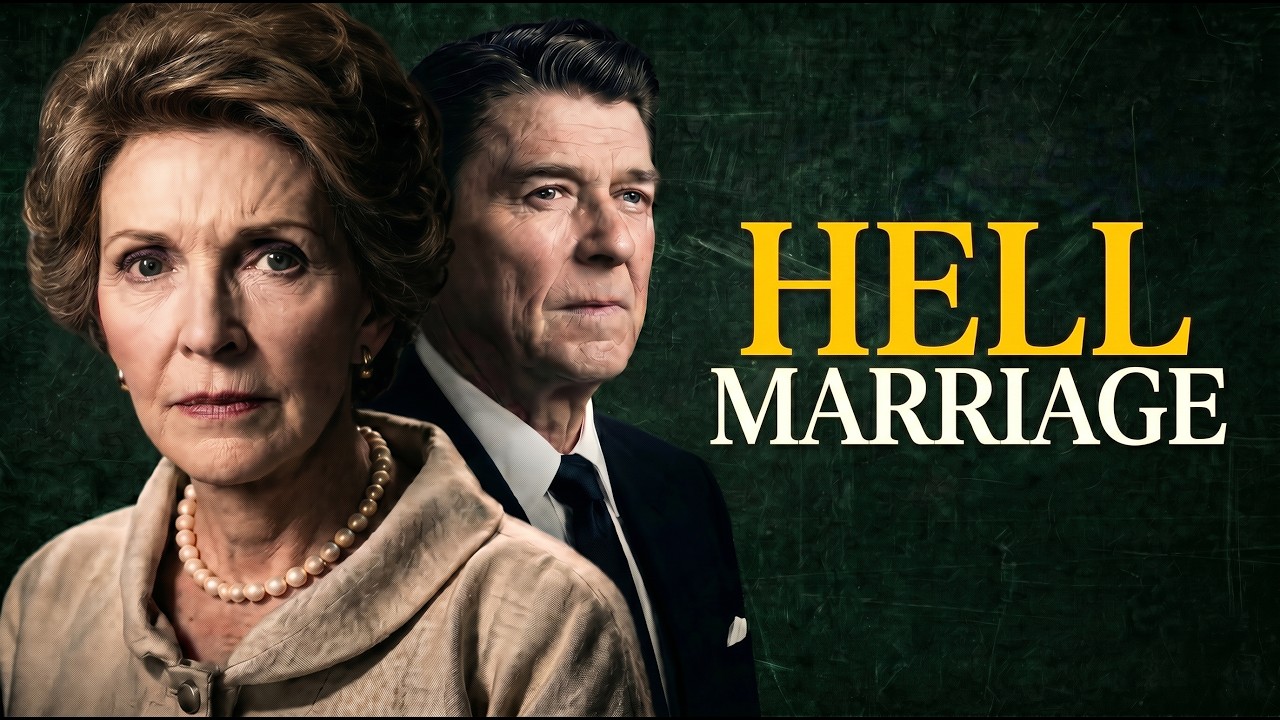
The image America held of Nancy Reagan was fixed by a single photograph: her eyes locked on her husband with an expression of total absorption, the famous gaze that came to define their marriage. Nancy herself once said her life did not truly begin until she married Ronnie. But the photograph did not show everything. Their wedding had no guests, only two witnesses, a small chapel, a bride who was already pregnant, and a groom who, according to their daughter, phoned his ex-wife first.
The marriage began with a blacklist. In the fall of 1949, a struggling MGM contract actress named Nancy Davis found her name on a published list of suspected communist sympathizers. It was a mix-up; another Nancy Davis worked in Hollywood. In the McCarthy years, such a mistake could end a career before it began.
So Nancy went looking for the one man who could fix it: the president of the Screen Actors Guild, Ronald Reagan. She asked director Mervyn LeRoy to arrange an introduction, and Reagan arrived on crutches, recovering from a shattered leg. Accounts of that first meeting disagree, and even her most thorough biographer found competing versions. But the essential point is consistent.
Nancy had seen Reagan on screen, decided she liked what she saw, and engineered the meeting. The blacklist problem could have been cleared with a single phone call. She wanted the dinner. That instinct did not come from nowhere.
Nancy was born Anne Francis Robbins in New York in 1921, the daughter of a touring stage actress and a car salesman who disappeared from her life almost immediately. When her mother returned to the road, Nancy spent roughly six years as the child left behind, watching her mother’s career come first. Then her mother married Loyal Davis, a prominent Chicago neurosurgeon, and everything changed. Nancy gained wealth, status, and stability, and she wanted it made permanent.
As a teenager, she asked to be formally adopted, took the Davis name, and effectively erased her father from her biography. It was her first act of image management. It would not be her last. Reagan, when she found him, was not the confident figure America later remembered.
He was newly divorced from Jane Wyman, who had left him while her career soared and his stalled. Biographers describe him in those years as wounded and adrift. The courtship dragged on for more than two years and was not exclusive; Reagan continued seeing other women well into his relationship with Nancy. Their daughter Patti was born on October 21, 1952, seven and a half months after the wedding.
Nancy was pregnant when Reagan finally committed. In a memoir published in 2024, Patti wrote that Nancy told Reagan about the pregnancy over dinner at Chasen’s, and that he left the table to phone Jane Wyman because he had promised his ex-wife he would not remarry before she did. The wedding took place on March 4, 1952, at the Little Brown Church in the San Fernando Valley. No press, no family celebration, no guests except two witnesses: the actor William Holden and his wife Ardis.
Nancy wore a gray wool suit. One of the most famous men in Hollywood married in near total secrecy, and the reason was not mysterious. A visibly pregnant bride in 1952 was a scandal. A quiet ceremony followed by a honeymoon that swung through Phoenix, where Nancy’s parents happened to be, kept everything contained.
The couple who would later stand before the world as the embodiment of traditional American marriage began that marriage by hiding it. What Nancy entered was not just a marriage. It was a rebuilding project. Reagan’s film career was collapsing, and by 1954 he hit bottom, reduced to emceeing a floor show at a Las Vegas hotel, a job he found humiliating.
The money and the offers were gone, and the two were bound together by shared failure. Then came General Electric, an eight-year contract hosting television and touring the country giving speeches to factory workers, and Reagan slowly transformed from fading actor into practiced political communicator. Through it all, he wrote Nancy letters, passionate, devoted letters, hundreds of them over the decades. The love was real.
That is what makes the story uncomfortable. It was a genuine attachment that got converted piece by piece into a political product. Nancy ran the conversion. When a circle of wealthy California businessmen decided in the mid-1960s that Reagan should be governor, Nancy became the filter everything passed through.
She vetted the friends, watched the advisers, tracked who was loyal and who was leaking. Reporters covering the 1966 campaign noticed something else. Whenever Reagan spoke, Nancy sat in view of the cameras, eyes fixed on her husband with an expression of total absorption. The press named it the gaze, and it became her signature.
While the cameras were pointed at the perfect couple, four children were living inside the image, and their accounts of it were brutal. Michael Reagan, adopted by Reagan and Jane Wyman, later described the day his father gave the commencement speech at his high school graduation. Afterward, Reagan shook hands with a line of graduates. When he reached his own son, he smiled and said, “My name is Ronald Reagan.
What’s yours? ” He did not recognize him. Patti wrote that she could not remember ever walking into her family’s home with a sense of security or belonging. The Miller Center’s historians put it plainly: Reagan loved his children but remained emotionally distant in a way they could never crack.
The very thing America celebrated, a couple so devoted they seemed to need no one else, was from inside the family the mechanism of exclusion. Nancy said it herself in her memoir, in what may be the most revealing sentence she ever published: “There’s a wall around him. He lets me come closer than anyone else, but there are times when even I feel that barrier. ” Biographers trace that wall back to Reagan’s childhood with an alcoholic father.
The architecture of the great American love story becomes clear: a man who could not be fully reached, and a woman whose deepest childhood terror was being left. She could never completely have him. He could never really leave her. For nearly thirty years, that bargain held quietly.
Then, on March 30, 1981, sixty-nine days into his presidency, a young man named John Hinckley fired six shots outside the Washington Hilton, and one bullet lodged an inch from Ronald Reagan’s heart. His courage that day was genuine, and it sealed the public’s affection permanently. But Nancy’s experience of that afternoon was different, and she wrote about it with unusual candor. The thing she had organized her existence around had almost been taken from her in a single second.
Within weeks, Nancy quietly retained a San Francisco astrologer named Joan Quigley. Nancy asked whether Quigley could have foreseen March 30th. Quigley said yes. From that moment for the next seven years, the first lady consulted her by phone, sometimes nearly daily, and used her charts to shape the schedule of the president of the United States.
The takeoff and landing times of Air Force One, the timing of press conferences and debates, the scheduling of Reagan’s 1985 cancer surgery, favorable days for summit meetings. Nancy concealed the arrangement even inside the White House, routing Quigley’s payments through a third party. Donald Regan, the chief of staff who had to build the actual calendar around a color-coded chart of good and bad days, later wrote that the most powerful man on Earth was, in his words, a virtual prisoner of the arrangement. When the Iran-Contra scandal broke in late 1986, Nancy did not stand by supportively.
She went to war. She decided Donald Regan was managing the crisis badly and treating her with contempt, and she methodically orchestrated his removal, pressing her husband for months. In February 1987, Regan was out. Then she pushed against the instincts of the political staff for her husband to apologize to the country.
Reagan delivered that speech on March 4, 1987, their thirty-fifth wedding anniversary. Regan got his revenge. In May 1988, his memoir detonated the astrology secret. Within days, reporters identified Quigley by name, and the White House was forced to confirm that astrology had been used for the president’s scheduling.
Nancy was humiliated on a global scale. Her answer was characteristic. She didn’t hide. She published.
My Turn came out in 1989, and in it she framed the astrology as an emotional crutch after the shooting, admitted the wall around her husband, and reasserted control of the narrative in her own voice. Then history handed her the final instrument of that control. In November 1994, Ronald Reagan told the country in a handwritten letter that he had Alzheimer’s disease and was beginning the journey that would lead him into the sunset of his life. For the next ten years, Nancy became the sole gatekeeper of one of the most famous men alive.
She called the vigil The Long Goodbye. The estranged children came home, largely on her terms. In 2000, Nancy published a selection of her husband’s love letters under the title I Love You, Ronnie. The most intimate surviving evidence of the marriage, curated by one of its two participants, released while the other could no longer remember writing it.
She chose which letters America read. Reagan’s June 2004 state funeral had been planned by Nancy for years, down to fine detail. The Reagan Library became the temple of the official story, and she governed access to it. She even broke publicly with her husband’s party to champion stem cell research.
When she died in March 2016, she was buried beside him under the legend she had spent sixty years constructing and protecting. Don Regan was dead, Quigley was dead, Wyman was dead. Nancy had outlasted every witness with a competing version. The devotion was real; the letters prove it.
But the photograph was never a candid. It was the public-facing wall of a sealed structure built by a girl who had been left behind once and made sure it could never happen again. Nancy Reagan did not have the marriage America saw.
She built the one America was allowed to see, and she was the last one standing when the record was sealed.