In 1924, a lawyer in Columbus, Georgia, delivered a blunt message to Claude Hatcher: stop using the word “cola. ” Coca-Cola owned it. Hatcher’s company had built its identity on that word for twelve years, and now the name had to go. He did not fight in court.
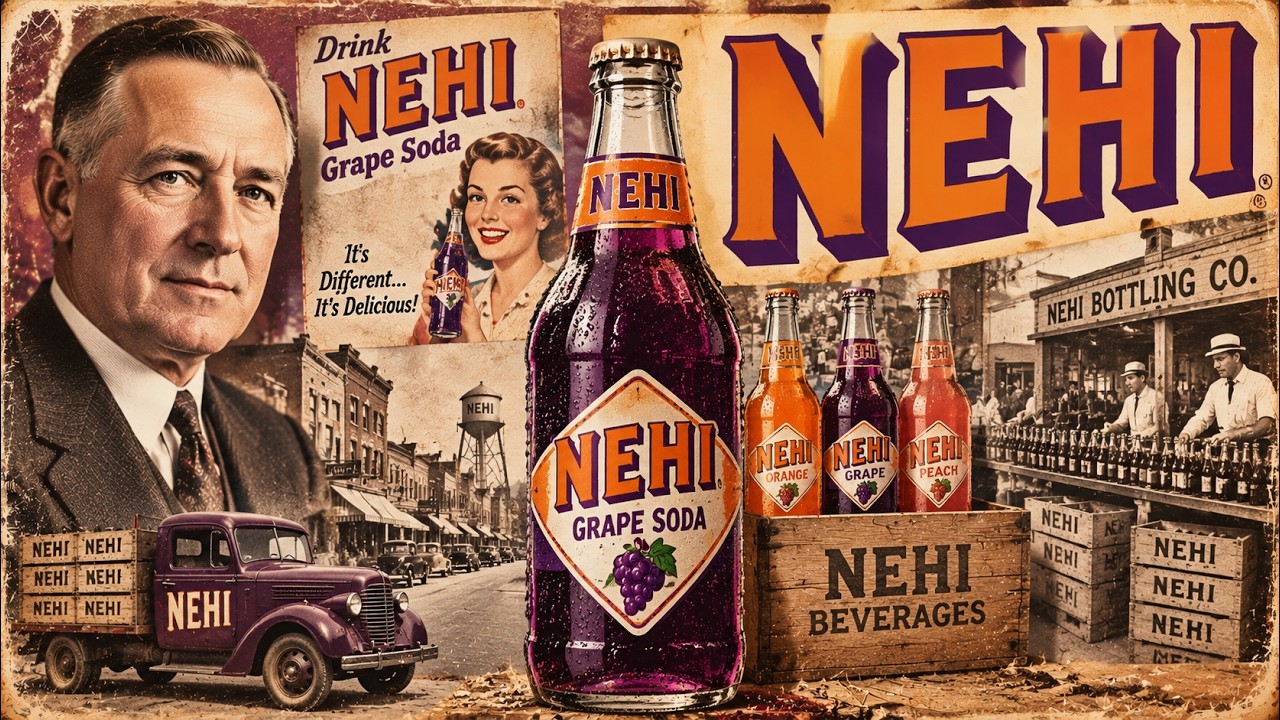
He changed the label. Four years later, the replacement drink was outselling the cola he had been forced to abandon by sixty times over. Annual production had climbed from ten thousand cases to six hundred thousand. The new bottles stood taller than anything else on the shelf.
The flavor was grape, orange, peach—not cola at all. And that turned out to be the winning move. But the true story of Nehi is not a trademark dispute settled by lawyers. It is the story of hundreds of small American towns that each gained their own bottling plant, and what happened when the soft drink industry decided those plants were no longer worth keeping.
The story begins in Columbus, Georgia, in 1905. The town sat on the Chattahoochee River along the Alabama border, built on cotton mills and wholesale trade. Claude Hatcher grew up inside that trading world. His father ran a wholesale grocery business, the kind that supplied smaller stores across the region with flour, canned goods, and everything in between.
The Hatchers were merchants, not manufacturers. Their business was distribution—moving goods reliably from one place to another. That instinct for supply chains would matter more than anything Hatcher ever put in a bottle. Hatcher trained as a pharmacist.
In that era, pharmacists compounded syrups and tonics by hand, often selling them from the same counter where they filled prescriptions. Mixing carbonated water with flavored syrup was a natural extension of the trade. In 1905, Hatcher began doing exactly that in the basement of his father’s grocery store, producing a ginger ale and a root beer. His father joined him, and together they organized Union Bottling Works inside the family grocery business.
By 1907, the operation had grown enough to move to a permanent location at the corner of 10th Avenue and 9th Street in Columbus. It was no longer a basement experiment. It was a business with an address. Hatcher was aiming at a specific gap in the market, and that gap had a name: Coca-Cola.
By the early 1900s, Coca-Cola dominated the American South, manufactured a few hours away in Atlanta and distributed through a bottling network that smaller southern towns had no real alternative to. If a grocer in a small Georgia town wanted to stock a cola, there was essentially one company to buy from. There was no regional competitor offering small bottlers their own franchise, their own territory, their own stake in a growing product line. Hatcher saw the opportunity the way a wholesale merchant sees one—not as inspiration, but as an opening in a supply chain.
In 1907, Union Bottling Works introduced a cherry-flavored cola. It caught on quickly enough that by 1912, the company reorganized under a new name built entirely around that drink: the Chero-Cola Company. Chero-Cola expanded through franchise bottling. Independent operators in towns across the South and Midwest paid for the right to bottle and sell the drink in their own territory, using Hatcher’s syrup and formula.
By 1920, roughly seven hundred franchise bottling plants carried the Chero-Cola name—seven hundred small businesses built on a formula mixed in a Columbus basement fifteen years earlier. Then Coca-Cola came for the name. By 1924, through legal pressure over trademark rights to the word cola, the company forced Hatcher to strip it from his brand. Hatcher did not fight the ruling in the press.
He fought it with a new product line: Nehi, not a cola at all, but a range of fruit-flavored sodas in grape, orange, and peach. In one sense, it was a retreat from the category Coca-Cola owned. In another, it was a move into a category no one had cornered yet. Fruit soda in 1924 was a scattered regional business.
No single company owned grape the way Coca-Cola owned cola. The formula relied on real fruit flavoring rather than the thinner, more medicinal syrups common in cheaper sodas of the era. The grape came through sweet and heavy on the tongue, closer to fruit than to candy. The orange carried a citrus peel sharpness that cut through the syrup.
It was not subtle. It was not meant to be. A drinker choosing among dozens of regional soda brands in a crowded drugstore cooler did not reward subtlety. Bold, identifiable flavor won shelf space.
The packaging did the rest. Hatcher put the new soda in a bottle roughly twelve inches tall, nearly double the six-inch bottle that had become the industry standard. Next to any competitor on a drugstore shelf, it simply looked bigger and more present. A customer scanning a cooler from across the room could pick it out without reading a single label.
The name came directly from the bottle: Nehi was a play on “knee-high,” a description of how tall the bottle stood next to a person’s leg. The pun became the entire marketing hook. Print ads paired the bottle with images of a woman’s leg bent at the knee, the soda positioned right at the height the name promised. Pricing details from Nehi’s earliest years are thin in the surviving record, but the category standard is well established.
A nickel a bottle was the standard price for soda across the South and Midwest through the 1920s—the same nickel Coca-Cola had trained a generation of drinkers to expect. Nehi entered the market at that same nickel, competing on size and flavor instead of price. A taller bottle for the same coin. Hatcher did not try to build a single national distribution operation reaching every cooler in America directly.
He extended the franchise bottling model that had carried Chero-Cola to seven hundred plants. Independent operators in towns across the South and Midwest each bought the concentrate, mixed and bottled Nehi locally, and sold into their own territory. The structure meant a bottling plant in a small Georgia town, a small Alabama town, a small Tennessee town could each be Nehi’s local face, hiring local drivers and supplying local drugstores and general stores. It was fast to scale because it did not require Hatcher to build the infrastructure himself.
Hundreds of small business owners were building it for him, one town at a time. By the late 1920s, Nehi had grown from a regional fix into a national name, and the advertising followed the money. Bing Crosby appeared in a full-page spread in Life magazine with a bottle of Nehi grape soda in frame. Joan Crawford carried the orange flavor into Ladies’ Home Journal, styled as though the photograph had been taken on the set of one of her films.
Bob Hope folded Nehi and Royal Crown into his USO radio broadcasts and live shows, working the brand into his self-deprecating jokes for rooms full of American servicemen. The sales figures backed up what the ads were buying. Nehi’s production climbed from roughly ten thousand cases a year in 1924 to more than six hundred thousand cases annually by 1928—a sixty-fold increase in four years, achieved almost entirely through the franchise network Hatcher had built for Chero-Cola and redirected toward the new line. The Great Depression hit Nehi the way it hit nearly every consumer business in America, not with a single collapse but with a slower erosion of margin.
Company revenue slid from roughly twelve million dollars to eleven million in 1930 alone. Then came a crisis that had nothing to do with consumer spending: raw sugar prices spiked from under five cents a pound to more than thirty cents a pound, threatening to make bottled soda unprofitable across the industry. Hatcher’s response was to buy sugar refining equipment in New Orleans and bring it back to Columbus, betting that owning the refining process would insulate the company from a crisis the rest of the industry could only absorb. He hired a chemist to manage the conversion.
It worked well enough to keep the company solvent through the worst of the decade. Hatcher did not live to see what came after. He died on December 31, 1933, at the age of fifty-seven, with sugar costs still reshaping the business he had spent nearly three decades building. Control passed to H.
R. Mott, who inherited a company carrying depression-era debt and a product line stretched thin across too many flavors. Mott cut what was not working, streamlined what remained, and made the company debt-free within a year. Then he reached back into the company’s own history.
The original Chero-Cola formula was reformulated in 1934 by a chemist named Rufus Kamm and relaunched under a new name: Royal Crown Cola. Royal Crown did what a good reformulation is supposed to do. It sold. Through the 1940s and into the 1950s, RC built its own identity inside the company, competing directly against Coca-Cola and Pepsi.
By the mid-1950s, that success had a name attached to it, and the name was not Nehi. In 1955, the company changed its corporate name to the Royal Crown Cola Company. The fruit sodas that had carried the business through the 1920s and 1930s were still on shelves, but they were no longer what the company called itself. What made Nehi’s position different was the structure underneath it: the exact franchise bottling network that had once been its greatest advantage.
Across the 1970s and 1980s, as national retail chains grew larger and demanded uniform pricing and centralized ordering, the scattered network of small-town bottlers could not match the terms of a single large regional distributor. Independent bottlers were bought out by larger operators, absorbed into bigger territories, or closed outright when the economics of a single town franchise stopped working. There was no dramatic attempt to save Nehi, because by then Nehi was not the thing anyone at the corporate level was trying to save. The company’s attention went to Royal Crown, the cola brand now carrying the corporate name.
Nehi rode along as a legacy line, still bottled and sold regionally, but no longer the subject of new campaigns or fresh investment. The ownership changes that followed read less like a company’s final years and more like a name changing hands between increasingly large entities. In 1993, Triarc Companies, once the Royal Crown Cola Company, itself once the Chero-Cola Company, was acquired by an investment firm. More ownership changes followed.
Cadbury Schweppes eventually acquired the portfolio, folding Nehi into a multinational company with no particular history in small-town American bottling. The final step arrived with a corporate split, not a bankruptcy. In 2008, Cadbury Schweppes spun off its American beverage division into a standalone company, Dr. Pepper Snapple Group.
Nehi went with it, becoming one line among dozens. Nehi did not disappear. The brand exists today under Keurig Dr. Pepper, formed from a later merger of Dr.
Pepper Snapple Group with the coffee company Keurig. Nehi grape, orange, and other flavors are still manufactured and sold through large-scale industrial bottling operations. There is no small-town franchisee mixing syrup according to a formula passed down through a single Georgia family. The name survived.
The structure that built it did not. What survived alongside the name is a smaller economy built by people who remember what came before the conglomerate owned it. Vintage bottle collectors trade original glass Nehi bottles, the tall twelve-inch design from the 1920s. Original porcelain and tin advertising signs circulate through collector networks.
In Columbus, Georgia, the site where Claude Hatcher first began formulating drinks in his father’s grocery store basement is marked today by a historical plaque erected in 2015. One detail tends to surprise people who know Nehi only as a name on a soda can. The brand’s most visible piece of pop culture immortality came not from an advertising campaign but from a single prop bottle placed on a table in the 1989 film Driving Miss Daisy, used as a small visual shorthand for the American South of a certain era. Audiences who had grown up with it in a drugstore cooler simply recognized it.
A piece of branding so deeply embedded in regional memory that it outlived the company that built it. Nehi was never destroyed by a single bad decision or a single competitor’s knockout blow. It was absorbed slowly, structurally, one bottling franchise at a time, by an industry that decided small-town infrastructure was no longer worth the inefficiency of keeping it. The name proved durable enough to survive that absorption.
The hundreds of small businesses that once carried it into hundreds of small towns did not.