On the evening of Tuesday, October 1961, twenty-six-year-old Dorothy Pierce boarded the number 14 bus at Harwich High Street. She paid a sixpence fare for a ticket to Langley Road, four stops away. Three people saw her board. A neighbor spoke with her at the stop.
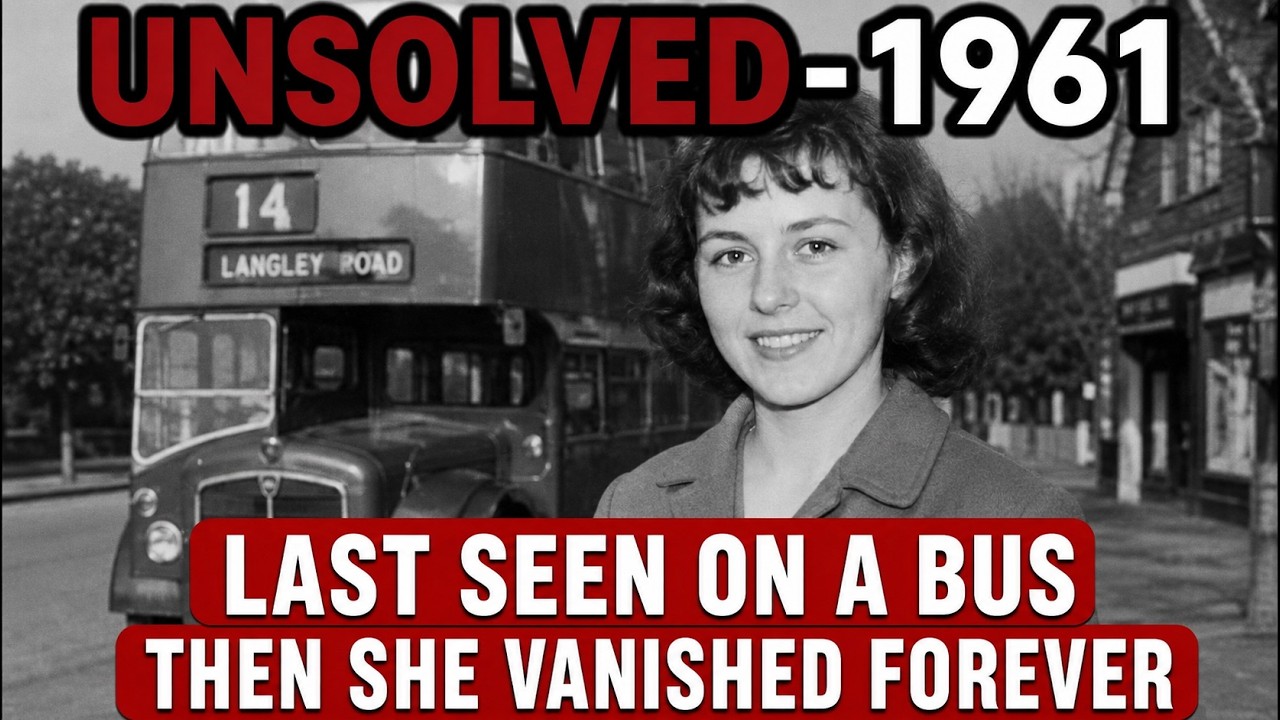
A young man watched her climb the stairs to the upper deck. The conductor issued her ticket. Dorothy never got off at Langley Road. When the bus reached its terminus at Eastwick Lane, she was on it no longer.
There was no stop between the High Street and Langley Road where she could have been seen leaving. The bus route had been lit, the town was busy, and Dorothy Pierce had simply vanished. Harwich was a mill town in 1961, past the height of its industrial life but not yet aware of how far its decline would go. The buses ran on time.
The working men’s club on Prior Street was full most evenings. Dorothy had grown up in this town, the second of four children, raised by a mother who worked as a seamstress and a father who drove lorries long distance and was home three nights a week. She had left school at fifteen and worked a series of jobs before landing, at twenty-two, in the payroll department of the Harwich Municipal Council, a job she held for four years and was good at. She was precise with numbers and meticulous about details.
She kept a small notebook in her handbag recording every shilling she spent and saved toward the deposit on a flat she planned to rent with her friend Patricia Ellison. The letting agent had the paperwork. Dorothy had told her mother she would be moving out by Christmas. She had a boyfriend, Frank Siddall, who worked in the accounts office of the same council building.
They had been courting for eight months and had plans for the following Saturday: supper at a proper restaurant on the High Street, the first for either of them. Frank had been nervous about it all week. On Tuesday evenings, Dorothy attended a dressmaking class at the Harwich Women’s Institute. She was not especially talented at it, by her own assessment, but she enjoyed the company.
That October evening, she stayed slightly after the hour to help the instructor fold fabric samples. Then she walked to the High Street to catch the bus home. At the stop, she spoke with a neighbor about the cold snap. She said she was looking forward to a cup of tea when she got home.
Then she boarded, paid her fare, and that was the last documented moment of her life. Frank Siddall raised the alarm. When Dorothy did not come to work on Wednesday, he assumed she was ill. When she was still absent on Thursday, he walked to her mother’s house after work.
Her mother, Agnes, answered in distress. She had assumed Dorothy was staying at Patricia Ellison’s flat. Patricia had assumed Dorothy had decided to spend a few nights at her mother’s. Neither had spoken to Dorothy since Monday.
By Thursday evening, Dorothy had been missing for two days and no one had known. Detective Constable Howard Marsh was assigned the case on Friday morning. He was careful and methodical, relatively new to plain clothes work. He understood that whatever had happened to Dorothy had happened on or near the number 14 route.
He interviewed every member of the dressmaking class. He walked the four-stop stretch of road three times, speaking to residents whose houses faced the bus route, shopkeepers whose premises backed onto side streets, anyone who might have seen a young woman in a green coat on a Tuesday evening. He found nothing that first week. What he found in the second week was more troubling.
Two residents on Sutton Avenue, a road that crossed the bus route at the second stop, reported having seen a dark van parked near the junction that Tuesday evening. One witness, a retired school caretaker named Albert Mossop, said he had seen the van pull away quickly after the bus departed. He had thought little of it at the time and came forward only after seeing a notice in the local paper asking for information. The van was traced to a hire company in Nottingham.
The records showed it had been rented for two days by a man who gave the name Raymond Doyle and an address in Arnold. The address did not exist. The name matched no one. The trail ended there.
By Christmas 1961, the investigation had no suspect, no motive, nobody. The case passed to Detective Sergeant Peter Nolan, a more experienced man, in early 1962. He pursued the van lead for six months. The hire company had processed over forty transactions in the same period and its record-keeping was inadequate.
The man who called himself Raymond Doyle had paid in cash. No one at the company could provide a reliable description. By the summer of 1962, that line of inquiry had produced nothing actionable. Dorothy’s body was never found.
Not in 1961, not in 1962, not ever. Agnes Pearce would go to her grave not knowing where her daughter was. Frank Siddall carried a guilt he had no rational reason to and was never heard from again. Patricia Ellison never rented the flat, and could not pass a letting agent’s office for the rest of her life without thinking of the paperwork that was never signed.
In 2002, the East Midlands Police Cold Case Unit selected the Pierce file for review as part of a national program. The van lead had never been formally exhausted, and new database technology meant that the fictitious name Raymond Doyle could now be cross-referenced against other unsolved cases from the same period. Detective Constable Sarah Beaumont-Young, a thorough officer with a background in intelligence analysis, pulled the file in March 2002 and spent three weeks reading every page. She ran the alias through the National Intelligence Database.
It produced three hits from unrelated investigations between 1959 and 1965, all in the East Midlands, all involving a false name on vehicle or premises hire, all connected to incidents in which women had reported being followed or approached by a man in a van. In two of those cases, witnesses had described the same man: heavy-set, mid-forties to early fifties, gray-brown hair, a regional East Midlands accent. That description matched what Albert Mossop had written in pencil on a lined notebook page about the man sitting in the parked van on Sutton Avenue: heavy, not young, sitting very still like he was waiting for something. Mossop had died in 1989.
His original statement was still in the file. It took another eight months of work across three police services to put a name to the man. His name was Walter Grimshaw. He had been born in 1914 in Derby, worked as a delivery driver for most of his life, and had died of a stroke in April 1981, twenty-one years before Beaumont pulled his name from a pattern of linked records.
He had lived quietly in Alvaston with a wife who had died in 1976. He had no criminal convictions. He had never been arrested. To everyone who knew him, he had been entirely unremarkable.
He had owned several vans over the years. The East Midlands cases that generated the alias pattern all fell within forty miles of his home. A search of archived records from the Nottingham hire company, whose paperwork had been transferred to microfilm in the mid-1980s, produced a hire record from October 1961 listing the customer’s occupation as delivery driver. A forensic document examiner compared the handwriting on the customer signature line with a sample of Grimshaw’s handwriting from his employment records and concluded it was a probable match.
Probable, not certain. There would be no trial. Grimshaw was twenty-one years dead. There was no forensic evidence, no confession, no body.
But in March 2003, the East Midlands Police issued a public statement concluding that Grimshaw was the prime and most likely suspect in the disappearance and probable death of Dorothy Pierce, and that the case, while formally remaining open, had been resolved to the fullest extent possible. Beaumont drove to the home of Dorothy’s younger sister, Jean, who had been fifteen when Dorothy disappeared and was now in her mid-fifties. She sat in Jean’s front room and went through every part of it. Jean said very little.
At the end, she thanked Beaumont quietly and asked one question: whether Dorothy would have been frightened. Beaumont said she did not know. Then she said that Dorothy had been precise, careful, and meticulous. She would have understood exactly what was happening.
And she would not have gone without a fight. Jean nodded. She said that sounded like Dorothy. Some evidence is physical.
Some is written down. Some exists only in a friend who drove past a letting agent’s office for forty years and could not stop thinking about the lease they were supposed to sign together. Dorothy Pierce was saving her shillings in a notebook toward a flat she planned to share with her best friend. She had a Saturday dinner planned with a man who was nervous about taking her to a proper restaurant.
She stayed late to fold fabric samples. She laughed before she spoke. Walter Grimshaw was never prosecuted. He died in bed of natural causes in 1981, while Dorothy’s mother was still alive and still waiting.
That imbalance has no comfortable resolution. The truth arrived in 2003, but the people who most needed it were gone or beyond reach. Jean Pearce had her answer. Dorothy’s name, precise and careful, is on record now.
In March 2003, in a small room in a police building in the East Midlands, Dorothy Pearce finally received her knowing.