On March 12, 1945, Friedrich Fromm stood before a firing squad at Brandenburg-Görden Prison. Once one of the most powerful men in the German military, the Generaloberst who had commanded the entire Replacement Army now faced execution by the very regime he had served. His final words echoed across the prison courtyard: “I die because it was ordered. I had always wanted only the best for Germany.
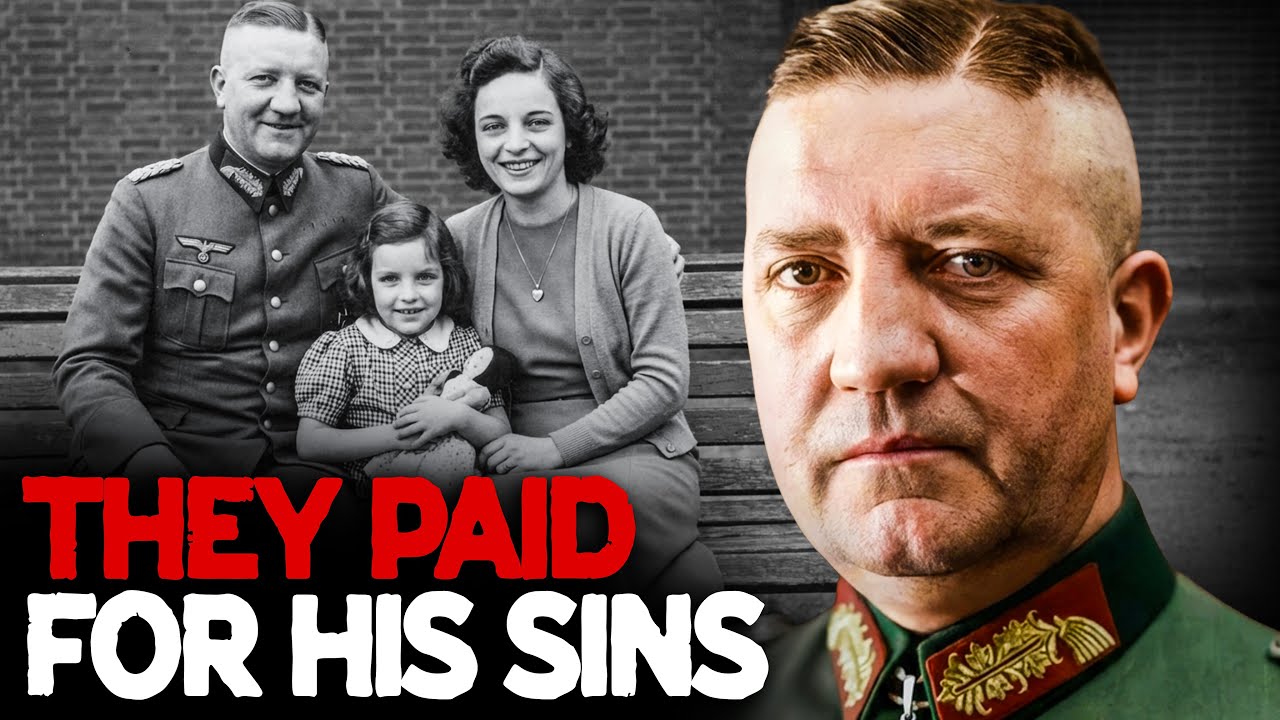
” The volley of shots ended his life. But for his family, this execution did not mark the end of their ordeal. It marked only the beginning. Friedrich Wilhelm Waldemar Fromm was born in Charlottenburg, Berlin, on October 8, 1888.
He came of age during the final years of the German Empire and served as an artillery officer in the First World War, emerging with a clear understanding of modern industrial warfare. During the interwar years, he climbed steadily through the ranks of the Reichswehr, the small professional army Germany was permitted under the Treaty of Versailles. By the 1930s, he had become one of the most capable administrators in the German military establishment, working under General Ludwig Beck, chief of the general staff. His expertise was not battlefield command, but the complex logistics of military organization: procurement, production, training, and personnel replacement.
In 1939, as Germany launched its assault on Poland and ignited the Second World War, Fromm was appointed chief of army equipment and commander of the Replacement Army, known in German as the Ersatzheer. This position placed him at the very center of Nazi Germany’s war machine. Hitler called Fromm his “strong man in the homeland war zone. ” The role gave Fromm extraordinary power.
He controlled army procurement and production, overseeing the vast industrial apparatus that supplied the Wehrmacht with weapons, ammunition, vehicles, and equipment. He commanded all army troops stationed inside Germany, from training battalions to garrison units to home defense forces. He oversaw the training and replacement of personnel for every combat division on every front, from the frozen approaches to Moscow to the deserts of North Africa. Every soldier who fell in combat created a vacancy that Fromm’s organization had to fill.
Every weapon that broke down required replacement from the production chains he supervised. But Fromm was not merely an administrator following orders without reflection. By the autumn of 1941, as Operation Barbarossa stalled outside Moscow and the Soviet counterattack began, Fromm understood what many in the Nazi leadership refused to accept: the war could not be won. In October 1941 and again in November 1942, he formally recommended to Hitler that Germany seek a negotiated peace with the Soviet Union.
His memoranda laid out the stark reality. German army stockpiles were exhausted. Production could not keep pace with losses. The strategic situation was deteriorating irreversibly.
Hitler dismissed Fromm’s advice with contempt. The Führer did not believe in negotiation from a position of weakness and could not admit the war was going badly. Fromm’s influence began to wane; Goebbels and Keitel worked to undermine him at court. Eventually, Hitler ordered that Fromm no longer be brought to military conferences.
Yet Fromm’s position remained central to the German war effort, and that centrality would soon draw him into the most dangerous conspiracy of the Second World War. The July 20, 1944, plot to assassinate Adolf Hitler emerged from within his own command. By 1944, the conspiracy had coalesced around a plan centered on Fromm’s headquarters. Colonel Claus Schenk Graf von Stauffenberg, one of the plot’s principal architects and the man who would plant the bomb, served as Fromm’s chief of staff.
General Friedrich Olbricht, another key conspirator who controlled the operational planning, reported directly to Fromm. The plotters used Fromm’s office at the Bendlerblock in Berlin, the headquarters of the Replacement Army, as their nerve center. They forged his signature to activate Operation Valkyrie, the emergency plan designed to maintain order in the event of internal unrest, which they had secretly modified to seize power after Hitler’s death. Fromm knew about the conspiracy; this much is beyond historical dispute.
His subordinates met in his building, used his authority, and planned under his nominal command. Historians have debated for decades the precise nature of his involvement. He tolerated the plotters. He refused to report them to the Gestapo, which would have been his duty as a military officer.
Some accounts drawn from the testimony of surviving conspirators suggest he tacitly agreed to participate if the plot succeeded and if he was offered a senior position in the new government. Other accounts portray him as sympathetic to the conspiracy’s goals but skeptical of its chances, unwilling to commit himself until success was assured. This fence-sitting, this careful hedging of bets, would prove fatal. An attempt to assassinate Hitler on July 15, 1944, failed because key Nazi leaders were absent from the meeting where Stauffenberg planned to detonate his bomb.
Fromm withdrew and refused any further involvement, telling the conspirators he would have no part in an attempt that might fail. Yet he still did not report them. He still allowed them to operate from his headquarters. On July 20, 1944, everything changed.
Stauffenberg flew to Hitler’s headquarters at the Wolf’s Lair in East Prussia, carrying a briefcase with two bombs. Due to time constraints and the challenge of arming the devices with his war-injured hands, Stauffenberg managed to arm only one bomb. He placed the briefcase under the heavy oak map table where Hitler and his staff had gathered for a military conference, then excused himself and left the building. At 12:42, the bomb exploded.
The blast killed four people and wounded many others. But Hitler survived, protected by the heavy table and by the position of the briefcase, which had been moved by a colonel who found it in his way. The Führer emerged with minor injuries. Stauffenberg, watching from a distance, believed Hitler was dead and flew back to Berlin to activate Operation Valkyrie.
But hours of delay and the failure to cut communications from the Wolf’s Lair allowed news of Hitler’s survival to reach Berlin. When Fromm learned Hitler had survived, he tried to arrest the conspirators. His sudden shift from tolerance to opposition came too late to be convincing. The conspirators overpowered him and locked him in a cell in his own headquarters at the Bendlerblock.
For hours Fromm sat imprisoned while the coup unfolded and then collapsed around him. The coup failed when loyalist troops freed Fromm from his cell. He moved with desperate speed. Despite direct orders from Hitler to take the conspirators alive, Fromm convened a summary court-martial.
He condemned Stauffenberg, Olbricht, Colonel Albrecht Mertz von Quirnheim, and Lieutenant Werner von Haeften to death. He allowed Colonel General Ludwig Beck to attempt suicide, and when Beck’s wound failed to kill him, Fromm ordered him shot. Shortly before midnight, the four condemned officers were executed by firing squad in the courtyard of the Bendlerblock. When Joseph Goebbels arrived at the scene, he remarked coldly that they had been in a damn hurry to get their witnesses below ground.
On July 22, 1944, Fromm himself was arrested by Heinrich Himmler and stripped of his military rank. For months he languished in prison while the Gestapo investigated. The People’s Court could not prove that Fromm had actively participated in the conspiracy. Instead, on March 7, 1945, he was convicted of cowardice before the enemy for failing to suppress the conspiracy more forcefully.
The sentence was death. Hitler personally commuted the method of execution from hanging with piano wire to death by firing squad. Five days later, on March 12, 1945, Friedrich Fromm was executed. The Third Reich had less than two months left to survive.
Fromm’s daughter, Helga Hanka, was thirty-one years old when her father was executed. Born on June 1, 1913, she had watched her father rise through the ranks. She pursued higher education at a time when few women did so, studying geography, history, and world economics at the universities of Rostock and Berlin. She later worked as a secretary at IG Farben in Berlin, the massive chemical conglomerate that would become notorious for its involvement in Nazi war crimes.
She married Hans-Günther Hanka, and together they built a life that included an estate in West Prussia, not far from the medieval city of Marienburg. By early 1945, that life was disintegrating as the Red Army advanced westward. German civilians in the eastern territories faced a desperate choice: flee westward and risk the chaos of the collapsing front, or remain and face the advancing Soviets. For Helga, the choice was made more urgent by her father’s arrest and execution.
The Fromm name now carried the taint of treason in the eyes of the Nazi regime. The Gestapo had already demonstrated its willingness to apply Sippenhaft, the doctrine of collective family punishment, to the relatives of the July 20 conspirators. Helga could not know whether her father’s case would trigger similar reprisals against her family. In the final weeks of the war, she gathered her children and fled westward, leaving behind the estate in West Prussia.
The roads were clogged with refugees. Allied bombers struck rail lines and bridges. Temperatures plummeted, food was scarce, and disease spread through the refugee columns. May 1945 brought the German surrender, but not peace.
Germany was divided into four occupation zones, and Brandenburg fell within the Soviet zone. For the next three years, Helga and her children lived under Soviet military authority. Conditions were harsh; the zone was being systematically stripped of industrial equipment and resources as reparations. The economy collapsed, and food was rationed.
Former members of the Nazi party and their families faced particular scrutiny. Her father had been a Generaloberst, one of the highest ranks in the German military. His execution by the Nazi regime did not necessarily absolve the family of association with the war effort in the eyes of Soviet authorities. In 1948, Helga made a fateful decision.
She took her family and crossed into the British occupation zone, settling in Lüneburg in Lower Saxony. They reunited with her husband, who had made his way west separately. In the west, they became officially recognized as expellees, Heimatvertriebene, Germans who had been driven from their homes in the former eastern territories. Millions of such refugees had flooded into the western zones.
Many lived in camps for years, and they faced discrimination from local populations who resented the competition for scarce resources. The experience of expulsion shaped Helga’s postwar identity in ways that would define her political career. In the early 1950s, she became involved with the Bund der Heimatvertriebenen und Entrechteten, the League of Expellees and Disenfranchised, known as the BHE. This party, founded in Schleswig-Holstein in January 1950, represented the interests of expellees and other Germans who felt disenfranchised by the postwar settlement.
At the federal election of 1953, the BHE won 5. 9 percent of the vote and entered the Bundestag, becoming a coalition partner in Chancellor Konrad Adenauer’s government. Many of its leaders had been members of the Nazi party; of the party’s 27 deputies elected in 1953, ten admitted to Nazi party membership, three to SS membership, and two to SA membership. Helga Hanka rose through the ranks of expellee politics, serving in the Lower Saxony state parliament, the Landtag, from May 6, 1955, to June 20, 1970, spanning five consecutive electoral terms.
As the BHE declined in the late 1950s and early 1960s, its members faced a choice. The party had failed to clear the 5 percent threshold in the 1957 federal election, losing all its seats. The economic miracle was reducing the urgency of expellee grievances. In December 1961, Helga Hanka joined the Free Democratic Party, the FDP, aligning herself with West Germany’s liberal tradition.
From July 1968 to June 1969, she served as deputy chairman of the FDP parliamentary group in the Lower Saxony Landtag. Her political career reflected the broader transformation of West German society. The expellee question, so urgent in the 1950s, gradually faded as a political force. The generation born after 1945 had little memory of the lost eastern territories and little interest in pursuing claims to lands that had become part of Poland, the Soviet Union, or Czechoslovakia.
The broader historiography of Friedrich Fromm has undergone significant evolution since 1945. For decades, Fromm was remembered primarily for his actions on the night of July 20, 1944, particularly his hasty execution of the conspirators. He was dismissed as an opportunist, a fence-sitter who tried to eliminate witnesses to his own complicity when the plot failed. In 2005, military historian Bernhard R.
Kroener of the University of Potsdam published a monumental biography that challenged this simplistic narrative. The book drew on more than a decade of research and revealed a more complex figure. Fromm had been a talented organizer, key to the rebuilding of the German military in the 1930s. He had advocated for ending the war as early as 1941.
His relationship with the conspirators was complicated by genuine sympathy for their goals combined with profound skepticism about their chances of success. Kroener argued that Fromm was neither a coward nor an opportunist in any simple sense, but a man trapped by circumstances and his own indecision. Helga Hanka died on January 25, 2004, at the age of ninety. She had outlived the Third Reich by nearly six decades.
She had seen Germany divided and reunified, witnessed the Berlin Wall rise in 1961 and fall in 1989, and participated in the rebuilding of German democracy as an elected representative for fifteen years. Friedrich Fromm’s execution marked the end of his life, but not the end of his story. His family carried forward. His daughter built a career in democratic politics, representing the interests of expellees in a parliament that would have been unimaginable under the regime her father served.
The Fromm family’s experience mirrors that of countless German families who had to reckon with legacies shaped by choices made under extraordinary circumstances. Some embraced denial. Some sought confrontation with the past.
Most simply moved forward, building new lives in a changed world while carrying the weight of history in private.