On the morning of April 2, 1855, a column of horsemen moved along a dusty trail north of Brownsville, Texas. The sun was just rising over the mesquite, and the riders were driving a herd of horses westward toward California. The man leading the group was Nelson Lee, forty-seven years old, a former Texas Ranger and cattleman who had spent decades on the frontier. Within minutes, nearly every man in the party would be dead.
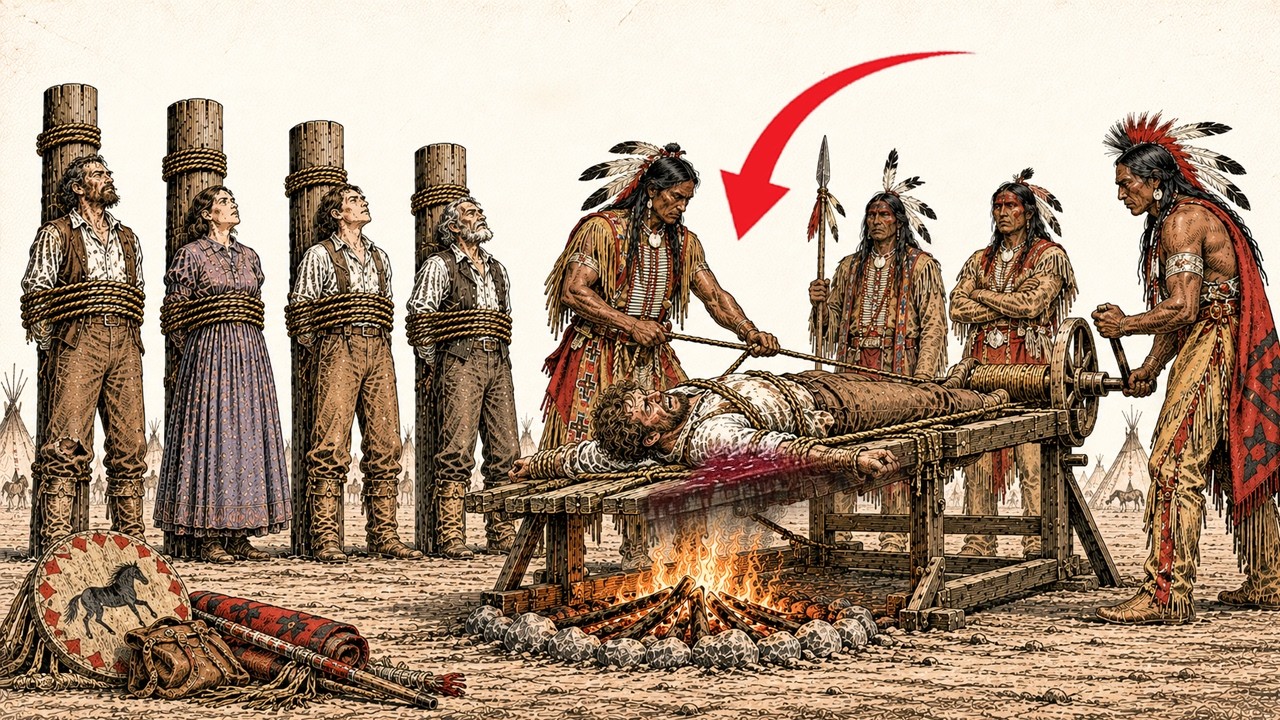
Only four would survive the first hour. Lee was one of them. The reason he was not killed on the spot had nothing to do with courage or luck. It was something in his pocket worth less than a dollar, a small mechanical device that would fascinate the warriors who captured him and keep him alive through three years of captivity among the Comanche.
But the stranger part of the story begins later, with the book Lee published four years afterward, a bestseller that shaped how a generation of Americans imagined the Comanche. The book carried a warning in its opening pages, written by the editors themselves, stating that what the reader was about to encounter may not, in a literal sense, have happened at all. In 1855, Texas was still gripped by the aftermath of the California gold rush. Horses were worth several times more in California than in Texas, and the promise of a fortune at the end of the trail drew men into country the United States Army did not control.
The route from Brownsville passed through the edges of Comancheria, the vast Comanche domain stretching from the Arkansas River to northern Mexico. To cross that land was to enter it by permission of the Comanche, who controlled movement through their territory with absolute authority. Lee understood the risks. He was not a young man chasing adventure.
He had watched others make the same mistake. Still, he took the trail. The Comanche warriors who attacked the horse herd the following morning were among the last full generation of Comanche fighting power. Their world was collapsing around them.
Anglo-American settlers, Mexican ranchers, disease, and the disappearance of the buffalo were pressing in from every direction. The attack on a group of white men driving horses through their land was not a crime in their eyes. It was defense, economy, survival. Some of the warriors were probably teenagers.
Some had families waiting in camps a hundred miles north. On the morning of April 2, they were watching the trail. The survivors’ accounts indicate a small party of men driving the herd, insufficiently protected for the country they were crossing. The horses raised dust for a mile behind them, a moving beacon visible to anyone who wanted to know they were coming.
South Texas in April was not a barren desert but a mix of thorn scrub, mesquite, and open flats. A man on horseback could disappear completely at two hundred yards. Ambushes here required no canyon. Only patience.
And the Comanche of 1855 were the finest light cavalry on the North American continent. A small group of white men driving horses across open ground against a Comanche raiding party was not a fair fight. It was arithmetic. The attack came without warning.
Gunfire erupted from the brush, the horses panicked and scattered, the men who fell in the first seconds never rose. Those who tried to fight were killed, and those who tried to flee were run down and killed. It was fast, brutal, and entirely one-sided. By the end of the first minutes, most of the group lay dead in the dirt.
Four remained alive. Nelson Lee was one of them. Everything known about what happened in the following minutes comes from a single source: the book published four years later. In its opening pages, the editors stated that the narrative had been recorded day by day as it fell from Lee’s lips, “not accurately in his own words, as he is not an educated though intelligent man, but his story is told substantially as he related it.
” That qualification, “substantially,” matters more than anything else in the entire record. As the survivors were taken by the raiders and forced northward, Lee, a forty-seven-year-old man pushed across open country at the pace of mounted warriors, was given little food and less rest. He was watched constantly because the pocket watch, the object that had saved his life, was now the thing tying him to whichever man currently owned him. The watch, a trinket worth less than a dollar in New York, had fascinated his captors.
They had stopped and spared him because he possessed something that made a strange sound. It made him worth keeping. Not quite a prisoner in the usual sense, and not a slave as that word is commonly used. Property, valued oddly, because of his connection to a piece of brass and glass with a spring inside.
Lee was sold, or traded, or given, the accounts differ, to a warrior whose name appears in the narrative as Big Wolf. His role in the camp was humble and exhausting. The watch was a ritual object, brought out for display, wound before visitors, its ticking exhibited to men who came from other camps specifically to hear it. Lee became the keeper of the watch.
His identity faded in the eyes of those around him until he was merely the sound the object made. He wound it every day with weakening hands, knowing that if the machine stopped, he stopped with it. Later he passed to another owner, a warrior called Spotted Panther. The narrative does not make clear how long each ownership lasted.
What matters is the pattern. Nelson Lee was no longer a man. He was something attached to something else, and both could change owners. For three years, nine hundred and ninety-five days at minimum, Lee endured.
The seasons turned. The camps moved, and he moved with them. He learned fragments of the language, enough to understand sometimes what was being said about him, never enough to argue. He watched other captives arrive and disappear, killed, ransomed, adopted, or taken away in ways he never learned.
There is a particular kind of endurance captivity demands, different from battle. A battle lasts minutes. Captivity lasts years. It is not about the ability to fight.
It is about the ability not to lose yourself when everything around you tells you daily that you no longer exist. The men who held him had wives, children, relatives, feuds, hunts, deaths, weddings, and wars that had nothing to do with the old white man in the corner of the lodge. Reducing the Comanche side of this story to their role as Nelson Lee’s captors would repeat the error of the 1859 book, reducing an entire people to their relationship with one white man’s ordeal. In his second or third year, Lee came to belong to a warrior the narrative calls Rolling Thunder.
He was now around fifty years old, thin, broken by malnutrition and exposure. Lying awake one night in Rolling Thunder’s camp, listening to the sounds around him and the fading fires, he made a decision. The question was not whether to escape, but whether escape was a word that still applied to him. He was in the middle of a continent, without a horse, without water, without a map that would do him any good, with no idea whether the nearest white settlement was a hundred miles away or four hundred.
If he left the camp, he would almost certainly die alone in country that would not even give up his bones. If he stayed, he would die inside a man’s lodge. He chose the desert. He chose the almost certain death he could walk toward on his own over the certain death that waited if he remained.
It was not a battle scene, not a heroic charge. It was a man in the dark deciding to stand up. The escape went at night, alone, taking almost nothing. The narrative later dramatized the moment, and later summaries emphasized what they called his singular escape.
A man in his condition, in that country, in that season, set out toward the horizon. The attempt should not have succeeded, and yet somehow it did. He crossed days without water, pushing a body that had no reason to keep moving except that it refused to stop. He finally reached the settled edges of the American Southwest, arriving in El Paso in the fall of 1858.
A summary by the Texas State Historical Association describes his condition in two words: severe suffering and starvation. His shoes had fallen apart. His feet were cracked, bleeding, wrapped in whatever cloth he could tear from his clothes. He had to eat carefully, because a starving man cannot eat freely without killing himself.
He rested. He began telling his story in fragments to those around him. Word spread. A man had come out of Comancheria.
A man who had survived three years. He sailed from the Gulf and reached New York City on November 10, 1858. Within days, he was sitting with editors at the publishing firm of Baker and Taylor, telling them everything from the beginning. He was fifty-one years old, only weeks out of Comanche country.
Day after day, according to the editors’ later account, he spoke, not in a single session but across many, while someone else wrote down what he said. In each session, another person decided what to keep and what to discard. The man being interviewed was a trauma survivor whose memory carried the weight of three years of captivity and whose body had only recently recovered enough for him to speak fluently. And the watch, the object that had saved his life, that had made him worth keeping, that had become the centerpiece of his captivity, was now the centerpiece of the book being written about him.
Three Years Among the Comanche was published in 1859, one year after Lee reached New York. It sold well. It fed a market of American readers desperate to know what the Comanche world looked like from the inside, readers who were not particularly interested in the accuracy of what they read. The book gave them Big Wolf, Spotted Panther, Rolling Thunder.
It gave them torture, captivity, and a miraculous escape, everything they had come to expect from the genre. And in its opening pages, in a note most readers ignored, the editors had revealed the truth about what they had made. Nelson Lee could not write. The man whose name adorned one of the most famous Comanche captivity narratives in American history was not literate.
Every word of that book passed through another hand before it reached the page. The editors’ note said the narrative had been recorded as it fell from his lips, day by day, “not accurately in his own words,” but “substantially as he related it. ” That is not a book written by a man. It is a book about a man, written by other men, shaped to fit what the market wanted.
The publishers of 1859 were not hiding this. They put it in the front pages. But no one read the front pages. They read about the torture.
They read about the escape. That is why, for more than a century and a half, scholars have debated how much of the book represents Nelson Lee’s real experience, how much is editorial drama, and how much, if any, was fabricated outright. Some readings treat the book as a largely honest account that was heavily revised. Others treat it as something closer to a hoax dressed in memoir clothing.
The honest answer is that the records cannot settle the question definitively. The only man who could, has been dead for over a hundred and forty years. Nelson Lee’s story is not one story. It is two.
There is what happened on the plains, which can only partially be seen. And there is what happened in that office in New York, which is why it can only partially be seen. The uncomfortable truth of Nelson Lee’s captivity is that the record we have of him was never fully his to tell. He spoke it.
Other men wrote it. The public bought it. And what we call his history is what survived that process.