Just past noon on July 1, 1863, a young captain in a gray coat stood at the edge of a wheat field outside Gettysburg, Pennsylvania. William Henry Murray was a farmer’s son from the foothills of North Carolina, barely into his mid-twenties, and every one of the 91 men behind him was a neighbor, a cousin, a boy he had grown up with in the shadow of Hibriten Mountain. In a matter of minutes, he would lead them across an open field, through a creek, and into the fire of one of the best infantry units in the Union Army. Then he would disappear.
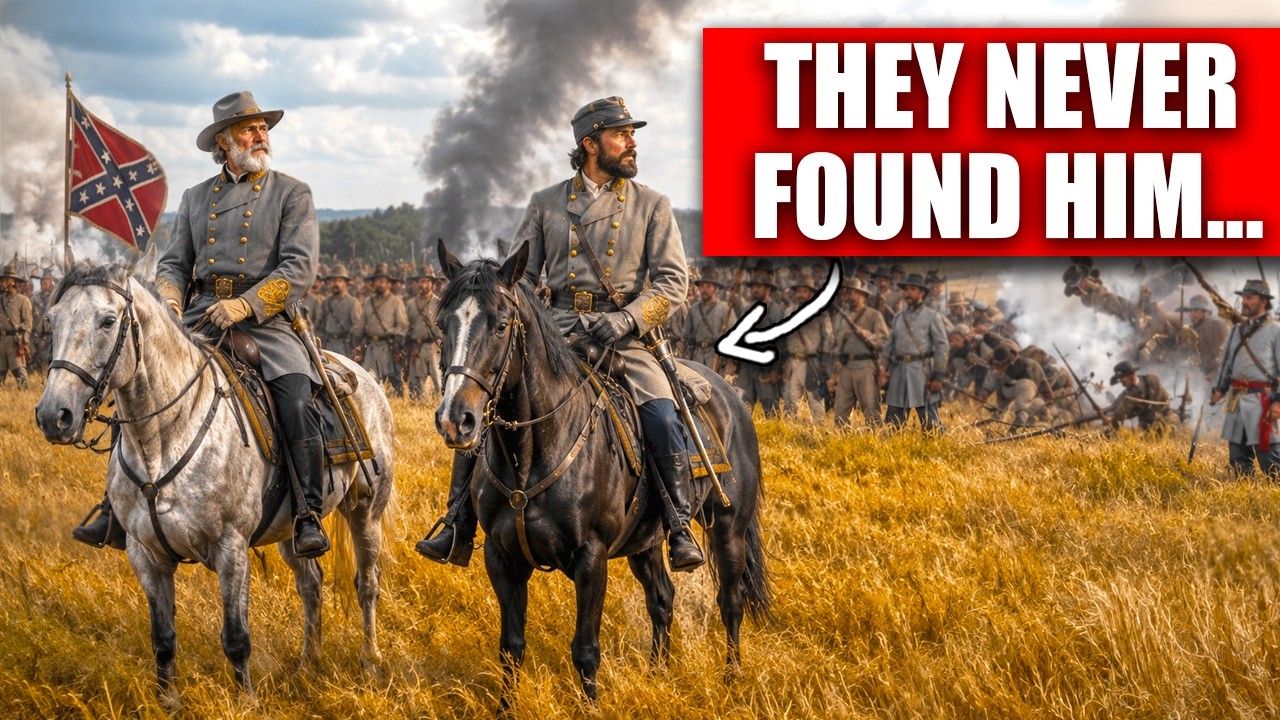
Not retreat. Not surrender. He would be shot down somewhere between that wheat field and those trees, and his body would never be positively identified. His grave was never found.
His bones were eventually dug up by strangers, shipped in a box to a cemetery in Richmond, and buried beneath a stone bearing a single word: Unknown. In the hour that followed, the regiment Murray belonged to, the 26th North Carolina, lost nearly 600 men. Roughly seven fell every minute. Three out of every four soldiers who walked into that field ended up dead, dying, or too broken to stand.
Murray’s company from Caldwell County suffered a 100 percent casualty rate. Every single man. It was one of the most complete destructions of a military unit in the entire Civil War. And still, the man who led them vanished from the record so thoroughly that no burial record carries his name, no grave ever carried his marker, and historians are still looking for his bones.
The story began two years earlier, in the spring of 1861, when news of Fort Sumter reached the foothills of western North Carolina. Murray was living the quiet life of a farmer’s son in Caldwell County, educated enough to read, write, and lead. When the county raised a company of volunteers, the men looked to him. They called themselves the Hibriten Guards, after the mountain that stood over their farms and churches.
They were not strangers thrown together by a draft board. They were brothers and neighbors who had fished the same creeks and sat in the same pews. Murray, barely into his mid-twenties, was elected their captain. It was a title that carried a terrible weight because if he made a mistake, the dead would be people his mother knew by name.
The Hibriten Guards became Company F of the 26th North Carolina Infantry, organized in August 1861 under Colonel Zebulon Vance, a man who would later become governor of the state. The regiment spent its first year in the swamps of eastern North Carolina. Hundreds of miles north in Detroit, another regiment was forming that would one day meet them on that field: the 24th Michigan. Clerks, farmers, and tradesmen who had never heard of Hibriten Mountain and never would until the day its sons came walking toward them across an open field.
By June 1863, the 26th North Carolina had grown into one of the largest regiments in Robert E. Lee’s army, somewhere between 800 and 843 men. They were part of Pettigrew’s Brigade in Heth’s Division. Most carried Enfield rifles, with 40 rounds per man.
The regiment marched from Fredericksburg into the Shenandoah Valley, across Maryland, and into southern Pennsylvania, ten to twenty miles a day in wool uniforms and summer heat. The men were in high spirits. They had won at Chancellorsville. They were invading the North.
The commanding colonel was not Murray but Henry King Burgwyn Jr. , a twenty-one-year-old aristocrat educated at the University of North Carolina and Virginia Military Institute. Wealthy, formally trained, and confident. Before leaving Virginia, Burgwyn wrote home: “I am proud of the 26th.
There is no better in the army, and if God permits, we shall make a name for ourselves in the next battle. ” In less than two weeks, he would be dead in a Pennsylvania field. The regiment he was so proud of would lose seven out of every ten men, and the captain of Company F would be so thoroughly erased that no one would ever find his grave. On June 30, 1863, General J.
Johnston Pettigrew was given a simple assignment: march toward Gettysburg and see if there were supplies there, shoes especially. The Army of Northern Virginia was always short of shoes. It was supposed to be a foraging expedition. Pettigrew marched his brigade eight miles east from Cashtown, and then he saw something that stopped him cold.
Union cavalry, regular professional federal cavalry, positioned on the ridges west of town. This was not a small garrison. This was the leading edge of something much larger. Pettigrew turned around and pulled back without firing a shot.
That evening, he reported what he had seen. Heth and A. P. Hill listened and did not want to believe him.
Heth decided to march back to Gettysburg the next morning in force, convinced the Federals were just militia he could brush aside. He was wrong. The cavalry Pettigrew had seen belonged to John Buford’s division, and marching hard toward Gettysburg from the south was the entire Army of the Potomac. The decision had been made, not by Murray, not by Burgwyn, not even really by Heth.
It had been made by the war itself, by the gravitational pull of two armies stumbling toward each other in the dark. Dawn on July 1 came warm and still. The 26th North Carolina fell into line and began walking east along the Chambersburg Pike toward the sound of guns. By half past seven, they could hear distant carbine fire.
Heth’s lead brigade had run into Buford’s dismounted cavalry west of town. The skirmishing grew heavier, then came the deeper percussion of artillery. Heth, wanting his supplies and wanting a fight, ordered Pettigrew’s Brigade forward, not as a reconnaissance but as an attack. The 26th North Carolina was going in.
Sometime between 10:30 and 11:00, the regiment deployed into a line of battle, eight hundred men stretching across an open wheat field west of a small stream called Willoughby Run. Beyond the stream, a rise of ground led into a dark patch of timber known as Herbst Woods. The men in those trees wore the distinctive black hats of the Iron Brigade. The fence lines crossing the approach forced men to bunch together as they climbed over, easy targets.
A Confederate veteran later recalled: “We had to climb the fence under fire, and in that moment many fell. ”
The order came sometime around noon. Bayonets fixed, the regiment stepped off, eight hundred men walking forward into the wheat. Civil War doctrine called for a measured advance: keep the line dressed, hold fire until close enough to see faces.
The regimental colors of the 26th North Carolina moved at the center of the line, and fourteen men would carry them before the day was done. In the tree line, the 24th Michigan leveled their Springfield rifles and waited. Colonel Henry Morrow later described what he saw: “They came on in splendid order, their line as straight as on dress parade, their flag steady amidst the storm. ” That steady, precise line contained Company F.
It contained Murray, and it was walking directly into a wall of rifle fire. The first volley hit at roughly two hundred yards. Men dropped across the front of the line, not one or two but clusters, whole sections collapsing like wheat cut by a scythe. The survivors closed ranks and kept walking.
The second volley came, then the third, and the regiment broke into a run. They had to close the distance or die in the open. The first men hit Willoughby Run at a dead sprint. The banks were slick with mud, and men slipped and fell.
Some went down into the water with their rifles above their heads and came up gasping. Others never came up at all. On the far bank, a rail fence forced the advancing Confederates to bunch up and climb. For two or three seconds, each man was silhouetted against the sky, completely exposed.
Men were shot off the fence and fell backward into the men climbing behind them. Once across, the 26th North Carolina pushed uphill into Herbst Woods. The smoke from concentrated musketry filled the woods like fog, cutting visibility to fifty yards. In the first minutes of fighting, the regiment began losing officers at a catastrophic rate.
Company commanders stood upright, carried swords, shouted orders. Along the length of the Confederate line, captains and lieutenants were going down. Somewhere in that smoke, Murray was still on his feet, still leading. Colonel Morrow of the 24th Michigan watched with something close to disbelief: “We cut them down by scores, yet they closed up and came again.
I had never seen such persistence. ”
The regimental flag was a magnet for fire. On July 1, the color bearer was shot. A second man picked up the flag.
He was shot. A third, shot. A fourth, down. At some point, Colonel Burgwyn himself, the twenty-one-year-old boy colonel, grabbed the colors and carried them forward.
Minutes later, near the banks of Willoughby Run, a ball passed through his lungs. He threw up his hands and fell. An officer nearby heard him cry out, “I am dead, boys. Save your colors.
” Burgwyn did not vanish. His death was witnessed, recorded, mourned. He would get a marked grave, monuments, a place in history. Murray would not.
It was somewhere between noon and 1:30 when Captain Murray was hit, probably within a few hundred yards of where Burgwyn had just fallen. Whether he was struck by a single ball or multiple hits, whether he died instantly or lay wounded and conscious in the undergrowth, no surviving account tells us. The clearest account of his fall comes from a private who served under him. Two weeks after the battle, Private J.
A. Capps wrote home: “Our company went in 90 strong. Captain Murray led us as he always did, cool and steady. When we came out, there was not a man who went in but what was shot in some way.
The captain fell and we had to leave him. I could not stop. The Yankees were shooting us down like wheat. ” Nine words contain the entire mystery: “The captain fell and we had to leave him.
” In the middle of an assault with bullets cutting through the air from fifty yards away, a private cannot stop to check on his captain. He runs forward because stopping means dying. And so William Henry Murray lay where he fell, alone in the smoke and noise and heat, and no one came back for him. Of the 91 men who formed up that morning, not one was standing unhurt by the end of the day.
The regiment that marched in at 800 strong had only 216 answer the next morning’s roll call. On July 2, the shattered remnants were pulled into supporting roles. On July 3, the survivors of Company F, the wounded who could still hold a rifle, marched across the fields south of Gettysburg toward Cemetery Ridge in the great Pickett-Pettigrew-Trimble Charge. Their path took them within sight of the ground where Murray had fallen two days earlier.
His body, if it had been buried at all by then, lay in an unmarked grave somewhere near Willoughby Run. They walked past it, and then they kept walking into another storm of fire. The charge broke apart. By the end of July 3, the 26th North Carolina’s total casualties for the battle stood at approximately 714 out of 843, the highest of any regiment, Union or Confederate, at Gettysburg.
On July 4, Lee ordered a general withdrawal. The wounded who could walk went with them. The dead were left. Almost every Confederate body on the field, including Murray’s, was abandoned to the enemy, the civilians, and the weather.
There would be no Confederate burial detail, no comrades returning to mark graves. Whatever remained of William Henry Murray now belonged to strangers. In the days after the armies left, the fields around Willoughby Run lay in the July heat. A federal officer who led a burial party later described what he found: “In the fields beyond the seminary, we found the rebel dead in great numbers.
On one ridge, near a run of water, they lay in ranks as if still advancing. Many of the officers had no marks by which we might know who they were. And in the haste of our work, we could set up only wooden boards, often with but a single word, Rebel. ” One word.
That was the epitaph for a captain, a farmer’s son, a man who had led 91 of his neighbors into the fire. Some accounts from Caldwell County held that men of Murray’s company buried him and knew roughly where he lay. If so, the marker, a board or a stick driven into the ground, did not survive the years between 1863 and the exhumation that followed. Other evidence points to a simpler and more terrible possibility: that Murray was buried by strangers who never knew his name at all, in one of the mass shallow graves near Willoughby Run.
Either way, the result was the same. In 1871, eight years after the battle, workers funded by southern organizations came to Gettysburg to bring the Confederate dead home. They exhumed graves, those they could find, and shipped the remains by rail to Hollywood Cemetery in Richmond, Virginia. Many wooden markers were gone by then, rotted or knocked over.
Research drawing on cemetery ledgers and shipping records concludes there is no record of Murray’s grave having been marked on the field. It is highly probable his remains were disinterred from the battlefield in 1872 to 1873 and shipped to Richmond. His name does not appear on the list of identified remains, so he is buried there as an unknown. In the decade after his death, a man with a name, a rank, a family, and a home county became a set of anonymous remains in a mass section.
The process of vanishing happened in stages, each one stripping away another piece of his identity. Colonel John R. Lane, shot through the neck on July 1 and somehow survived, later wrote the regiment’s account: “Our brave Colonel Burgwyn was dead. Captain Murray and many another gallant spirit had fallen.
And the old 26th was a wreck. ” A phrase that honored him and erased him in the same breath. Today, at Hollywood Cemetery in Richmond, there is a section set aside for the Confederate dead from Gettysburg. The stones are small and uniform.
Most say the same thing: Unknown. Rows and rows of unknowns. Somewhere among them, almost certainly, lie the bones of Captain William Henry Murray of Company F, the Hibriten Guards, 26th North Carolina Infantry. He has been there for 150 years.
But his stone does not carry his name. The mountain he was named for is still there. The man is not.
And for every name carved in stone on a Civil War battlefield, there is a man like William Henry Murray whose name is nowhere at all.