In the summer of 2013, forensic anthropologists knelt in the sandy soil of the Florida Panhandle with picks, trowels, and dental tools, working the ground the way one would work an ancient burial site. They were not excavating an ancient cemetery. They were excavating a reform school for boys. Before they finished, they had located and exhumed 55 sets of human remains from a patch of ground behind the school, in graves that appeared on no official map and beneath no headstone bearing a name.
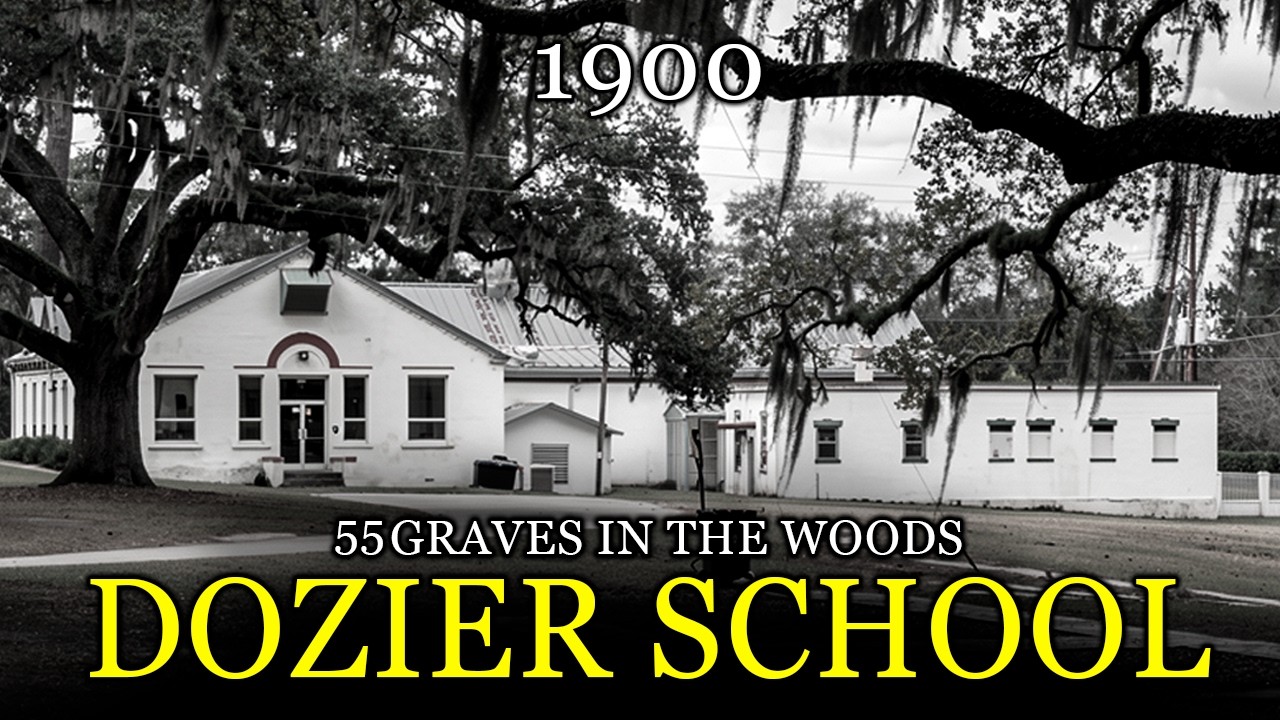
Some of the remains showed gunshot wounds. Some showed the unmistakable signature of severe blunt trauma. Several were buried in a scatter of unmarked plots that stretched well beyond the boundary of the cemetery that was supposed to contain them. The school looked, from the road, like nothing much at all.
Low white buildings under a canopy of live oaks dripping with Spanish moss, manicured lawns. It opened in Marianna, Florida, on January 1, 1900, and for much of the twentieth century it was, at various points, the largest juvenile reform institution in the United States. Boys were sent there for grand theft and for murder. They were also sent there for truancy, for running away from home, for being orphans nobody else wanted, and for decades, simply for being the wrong color and being seen on the wrong street.
For 111 years, it operated. Inside a low concrete building the boys came to call the White House, staff members strapped children until the leather tore skin and left scar tissue that some carried for the rest of their lives. Survivors eventually organized themselves into a group that told you everything about what had happened to them and where. They called themselves the White House Boys.
The school closed in 2011. A Pulitzer Prize-winning novel and an Academy Award-nominated film would later carry a fictionalized version of what happened here to millions of people who never heard its real name. And in 2025, more than a decade after the last boy walked out the gate, the state of Florida finally started writing checks to the survivors who were still alive to receive them. To understand how a school for children became one of the darkest institutions of the American South, you have to go back to 1897, to a state legislature in Tallahassee trying to solve a problem that on paper looked genuinely humane.
Florida, like most of the country, had exactly one place to send a child who broke the law: an adult prison. There was no meaningful distinction in the eyes of the law between a nine-year-old caught stealing and a grown man convicted of armed robbery. Reformers across the country argued this was a moral catastrophe. A child mixed into an adult penal population did not get reformed; he got an education in crime.
In 1897, the Florida legislature passed an act establishing the Florida State Reform School, intended to separate juvenile offenders from adult convicts and give them, instead of a cell, an education and vocational training. Five commissioners appointed by the governor selected a site in Marianna, a small town in the rural panhandle, and acquired an enormous tract of 1,400 acres. On January 1, 1900, the doors opened. There was no perimeter fence, no wall.
The campus was laid out with dormitory cottages, a dining hall, classroom buildings, workshops, and farmland the boys themselves would work. Boys studied reading and arithmetic, learned trades, and played football and basketball on organized teams. Many of the buildings were constructed by the hands of the boys who lived there. From the very beginning, the campus was split in two.
A dividing line, later marked by what is now called Penn Avenue, separated the south side, reserved for white boys, from the north side, reserved for what the records of the era called colored students. Two campuses, two sets of dormitories, two cemeteries. That segregation remained absolute and administratively enforced for 66 years, and it shaped almost everything that followed, including who got buried where and whose deaths got recorded at all. The optimism did not survive contact with reality for long.
In the earliest years, the school did function something like its founders had promised, at least on the white side. Superintendents reported boys learning genuine trades in bricklaying, carpentry, printing, and mechanical work. The school’s print shop turned out a campus newspaper, and its brickyard supplied material for state projects. Sports were taken seriously.
But on the north side, the story was different from the beginning, and it stayed different for 66 years. Decades later, when a group of elderly black men who had been confined at Dozier in the 1950s and 1960s returned to Marianna together to walk the grounds and put their own account on the record, the contrast they described was stark. One of them, John Bonner, described the difference in a single plain sentence. On the white side, he said, it was roomier, with industrial shops and woodworking facilities where a boy could earn a trade certificate that might mean something once he left.
The black side, he said, was the slave side. Richard Huntley had arrived at 11 years old and spent two years there. While white boys were assigned vocational work that led toward a certificate, boys on the north side were disproportionately assigned to raw agricultural labor, unpaid work extracted from children without the instruction or credential that made the white side’s version of the same activity look like education. Three years was all it took for the first documented allegations of abuse.
In 1901, and again in an inspection of 1903, state investigators found what the records described plainly: boys held in leg irons, children chained in a way that looked less like a school and considerably more like the prison system it had been created to replace. Investigators also documented a practice called peonage, in which the labor of the boys shaded into forced unpaid work extracted under threat of punishment. What visitors to the grounds did not see was the building constructed in 1929. It was a modest structure of 11 rooms, built of concrete block, containing two separate detention cells, one for white boys and one for black boys.
Within a generation, it earned a name that every survivor of this institution, no matter what decade they passed through it, would recognize instantly and never forget. They called it the White House. A boy could be walked there at night for an infraction that might be talking back, wetting the bed, or nothing he did at all. He was taken inside alone, without parents present, without any outside witness.
He was told to lie face down on a bed. A staff member, sometimes two, administered blows with a thick leather strap, the kind used in that era on farm equipment rather than on children, in a rhythmic, counted beating sometimes numbering into the dozens. Robert Straley, sent to Dozier as a teenager in the early 1960s, later gave sworn testimony that he received 40 lashes that left him with blood blisters and skin discolored deep black and purple. He worked afterward in the school’s small hospital, where he recalled treating other boys for the same injuries, soaking their wounds in Epsom salts and hydrogen peroxide because there was no other medical care being offered for what the institution itself had inflicted.
Another survivor, William Haines, described the sound before the pain, a staff member’s shoe pivoting on the concrete floor as he wound up to deliver the blow. Haines said he received 45 strikes in a single session, so severe that fragments of his own underwear were driven into the wounds on his skin. Jerry Cooper, the quarterback of the school’s 1961 football team and later president of the survivors organization, said he endured 136 lashes on one occasion. According to sworn testimony gathered decades later, the beating room itself had originally been a converted milking stall.
An industrial fan sat in the room, positioned, survivors and later investigators concluded, to muffle the sound of what was happening inside. The physical discipline was only part of what happened. Sworn statements documented what boys called the sweatbox, a form of solitary confinement applied disproportionately, according to survivor accounts, to black students on the segregated north side, where a boy could be locked in a small, poorly ventilated space for days in the heat of a Florida summer with minimal food or water. And there was sexual abuse, documented in the sworn statement record compiled during formal state investigation.
Straley stated under oath that he was raped while a student. Investigators in 2010 collected statements referencing a school social worker, since deceased, who multiple former employees alleged had molested students and was reported internally to the school’s director and superintendent, and told to drop the matter, with an assurance that the institution would handle it. There is no record that it ever did. Beneath the beatings and abuse ran a darker current still: boys who went into the Dozier School for Boys and simply never came out.
The earliest catastrophic loss of life happened in 1914, when a fire broke out in a dormitory on the north side. Six boys and two employees died. They were buried in a plot of ground behind the north side campus that came to be known informally as Boot Hill, after the American frontier term for burial grounds reserved for outlaws and the anonymous poor. At a state-run reform school for children, staff had adopted the same term for the plot where they buried the boys in their care.
There is a case from 1934 that stands out even against that backdrop. A 13-year-old was committed to Dozier on a charge of trespassing. Thirty-eight days after he arrived, he was dead. The surviving records do not offer a clean account of exactly what killed him.
What they establish is the fact. A child sent to a state institution for walking somewhere he was not supposed to walk, dead within five and a half weeks. Between 1914 and 1973, according to research compiled from state and institutional records, at least 96 boys died at the Marianna campus. Some deaths had documented causes: the 1914 fire, disease outbreaks, drownings, and in a number of cases investigators found deeply troubling, violence.
But dozens were recorded with minimal detail, no clear cause, no consistent burial documentation. In a segregated institution where the north side’s records were kept with even less rigor than the south side’s, an unknown number of children who died there were never formally logged as having died there at all. The internet version of this story and the documented version are not the same thing. For years, survivors circulated a figure that ran into the hundreds, sometimes as high as 200 boys buried on the grounds.
That number was aggressively challenged by defenders of the school, who pointed out, correctly, that no forensic evidence supported a number that large. The documented, forensically verified figure, established years later through scientific excavation, was 55. Fifty-five is not 200, but 55 is also not the number the state of Florida had ever officially acknowledged existed. And the myth correction cuts in an uncomfortable direction.
The inflated legend of 200 bodies actually gave the school’s defenders a foothold to dismiss survivor testimony wholesale, while the real, scientifically confirmed number of 55 children in unmarked graves, some killed by gunshot wounds, some by blunt trauma at a school for truancy and stolen bicycles, was already one of the most damning figures uncovered at any American institution. The investigation that finally established that number began in 2005, when a group of former students who had passed through the White House in the 1950s and 1960s founded an organization called the White House Boys Survivors Association. Roughly 300 men eventually joined. They elected as their president Jerry Cooper, the same man who had once quarterbacked the school’s football team while enduring beatings of over 100 lashes to stay eligible to play.
For years, their claims were met with skepticism and procedural delay. That changed in 2008, when two members, Robert Straley and Roger Dean Kaiser, connected over the striking similarity in their independent, decades-old accounts. They reached out to a filmmaker and civil rights activist, Michael O’McCarthy, who had his own history of abuse at the school. In 2009, the group persuaded Governor Charlie Crist and Attorney General Bill McCollum to authorize a formal investigation by the Florida Department of Law Enforcement.
Investigators located and identified two dozen unmarked graves, but the FDLE’s findings, released in 2010, concluded there was insufficient evidence to support criminal prosecution of any former employee. For the White House Boys, it was recognition without accountability. The graves were real. Nobody would answer for them.
What the state investigation could not fully resolve, science eventually did. In 2011, the University of South Florida, through forensic anthropologist Erin Kimmerle, was granted a permit to conduct archaeological research on the Boot Hill site. Florida Senator Bill Nelson wrote directly to the governor and the United States Attorney General requesting federal support. Using ground penetrating radar, Kimmerle’s team identified far more burial sites than the official record acknowledged.
Working from 2012 through 2016, and returning again in 2018, the team located and exhumed 55 sets of remains, 24 more than the earlier investigation had found. Many of the burials lay entirely outside the boundary of what had ever been formally designated as the cemetery, scattered into the surrounding woods as though whoever buried them had simply stopped keeping track. Some remains showed evidence of gunshot wounds. Others showed clear signs of blunt force trauma.
These were not primarily deaths from disease or accident that had merely gone unrecorded. Some of these boys had been killed. Kimmerle’s team then undertook the work of trying to give the remains their names back. Using DNA analysis and locating surviving family members, some of whom had spent 70 or 80 years wondering what had happened to a brother, a son, an uncle sent away to a reform school who never came home, researchers began matching remains to families.
The first confirmed match was a boy named George Owen Smith, sent to Dozier in 1940 at 14 years old. His family never saw him again. Investigators matched his remains, recovered wrapped only in a burial shroud, against a DNA sample from his surviving sister, Ovell Krell, who had waited her entire adult life for an answer. Kimmerle, announcing the identification, said the full circumstances of what happened to George might never be fully known, but that he would now be buried under his own name beside the family that had spent 70 years longing for answers.
Eleven surviving families came forward hoping for the same resolution. Not all received it. Some of the 55 have never been identified at all and likely never will be. There is a second cemetery this story requires you to know about precisely because of how absent it is from the record.
Boot Hill sat behind the north side campus, the side reserved for black students. Under the segregation policy enforced until 1966, a white boy who died at the school should logically have been buried somewhere on the south side in a separate, presumably better documented plot. No such cemetery has ever been definitively located. Ground penetrating radar surveys in later years identified dozens of additional soil anomalies across the property, but the team found nothing more than tree roots and disturbed earth.
The search for the missing white boys’ burial ground has never conclusively succeeded. It also has never been declared conclusively finished. Not every boy sent to Dozier had committed anything resembling a crime. Some were sent there for the crime of demanding equal treatment.
In July 1963, in the coastal town of St. Augustine, a group of teenagers connected to the local NAACP Youth Council walked into a Woolworth’s department store and sat down at the whites-only lunch counter. It was a sit-in, part of the wider wave of civil rights protest sweeping the South, organized under the guidance of a local dentist and civil rights leader named Robert Hayling. Sixteen young protesters and seven juveniles were arrested.
Four of the juveniles, two girls and two boys, refused a deal offered by the presiding judge: their release in exchange for their parents signing a pledge that the children would not participate in any further protest until they turned 21. Joanne Anderson, Audrey Nell Edwards, Willie Carl Singleton, and Samuel White refused. History remembers them as the St. Augustine Four.
The judge sent them to reform school. The two boys were sent specifically to Dozier. They were 14 and 16 years old, held for roughly five months through an autumn, a Thanksgiving, and a Christmas spent apart from their families, before national pressure, organized in part by the baseball legend Jackie Robinson, finally forced Florida’s governor to arrange their release in January 1964. Two teenagers who committed no crime beyond ordering a hamburger at a segregated lunch counter spent nearly half a year inside the same walls subject to the same discipline as boys sent there for theft and violence.
For decades, the gate stayed effectively unaccountable to anyone. In 1968, Florida’s governor Claude Kirk made a personal visit to the campus. What he found, by his own account, was overcrowding and conditions bad enough that he said publicly that somebody should have blown the whistle on this place a long time ago. That same year, the state officially banned corporal punishment.
On paper, the leather strap and the White House were finished. In practice, the building did not disappear. It sat unused for its original purpose, converted into storage space, sealed off from daily life, never demolished, never demolished, never fully accounted for. The end, when it finally came, arrived through the slow accumulation of pressure that had been building since 2005: survivor testimony, media investigation, the FDLE inquiry, and finally, in the school’s last operating year, a full investigation opened by the United States Department of Justice into conditions at the facility.
By that point, the physical footprint had shrunk dramatically. The Marianna campus was a fenced, 159-acre high-risk residential facility holding roughly 100 boys between the ages of 13 and 21. The Department of Justice’s investigation, opened formally on April 7, 2010, found serious ongoing violations decades after corporal punishment had officially ended. Investigators documented youth held in disciplinary isolation for periods stretching up to 120 consecutive days.
They found a pattern of transferring boys to the maximum risk lockdown unit next door as an additional disciplinary tool. They found what the final report called deliberate indifference to youth at risk of self-harm and suicide. The department’s final report, delivered to Governor Rick Scott in December 2011, concluded that the state’s failures amounted to systemic, egregious, and dangerous practices worsened by a persistent lack of accountability and control. On June 30, 2011, with the investigation still active, the state of Florida closed the Arthur G.
Dozier School for Boys for good, 111 years after it opened as an idealistic answer to the problem of children in adult prisons. The White House itself had already been dealt with in a fashion three years before the school closed. In 2008, Florida officials held a public ceremony and formally sealed the structure. A plaque was installed.
The doors were closed. It has remained empty, officially untouched ever since, kept sealed rather than demolished, as if the state could not decide whether it wanted the building destroyed or preserved as evidence. The rest of the 1,400 acres followed the pattern of institutional abandonment: dormitory cottages left to the Florida climate, roofs failing under decades of humidity and hurricane seasons, kudzu and pine seedlings pushing up through cracked concrete walkways, the football field gone to weeds. Formal acknowledgement from the state arrived in stages.
In 2017, the Florida legislature issued a formal apology to the survivors, using the word atrocities and stating plainly that what had happened at Dozier should never occur again. Jerry Cooper, the White House Boys president, would not live to see what came next. He died in 2022, and by his widow’s account, he was still, six decades later, dreaming about the bed and the strap and calling out the name of the man who had beaten him. On January 13, 2023, the state dedicated a permanent memorial on the Marianna site, positioned deliberately next to the sealed White House building itself.
It includes a courtyard with life-sized bronze sculptures: figures of adolescent boys arranged around a bed on which rests a leather strap, the industrial fan that once muffled the sound of the beatings positioned nearby, and two boys depicted helping a third to walk away from the scene. The memorial gave survivors recognition. It did not give most of them money. That finally started to change, slowly, after another decade of lobbying.
In 2024, both chambers of the Florida legislature passed a bill establishing a victim compensation program, the first in the institution’s 124-year history, creating a mechanism for the state to pay actual money to men who had survived physical, mental, or sexual abuse at the campus between 1940 and 1975. Governor Ron DeSantis signed it into law, appropriating $20 million. Applications opened later that year. Survivors, most in their 60s, 70s, and 80s, had to complete formal claim forms and in some cases provide sworn testimony recounting abuse that had happened to them as children more than half a century earlier.
When the application window closed, 930 claims had been submitted. Seven hundred sixty-four were approved, working out to slightly more than $21,000 per person. On June 30, 2025, the state of Florida sent the checks. Bryant Middleton, a Vietnam veteran approaching his 80th birthday, was one of the men who received one.
He had told a local news crew that the boys at Dozier had lived in fear 24 hours a day, and that he could still remember other children strapped to beds and beaten to a pulp. Richard Hill, another survivor, said publicly that he did not think everyone was satisfied with the amount, $21,000 measured against a childhood permanently altered. Carol Moore, a legal investigator who had spent years working the case, put it perhaps most plainly. What mattered most to the men, she said, was not really the money.
It was that they finally got recognized, that they finally got some form of justice, however incomplete, however overdue. It is worth sitting with how long that took. A 13-year-old boy died at this school in 1934, 38 days after arriving on a trespassing charge. Ninety-six years passed between that death and the first state-sanctioned excavation of the ground where children like him were buried.
One hundred twenty-five years passed between the school’s opening and the first checks being mailed to the men who survived it. Most of the boys who died inside those grounds between 1900 and 1973 will never receive anything at all, because there is no compensation program for the dead and no fund large enough to answer for children whose names may never be recovered from 55 sets of bones in unmarked soil. There is one more piece of this story that needs to be told carefully, because it is the reason so many people who have never heard the name Marianna, Florida, or Arthur Dozier nevertheless recognize the shape of this history when they encounter it. In 2019, the novelist Colson Whitehead published a book called The Nickel Boys.
It told the story of two black teenagers sent to a fictional reform school called Nickel Academy in the Jim Crow era Florida panhandle, a school run with the same segregated campuses, the same brutal punishment building, the same buried, unaccounted-for dead that had defined the real Dozier School for 111 years. Whitehead had drawn directly on the documented history of Dozier, and specifically on the forensic work of Erin Kimmerle. The book won the Pulitzer Prize for fiction in 2020. In 2024, the director RaMell Ross adapted the novel into a film titled simply Nickel Boys, released to widespread critical acclaim and earning nominations for best picture and best adapted screenplay at the 97th Academy Awards.
Millions of people absorbed a version of what happened at Dozier without ever learning the school’s real name. There is a specific quiet detail buried in Kimmerle’s account of the identification process that stays with you longer than almost anything else. When her team finally matched the remains of George Owen Smith to his sister Ovell Krell, Krell had waited 70 years for that phone call. She had been a child herself when her 14-year-old brother was sent away and never came home.
She got her brother back finally as a set of bones wrapped only in a burial shroud, identified through DNA rather than through any record the institution itself had ever bothered to keep. That is what accountability looked like when it finally arrived for one family out of the 55. Most families never got even that much. And here the story becomes stranger than either the novel or the film.
In late 2018, the state of Florida formally transferred ownership of the entire Dozier property, all 1,400 acres, to Jackson County. Hurricane Michael tore through the region that same year, destroying much of what infrastructure remained. What followed was years of grants, demolition, and redevelopment. Plans emerged for a regional distribution and manufacturing center, county government offices, a program serving young adults with autism, the old gymnasium to become a civic center, and the old cafeteria a museum.
The property has a new name: Endeavor Park, chosen deliberately as a way of stepping into a new future on ground that for a century meant something closer to the opposite of that word. The White House itself was excluded from the redevelopment. Under the terms of the land transfer, the building and the Boot Hill Cemetery were specifically carved out and preserved as a memorial site. County officials have also discussed building a walking trail through the site so visitors to what is otherwise becoming a convention center and business park can still learn the history of the ground beneath their feet.
That is the state of Dozier today. A convention center hosting corporate events, a short walk from a sealed concrete building where boys were beaten until the leather tore skin, and a still only partially resolved cemetery where forensic scientists once knelt in the dirt looking for children the state of Florida spent a century trying not to count. The forgotten dead of Dozier are not an abstraction. They are 55 specific sets of remains, some showing gunshot wounds, some showing blunt trauma, pulled out of Florida sand by a forensic team working with picks and trowels, because that is functionally what this reform school’s back 40 acres had become.
Eleven families came forward hoping for identification. Not all got it. Dozens more of the 96 documented deaths between 1914 and 1973 remain unresolved, uncounted among the 55. The leather strap that beat Robert Straley and William Haines and Jerry Cooper sits today cast in bronze on a memorial bed in a courtyard next to a sealed building a few hundred yards from a convention center called Endeavor.
Both of those things are true about the same 1,400 acres in the same year. And Florida has not resolved what it means to hold both at once. A novel wins a Pulitzer, a film earns an Oscar nomination, and millions of people absorb a fictionalized version of what happened at a place called Nickel Academy and never learn the real name Marianna or the real name Dozier or the real names Robert Straley, Jerry Cooper, George Owen Smith, or the 54 other boys who came out of that ground.
What exactly are we choosing to remember, and what are we choosing, once again, to let stay forgotten?