The number most people know is 400. That is the figure printed in Wikipedia, in Atlas Obscura, in nearly every account of the attic at the Willard Asylum for the chronic insane in Ovid, New York: 400 leather suitcases with names inked on them, stored under decades of dust. Across the road lie 5,776 graves with no names at all. The truth is more exact, and the story behind it begins in 1864, when the state of New York sent out a questionnaire.
The act authorizing it, chapter 418 of that year’s session laws, handed the task to one man: Dr. Sylvester D. Willard, secretary of the Medical Society of the State of New York. Willard drafted 68 questions, printed them, and sent them to every county judge, each of whom appointed a local physician to investigate.
The written instructions to those physicians survive, and one line reveals exactly what Willard expected them to find: give the overseer no notice of your visit, arrive and begin at once. The returns came back from every county but four. They asked how many of the insane poor were restrained by chains or handcuffs occasionally, how many constantly, and whether any rooms had no window opening out of doors. The catalog that returned described people sleeping on straw wet with their own waste, unchanged for days; people kept in cages and dark, prison-like cells, scores going through winter with no shoes or stockings.
In some poorhouses, light and air reached a person only through a diamond-shaped hole cut in a rough plank door. The attendants in most places were other paupers. None of this was simply local cruelty. It was the arithmetic of a statute.
The State Asylum at Utica, opened in 1843, was legally required to return any patient not discharged as recovered, and county officers had no authority to send cases of more than a year’s standing there at all. So the chronic flowed downhill into the poorhouses and stayed. Governor Reuben Fenton put the total in his message to the legislature: 1,345 people in 55 counties, nearly all of them incurable, 345 capable of labor. Albany had been told before.
A Senate Select Committee had reported the same conditions in 1857, and nothing permanent had come of it. What finally moved the legislature was not mercy. It was a cost comparison. Willard priced it: $1.
75 a week to warehouse a person in a county house, $5 a week to treat one properly. One hundred recent cases treated properly, he calculated, yielded 80 recoveries at $150 each, a total of $15,000. The same 100 left in poorhouses yielded 70 incurables living an average of 18 years more, at a cost to the state of $131,040. The bill passed on April 8, 1865, as chapter 342 of the laws of New York, an act to authorize the establishment of a state asylum for the chronic insane and for the better care of the insane poor, to be known as the Willard Asylum for the Insane.
It was named for a dead man. Sylvester Willard had gone down with typhoid fever days before the vote. The title mattered: not an asylum for the insane, but an asylum for the chronic insane. That phrase was the entire design, written into the law by a physician named John B.
Chapin, who had compiled Willard’s questionnaire returns, drafted sections 10 and 11 of the act, and then became the asylum’s first medical superintendent. He built the category, and then he ran it. Chronic was institutional language for something plainer. It meant the counties were finished with you, that Utica had refused you or sent you back, and that you were now the property of the state with no date attached.
On paper it was a filing distinction. It was not. Construction began in July 1866. The asylum opened on October 13, 1869, with beds for 250.
The shape is agreed upon: Second Empire, three stories, a central administration block with long wings running out on either side, men in one, women in the other. Chapin never accepted that chronic meant hopeless. His annual report argued that the counties were not competent to do this work, that the almshouse was a most unfit place, and that his patients were not all incurable. He wanted Willard to be hospital and asylum at once.
But the sentence that survives from the founding is not his. It is in Willard’s own report, and it describes the plan precisely: let the incurables be there colonized. From 1869 to 1881, Willard was the only institution in New York State built for the pauper chronic insane. There was nowhere else for these people to go.
To understand what happened inside, you first have to understand that it worked. Most accounts skip that part because a functioning institution is harder to look at than a broken one. The kitchen printed menus: Wednesday, 1881, breakfast was fried mush, bread, and coffee; dinner was roast beef, vegetables, and bread; supper was bread, butter, oatmeal, syrup, and tea. Able-bodied men had a separate scale, copied from British practice and labeled the English and Scotch dietary.
Under the English scale, a working man got five ounces of cooked meat, four ounces of bread, twelve ounces of vegetables, and half a pint of beer at dinner, with more beer and bread in the afternoon. The scale was written not for the sickest, but for the most useful. There was an amusement hall, films, a stage, sports teams, and organized trips to Roseland Amusement Park and the Finger Lakes Racetrack. A training school for nurses opened in 1890.
Former staff, decades later, described Willard as a happy place, and some of them meant it. In 1890, chapter 132 renamed the place Willard State Hospital and widened its mandate to admit acute cases as well. Over its first 17 years, Willard admitted 3,964 people. It discharged 145 as recovered, 371 as improved, 317 unimproved, and buried 1,307.
Six people were found on examination not to be insane at all. In its first 17 years, Willard buried nine people for every one it sent home well. The population swelled. From 63 patients at the end of October 1869, it grew to 142 by that December, 530 by 1873, 1,550 by 1877, making Willard the largest asylum in the United States, then 2,000 by 1890 and almost 3,000 by 1934.
Chapin refused to solve overcrowding by lengthening corridors. He went to Albany for money and built separate houses scattered across the grounds, each holding working patients and their attendants. By the end, more than 70 buildings stood on 929 acres. The procedure began at the water.
You arrived by steamboat at a dock called Ovid Landing. On opening day, several men brought the first patient down the gangplank: a woman named Mary Rote, deformed and demented in the language of the record, her wrists chained together. Three men arrived the same day, all in irons. One had traveled in a crate the record describes as looking like a chicken coop.
Their names were Alonzo Hopkins, Abram Lewis, and John Page, names recovered not from Willard’s sealed records but from the 1870 federal census. Your chains came off on the dock. For most people arriving in those years, it was the first decency they had known in years. You were bathed, clothed, fed, examined.
Then you were entered. You became a number. Lawrence Mocha, admitted in 1918, became patient 14,956. The indexes that held those numbers look down columns for the casebook volume and page, the burial record, the autopsy record, and a column headed clinical record, which is always blank.
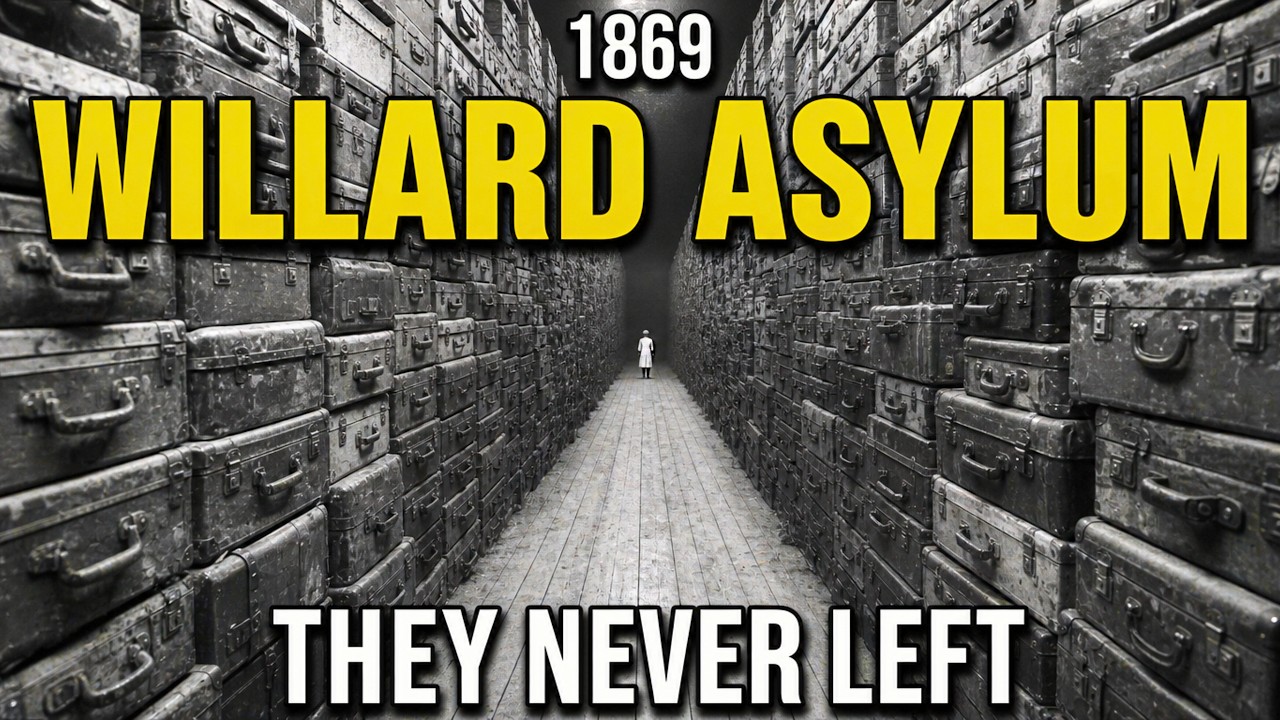
Your suitcase went upstairs into an attic in the pathology laboratory building, with hundreds of others. The popular version tells it as confiscation, the case taken at the door, never seen again. The curator who found the collection believes patients did have access to their belongings while they lived here, and the photographer who has spent years documenting the cases agrees. Against that, one woman arrived with 18 boxes and cases, including kitchenware from the 1930s still in mint condition, and reached none of it.
The documentation is incomplete. The record does not resolve it. Treatment read like a sequence of errors: hydrotherapy, thyroid extract, arsenicals, insulin shock, Metrazol, electric shock, occupational therapy, prescription drugs beginning in 1955. How often any of it was used at Willard is not something you can find out; those records are sealed under state law.
The morgue was built in 1870. Willard did not get an actual hospital building until Elliot Hall opened in 1931, 61 years after the first patient came off the boat. In December 1869, Willard held 142 patients and employed 141 people, almost one to one. By 1950, it employed over a thousand and held thousands.
The farm and shops kept the institution largely self-sufficient, complete with a slaughterhouse, piggeries, cow barns, bakeries, machine shops, gasworks, ice houses, and a locomotive house fed by 4,000 tons of coal a year. The hamlet outside the gates gave up its own name and took the asylum’s. What killed Willard was not Thorazine, which arrived in 1955, and not the Willowbrook scandal of 1972. There was no riot here, no fire, no grand jury, no indictment.
What killed it was a wage ruling in a case that had nothing to do with it. In 1973, a federal district court held in Souder v. Brennan that patients working inside state institutions were employees under the Fair Labor Standards Act, and employees have to be paid. Willard could not pay them.
None of these places could. The story of the people is difficult to tell because almost every patient name ever published from Willard is a pseudonym. State law forbids releasing the real ones. Five names were permitted.
Ethel Smalls arrived in 1930 at 40, recently divorced from a husband who beat her, two infant daughters dead, her father dying of cancer. She argued with her landlady, was told to leave, and instead went to bed and stayed there. The landlady had her committed. Ethel Smalls died at Willard in 1973, aged 83, 43 years for refusing to get up.
Margaret Dunleavy, a tuberculosis nurse, told her physician she felt persecuted by hospital administrators, and her physician advised commitment. She came with 18 boxes and cases of photographs, postcards, letters, maps, and furniture, and died at 81. Herman Graham had epilepsy and a portrait photography business, and at Willard never took another photograph, doing light duties for 35 years as his doctors noted the change from ambition to compliance. Rodrigo Lagan, an advocate of Philippine independence working as a house servant, was committed in 1917 on his employer’s report that he heard voices, and confined for 64 years.
Demetrius Archuk, a Ukrainian refugee committed after his wife died of a miscarriage and he began turning up at the White House, became an accomplished folk artist inside and ultimately died in 2001 at 84, having entered an institution during the Truman administration. Lawrence Mocha was born poor in Austro-Hungarian Galicia in 1878. Struck in the head with a rock as a young man, he drank, served in the army, emigrated, and found work at Bellevue Hospital. In 1918, after a disturbance, he was sent to Willard.
He kept to himself for years, then took an interest in the graveyard. With a pick, a shovel, and a rectangular wooden template, Mocha dug at least 1,500 graves, 60 to a row, 6 feet deep, wearing hip waders against the groundwater. He lived for a time in the cemetery in a shack with a stove, made an extra dollar here and there preparing bodies for burial, and asked for release in 1945. He was ignored.
For the last decades of his life he showed no symptoms and took no medication. The researcher who reconstructed his file gave the explanation: certain people were kept there because they were decent workers. Mocha dug until he died in October 1968 at 90. The grounds crew lowered him on ropes into a hole someone else had dug, with a priest at the graveside, and gave him a number.
There is a myth that Abraham Lincoln signed off on the asylum six days before his death. The arithmetic works: the act passed April 8, 1865, and Lincoln was shot April 14. The conclusion is nonsense. A New York statute is signed by the governor of New York, Reuben Fenton.
A president has no role in enacting the laws of a state. The attic produced an industry: a museum exhibit, a book in 2008, a photographer shooting the cases one at a time since 2011, a novel published in 2013 that has sold over half a million copies. The New York Times, going through the story in 2014, printed the best attributed figure: 427 suitcases. Still 427 people who packed a bag expecting to come back.
The end took 30 years. Sampson State School closed in 1971. In 1974, the place was renamed Willard Psychiatric Center. In the early 1980s, the original main asylum building was demolished.
In 1993, New York passed the Community Mental Health Reinvestment Act, directing that every dollar saved by closing a state psychiatric center be redirected into community programs. That law is what closed Willard. It turned an institution into a line item worth more removed than kept. In February 1995, Governor George Pataki announced the closure.
Part of the site would become a drug treatment campus for prisoners. That spring, a curator named Craig Williams drove four hours from Albany, expecting to collect furniture and nurses’ uniforms. An employee named Beverly Courtwright, whose family had worked at the hospital for three generations, led him to a locked attic door she had not opened herself, unsure the suitcases should be shared with the world. She opened it: 427 cases under dust and pigeon droppings.
Willard Psychiatric Center closed in April 1995. One hundred and thirty-five patients were left in a place built for 250 and once holding thousands. Nobody was charged with anything because nothing illegal had occurred. Roughly 50,000 admissions across 126 years, and by the state’s own reckoning, about half of the people admitted died as patients.
Every clinical record went to the New York State Archives and was sealed, the official response being not an inquiry but a confidentiality rule. Today the Willard campus is 550 acres with more than 75 buildings and a mile of Seneca Lake shoreline, on the National Register since 1975. The drug treatment camp has closed. Seneca County has a study, a plan, and $500,000 of its own money committed.
The redevelopment is costed at $332 million, and no master developer has come forward. Across the road, 29 and a quarter acres hold 5,776 people. The only headstones belong to 38 Civil War veterans. The numbered markers patients forged were pulled up over the years, sold for scrap, or thrown into a gully because they got in the way of the mowing.
New York State preserved 427 suitcases in an attic for 80 years. It would not preserve one name in the ground across the road. For generations, if somebody around here said or did something odd, people said he belonged in Willard. That was the local insult.
The state kept the luggage. It would not keep the names.