In May 1945, Germany did not simply lose a war; it ceased to exist as an independent country. There was no government, no army, no internationally recognized borders. For the first time in its modern history, the fate of every German citizen was placed entirely in the hands of four foreign armies. Which flag flew over a town determined what the next four years of life would look like, and the experience could differ dramatically between communities only a few miles apart.
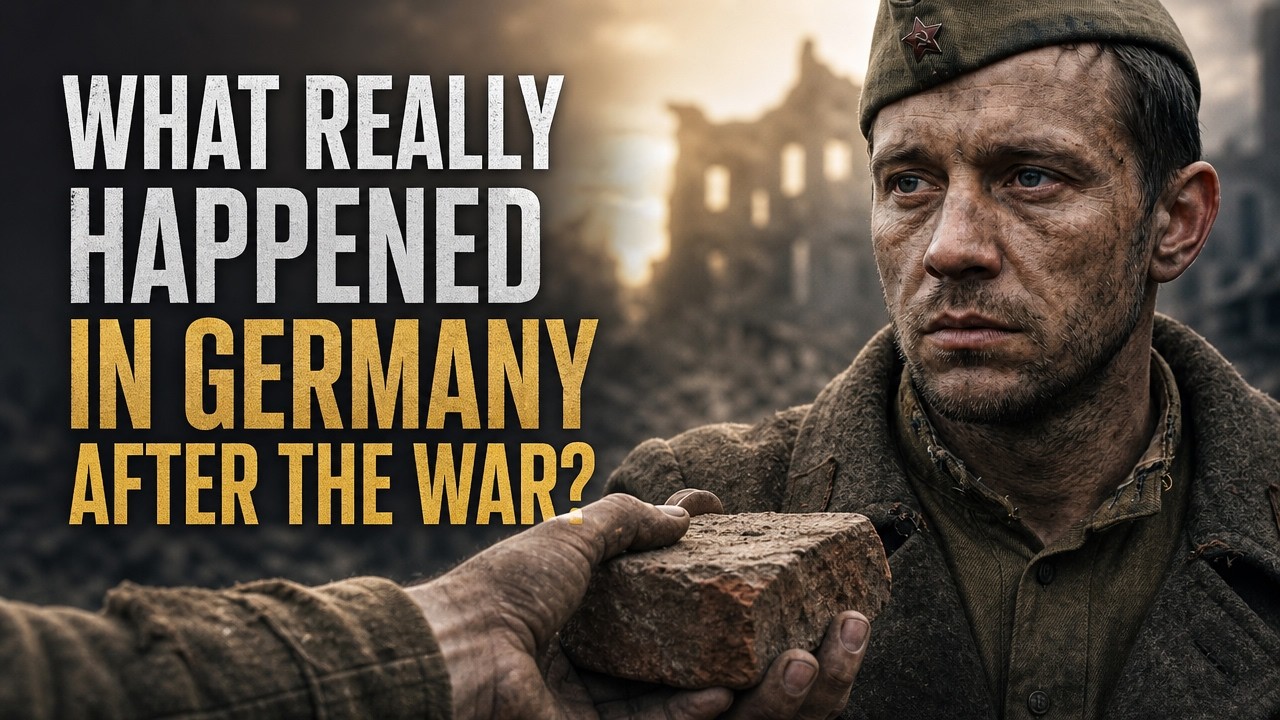
When Germany signed its unconditional surrender on May 8, 1945, the country was in almost every practical sense gone. Years of Allied bombing had reduced major cities like Berlin, Cologne, and Dresden to fields of rubble. Populations lived in cellars and half-collapsed buildings with little access to clean water, electricity, or reliable food. Transportation networks were shattered.
Millions of soldiers were dead, missing, or in captivity, and millions of civilians were displaced or fleeing westward ahead of advancing armies. On top of this, thousands of ethnic Germans were being forcibly expelled from territories in Eastern Europe being reassigned to Poland and Czechoslovakia, a displacement that would eventually total around twelve million people, most arriving in an already devastated Germany with nothing but what they could carry. The decision about what would happen to this shattered nation had largely been settled before the fighting ended. At Yalta in February 1945, and finalized at Potsdam that summer, the leaders of the United States, Britain, and the Soviet Union agreed to carve Germany into four occupation zones: American, British, French, and Soviet.
Berlin itself, though deep inside Soviet-controlled territory, was divided into four sectors. The Potsdam Conference brought together an unusually mismatched set of leaders: American President Harry Truman, in office only months after Roosevelt’s death; British leadership that changed mid-conference following an election at home; and Joseph Stalin, negotiating from enormous strength given the size of the Red Army now occupying half the continent. The agreements rested on compromise and, in places, deliberate vagueness, the kind that works well enough to get everyone to sign a document but leaves enormous room for very different interpretations. On paper, it looked like a coordinated unified plan.
In practice, it produced two of the most dramatically different occupation experiences in modern history, separated only by an administrative line on a map. The brutal reality of occupation reached German civilians before the war officially ended. As early as February 1945, Soviet forces had fought their way into Budapest and pushed relentlessly into Prussia and the eastern German territories in their path. Soviet commanders had promised protection to the civilian populations they encountered, but for a staggering number of German women and communities, that promise was broken almost immediately.
Historian Norman Naimark, drawing on archives sealed for decades, documented widespread sexual violence on a scale that later researchers estimated may have reached as many as two million victims between the initial advance and well beyond the formal end of the war. Berlin was hit hardest, but the pattern repeated across the entire Soviet zone. This violence did not emerge from nowhere. The German invasion of the Soviet Union in 1941 had unleashed unimaginable brutality against Soviet civilians: mass killings, deliberate starvation policies, and the destruction of entire towns and villages, with Soviet losses eventually totaling in the tens of millions.
Many Red Army soldiers had personally witnessed or survived that devastation in their own homeland. None of that history excuses what followed, but it explains why so much of the vengeance unleashed on German soil in 1945 felt to the soldiers carrying it out like a settling of accounts rather than simple lawlessness. For the German civilians on the receiving end, the distinction hardly mattered. Once the fighting stopped and organized administration replaced the chaos of conquest, the occupation of Germany essentially split into two entirely different projects running in parallel.
In the Soviet zone, the emphasis shifted toward extracting value and building political control. Entire factories were dismantled and shipped back to the Soviet Union as reparations. German scientists, technical experts, and valuable equipment were relocated eastward. The Soviet authorities began the patient work of installing a political system loyal to Moscow, culminating in 1949 in the creation of the German Democratic Republic, a state Naimark describes as born already dependent on Soviet military power and an increasingly sophisticated secret police apparatus.
One move in particular illustrates how deliberately this political engineering was carried out. In 1946, under considerable Soviet pressure, the traditional Social Democratic Party in the east was merged somewhat forcibly with a much smaller Communist Party to create a new organization, the Socialist Unity Party. On paper, it looked like a voluntary union of two left-wing parties. In practice, it eliminated the Social Democrats as an independent political voice, consolidating power into a single party structure Soviet authorities could reliably control, a pattern that would repeat itself across most of Soviet-occupied Eastern Europe.
In the American, British, and French zones, a very different vision took shape. The western allies shared a common goal formalized in the Potsdam agreement’s famous five Ds: demilitarization, denazification, democratization, dismantling of monopolies, and decentralization. This meant removing former Nazi Party members from positions of public responsibility, prosecuting the most serious war criminals, and most ambitiously, attempting to teach an entire nation how to run a functioning democracy essentially from scratch. The process was not always smooth.
Western authorities initially tried to impose democratic structures from the top down, only to face friction with ordinary Germans at the local level. Over time, they adapted, handing increasing responsibility to German-run provincial and local governments. Denazification was easier to announce than to carry out fairly. The most famous piece of the process took place in Nuremberg, where an international military tribunal representing all four occupying powers put the most senior surviving Nazi leadership on trial for crimes against humanity, war crimes, and crimes against peace.
Running from late 1945 into 1946, the Nuremberg trials produced convictions, death sentences, and a permanent legal record of the Holocaust and the wider machinery of Nazi atrocity. It was one of the few moments where all four powers, soon to become bitter Cold War rivals, worked side by side toward a shared goal. Below that top tier, denazification became a messier, more localized process in the western zones. Millions of ordinary Germans filled out lengthy questionnaires about their wartime activities and party membership and were sorted into categories ranging from major offenders to those considered essentially blameless followers.
The sheer scale of the task, combined with the practical need for experienced administrators, teachers, and engineers to keep basic services running, meant that many former Nazi Party members with only modest involvement were eventually cleared to return to their old jobs. In the Soviet zone, denazification took a harder-edged shape, closely tied to the installation of a new communist order. Removing Nazi influence became inseparable from removing anyone considered politically unreliable by the new Soviet-backed authorities, cleansing the old regime’s supporters while clearing space for a new one entirely loyal to Moscow. Nowhere was the contrast between the two occupations more visible than in the economic sphere.
By 1947, American policymakers were realizing that a starving, economically collapsed western Germany served no one’s interests, least of all their own, as the emerging Cold War made a stable, allied Western Europe increasingly important. The Marshall Plan, launched that year, eventually channeled roughly thirteen billion dollars into rebuilding Western Europe, a significant share flowing into the American, British, and French zones of Germany. Then, in June 1948, came one of the single most consequential decisions of the entire occupation: currency reform. The old Reichsmark, devalued by years of wartime overprinting and rationing, was replaced in the western zones with a new currency introduced in secret to prevent speculation and hoarding.
The effect was almost immediate. The black market that had dominated daily economic life for years collapsed within weeks. Store shelves that had been deliberately kept empty suddenly filled with goods, as producers finally had a stable currency worth accepting. It was, by most accounts, the true starting gun for what would later be called West Germany’s post-war economic miracle.
The Soviet response to the currency reform revealed exactly how differently the two sides now viewed Germany’s future. Rather than accept a stable, prosperous western zone acting as a magnet for the rest of the country, Soviet authorities cut off all land and river access into West Berlin, hoping to force the Western powers to abandon the city entirely. The Berlin blockade, beginning in the summer of 1948, was less a battle than a test of will, and it played out almost entirely in the air. Rather than accept Soviet demands or risk direct military confrontation on the ground, the United States and Britain chose a third path: they would supply the entire western half of a blockaded city by air indefinitely.
Over the following eleven months, Allied aircraft flew an almost continuous stream of missions into West Berlin, delivering an eventual total of roughly two point three million tons of food, coal, and supplies to a population the Soviets had assumed could simply be starved into submission. It did not work. The blockade, intended to demonstrate Western weakness, accomplished almost precisely the opposite. West Berliners watched Western aircraft risk their lives day after day to keep their city alive, and the psychological effect was profound.
Trust between West Berlin’s population and the Western Allies, only a few years removed from total war against each other, solidified in a way that years of formal occupation policy alone could never have achieved. The Soviets called off the blockade in May 1949, having gained nothing and lost a great deal of remaining goodwill in the process. By this point, the practical unification of Germany under any single post-war framework was effectively dead. Within months of the blockade’s end, two separate German states were formally established.
The Federal Republic of Germany in the west was built around a new constitution and a parliamentary government based in the city of Bonn. The German Democratic Republic in the east was structured as a one-party state aligned tightly with Moscow. What had begun as a single temporary framework for governing a defeated enemy had, in barely four years, hardened into something far more permanent: two separate countries carved from one nation, defined less by their own choices than by which army happened to conquer their particular street in the final weeks of 1945. The human consequences of this split were immense and deeply personal.
Families found themselves permanently divided by an administrative boundary originally drawn for the convenience of foreign military planners. Two fundamentally different political and economic systems took root on either side of that boundary, producing, over the following decades, two increasingly distinct societies: one built around western-style democracy and market capitalism, the other around one-party rule and a centrally planned economy loyal to Moscow. Behind these large political shifts, ordinary daily survival looked remarkably similar on both sides of the new divide, at least in the earliest years. Across occupied Germany, it was often women, a generation of men having been killed, wounded, or held in prisoner-of-war camps, who took on the physical work of clearing their cities brick by brick.
Known as Trümmerfrauen, or rubble women, they organized into work brigades that cleared debris, salvaged usable bricks, and slowly rebuilt the foundations of cities that would soon find themselves on opposite sides of an ideological wall. Whatever government eventually claimed authority over these cities, it was ordinary German civilians, mostly women, who did the literal work of rebuilding them with their own hands. This division would not begin to heal until 1989, when the collapse of the East German state finally opened the path toward reunification the following year. But the conditions for that decades-long separation were set in those first extraordinary four years: in the violence of the Red Army’s advance, in the very different visions pursued by occupiers on either side of an arbitrary line, and in a single defiant airlift that convinced half a divided city exactly whose side it wanted to be on.
The line dividing East from West Germany was never chosen by German citizens at all. It was a logistical arrangement drawn up by foreign military planners years before the war ended, designed simply to organize which army would occupy which region once Germany surrendered. That administrative convenience ended up shaping the entire remaining course of the twentieth century for tens of millions of people, determining almost entirely by geographic accident whether a German family would spend the next four decades under democracy or dictatorship, prosperity or scarcity, freedom of movement or a wall built specifically to prevent it. The occupation of Germany was supposed to be a temporary solution to a temporary problem.
Instead, it became one of the defining fault lines of the entire Cold War, proof of how quickly wartime allies could become ideological adversaries and how permanently a hastily drawn line on a map could reshape the lives of everyone living on either side of it. In under four and a half years, less time than many university degrees take to complete, a single defeated nation was occupied, brutalized in parts, rebuilt in others, and finally split into two entirely separate countries built on opposing ideologies. The soldiers who marched into Germany in 1945 as wartime allies would, by 1949, be watching each other across a new and increasingly permanent line in a standoff that neither side fully intended at the war’s end, and that would define global politics for the next four decades.