In October 1956, Queen Elizabeth II stood on a dock and watched her husband sail away toward the far side of the world. She would not stand beside him again for four months. Prince Philip, Duke of Edinburgh, was bound for the Antarctic and the loneliest islands of the Commonwealth, departing on a voyage that would miss Christmas, miss his children’s birthdays, and place two oceans between himself and his wife. Before the winter ended, his oldest friend would lose his marriage, a foreign newspaper would print the word “rift” across its front page, and the most silent palace in the world would do the one thing it had sworn never to do.
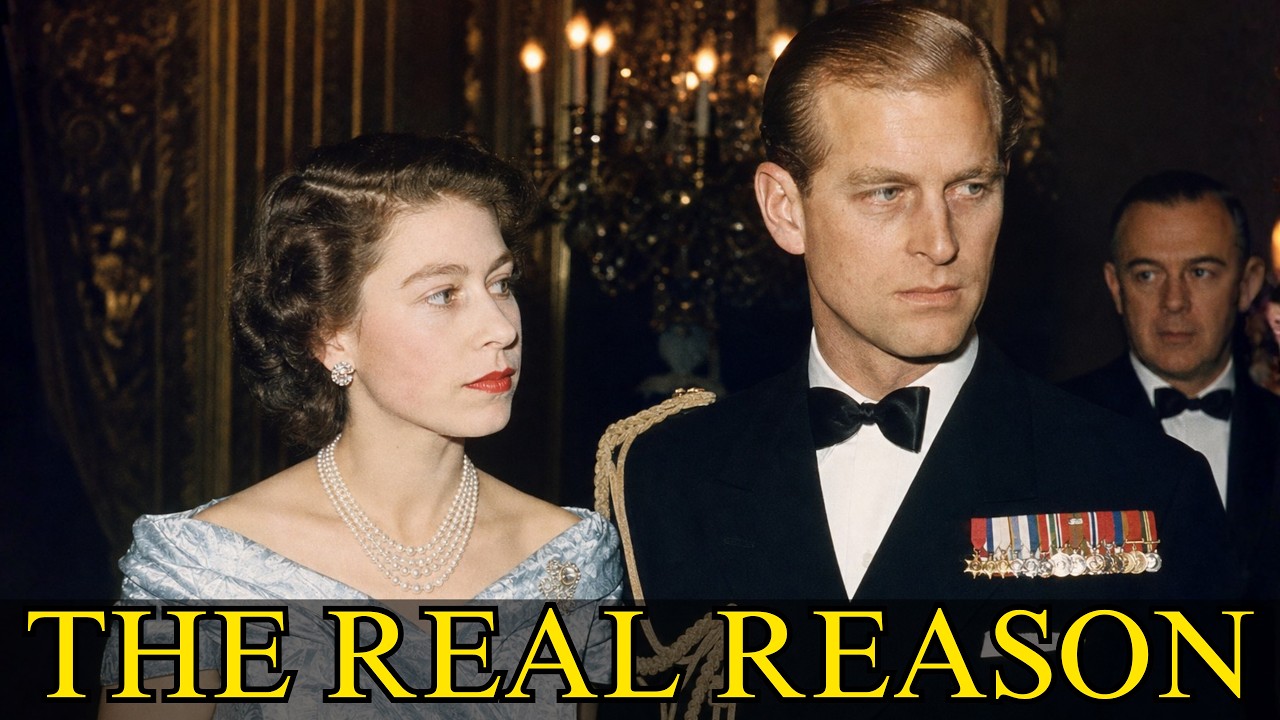
It would answer. By the autumn of 1956, the royal marriage had settled into a shape the whole world could see and almost no one could read. The queen was thirty years old, four and a half years into her reign, a mother of two small children—Charles, seven, and Anne, six—carrying the unending labor of the crown. Her husband was thirty-five, a man restlessly looking for a purpose in a house that was not his own.
He had been born a Greek prince on Corfu in 1921, raised in exile after his father was banished and his mother was placed in a sanatorium, passed between relatives, schooled in three countries, and taught early that anything he wanted he would have to earn himself. What he earned was a naval career of real distinction. He entered Dartmouth in 1939, passed out at the top of his term, served through the war from the Mediterranean to the Pacific, and at nineteen was mentioned in dispatches for his handling of searchlights in the night action at Cape Matapan. He rose to first lieutenant of a destroyer, and everyone who served with him assumed he would go all the way to the top.
But after his marriage to the heir to the throne, the sea began to close to him. In 1949 he was posted to Malta, promoted to lieutenant commander, and in 1950 given his own command, a frigate, the first and only ship that was ever truly his. Queen Elizabeth would later say that those years in Malta were the only stretch of ordinary married life she ever had. It ended in the summer of 1951 when the king’s failing health required the couple to take on public duties.
Philip took leave, handed over his ship, and never went back. The day his wife became queen cost him the last thing that was his own. He was in Kenya when word arrived that her father was dead. It fell to him to break the news, walking her out into the garden of the lodge to tell her gently.
He understood at once what her accession would cost him. Before the accession, the family had lived at Clarence House, where the household had been very much his show. At Buckingham Palace, all that changed. The palace was an institution run by courtiers formed in the Edwardian age who had no intention of letting an energetic outsider of thirty change it.
Philip was constantly being squashed, snubbed, and wrapped over the knuckles. He lost even the right to give his name to his own children when the royal house remained the House of Windsor against his wishes. He said he was nothing but a bloody amoeba, the only man in the country not allowed to give his name to his own children. He said at times that constitutionally, he did not exist.
Instead of sinking into resentment, he went looking for work. He took over the running of the royal estates, fought and won the battle to have the coronation televised against the wishes of Churchill himself, and in 1956 founded the award scheme for young people that still carries his title. It was into this hunger for a purpose of his own that the invitation arrived. The Olympic Games of 1956 had been awarded to Melbourne, the first time in history they were held in the Southern Hemisphere.
The queen could not travel, but her husband could go in her name. Since he was going all that way, he might carry the flag onward through the loneliest corners of the Commonwealth aboard the new royal yacht, Britannia. To the courtiers it was a neat solution to a scheduling problem. To Philip, it was a mission that was genuinely his, on the sea, reaching places the queen herself would never see.
He said yes. On the twenty-second of November, he stood in a packed stadium in Melbourne and opened the games in his wife’s name. From Melbourne the ceremonial gave way to a long, deliberate reaching out to the ends of the earth. He came to New Zealand, called at Norfolk Island and the Chatham Islands, each landfall taking him deeper into distance.
Then came Christmas, and the most revealing moment of the whole absence. The queen delivered her Christmas broadcast alone, with her husband thousands of miles away at sea. She spoke of him directly, saying none of the voices she had heard that afternoon gave her and her children greater joy than that of her husband. If he could not be home on Christmas Day, she said, she could not wish for a better reason than that he should be traveling in other parts of the Commonwealth.
The broadcast turned the separation into a virtue for the listening millions. But the very need to address the absence out loud told a different truth: the absence was already being noticed, already becoming a thing that required an answer. In January 1957, Britannia crossed the Antarctic Circle. Philip became the first member of the royal family to do so.
He touched Tristan da Cunha, perhaps the most isolated inhabited island on earth, and other specks of British land across the southern ocean. By the time she came home, Britannia had logged more than seventy-two thousand sea miles. No consort in living memory had been away so long, and the length of it was without precedent. Out in the wider world, and especially in the foreign press, a question began to form: what kind of marriage sends a man to the bottom of the world for a third of a year?
The answer was about to be supplied by the man standing at Philip’s side through all these lonely weeks. Michael Parker was an Australian naval officer who had met Philip in 1942, and they became fast friends in the way men who have shared danger do. After the accession, Parker became Philip’s full-time private secretary, the man who ran his working life. For a decade he was closer to Philip than almost anyone outside the marriage itself.
But the job was never truly off duty. He traveled when the Duke traveled, and he was expected to drop everything at any hour. His wife, Eileen, lived a marriage that always came second to the crown. While the two men sailed through the Pacific and the Antarctic, her marriage was ending.
In the early days of February 1957, she made it public. She and Michael were to separate, and in time she would seek a divorce on the grounds of adultery. The threat to the palace was contamination. A divorce breaking out at the very heart of the Duke’s staff could splash upward onto the master.
When Britannia reached Gibraltar, Parker resigned. He gave up his post on the sixth of February, so that the divorce breaking around him would fall on a private citizen and not on a member of the royal household. A photograph survives from that day, showing the two friends standing side by side for the last time in that role. The machine had sacrificed a friendship to protect the crown.
Two days later, on the eighth of February 1957, a London correspondent for the Baltimore Sun filed a report that gathered up everything the deferential British press had been too careful to print. The headline spoke of a rift between the queen and the Duke, and it hung that rift on a phrase that raced around the planet within hours: a party girl. The story joined the long absence, the raffish half-world of a Soho lunch club Philip attended, the sudden resignation at Gibraltar, and insinuated a reason. The wire services picked it up and carried it everywhere.
Within days the story was in newspapers around the world. Not one hard fact in it could be stood up. Every element of it was insinuation, built from true small details into a false large conclusion. No affair was ever proven then or in all the decades since.
The men who ran the palace faced a decision without precedent. For a hundred years, the answer to every question about the sovereign’s marriage had been silence. Never complain, never explain. The queen’s press secretary was Commander Richard Colville, a naval officer of the old school whom Fleet Street called the Abominable No Man.
Now the palace did the thing it never did. On or about the eleventh of February, it issued a flat, public, unmistakable denial. It was quite untrue that there was any rift between the queen and the Duke. After a hundred years of never explaining, the most silent institution in Britain had broken its silence in a single sentence.
The denial was a sign not of weakness in the marriage, but of panic in the institution. What it denied was the rift, the one thing the household could speak to with authority because the household was close enough to know. Rather than wait for him to come home, the queen flew out to meet him. They were due to make a state visit to Portugal, and so it was arranged that they would come together in Lisbon on the sixteenth of February, only days after the denial, in the full light of the world’s press.
By flying out to meet him, she rewrote the picture at a stroke. The story the world would see was no longer a husband slinking home under a cloud, but a wife crossing a continent to throw her arms around the man she loved. Observers noted as the couple came out together a smudge of lipstick on the Duke’s cheek, a small unstaged detail that did more to answer the story than any official denial. The denial had been words.
The reunion was a picture. Within days the story was sliding off the front pages. On the twenty-second of February 1957, at the height of the rift story, the queen declared that the Duke of Edinburgh should henceforth be known as a prince of the United Kingdom. When he had married into the royal family a decade before, he had renounced his foreign titles and become formally simply a duke.
For ten years he had been a prince in name and courtesy, but not in the strict letter of the law. Now, at the precise moment the world was questioning her marriage, the queen raised her husband higher. A woman does not elevate a straying husband at the very moment she is supposed to be discovering his betrayal. The gesture said in the only language a monarch truly commands that the marriage was sound and the rumor was refuse.
The deeper wound over the family name took three more years to reach its peace. In the early spring of 1960, the queen confirmed that her own descendants would bear the joined name Mountbatten-Windsor, the compromise Philip had wanted for eight long years. It came only eleven days before the queen gave birth to their third child. After years of feeling like the only man in the country forbidden to give his name to his children, he was granted at last a share of it on the eve of another child’s arrival.
The winter of 1956, stripped of the drama, leaves a harder and quieter truth. The strain in the marriage was real and well documented: the temper, the thrown tennis racket at a reservoir in Australia, the reel of film burned to keep it secret, the long grievance over the name. But strain is not collapse. Not one of the affairs the rumor mill attached to Philip was ever proven.
The very woman whose work was most often blamed for keeping the innuendo alive called the whole thing nonsense, complete nonsense, and said she did not believe there had ever been anything in any of it. Philip’s own answer remains the hardest to argue with: for forty years he had never been able to move anywhere without a policeman at his side. How could he possibly have gotten away with anything? The rift story was a structure of insinuation raised on a foundation of the mundane.
When the winter passed, the structure fell down because there had never been anything holding it up. The palace had broken its silence on a kind of faith, defending a marriage whose strength it could not yet prove to a skeptical world. Time proved it. The marriage lasted seventy-three years, the longest of any sovereign in the history of the British crown.
At their golden wedding in November 1997, the queen rose at the anniversary lunch and said the truest thing anyone ever said about the marriage: he had quite simply been her strength and stay all these years. Philip died at Windsor Castle in the spring of 2021, two months short of his hundredth birthday. The queen followed him the next year, and they were laid together at last, side by side. A foreign newspaper had once printed in bold black type that this marriage was cracking apart over a party girl who never existed.
The marriage went on to last seventy-three years and to end only with death. The rift story was smoke. The strength and stay were real.
And the palace that broke its silence to say so, for once in its guarded history, had told the plain truth.