In the last weeks of December 1943, Japanese gun crews on the ridges east of the Tokina River worked their howitzers forward into the high ground, moving a few hundred yards at a time through country without roads. The heaviest of those pieces were 150 mm guns, and from their positions the American beachhead lay open below them. There was a great deal to look at. The inland face of the perimeter ran 22,500 yards and had been completed on the 15th of December.
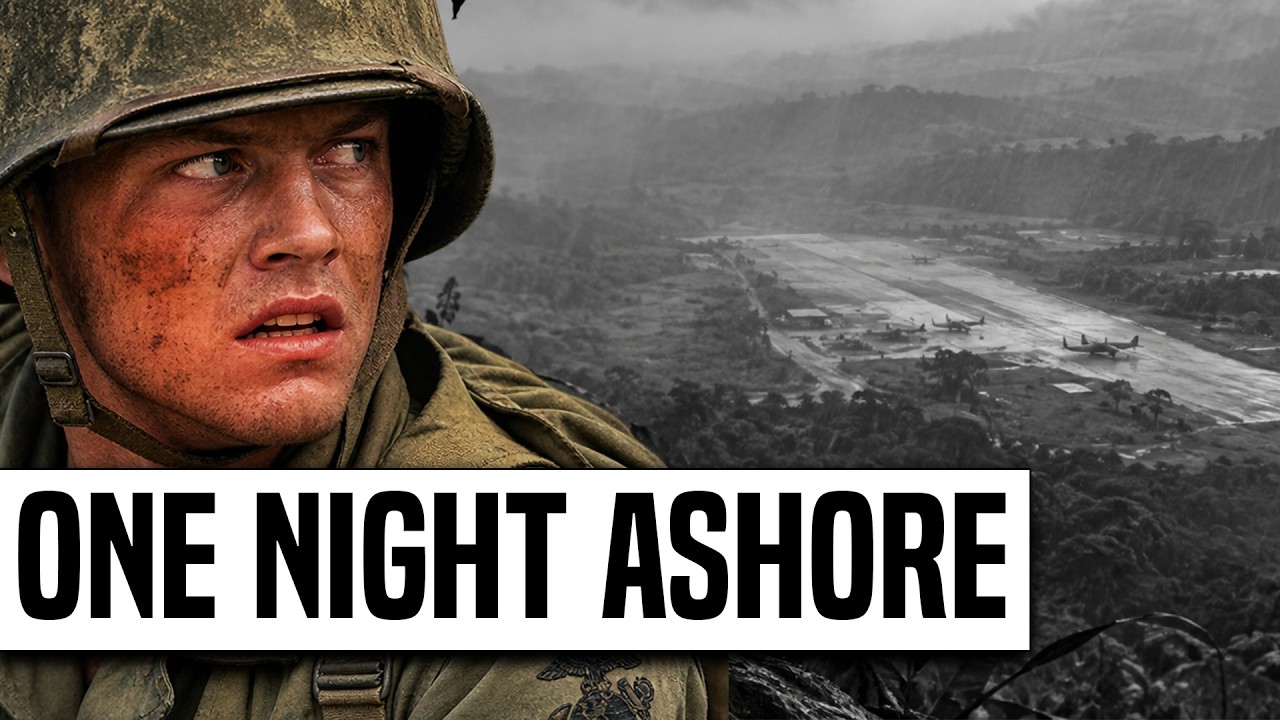
Inside it stood more than 44,000 men. Three airstrips were going into the flat ground behind the beach, one of them already taking aircraft, and around them sat the fuel, the ammunition, the ration dumps, the sawmills, and the drainage ditches of a base that had not existed eight weeks earlier. On the 29th of November, the gunners on the ridge had managed to drop shells on the airfield site from extreme range, which was about as much as that position was ever going to achieve. By the 17th of December, the Solomons Air Command counted 199 fighters, 200 light and medium bombers, and 99 heavy bombers in working order—roughly twice what Japan held in the whole southeast area.
Four days later, a battalion of Fijian infantry came ashore at Empress Augusta Bay with orders that had nothing to do with any of that. The unit was the First Battalion of the Fiji Infantry Regiment, and by the American count it had 34 officers and 777 Fijian soldiers. Half the officers were New Zealanders. Three of them had gone up as instructors in November 1939 and simply stayed.
Their commanding officer, Lieutenant Colonel Taylor, had fought with the New Zealand Division in Egypt and France in the First World War before joining the Fiji administration. He flew up from Munda on the 20th with his adjutant to talk to the American command. That evening, Japanese aircraft came over the perimeter, and Taylor was hurt badly enough to be taken off the island. He had been on Bougainville for one night.
Command passed to his second-in-command, Major Jeffrey Upton, who was promoted and who kept the battalion for the rest of its fighting life. Upton had been meant to reach Fiji in the middle of 1940. He arrived a month behind schedule because the ship he was traveling in, the Niagara, struck a mine outside Auckland Harbor on the 19th of June and went down. Eight days after the landing craft grounded on the 29th of December, a party of 204 men under a New Zealand officer, Captain Freeman, walked out through the American wire and started up the new Numa Numa trail.
Their destination was a mission station called Ibu, thirty miles beyond the perimeter and 1,700 feet up in the Crown Prince Range. The march was reckoned at five days. Every man carried a full pack, four days of rations, and extra ammunition, and the trail had to be searched ahead of the column the whole way. The reason a battalion did that in a beachhead holding two hundred aircraft and forty-four thousand men sits in the American paperwork, and it is not flattering to the aircraft.
Air observation over that country could not resolve ground movement. The canopy shut over everything underneath it, and photographs of a jungle ridge showed a jungle ridge. Every piece of intelligence that mattered about the Japanese 17th Army east of the perimeter came from men walking through it and coming back. A reconnaissance patrol from the 37th Division had already got a little over halfway to Ibu and recommended the place.
The Fijians and their New Zealand officers were being asked to finish the job on foot. The battalion started patrolling on Christmas Day in country as thick as anything in the Solomons. First contact went to a New Zealand subaltern, Second Lieutenant Macdonald, whose patrol accounted for seven Japanese. The standing order at that stage was to avoid a fight unless forced into one, since a patrol that shoots announces where it has been.
The battalion history, written after the war by one of its own New Zealand officers out of platoon commander reports, gives the logic in nine words: information was of more value than limited enemy casualties. The Americans seem to have been fascinated by the newcomers. The United States Army history breaks off from the operational narrative to note the Fijians’ turnout, their height, the precision of their marching, and their singing, which ran from Fijian songs through Onward Christian Soldiers to Pistol Packin’ Mama, also in Fijian. While the Fijian patrols were going out on the 25th, the perimeter behind them had just ended a piece of business that had been running for three weeks.
Three days before they landed, on the 18th, the 21st Marines had taken a spur of high ground east of Hill 1000 that did not appear on the terrain maps at all. The Marines named it Hellapoppin Ridge. They also called it Fry’s Nose and Snuffy’s Nose, after the battalion and regimental commanders whose problem it had become. Then, on the day the Fijians came ashore, a marine patrol found between fourteen and eighteen Japanese dug in on a knoll near the Tokina River called Hill 600A.
A fighting patrol went up to clear them off and came back down having lost one man killed and one hurt. The following morning, a platoon climbed to put an outpost on the crown of the hill, and small arms fire from men who had reoccupied the position overnight blew it straight off again. A company went up to reinforce, tried a double envelopment, found the reverse slope held, and spent an ugly stretch pinned between the Japanese line and its own supporting fire before it worked itself free. A day later, another company attacked with a heavy machine gun platoon attached and was stopped.
It pulled back, called for artillery, sat through half an hour of shelling that mostly burst in the treetops, then attacked twice more, and stopped twice more. On the morning of the 24th, scouts went forward ahead of a fourth attack. The hill was empty. They counted twenty-five covered emplacements on it and one dead Japanese soldier.
The guns had damaged a handful of the bunkers. Over two days, the Marines lost four killed and eight hurt, taking a position whose garrison walked away from it in the dark. That is what the perimeter looked like from the inside. The New Zealand officers were issuing patrol orders during the first week.
Three days later, the 9th Marines came out of the line and the 164th Infantry took their place. The next afternoon, the 132nd took over the third regiment sector, and the Army held ground the Marine Division had kept since the first week of November. The Army history says the departing Marines were seen off by one of the island’s frequent earthquakes, which by that stage of the campaign was not worth stopping work for. Not all of them went.
The 21st Regiment held its ground until the first days of January. The 3rd Defense Battalion kept its guns in the beachhead until the following June, and Marine squadrons flew out of the new strip all that time. What the Fijians and their officers had walked into was a piece of machinery finished about 72 hours before they arrived. Hellapoppin Ridge ran three hundred yards long with a crest about forty yards wide, and the Japanese company holding it had built its positions on the reverse slope with overhead cover and a defense facing every direction.
The Marines could not tell where the position began or ended. Their own artillery firing from the airstrip area almost due east kept throwing rounds over the ridge or bursting them in the trees above their own front line. Mortars were too light. Six days of attacks by every company of one battalion had achieved nothing.
On the 13th of December, the corps commander asked the Solomons Air Command for aircraft instead. Six Marine machines that had just landed on the new Torokina strip took on hundred-pound bombs and went against the ridge at dusk with smoke shells from 81 mm mortars marking the ground. Four of the six put their bombs where they belonged. The fifth dropped its load six hundred yards north of the ridge behind the Marine front line and killed two Marines and hurt five.
The sixth turned round and went home without attacking. The corps asked for another strike the following day. On the 14th, seventeen torpedo bombers flew the same mission differently. They landed at Torokina first, and the pilots were walked through the ground picture before they took off again.
Colored smoke grenades marked the friendly line, white smoke marked the ridge, and the aircraft attacked in column flying parallel to the Marine positions instead of across them. About ninety percent of the bombs fell where they were meant to. On the 15th, the thing was done again with eighteen aircraft briefed by the strike operations officer and a ground commander who then took off in a scout bomber and guided them in himself. On the 18th, they finished it.
A battery of 155 mm howitzers went into landing craft, moved to the mouth of the Torokina River, and set up to fire north along the valley so that shells could reach the crest and the far slope without crossing over the Marines on Hill 1000. The battery put about 190 rounds onto the ridge in an hour and stripped the brush off it. Two air strikes went in on the bare ground, the last aircraft staying overhead to make dummy runs and hold the defenders in their holes while the infantry moved. Two Marine battalions crossed the ridge in a double envelopment and finished the business in the afternoon.
The corps and the regiment had spent two days preparing that hour down to the registration shots fired in smoke before the guns settled on the crest. Twelve Marines were killed and 23 hurt. More than fifty Japanese bodies lay on the ridge. The two official histories do not agree about that day.
The Marine Corps volume has the ridge taken on the 18th of December after the artillery and the two strikes. The Army Green Book says the coordinated attacks resulted in its capture on Christmas Day. The same two histories disagree about the Fijians. The Green Book has the Ibu detachment leaving the beachhead on the 28th of December and the outpost set up on the 30th.
The New Zealand official history and the battalion’s own history both have the column stepping off on the 29th and reaching Ibu on the 2nd of January. Nobody has reconciled them, and the men who could have are gone. The New Zealand officers landed into a place where an airstrike could be put four hundred yards from friendly infantry as a matter of routine, and where a request for guns was answered by barging a battery to a rivermouth to change the angle of fire. All of it had been worked out in front of witnesses in six days by people who got it wrong first and had two of their own dead to show for it.
None of it could see through a tree. That is the gap the battalion was sent into, and every New Zealand officer in it understood the arrangement by the end of the first week. The Americans had firepower on a scale the New Zealanders had never been near. What the Americans lacked was eyes underneath the canopy, and the battalion’s value was going to be information rather than casualties.
Within a month, one of its patrol officers would walk over the Japanese coastal guns at Numa Numa in the dark, fly out of a mountain strip in a light aircraft, and ride in the aircraft at the head of the strike to point out what he had seen. The whole arrangement rested on one man going in to look and then coming back to say what was there. The rest of the machine the New Zealanders found had gone in just as fast. Japanese gunners made the mistake of emplacing on a forward slope on the 3rd of December, and counter-battery fire from three battalions of 75 mm howitzers, one battalion of 105 mm howitzers, and a battery of 155 mm guns smashed the position inside the day.
A day after that, two light aircraft reached the beachhead so artillery observers could work from the air, because the scout bombers doing the spotting flew too fast and carried too many blind spots to be any good at it. The fighter strip at Cape Torokina was fit for operations on the 9th. Seventeen Corsairs of a Marine fighting squadron flew in on the 10th and set up house on a field that had been swamp and jungle five weeks before. The Army history credits eight CB battalions and a New Zealand engineer brigade with starting that strip almost as soon as the beachhead existed.
The dry ground they were given was wanted by everybody, and units already squatting on it had to be evicted. That brings the thing back to the 1st of November 1943, to a stretch of shoreline with none of this on it. The assault waves went in across twelve beaches on an 8,000-yard front into a shore so unsuitable in places that the New Zealand official history counts 86 landing craft stranded during the operation. Seventy-eight Americans were killed on the first day and 104 were hurt.
Behind the sand lay swamp, tidal lagoon, and reeds higher than a man. And behind that, the mountains where the Japanese 17th Army held the island with a strength then put at around 40,000. The perimeter, the road net, the three strips, the depot, and the cemetery all sat in the future. The corps was there to take a patch of bad ground and build airfields on it.
Nobody on that beach on the first morning could have said whether the patch would still be American in February. The men who would learn to bomb a forty-yard crest with their own infantry on the next ridge were that morning lying in wet sand under mortar fire, trying to get inland far enough to dig.