On August 7, 1942, the first day of the American landings on Guadalcanal, a civilian plantation manager named Paul Mason sat on Malabito Hill at the southern tip of Japanese-held Bougainville Island, watched a formation pass overhead, and sent the sentence American commanders had been waiting for every morning: twenty-four bombers heading your way. Mason had a radio, a pair of binoculars, and no way off the island. The warnings from Bougainville gave Henderson Field forty to forty-five minutes of notice before an attack arrived, sometimes considerably more. That window was all the defenders had.
The Cactus Air Force, as the ad hoc collection of Marine and Navy aircraft on Guadalcanal was called, owed its survival in the skies over the island to a network of civilian coastwatchers operating behind Japanese lines. Mason was one of them. Roughly 350 miles to the north, at the other end of the same island, a former district patrol officer named Jack Read watched the same aerial traffic from a hideout at Bura Bura. His position overlooked the Buka Passage, Buka Island itself, and the channels running southeast through waters the Americans called the Slot.
Every bomber flight from Rabaul had to cross that region. Read’s reports reached Guadalcanal about thirty minutes before Mason’s, and more than an hour before stations farther south, because he was closer to the point where formations assembled with their fighter escorts. Above Bura Bura the aircraft were still low, still climbing, and still maintaining formation, which allowed Read to count them and identify their types. Not just approaching aircraft, but nine bombers and eighteen fighters, the kind of information a fighter director needed before deciding how much of his force to commit and how much to leave the field uncovered.
The warning system that protected Henderson Field depended on six- or seven-word radio messages sent by two men who were not in the United States armed forces. Above twenty thousand feet, the Grumman Wildcat climbing from Guadalcanal gained about five hundred feet per minute. The bombers it had to intercept arrived at twenty-five thousand feet, sometimes higher. The math was straightforward.
A fighter taking off from the ground needed nearly forty minutes to climb above formations that had already reached their altitude by the time they crossed the coast. Through all of August 1942, there was no radar on Guadalcanal at all. The first set arrived on September 2, four weeks into the campaign. The Marines had grown accustomed to operating without it.
Instead, they had a plantation manager with a wireless set. In Guadalcanal, the messages arrived at a wooden building the Japanese had erected before the Marines seized the airfield, a single-story structure the Americans called the Pagoda. It sat on a rise about two hundred yards northwest of the runway and served as both observation tower and air operations center. The first warning signal was a captured Japanese whistle, which proved useless because in such a confined area the sound of the whistle arrived at the same moment as the bombs.
Construction battalion sailors mounted a flagpole over the Pagoda instead. A white flag meant bombers were on the way. A black flag meant two minutes or less, or that they were overhead. No flag meant nothing had been spotted yet, which on Guadalcanal usually referred to two hills three hundred miles away rather than the sky directly above.
Brigadier General Louis Woods, who ran the Cactus Air Force during its worst weeks, considered placing the air operations center on the most prominent hill on the island a poor decision. The Japanese eventually leveled the building. The runway those fighters took off from was worse than its reputation. Japanese engineers had started work on the field from both ends and left a gap in the middle roughly sixty yards wide.
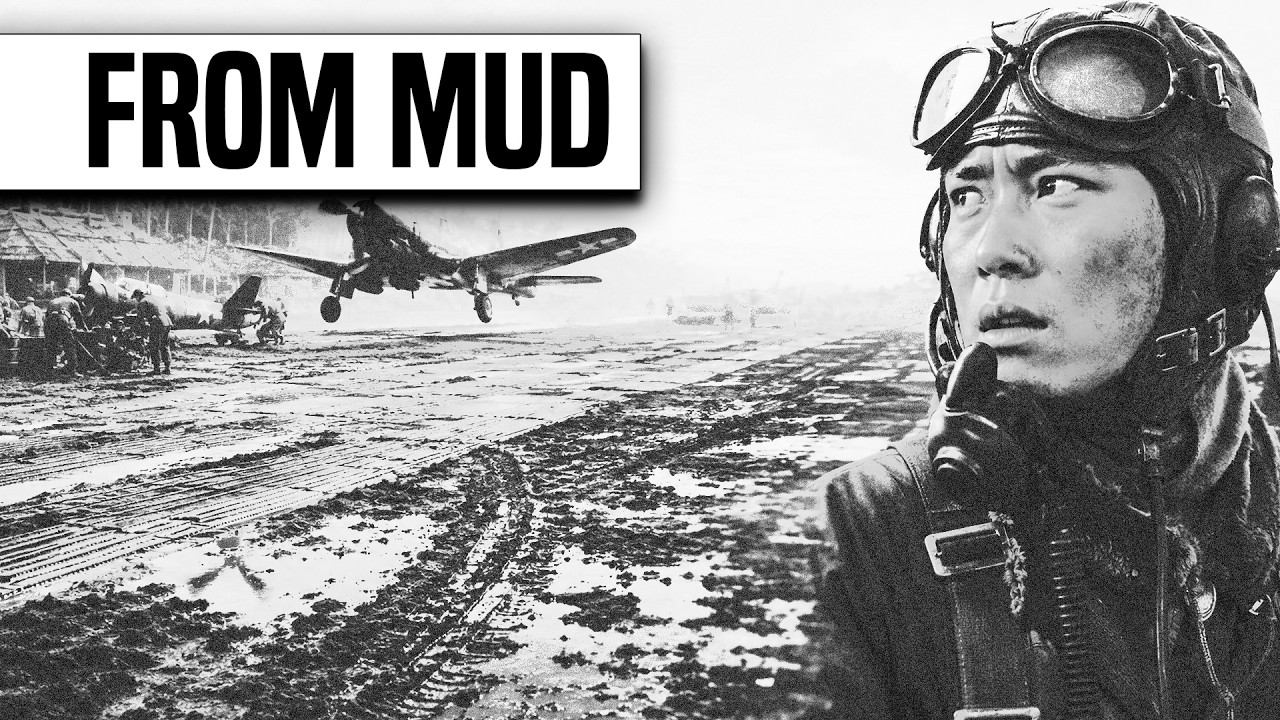
The Marines’ first task was moving five thousand cubic yards of earth with hand tools and captured dump trucks, leveling it with a captured road roller, and surfacing it by dragging a steel beam. The entire field sat in a bowl, so rainwater collected and stayed. Vandegrift declared the field ready for fighters and dive bombers on August 12. There were no taxiways, no reinforced shelters, no drainage system.
Perforated Marsden matting covered a thousand feet of the runway to provide traction on the soft ground, while the rest was packed earth that turned to black mud after an hour of rain and then crumbled under the sun into fine dust capable of destroying any engine. Colonel Fiske Marshall, arriving in September to take command of Marine Air Group 25, said the place looked like a Dore drawing of hell. Captain Dale Brannon of VMF-67 took off with Bell P-400s from that surface. His technique involved setting flaps to half flap for extra lift, standing on the brakes, running the engine up to maximum power, and letting the aircraft drag itself through the mud while the brakes remained locked.
Then he released the brakes and began to steer. In the first weeks, the runway caused nearly as many aircraft losses as the Japanese did. There was a secondary strip nearby, officially called Fighter One but known to everyone as the Cow Pasture, because it had no matting at all, just a strip of mowed grass. The men taking off from that ground were beginners.
Lieutenant Colonel Richard Mangrum reviewed the flight records of his new pilots before the squadron sailed and found that none of them had more than two hundred hours of flying time. The average for the Japanese aircrews coming from Rabaul was around eight hundred hours. What those forty minutes bought was a specific tactic developed by Major John L. Smith of Marine Fighting Squadron 223.
The Wildcat could not fight the A6M Zero on equal terms, and Smith did not attempt it. He trained his pilots to climb ahead of the incoming formation and to one side, then turn sharply into the opposite heading at five thousand feet above the bombers, roll inverted, and attack by diving through them. This angle put the Wildcats outside the defensive guns of the Betty bombers and allowed direct hits on fuel tanks without giving the bombers an effective way to stop the attack. After the first pass, the fighters turned left in a climb and watched the situation.
If the escorts had not arrived, they repeated the attack. If they had arrived, the Wildcats dove away toward the antiaircraft batteries over the airfield or hid in the clouds, because the target was the bombers, and taking on a Zero meant almost certain death. Every part of that depended on being at five thousand feet above the formation before it arrived. October 2, 1942, proved what happened when that condition was not met.
The war diary of Marine Air Group 23 recorded an air raid warning at 12:30 that day, with radar reporting a squadron of small fast aircraft approaching Henderson Field. Fourteen Wildcats from VF-511, eleven from VMF-224, and seven dive bombers took off. Half an hour later, about thirty Zeros were engaged over the airfield. The Japanese had sent fighters instead of bombers, which meant a faster approach and a smaller radar return, and the thirty-minute warning was not the same as forty.
The Wildcats were still climbing when the Zeros dove on them. Four Zeros were shot down. Six American fighters were lost, and only two of their pilots survived. One of the men shot down that afternoon was John Smith.
He emerged from a cloud to find three Zeros ahead of him, destroyed one, took cannon fire from the other two, lost his engine, and landed his aircraft in kunai grass four miles east of the airfield. Marion Carl had radioed a warning to him using a radio salvaged from a wrecked dive bomber. The man who figured out how to shoot down Betties from above spent that engagement beneath everyone else. Warning time was the decisive variable, not the warning itself.
The SCR-270B radar that arrived on September 2 could detect high formations at 150 miles, which in theory made the men on Bougainville unnecessary. In practice it did not. Radar gave direction, distance, and approximate altitude. It could not tell the fighter director whether the target was a full bomber strike with escorts of equal size or a single reconnaissance aircraft.
That difference determined whether the Cactus Air Force launched everything it had or held most of it in reserve. When twenty-five Betties and fifteen Zeros attacked on September 12, the airfield launched twenty Wildcats based on both sources at once, the radar and coastwatcher Donald Kennedy in New Georgia. Neither alone would have served the purpose. Sixteen days later, with both reporting again, thirty-five fighters took off against a comparable Japanese force of bombers and escorts.
The escort lost eight of its number without protecting the formation it had come to guard. Between late August and mid-November, the Japanese lost roughly ninety-six fighters, ninety-two Betties, and seventy-five other aircraft over that stretch of water. The Cactus Air Force lost 118 aircraft shot down, wrote off another thirty to accidents, and had eighty-four pilots killed from all causes. The raids were expected without any warning at all.
Rabaul lay roughly 560 miles from Guadalcanal. A Betty that flew that distance and returned before dark had no fuel to spare for detours and no daylight to wait. Formations arrived most days between 11:30 in the morning and 2:30 in the afternoon, a schedule so precise that the Marines called it Tojo Time and set their watches by it. Any commander with a map and the range figures for the G4M could tell his pilots roughly when to be airborne.
The clock told the Marines when. What it did not tell them was the number, the type, or whether this was the morning the Japanese decided to send everything they had. In late October 1942, Japanese command took a firm position on the coastwatchers. They had to be eliminated.
It was known the two men were hiding somewhere in the jungle at opposite ends of Bougainville. One hundred soldiers moved toward the Buin area to hunt Mason, bringing tracking dogs with them. Mason’s response was a radio request to Guadalcanal asking for the dogs to be bombed. A Catalina arrived and bombed Buin.
The dogs were in their cages at the time. Others paid a far higher price for the network than the two men on the hills. In January 1943, the Japanese gathered the local people around Kieta and executed the paramount chief Barus in front of them, after he had sheltered Allied personnel in his village and refused to reveal where Mason was hiding, refusing again when given a final chance to answer. By July 1943, the Japanese had sent enough infantry to make the hills untenable.
An American submarine evacuated Mason and Read. Mason had lived on Bougainville for seventeen years by then, arriving in 1925 to manage the Aenos plantation after its previous manager was killed by his workers. He had a knack for repairing radios. Read had arrived in November 1941 as assistant district officer for the Buka Passage subdistrict, and when civilian administration closed in February 1942, he was the last government man left on the island.
Neither had been trained for any of this. Both received paper commissions in the Royal Australian Naval Volunteer Reserve on the theory that naval rank might protect them if captured alive, which none of those involved believed for a moment. Mason returned in 1944 to run guerrilla operations against the same garrison that had spent a year hunting him. He died in Brisbane in 1972.
The airfield had been named for Major Lofton Henderson, a Marine dive bomber pilot killed at Midway. Major Kenneth Weir pushed the name through and gave a reason having nothing to do with remembrance. If he had not, the field would have been named for some old man with a big belly behind a desk in Washington. The Marines kept the airfield.
The two men who made keeping it possible spent the campaign three hundred miles up the chain on two hills, watching and sending sentences like the one Jack Read broadcast one August morning: forty-five dive bombers coming from the southeast.