The American frontier did not end with a gunshot. There was no final showdown on a dusty street, no last stand that legend could seize upon as a defining moment. Instead, it ended with a sentence. A single sentence written by a government statistician named Robert Porter in the 1890 census report, stating that the unsettled areas of the United States had been so broken up by isolated settlements that a distinct frontier line could no longer be said to exist.
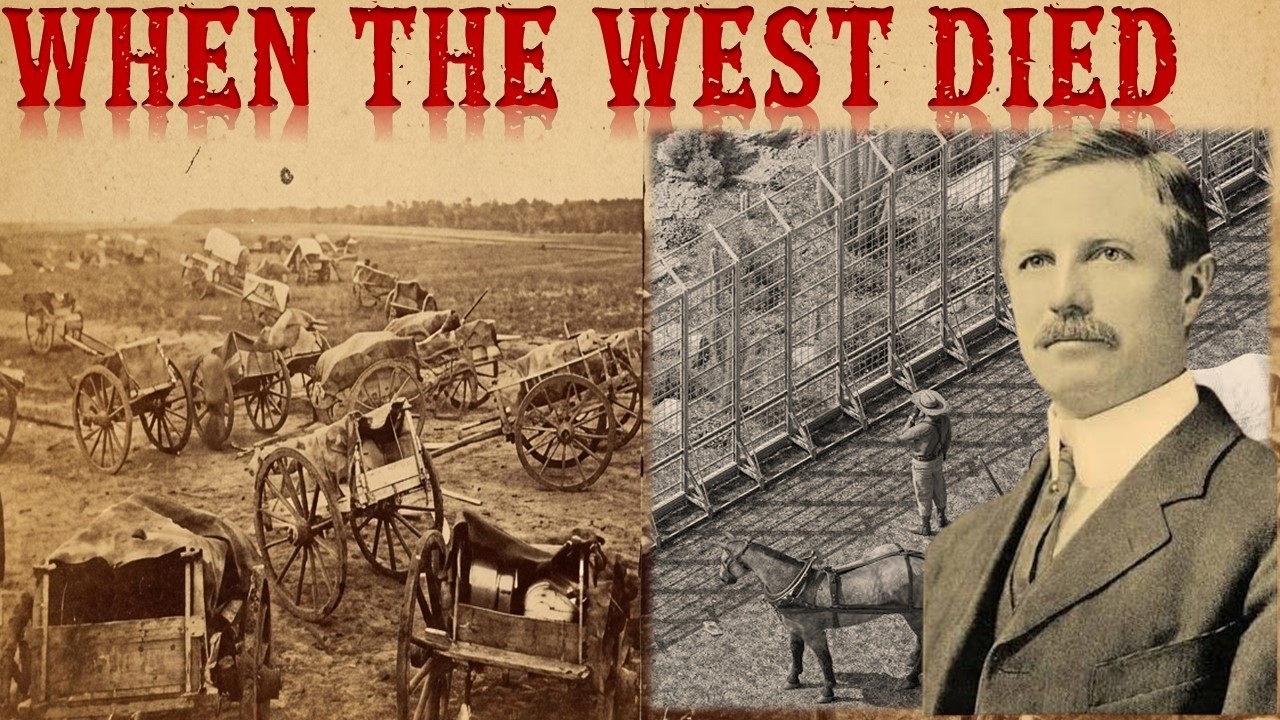
That was it. The frontier, that legally defined geographic line between settled and unsettled American territory, which the Census Bureau had tracked and reported on since 1790, was gone. It had not been conquered or torn away. It had been measured, counted, and declared extinct in the dry administrative language of an official government document.
The Wild West did not end. It was counted out of existence. The 1890 census documented what people living in the frontier era had been witnessing for twenty years without having the words to describe it. The open range was closing, not in one place or one season, but across the entire Western landscape at once.
The specific, brutal, economically driven process of barbed wire, settlement claims, and railroad expansion had transformed open land into divided, registered, legally bounded private property. The defining feature of the frontier, the ability to move freely across unfenced land, could not survive that transformation. The cattle drives were already finished. The last significant drive along the Chisholm Trail had taken place in 1884.
The Big Die-Up of 1886 and 1887, the catastrophic winter that killed between fifty and ninety percent of the cattle on the northern plains and destroyed the open-range cattle industry in a single season, accomplished in four months what a decade of settlement pressure had been preparing. The open-range economy built by the cattle drive era collapsed under overgrazing, barbed wire, and a winter that the mythic version of the frontier had prepared no one for. The buffalo were gone. There had been thirty million of them in 1870.
By 1889, fewer than a thousand remained. The industrial slaughter, endorsed by Sheridan as policy toward the Indians and financed by the hide market, accomplished in two decades what no natural process had done in ten thousand years of the animals’ presence on the continent. The Indian Wars were drawing to a close. On December 29, 1890, three weeks after the census report declared the frontier closed, the Wounded Knee Creek witnessed the deaths of between 250 and 300 Lakota men, women, and children in the snow of a South Dakota winter.
It was the last significant military engagement of the Indian Wars. The resistance that had required the army to fight on the frontier for twenty-five years was over. The frontier was not won. It was consumed.
Frederick Jackson Turner read the census report and grasped its implications before almost anyone else in American public life. He presented his paper, “The Significance of the Frontier in American History,” at the World’s Columbian Exposition in Chicago in July 1893. His argument was simple, and its cultural impact was enormous. Turner argued that the frontier had been the engine of American democratic character, the place where the European institutions that immigrants brought with them were stripped away by the demands of the wilderness and replaced with something uniquely American: individualism, practical intelligence, and the democratic instinct of men who had no one to rely on but themselves, and who therefore developed the self-reliance that democratic citizenship required.
The frontier was closed. The engine was gone. What Turner did not say, and what the myth that followed him consistently refused to say, was what else had been consumed in producing that democratic character: the peoples whose lands the frontier had crossed, the cultures whose material foundations the frontier had systematically destroyed. The specific human cost of running the democratic engine was paid by people who had never agreed to pay it and received nothing from the process but its consequences.
The men who had been the human expression of the frontier did not disappear when the Census Bureau announced that the frontier line had faded. They aged. They adjusted or they did not, and they became what the myth was already building: the last representatives of a vanished world, living artifacts of something the nation was turning, even as they breathed, from lived experience into legend. Wyatt Earp lived until 1929.
He died in Los Angeles, in a house, in his bed. His final years were spent advising the early Hollywood film industry on what the frontier had actually been like, watching the industry transform what he told them into something far more satisfying than the true story. Geronimo died in 1909, in captivity at Fort Sill, Oklahoma, where he had been held as a prisoner of war for twenty-three years after his surrender in 1886. He was allowed to ride in Theodore Roosevelt’s inaugural parade in 1905, a peculiar irony: a man imprisoned for twenty-three years, displayed as a trophy of the civilization that imprisoned him at that civilization’s celebration.
The last cattle drive. The last gunfight. The last Indian war. These endings did not arrive together in a single date.
They came across the two decades of the 1880s and 1890s, in the specific, gradual, overlapping way actual historical periods end, not with a sharp break but with an accumulation of last times no one recognized as final while they were happening. The frontier ended the way all things end when they are too vast and too embedded in daily life to expire dramatically. In its place came fences, railroads, and legally defined, permanent private property, which the Homestead Act, barbed wire, and surveyors’ stakes had been building across the open land for thirty years. The myth came to fill the void the frontier left behind.
Buffalo Bill’s Wild West show was already touring when the census declared the frontier closed, turning the recent past into entertainment and building an image of the frontier the country needed now that it was gone. The Wild West did not end. It became a show. And the show, that specific, artificial, deliberately simplified, romantically exaggerated version of what the frontier had been, proved more enduring than what it replaced.
The frontier had lasted thirty years. The myth has lasted a hundred and fifty, and it is still running.