Janet Norton Lee did not raise her daughters so much as train them. Born in Manhattan in December 1907 to James T. Lee, a powerful real estate developer, and Margaret Merritt, she grew up watching wealth fail to buy what mattered most in early twentieth-century New York: lineage. Her parents were children of Irish Catholic immigrants, and the Protestant Anglo-Saxon elite who controlled high society regarded the Irish as servants no matter how much money they accumulated.
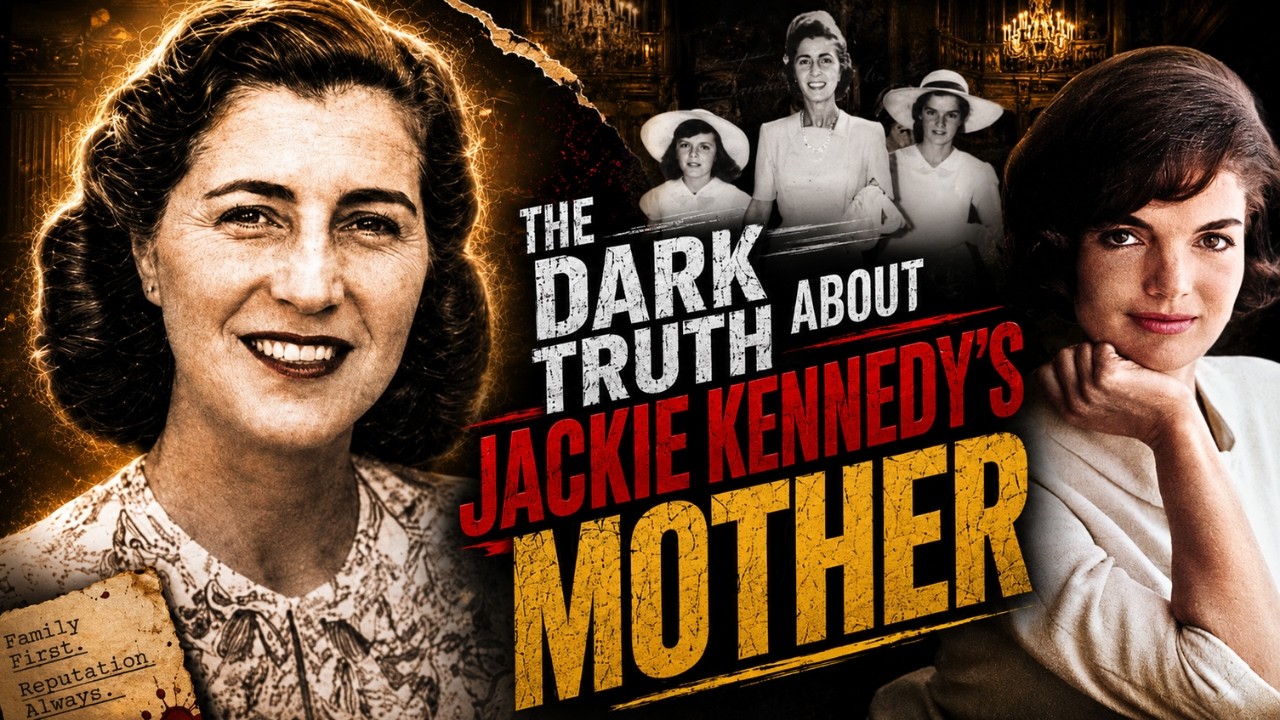
Janet absorbed this rejection not as rebellion but as calculation. She decided to erase her origins entirely. She stopped speaking of her grandparents and began claiming direct descent from the aristocratic Lee family of Maryland and Virginia, the family of Confederate General Robert E. Lee.
She repeated the lie until it became accepted truth. She attended Miss Spence’s School, not for academics but to study the manners and accents of wealthy girls, then used her father’s money to dominate competitive horse riding, a sport reserved for the upper class. She won three major championships at the National Horse Show and secured board positions with the Redwood Library and the Newport Historical Society, cementing her fabricated aristocratic identity into legitimate institutions. Once her public image was secure, she needed a husband whose name would confirm it.
She found John Vernou Bouvier III, known as Black Jack, a charming Wall Street stockbroker with a reputation as a notorious womanizer. His family claimed descent from French nobility. They married in July 1928. It was never a love match.
High society gossip summarized it cruelly: she married him for his social standing, and he married her for her father’s bank account. Both were frauds. The Bouviers were third-generation immigrants, not aristocrats, and Black Jack believed Janet’s lie about her own background. The illusion lasted a year.
The stock market crash of October 1929 wiped out Black Jack’s fortune, and he descended into heavy drinking and reckless gambling. The couple had two daughters, Jacqueline in 1929 and Caroline Lee in 1933, but children did not calm him. His chronic infidelity became public and humiliating. When Janet opened a newspaper to find a photo of her husband holding another woman’s hand in public, the humiliation was complete.
In 1936 she separated from him and began a bitter legal battle that ended in divorce in 1940. The divorce left Janet facing the thing she feared most: poverty. The court awarded her one thousand dollars a month in alimony, a substantial amount by ordinary standards, but not nearly enough to maintain the aristocratic life she had so carefully constructed. She moved to New York and took a job as a fashion model, an unspeakable humiliation for a former society queen, and was forced to ask her own parents for financial help.
She cut grocery budgets and skipped meals so her daughters could keep a live-in maid and a tutor, understanding that once the girls realized they were poor, they would lose the confidence needed to control the world they were meant to inherit. She began looking for a second husband with the cold eye of a greedy investor. She found Hugh Dudley Auchincloss, known as Huddie, a quiet and unremarkable lawyer and former intelligence officer who was heir to a vast Standard Oil fortune. He owned Merrywood, a grand estate in Virginia, and Hammersmith Farm, a twenty-eight-room mansion in Newport, Rhode Island.
In June 1942 they married. It was a purely practical arrangement. Shortly after the honeymoon, Huddie revealed he suffered from chronic impotence. Janet saw this as a breach in the contract.
Without children, her connection to the Auchincloss wealth would remain secondary. In a time when artificial insemination was medically experimental, legally murky, and condemned by the Catholic Church, she secretly arranged the procedure. She gave birth to two children, Janet Jennings Auchincloss in 1945 and James Lee Auchincloss in 1947, binding herself permanently to the oil fortune. With her financial security guaranteed, Janet turned her full attention to her two daughters from her first marriage.
She treated their upbringing not as motherhood but as a military campaign. Her philosophy was absolute: luxury was not a preference but a biological necessity for survival. She designed what biographers later called the Geisha Curriculum, an intense, round-the-clock training program designed to turn Jacqueline and Lee into perfect instruments of social conquest. At meals in Merrywood, they were required to speak only French.
They were drilled in classical literature, Renaissance art, and European history so they could charm senators and foreign dignitaries at dinner parties. Riding horses was made a test of character. When Jacqueline fell off, she was ordered back on the saddle immediately, learning to hide fear and withstand pain without tears. Janet taught her daughters to manipulate men, to listen with intense attention that made them feel like the center of the universe, and to court the parents of potential husbands because parents controlled inheritances.
The training worked, but it came at a terrible cost. Janet resented her older daughter because Jacqueline closely resembled her father. She mocked Jacqueline’s hair, criticized her hands and feet, and shamed her for her shoulders. She made her daughter feel monstrous.
During divorce proceedings in 1940, a former maid testified under oath that Janet had beaten and hit her two young daughters. Jean and Lee were trapped in a gilded cage, dressed in fine clothes and educated in exclusive settings, but forced to navigate the volatile rage of a mother who saw them as assets to be managed. By the early 1950s, Janet had prepared Jacqueline for the highest level of American power. Her target was John F.
Kennedy, the charismatic young congressman from Massachusetts, whom his father was already grooming for the presidency. The Kennedys were Irish Catholics, the very people Janet had spent her life fleeing, but they had immense wealth and political ambition. Janet recognized that combining her carefully fabricated aristocratic line with the Kennedy political machine would create an invincible American dynasty. At a dinner party in May 1952, Jacqueline put her training to perfect use.
While other women fawned over the handsome congressman, she remained reserved, challenged him with sharp intelligence, and left him fascinated. Their courtship began. When Kennedy proposed with a diamond and emerald ring, Jacqueline hesitated, telling him she needed time to think, and left for London for a month to cover Queen Elizabeth’s coronation as a photographer. Janet was frantic.
When Jacqueline returned and accepted, Janet took complete control of the wedding plans for September 12, 1953, in Newport. The wedding was designed as a display of absolute aristocracy. Ann Lowe, a gifted Black fashion designer, was contracted to create Jacqueline’s famous dress, but when a flood destroyed the gowns ten days before the wedding, Lowe and her team worked around the clock to remake them. When Lowe arrived to deliver the dresses, staff directed her to the back service entrance.
She refused and insisted on entering through the front door. Janet later refused to mention Lowe by name, saying only that the dress was the work of a colored seamstress. On the morning of the wedding, Jackie’s biological father, Black Jack Bouvier, was reportedly heavily drunk in his hotel room. Historical accounts suggest Janet deliberately supplied him with alcohol the night before.
Whether she engineered his drunkenness or simply exploited his addiction, her response was decisive: she barred him from the ceremony and ordered her husband Hugh Auchincloss to walk Jacqueline down the aisle. Jacqueline, who adored her father despite his flaws, walked toward her marriage to a future president hiding immense emotional pain behind a fake smile. When Jacqueline became First Lady in 1961, Janet moved into a new role as the hidden manager behind the scenes. She was consulted on Jacqueline’s wardrobe, ensuring every Cassini suit conveyed the proper combination of modern elegance and aristocratic authority.
But her most important role was far darker. John F. Kennedy was a chronic womanizer, and Jacqueline was reliving her mother’s own marriage to Black Jack. When Jacqueline sought comfort, Janet offered no emotional consolation.
She taught her daughter to disengage emotionally and to exploit her husband’s guilt, demanding expensive jewelry and art whenever his affairs became humiliating. The image of the happy presidential family had to be maintained at any cost. Janet pursued the same ambitions for her second daughter. Lee, who had always lived in her sister’s shadow, set her sights on a Polish nobleman named Prince Stanislas Radziwill, known as Stas, in 1959.
The problem was that both Lee and Stas were divorced, and the Catholic Church did not recognize their civil marriage. Since John Kennedy was about to become the first Catholic president, Janet mobilized the full power of the Kennedy political machine and the Auchincloss wealth to pressure the Vatican, securing a rare and controversial annulment of Lee’s first marriage. Lee then styled herself Princess Caroline Lee Radziwill. In truth, Poland had abolished all noble titles in 1921, making the title legally meaningless, but Janet understood that if one insists on being called a princess with enough money and clothes to back it up, society will eventually bow.
Janet’s support had limits. In the early 1960s, Lee fell passionately in love with Aristotle Onassis, a Greek shipping billionaire with a scandalous reputation. While still married to Radziwill, Lee began an open affair with Onassis, who lavished her with wealth and took her on his yacht. Lee was ready to divorce her husband.
Janet saw Onassis not as a romantic partner but as a political liability. John Kennedy was preparing for the 1964 reelection campaign, and a sister-in-law divorcing a Catholic prince for a controversial businessman under investigation by the Justice Department was unacceptable. Janet traveled to Europe, confronted Lee, and forced her to end the affair and return to her unhappy marriage. Lee complied but carried a deep resentment that would poison the family forever.
By 1963, Janet had achieved everything she had fought for. She had made a First Lady and manufactured a princess. But she had also been systematically pushed into the shadows by the Kennedy public relations machine. The administration promoted the mythology of Camelot, a youthful and vibrant image that left no room for a rigid Newport aristocrat.
Media coverage cast her as a cold, manipulative mother-in-law. When Lee Radziwill graduated from Concord Academy, photographs of the family ran in newspapers with Janet literally cropped out of the frame. She endured the insult silently, understanding that real power did not require headlines. In August 1963, Jacqueline gave birth to a premature son, Patrick Bouvier Kennedy, who died after two days.
Jacqueline fell into profound depression. When she accepted an invitation from Aristotle Onassis to recover on his yacht, Janet was reportedly furious, but she could not control the First Lady. Then came November 22, 1963. Janet was playing golf at the Chevy Chase Club in Washington when a staff member rushed to the course.
The president had been shot in Dallas. She dropped her clubs, called her husband, and went to Bethesda Naval Hospital. When Jacqueline arrived wearing her famous pink Chanel suit, stained with her husband’s blood, the First Lady had refused to change clothes, saying, “Let them see what they have done. ” Janet understood immediately that her daughter was transforming shock into historical accusation.
She did not try to force Jacqueline to change. She stood by her. For three days, Janet moved into the family quarters of the White House. While Kennedy aides organized the funeral, Janet handled the collateral damage.
She protected Jacqueline, insisted the cameras and politicians stay out of the family rooms, and cared for Caroline and John Jr. , calming them and feeding them, providing the only sense of normalcy left in their shattered world. In November 1976, Hugh Auchincloss died after years of declining health. At sixty-nine, Janet was a widow and now held the entire Auchincloss inheritance.
Within a month of her husband’s death, she remarried. The speed shocked high society. The groom was Bingham Willing B. C.
Morris, a family friend who had known Janet since childhood. For the first time in her life, she had married for companionship rather than strategy. The marriage was a disaster. Morris revealed a cruel and toxic nature behind closed doors, subjecting Janet to severe elderly abuse, systematic psychological cruelty, and physical hostility.
When word reached Jacqueline, she acted immediately, mobilizing her legal teams and financial resources to force a legal separation in 1981. mother’s abuser. Jacqueline became her mother’s protector. By the early 1980s, Janet’s sharp, calculating mind began to deteriorate.
She was diagnosed with Alzheimer’s disease. The illness dismantled her carefully constructed defenses. She forgot the French she had forced her daughters to speak, lost her perfect posture, and the aristocratic façade faded into confusion. In a moment of rare clarity, she attempted to repair the broken relationship with her younger daughter.
Lee had been treated as the backup asset, forced to give up Onassis only to watch her sister marry him years later. Janet secretly arranged a bank transfer of $750,000 to Lee, a massive sum, her materialist expression of maternal love and guilt. Lee accepted the money but not the apology, and the transfer only revealed the family’s fundamental inability to communicate except through wealth. As Janet sank into darkness, Lee withdrew entirely, claiming she was too emotionally fragile to endure the strain of caregiving.
Jacqueline, who had every reason to resent her mother, took charge, visiting constantly and holding the hand of the woman who had once beaten her and mocked her appearance. On July 22, 1989, Janet Norton Lee Auchincloss Morris died at the age of eighty-one. Her funeral was held in Newport, packed with the remains of the East Coast elite, the Kennedy and Auchincloss families, and men of political power. Bingham Morris, her abusive estranged third husband, dared to attend.
Jacqueline did not wait for a private moment. She walked directly to him in front of the mourners, demanded he turn over all of Janet’s personal possessions, and issued a final eviction order: he was no longer welcome at Hammersmith Farm or any Auchincloss property, and he had to pack and leave before sunset. Morris crumbled and left, never seen near the family again. The real legacy of Janet Norton Lee is complicated.
She was the engineer who designed the cultural symbols of the 1960s. The Kennedys had the ambition and the money, but they lacked the elegance needed to transform politicians into myths. Janet provided it, turning Jacqueline into the ultimate weapon of cultural diplomacy. But the cost of that ambition was permanent.
She taught her daughters to equate love with financial power, punished vulnerability, and destroyed the bond between them. The glitter of the Bouvier women was built on a foundation of deep psychological trauma. She treated the world as a hostile environment to be conquered, using deception, wealth, psychological warfare, and even her own daughters to build an impregnable fortress against the weakness she feared above all else. She demanded perfection, punished weakness, and left behind a legacy proving that the most enduring crowns are always forged in the fire of personal pain.
She died knowing the dynasty she built would outlive them all.