In 1929, a reporter for the Chicago Tribune walked down South Prairie Avenue and recorded what she found. A caretaker guarded the empty, shuttered Field Mansion. A furnished-room sign hung on the Armour house. Chickens and ducks wandered through the grounds of the Sherman estate.
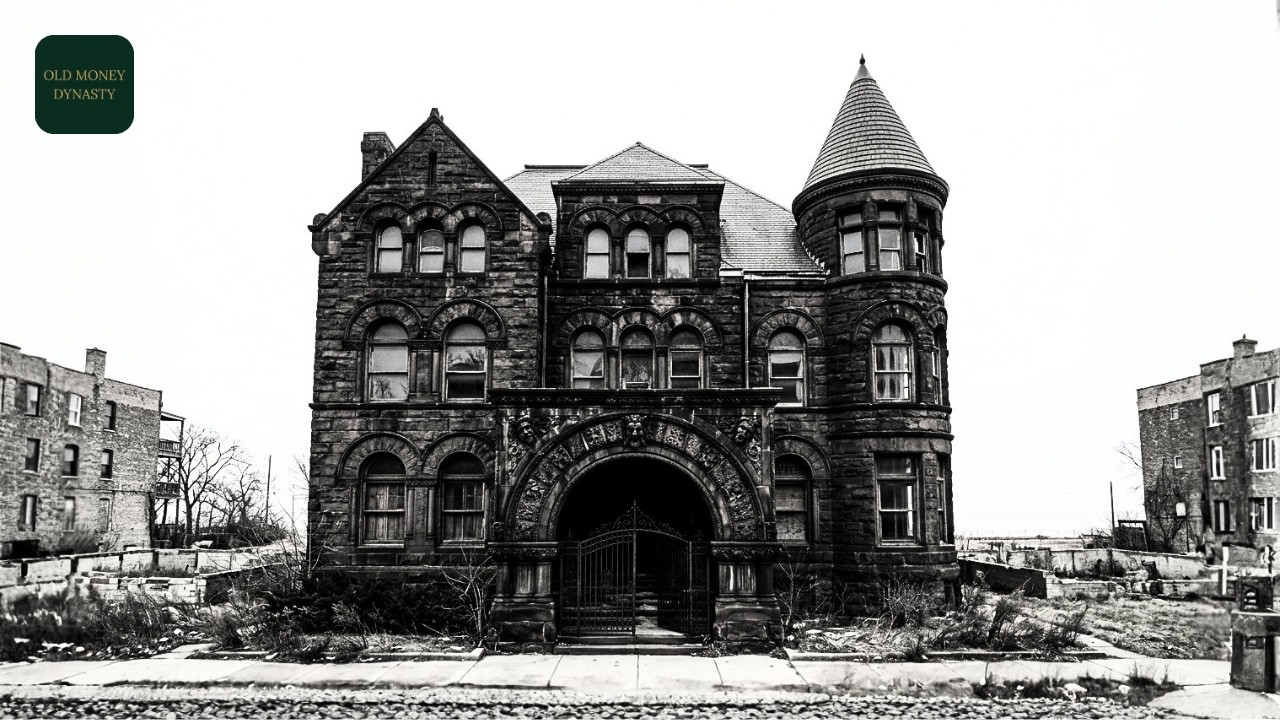
At 18th Street, where the Pullman Mansion had once stood, nothing remained but a stone wall and a few steps leading to a vacant lot. Thirty-six years earlier, that same six-block stretch had been the wealthiest residential street in the American Midwest. A writer at the time of the 1893 World’s Fair counted 77 millionaires living between 16th and 22nd Streets. The three richest men in Chicago—Marshall Field, George Pullman, and Philip Armour—lived within four blocks of one another.
A Rand McNally guidebook told tourists this was home to merchants whose business affected every market on the planet. The reasons Prairie Avenue emptied tell a larger story than any single family or fortune. A fire that wiped out a third of Chicago and forced the city to rebuild from nothing. A labor strike so devastating that the president deployed the army, after which the dead man’s family encased his coffin in concrete and steel to protect it from his own workers.
A shooting death that Chicago’s newspapers refused to investigate because the victim’s father spent too much on advertising. And a World’s Fair that changed American architecture while a killer operated just miles from the fairgrounds. George Pullman’s mansion anchored the corner at 18th Street. Its drawing room was finished in ivory and gold, lined with six mirrors tall enough to reflect an entire crowd.
Pullman entertained the way other men ran businesses—with total commitment. He hosted 400 guests at a time and had a private theater that seated 200. In a city full of industrialists building private libraries and smoking rooms, Pullman built an audience. One block south, Marshall Field took a different approach.
He hired Richard Morris Hunt, the architect behind the Vanderbilts’ Breakers in Newport, but reportedly told him he wanted nothing showy. He considered Pullman’s mansion excessive. Despite that instruction, the project ran to roughly $2 million, a peculiar version of modesty. The house did hold one genuine first: it was the earliest residence in Chicago with a complete electrical lighting system.
Guests walked into rooms that glowed without gas or candle, and several found it unsettling. Philip Armour completed the trio when he moved to the street in 1877. His fortune came from the Union Stockyards a few miles southwest, where his company processed millions of animals a year. On warm summer days, if the wind shifted, the residents of the most fashionable street in the Midwest could smell exactly where their neighbors’ money came from.
These were families who imported French paintings, hired European decorators, and held charity balls—living downwind of the largest slaughtering operation on the planet. The competition between households was relentless. Nearly every home had a ballroom. When a banker named Daniel Thompson built the first South Side house valued at $100,000, neighbors began planning larger ones before the paint had dried.
Forty of the 60 members of the Commercial Club, the most powerful business association in the city, lived within walking distance on this single street. One house broke the pattern entirely. In 1887, farm equipment manufacturer John Glessner hired Henry Hobson Richardson to design something unlike anything else on the avenue. Richardson gave him a fortress of rough granite walls with almost no windows facing the street, all living space arranged around a private interior courtyard.
It was the architectural equivalent of turning your back on your neighbors. Most of them hated it. But a young draftsman working elsewhere in the city took notice. Frank Lloyd Wright later said the Glessner House was one of the buildings that changed his thinking about what a home could be.
In 1893, none of the street’s collapse was visible. Prairie Avenue was at its absolute peak. The catastrophe that created the conditions for all this concentrated wealth had happened only 22 years earlier. On the night of October 8, 1871, a fire started in a barn on Chicago’s West Side.
By midnight, the wind had shifted hard to the southwest, and the fire was making its own weather. Witnesses on the north bank of the Chicago River described spinning columns of flame taller than buildings tearing across rooftops and hurling burning debris hundreds of yards ahead of the main blaze. Firefighters called them fire devils. The fire was no longer following the wind—it was creating it.
The city had been waiting for this and had done almost nothing about it. Between July and October of 1871, Chicago received roughly a quarter of its normal rainfall. Wooden buildings, wooden sidewalks, more than 600 miles of wooden sidewalks, wooden docks and bridges, even the river itself was a fire hazard with its banks packed with lumberyards. A fire had burned through several blocks the night before.
Firefighters were already exhausted when the alarm came in on the evening of October 8. Then the watchman in the courthouse tower sent the dispatch to the wrong location. By the time engines reached the actual fire on DeKoven Street, the barn was gone and the houses on either side were fully involved. The fire jumped the South Branch of the Chicago River, which was supposed to be impossible—the river was meant to function as a natural firebreak.
But the lumber yards, docks, and boats gave the flames a continuous path. By dawn on October 9th, the fire had consumed most of the commercial heart of Chicago and jumped the main stem into the North Side. Within 36 hours, an area roughly four miles long and a mile wide had been destroyed: 17,500 structures, 73 miles of road, 100,000 people with nowhere to live, roughly 300 dead. The damage was assessed at approximately $200 million—a third of the city’s total value gone in a day and a half.
Chicago did something no other American city had done after a disaster of this scale. It rebuilt not just quickly, but fundamentally differently. New fire codes required masonry and stone in the burn zone; wood frame construction was banned downtown. This forced architects to solve problems they had never confronted at this scale.
Within a decade, these questions produced the Chicago School of Architecture. William Le Baron Jenney built the Home Insurance Building in 1885, ten stories held up by a skeleton of iron and steel instead of load-bearing walls—widely considered the first true skyscraper. The fire also drew a new map of social power. It consumed the downtown, but stopped short of a residential corridor running along the South Side: Prairie Avenue, untouched.
The richest men in Chicago had lost their offices, their warehouses, their storefronts. Now they needed somewhere to rebuild. They looked south toward the one fashionable street the fire had skipped. Within five years, that six-block stretch had become the most expensive residential address between the East Coast and the Pacific.
Twenty-seven million people visited Chicago between May and October of 1893. The population of the entire United States was 63 million. Nearly half the country came to one city in six months. They arrived at a place that 22 years earlier had been a smoking ruin, and they walked into something several compared to a dream.
They called it the White City. Daniel Burnham had just lost the one person he could not afford to lose. His partner, John Wellborn Root, the design mind of the firm, died of pneumonia in January 1891, already deep into the exposition layout when he collapsed. Burnham was left with the largest construction project in American history, a hard deadline, more than 150 buildings to erect on 686 acres of swampy lakefront, and no partner.
He did not slow down. He recruited the most prominent architects in the country and told them to design in one unified style. The Eastern architects, led by Charles McKim, pushed for Beaux-Arts classicism—columns, pediments, symmetry, white facades. Louis Sullivan argued against it, but Burnham sided with the classicists.
Sullivan got a single building, the Transportation Building, placed away from the main Court of Honor and painted in rich colors while everything around it was white. The French gave it an award. The American public mostly ignored it. Frederick Law Olmsted designed the grounds around water: a great basin reflecting the white facades, canals, artificial lagoons, electric boats gliding between them.
At night, the entire complex was illuminated by electric light, still a novelty to most visitors. The buildings were enormous—the Manufacturers and Liberal Arts Building covered 44 acres under a single roof. But none of it was real. The facades that looked like marble were made of staff, a mixture of plaster and jute fiber, molded and painted.
The structures were designed to last six months. The greatest architectural spectacle most Americans had ever seen was a theater set. Inside those temporary walls, the exposition introduced Juicy Fruit Gum, Cracker Jack, and the zipper. Pabst Beer won the blue ribbon it still carries on its label.
Electricity was presented not as a curiosity but as the future. Then there was the Ferris wheel: 264 feet tall, 36 cars, over 2,000 passengers per ride. Bertha Palmer, Potter Palmer’s wife, chaired the Board of Lady Managers, oversaw the Woman’s Building, negotiated with foreign governments, and commissioned Mary Cassatt to paint a mural. By the close, she was arguably the most publicly powerful woman in the country.
The fair closed on October 30th. Within months, the crowds were gone and the buildings began deteriorating. Chicago sank into a depression that had started before the fair opened—banks failing, railroads collapsing, unemployment surging. The exposition had masked it with spectacle.
Once the spectacle stopped, the reality came through hard. In July of 1894, fire swept through the abandoned fairgrounds. Most of the White City burned. One building survived: the Palace of Fine Arts, built of brick and steel because foreign governments refused to display their artworks in anything flammable.
It stands today as the Museum of Science and Industry. The rest was plaster. It looked like the future. It was designed to disappear.
Visitors to the town of Pullman often used the same word: beautiful. Tree-lined streets, row houses with indoor plumbing, a library, parks, a church, an arcade building with shops, a theater, and a bank—all designed by Solon Spencer Beman with a consistency that made it look less like a factory settlement and more like a prosperous small city. George Pullman owned every square foot of it. Rent came directly out of workers’ paychecks before they ever touched the money.
If a worker wanted to borrow a book from the library, there was a fee. Then the economy collapsed. The Panic of 1893 hit the Pullman company hard. Orders dropped.
Pullman slashed his workforce from 5,500 to 3,300 and cut wages for those remaining by an average of 25 percent. He did not reduce rents. He continued paying shareholders their usual 8 percent dividend. When a committee of workers asked to meet about the gap between what they earned and what they owed, Pullman heard them out, made no concessions, and fired three of the committee members.
On May 11, 1894, nearly 4,000 workers walked off the job. One of them said it plainly: “We do not expect the company to concede our demands. We do know we are working for less than will maintain ourselves and our families. On that proposition, we absolutely refuse to work any longer.
”
The strike might have stayed local if not for Eugene Debs. His American Railway Union, roughly 150,000 members strong, called a national boycott: no member would handle any train carrying a Pullman car. Within four days, 125,000 workers on 29 railroads had walked off. Rail traffic west of Detroit stopped.
President Cleveland intervened on the side of the railroads. Attorney General Richard Olney, a former railroad lawyer himself, obtained a federal injunction on the grounds that the strike was obstructing mail delivery. Federal troops marched into Chicago. By late July, it was over.
Roughly 30 people were dead in Chicago alone. Debs was sentenced to six months in prison, where he read Marx and emerged as the country’s most prominent socialist. The workers went back to the same jobs at the same wages with the same rents. A presidential commission condemned Pullman directly, calling his model town un-American.
George Pullman died of a heart attack on October 19, 1897, at age 66. His family was afraid of what might happen to the body. Grave robbing was common, and the Pullman name was hated by tens of thousands of former workers. They made arrangements: a mahogany coffin lined with lead, lowered into a concrete pit, covered in asphalt and tar paper, then more concrete, then a layer of steel railroad rails bolted together, then more concrete on top.
The burial took two days. His monument was designed by Solon Beman, the same architect who had built the model town. He now designed the structure meant to keep those same workers from ever reaching his client again. Marshall Field Jr.
was 37 years old when he was shot in the abdomen on November 22, 1905, in his father’s house on Prairie Avenue. He died five days later. The official cause was paralysis of the bowels resulting from the wound to the spine. The inquest concluded it was an accident: Field had been cleaning a revolver and it discharged.
Practically nobody believed this. Two reporters received a tip that Field had spent the previous evening at the Everleigh Club, the most exclusive brothel in Chicago. The Everleigh sisters ran a house that served senators, foreign dignitaries, and business magnates. The entrance fee alone was $50 at a time when a factory worker earned maybe $2 a day.
The sisters denied Field had ever visited, but the rumor persisted. In 1913, a woman named Vera Scott in Los Angeles confessed to police that she had shot Field at the club eight years earlier. She later recanted parts of her statement; her credibility was questionable at best. What happened next says more about Chicago than any single detail of the shooting.
Every major newspaper in the country ran the story. Every newspaper in Chicago killed it. Not one Chicago paper printed a word of Vera Scott’s confession. An independent publication called The Day Book, which carried no advertising, pointed out why: Marshall Field & Company was the largest department store advertiser in the city.
The Field name was untouchable. The third theory is quieter: Field may have been severely depressed and shot himself deliberately. None of these accounts has ever been conclusively confirmed or disproven. Marshall Field Sr.
survived his son by six weeks. On New Year’s Day, 1906, he played golf with his nephew, his secretary, and Robert Todd Lincoln. He caught pneumonia during the round and never recovered. He died on January 16th at age 71.
His estate was valued at approximately $125 million. In his will, he left $8 million to the museum that already bore his name. The bulk went into a trust for his two grandsons. By 1906, the street was already starting to empty.
Potter Palmer had bought a half mile of worthless swampy lakefront north of downtown in the early 1880s, and most of his peers thought he had lost his mind. He had already reshaped the city once, turning State Street into the commercial center and building the Palmer House Hotel. His lakefront residence—the largest Chicago had ever seen—was called the castle. Bertha Palmer filled it with French Impressionists, buying Monet, Renoir, Degas, Pissarro, and Cassatt, often directly from the artists.
The collection became one of the foundations of the Art Institute of Chicago. Within a few years, the wealthiest families began buying lots along Lake Shore Drive. Palmer had not just built a house—he had invented a neighborhood. The Gold Coast became the new center of social power, and the migration north accelerated through the 1890s.
Bertha outlived Potter by 16 years. He died in the mansion in 1902, leaving her $8 million. Through real estate investments, primarily in Florida land, she nearly doubled it before her own death in 1918. The castle was sold in 1928, stood vacant for years, served as a Red Cross surgical dressing center during World War II, and in February of 1950 was torn down.
A 22-story apartment building went up in its place. No preservation effort. No public debate. By 1973, there were eight houses left on Prairie Avenue.
The printing industry moved in first, then light manufacturing. The elevated train and the Illinois Central Line brought noise and soot. One by one, the millionaires’ heirs sold and left. Some moved to the Gold Coast, others to Lake Forest or the North Shore.
The houses they left behind were too large for single families and too expensive to maintain. Many were subdivided into rooming houses. Others sat vacant until someone decided the land underneath was worth more than the building on top of it. The last original resident, Addie Hibbard Gregory, stayed until 1944.
After she left, there was no one. For two decades the remaining houses existed in a kind of limbo. Then, in 1966, a group of preservationists bought the Glessner House, which had been scheduled for demolition. The purchase cost them almost nothing.
But that transaction started a movement. The effort led directly to the founding of what became the Chicago Architecture Foundation. In 1972, the Prairie Avenue Historic District was placed on the National Register of Historic Places. Today the district is anchored by the Glessner and Clarke House Museums.
A few other original mansions survive. Fifty mansions stood in the 1890s; seven or eight remain. The Pullman House, the Armour House, the Field Senior House, the Sherman House—all gone. Most were demolished without a photograph being taken of the interiors.
What keeps pulling back anyone who studies this story is the speed. How quickly all of it was built. How quickly all of it disappeared. The families who rebuilt Chicago after the fire created something extraordinary within 20 years.
By 1910, their children had started leaving. By 1950, the last of the great houses were being torn down. Three generations. That is all it took.
Prairie Avenue is quiet now. The mansions that remain sit between newer buildings, handsome and slightly out of place, like guests who arrived at the wrong party and decided to stay anyway. The Union Stockyards closed in 1971. The Palmer Castle had been gone for 20 years by then.
The Pullman Mansion for nearly 50. Marshall Field’s department store on State Street survived until 2006, when it became a Macy’s. Chicagoans protested. It did not help.
The Field Museum still stands on the lakefront. So does the Museum of Science and Industry, the only building left from the White City. The Glessner House is open for tours. Pullman’s grave in Graceland Cemetery is easy to find.
It looks modest from above. Everything that matters is underneath. Chicago does not preserve the way some cities do. It builds, tears down, and builds again.
That has always been the deal. The fire just made it official.