In 1920, a bitter, root-flavored soda outsold Coca-Cola across the United States. The drink was Moxie. Not a regional curiosity, not a niche favorite, it was the bestselling soft drink in America. Forty-eight years later, the company that owned it did something no rival had ever managed to do to Moxie.
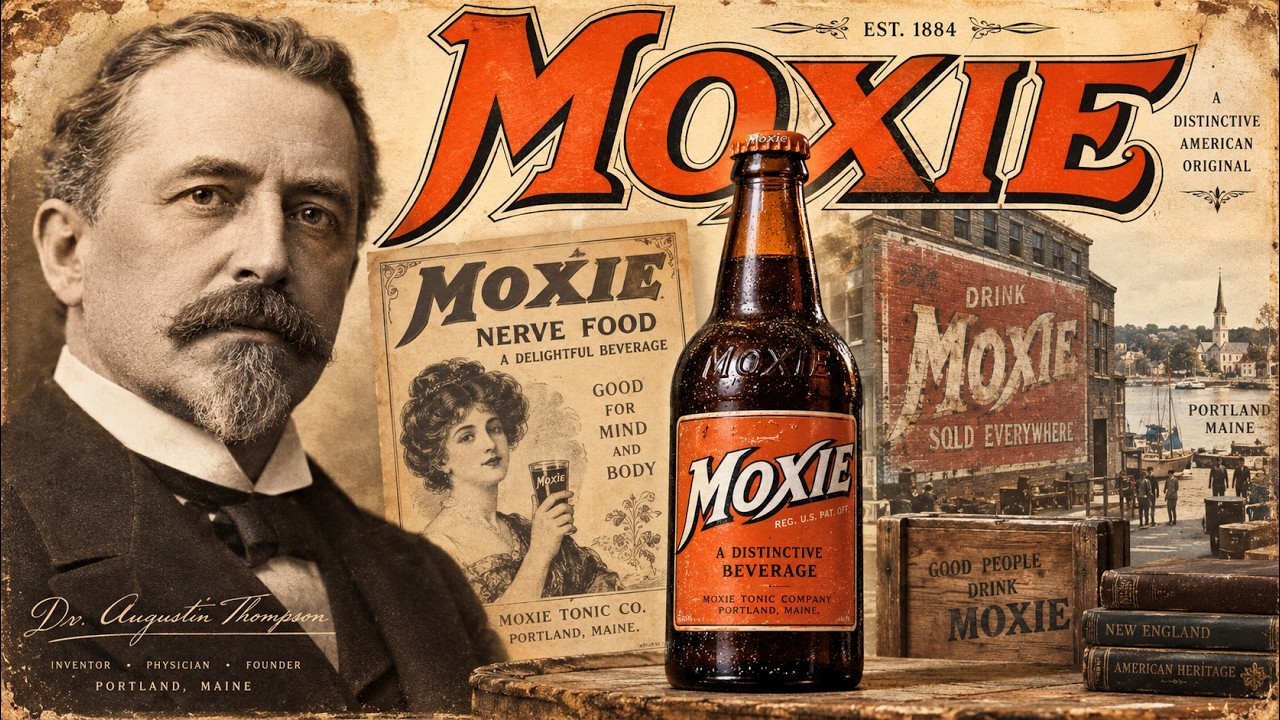
It changed the formula. It softened the bitterness and put a flower child on the label. Within months, nearly half of its drinkers walked away. The company that had once beaten Coca-Cola at its own game was bleeding out from a wound it gave itself.
In 2018, the final twist arrived when Coca-Cola, the very company Moxie had defeated in 1920, bought what was left of it. The story begins in Lowell, Massachusetts, in 1876. Lowell was a city built on machines, with 40,000 people, most working the textile mills along the Merrimack River. It was also home to the largest patent medicine factory on Earth, a business environment where selling tonics was common.
Augustine Thompson was born in 1835 in Union, Maine. When the Civil War came, he enlisted and within nine days of signing up was commissioned captain of Company G, 28th Maine Volunteer Infantry. He served through the war and came home a decorated veteran, an experience that pushed him toward medicine rather than business. He enrolled at the Hahnemann Homeopathic College in Philadelphia and graduated at the top of his class.
In 1867, he opened a practice in Lowell, and by the mid-1880s his patient list was one of the largest in New England. Thompson was practicing medicine at a dangerous moment in American history. The patent medicine industry of the late 1800s was a market with almost no rules. Tonics on drugstore shelves routinely contained cocaine, arsenic, or enough alcohol to qualify as liquor in anything but name.
They were sold to nervous mothers and exhausted laborers, promising energy and calm while delivering neither safely. Thompson saw the gap from a plain practical observation as a working physician who watched patients dose themselves with substances that did more harm than good. He wanted to build something that worked without any of that. In 1876, he found his answer in an unlikely ingredient: gentian root, extracted from a plant he described publicly only as a rare South American specimen, discovered, he claimed, by an old friend referred to as Lieutenant Moxie.
The story has never been verified. The gentian root, however, was real, and its taste was unmistakable: sharp, herbal, and deeply bitter, cut with cinchona, sassafras, and caramel to make it drinkable. Thompson called his creation Moxie Nerve Food and sold it as medicine dispensed by the spoonful. For its first eight years, it was a tonic in small syrup bottles, marketed with claims that it could relieve nervousness, restore brain and nervous exhaustion, and treat ailments ranging from insomnia to paralysis.
The turning point came in 1884 when Thompson added carbonated soda water to the syrup. The bitter tonic became a fizzing, drinkable beverage. The first bottle of this new Moxie was sold on March 7, 1885, at 74 Heath Street in the Jamaica Plain section of Boston, a building that would later become known as Moxie Land. Moxie is by most accounts the oldest continuously produced soft drink in the United States, older than Coca-Cola and older than Dr Pepper.
What made Moxie catch on was its refusal to hide its bitterness. Most patent medicine drinks leaned on sugar to mask bad ingredients or leaned on stimulants to fake an effect. Moxie built its identity around being unlike anything else on the shelf. The flavor was so sharp that people either loved it immediately or rejected it on the first sip.
There was no middle response. The name itself carried the brand, as the word moxie detached itself from the bottle and entered everyday American speech, meaning nerve, grit, and the willingness to push forward when things got hard. Moxie moved through two channels simultaneously: soda fountains where druggists mixed the syrup fresh, and bottled sales that let it travel into general stores, taverns, and homes. Then came the moment that turned a regional New England curiosity into a national name.
At the 1904 World’s Fair in St. Louis, which drew roughly 20 million visitors, Moxie was poured directly in front of a national audience that had never tasted anything quite like it. Visitors carried the taste and the word home with them to cities across the country. By the second decade of the 20th century, Moxie was no longer a regional seller.
It was a national contender with the advertising budget to match. The Moxie Horse Mobile, a full-size wooden horse mounted on the chassis of an automobile and driven through downtown streets by costumed riders handing out samples, became one of the most recognized promotional vehicles in American advertising history. The company also ran extensive print and roadside campaigns with bold, declarative slogans, understanding it was never going to win over every soda drinker and leaning into being an acquired taste. Celebrity association gave the brand its most enduring cultural credibility.
President Calvin Coolidge, a son of neighboring Vermont, was known to favor Moxie personally, a detail that traveled through New England without the company having to pay for it. Decades later, the company signed Boston Red Sox slugger Ted Williams, who fronted a series of print and radio advertisements. The company even released a companion product, Ted’s Root Beer, bottled in Needham and named directly for him. Production scale matched the marketing ambition.
From 1928 through 1953, Moxie’s operations were centered at 74 Heath Street, complete with a rooftop advertisement visible to travelers heading toward Logan Airport. And the peak metric remains the single most extraordinary fact in Moxie’s entire history: in 1920, Moxie outsold Coca-Cola across the United States. A bitter tonic born in a Lowell doctor’s office had become the bestselling soft drink in the country. Augustine Thompson died in Boston on June 8, 1903, at the age of 67.
He never saw the Horse Mobiles, never saw Ted Williams, and never saw 1920. A brand this dependent on personality and its founder’s instinct would eventually be run by people who had never known Thompson at all. The first warning sign arrived quietly. Through the 1930s, as the Great Depression tightened budgets, Moxie’s management scaled back advertising spending to preserve cash.
For a company whose market position had been built on personality and spectacle, cutting the advertising budget removed the one thing that compensated for a flavor most Americans did not instinctively reach for. Sales began a slow, steady decline that management read as a temporary casualty of the downturn. It was the beginning of a 40-year slide. By the mid-1960s, the company had changed hands.
In 1966, the Monarch Beverage Company of Atlanta acquired Moxie. Two years later, in 1968, that new leadership made the decision that would define Moxie’s collapse. They changed the formula, softening the bitterness to make the drink more approachable to a generation raised on sweeter national colas. The company rolled out a sweeter recipe alongside a redesigned bottle featuring flower child artwork, chasing the youth culture of the late 1960s.
The customer response was immediate and brutal. Longtime drinkers experienced the change as a betrayal. By most accounts, the company lost close to half its existing customer base within months. Monarch reversed course, restoring the original bitter formula and the traditional label, and leaned again on Ted Williams to reassure a customer base that had just watched the company abandon the one thing it promised never to change.
The reversal stopped the bleeding but did not undo the damage. What followed was a slow disassembly spread across decades. By 1968, the brand’s operations had relocated to Georgia entirely. The larger problem was the consolidation sweeping the American bottling industry.
Independent regional bottlers were being bought out or squeezed out, replaced by the centralized distribution networks of Coca-Cola and Pepsi, who built shelf space dominance so complete that a regional bitter soda had nowhere left to compete. By the early 2000s, Moxie survived almost entirely as a New England curiosity. In 2007, ownership shifted to the Coca-Cola Bottling Company of Northern New England, an independent bottler. The company that had once been beaten nationally by Moxie was now involved in bottling what remained of it.
The plant on Heath Street was long gone. After operations moved to Needham Heights in 1953, the Boston Housing Authority demolished the original Jamaica Plain building and replaced it with the Bromley Park housing development. In 2018, the final and most improbable chapter arrived. The Coca-Cola Company, the very corporation Moxie had outsold nationally in 1920, purchased the brand outright.
Longtime drinkers braced for another reformulation. It never came. The gentian root formula remained untouched, and the bottling stayed local, still rooted in New Hampshire. Moxie had been designated the official soft drink of the state of Maine in 2005, and the town of Lisbon, Maine, hosts the Moxie Festival each summer, drawing collectors and longtime drinkers.
The surprise footnote belongs to the very decision that nearly ended the company. The 1968 reformulation disaster happened 17 years before Coca-Cola itself would make almost the identical mistake on a vastly larger stage. When Coca-Cola launched New Coke in 1985, sweetening its own century-old formula to chase changing tastes, the national backlash and rapid reversal were treated as a shocking, unprecedented crisis in American business history. It was neither.
A small New England soda company had already run the exact experiment in 1968, watched it fail in exactly the same way, and reversed course for exactly the same reason. Nobody at Coca-Cola’s corporate headquarters seems to have been paying attention. The moment that came closest to actually killing Moxie was never external. It was internal, a decision made by people who owned the name but did not understand why customers had given it to them in the first place.
Somewhere in Maine, in a small store with a cooler full of modern flavors, there is still usually one case of Moxie. Brown bottle, orange lettering, the same bitterness Augustine Thompson insisted on 150 years ago, opened by someone who drove out of their way specifically to find it.