On August 8, 1944, in a wheat field near Saint-Aignan-de-Cramesnil in Normandy, an unusually quiet morning settled over the countryside. There stood Michael Wittmann, a 30-year-old Waffen-SS commander, in the cupola of his Tiger tank. He was credited with destroying 138 enemy tanks. Hitler himself had decorated him.
Magazines carried his photograph, radio broadcasts praised him, and he wore the Knight’s Cross with Oak Leaves and Swords. Schoolchildren in Germany knew his name. In England, tank crews whispered it like a curse. In a small town in Ohio, a mother packed her son’s lunch before his shift at the Detroit arsenal.
She had never heard of Michael Wittmann and never would. But her welding torch was about to kill him. Wittmann had less than an hour to live. Somewhere across the fields, a British Sherman Firefly was loading a 17-pounder shell.
A young soldier named Joe Ekins, 21 years old, checked his gun sight. Two months earlier he had been an apprentice to a shoemaker in Rushton, Northamptonshire. He had fired his tank’s main gun exactly six times in combat. He was about to fire three more.
To understand how a shoemaker from a small English town killed the most famous tank commander of the Second World War, no story can begin with the tanks themselves. It must begin with a birthday party on April 20, 1942. Deep in the pine forests of East Prussia, at Adolf Hitler’s forward headquarters, the Wolf’s Lair, the leader of the Third Reich celebrated his fifty-third birthday. There was no cake, only a demonstration.
In a clearing, two enormous machines stood side by side, their exhaust rising into the cold Prussian air, their armor plates still warm from the workshop. On Hitler’s left stood Erwin Aders, 61, chief engineer of Henschel and Son, a company that had built locomotives since the age of steam. On his right stood Ferdinand Porsche, 66, already a legend, designer of the Volkswagen and Hitler’s favorite engineer. Between them stood two competing prototypes for the tank that would decide the war.
Aders had built a machine of iron and steel, conventional, gasoline-powered, brutally simple. Porsche had built something exceptional, a hybrid drive running a gasoline engine through electric motors, the future of armored warfare wrapped in 50 tons of Krupp steel. Everyone expected Porsche to win. Porsche was Hitler’s friend, and his company had already built 100 hulls in anticipation of the contract.
Behind the prototypes, in a small notebook, a Wehrmacht procurement officer had written six words that would change the course of history. Germany did not have enough copper. Porsche’s brilliant electric transmission required vast quantities of copper, a metal Germany could no longer import in wartime. The blockade had cut off supply.
Aders’s design used almost no copper. Hitler paced back and forth, listening to men in gray uniforms explain supply logistics. At that moment, the leader of the Third Reich made a decision based not on battlefield performance but on raw material shortages. He chose the Henschel design and ordered production to begin.
Then he turned to his generals, his voice rising to the tone that would echo through newsreels for the rest of the war. A single Tiger tank will destroy a battalion of enemy tanks. Quality, gentlemen. Quality is the German approach.
The generals nodded. None of them mentioned that Germany had chosen its wonder weapon not because it was the best, but because there was not enough copper for the alternative. This was the Tiger’s first secret: it was born from scarcity and dressed in the guise of strength. Six thousand kilometers away, in a completely different world, a 58-year-old man in a wheelchair made the telephone call that would end the German Reich.
May 30, 1940. The Oval Office, Washington, D. C. Franklin Delano Roosevelt sat at his desk.
News from Europe was catastrophic. British forces were being destroyed on the beaches of Dunkirk. France was collapsing. Norway had fallen.
The finest army in Europe had been shattered by German panzer divisions. And America possessed fewer than 500 modern tanks. Roosevelt picked up the telephone. He did not call a general, a senator, or a secretary of war.
He called a man he had publicly despised for eight years. William Signius Knudsen, 61, president of General Motors, a Danish immigrant who had arrived at Ellis Island in 1900 with just 30 dollars, a Republican, a capitalist, a man who had denounced Roosevelt’s New Deal from every platform he could reach. The telephone rang on the 71st floor of the GM building in Detroit. Knudsen answered.
Roosevelt said he needed him in Washington to run war production. There was a long silence on the line. Knudsen stood at the summit of American industry, earning 300,000 dollars a year. He hated the man on the phone.
He answered in the Danish-accented English he had never lost. Yes, Mr. President. I will come.
He hung up, went into his office, told his secretary he was resigning, and accepted a government salary of one dollar a year. His wife thought he had lost his mind. His colleagues thought Roosevelt would destroy him. Alfred Sloan, chairman of General Motors, told him plainly that he would be mocked in Washington.
Knudsen did not care, because he understood something Hitler would never grasp, something that would only become clear in 1945. Modern war is not won by warriors. It is won by assembly lines. Knudsen arrived in Washington within a week, bringing no staff and no plan, only a telephone directory and a lifetime of experience building things.
His first call was to K. T. Keller, 54, president of Chrysler, a man who had spent his life manufacturing fenders and door panels. Knudsen asked if Keller could build tanks.
There was a short silence. Keller said he did not know, that he had never seen one. Knudsen told him to go look at one. Two days later, Keller and his chief engineer, Edward Hunt, drove to the Rock Island Arsenal in Illinois.
They climbed into an old medium tank, drove it around a test track, opened the engine compartment, examined the transmission, and spent six hours going over the machine like children examining a new toy. That evening, Keller called Knudsen back. Yes, we can make them. How many do you need?
Knudsen answered with a number no American had ever spoken about tanks before. Thousands. Within eight weeks, the government bought 113 acres of farmland in Warren, Michigan. Chrysler agreed to run the plant, the government paid for it, and Chrysler leased it for one dollar a year.
Construction began in the fall of 1940, the steel frame rising through the winter as workers poured concrete in the snow. On April 24, 1941, with walls barely complete and parts of the roof still open, the Detroit Arsenal Tank Plant opened its doors. A 30-ton medium tank fired its main gun before the governor of Michigan and a crowd of dignitaries, smashing telephone poles and flattening a small wooden shed built as a test target. The Detroit Arsenal was the first factory in history designed from empty ground for mass production of armored vehicles, covering 1.
25 million square feet, larger than all of Germany’s tank factories combined. In Kassel, Germany, the Henschel und Sohn factory was preparing to build the first Tiger tank. It was August 1942, and the scene inside the workshop seemed from another era. Nine thousand skilled workers moved slowly around an unfinished tank hull.
Master craftsmen, some in their sixties, supervised silver-haired apprentices. Each tank was built in place, with workers moving around it rather than the tank moving down a line. There were nine assembly stages, each taking days, some taking weeks. Skilled welders spent afternoons on a single weld.
Mechanics checked gears with micrometers. Painters applied identification numbers by hand, digit by digit. When the first Tiger was finished, it had consumed 300,000 man-hours of labor, contained 26,000 separate parts, weighed 57 tons, and cost a quarter million marks, enough to build a small factory. The workers gathered around it, signed their initials on hidden components, and took photographs.
In that moment, they felt the weight of German engineering pride. Colonel Wolfgang Thomale, observing the trials at Kummersdorf, wrote in his report that this machine represented the peak of German engineering, and that if Germany could build 100 each month, it would win the war. Germany never built 100 Tigers in any month of 1942 or 1943. Production peaked only in April 1944, with 104 Tigers.
By then, Chrysler in Detroit was producing 896 Sherman tanks per month. But the Tiger’s first humiliating defeat came not on an assembly line but in a swamp, on September 22, 1942, near the town of Mga, 30 kilometers southeast of Leningrad. The Eastern Front in autumn, ground soft, Russian mud turning from summer softness to autumn glue. Four Tigers of the 502nd Heavy Tank Battalion, the first four Tigers ever used in combat, advanced single file along a narrow forest track.
Hitler had sent them to the front in haste, demanding a demonstration, wanting pictures for newsreels and proof of his wonder weapon. The battalion commander begged for time to test the tanks, warning that the terrain was unsuitable, that Tigers should be used in open ground at long range in large numbers. Hitler refused. The Tigers advanced single file because the track was too narrow for anything else.
The first Tiger’s engine overheated within the first hour. The transmission of the second, an engineering masterpiece with eight forward gears, began to fail. The third Tiger threw a track in the soft ground. Only one Tiger reached the battlefield, fired a few shots, and withdrew.
Three of the first four Tigers ever built were disabled not by the Red Army but by Russian mud and meticulous German engineering. The Soviets eventually recovered a stuck Tiger, shipped it to Kubinka, filmed every bolt, measured every plate, and began designing weapons to destroy it. The Tiger’s first combat deployment was a catastrophe the German people would never learn about. Hitler ordered all discussion of the operation classified.
Three months later, on the other side of the world, something happened that Hitler would have refused to believe. In December 1942, at the Detroit Arsenal Tank Plant in Warren, Michigan, Mary Kreshevsky, a Polish immigrant welder whose brother was fighting with the First Armored Division in North Africa, stood on the production line on the third shift. The line never stopped, not for lunch, not for weather, not for holidays. Above her head hung a sign in huge letters.
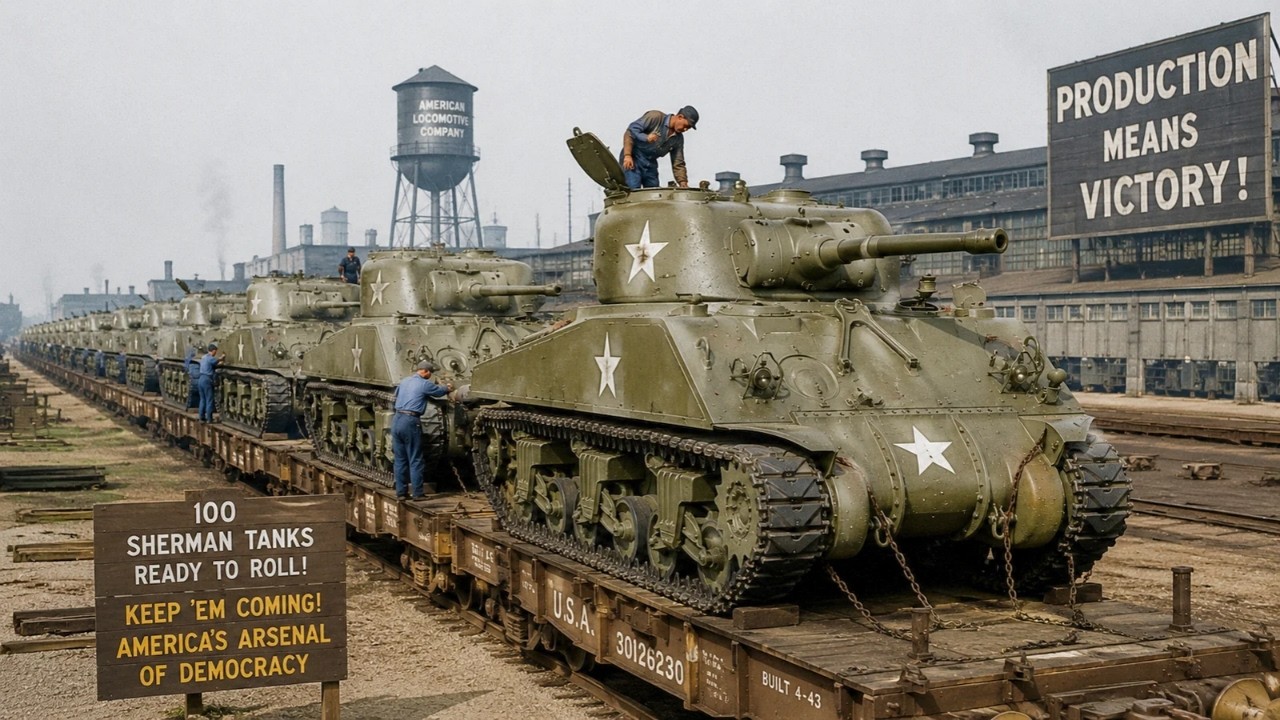
Every tank we build is a life we save. Mary Kreshevsky welded once, and the tank moved. She welded again, and the tank moved again. Every four hours, a complete M4 Sherman came off the line.
By the end of December 1942, the Detroit Tank Plant alone produced 907 Shermans in one month. That same month, the Henschel plant in Kassel produced 38 Tigers. The ratio was 23 to 1, and Detroit was only one of 11 American factories building Shermans. Across the United States and Canada, combined monthly production approached 3,500 tanks.
The combined monthly output of all Tiger factories in the Third Reich was 34. In January 1943, General Heinz Guderian, the 54-year-old inspector general of panzer forces, the man who had invented modern armored warfare and conquered France with panzer columns in six weeks, received an intelligence report containing American production figures. He read it in his office in the Bendlerblock in Berlin. He read it twice.
Then he picked up his diary and wrote a single sentence. If these figures are even half true, we have already lost the war. Then he closed the diary. He did not tell Hitler.
He knew the fate of messengers who brought bad news to the Führer. He knew something else too, something that would haunt him for the next thirty months. He knew that Germany would spend the rest of the war building the finest tanks in the world, and it would change nothing, because in a swamp near Leningrad, on a farm in Warren, Michigan, and in a telephone call between Franklin Roosevelt and William Knudsen, the war had already been decided, not by tanks or assembly or warriors or welders or generals, but by a Danish immigrant, a Polish welder, and an engineer named Edward Hunt. The mathematics had been written.
Now there was only execution. On August 8, 1944, in a wheat field near Saint-Aignan-de-Cramesnil, Michael Wittmann was about to become the most famous number in that terrible arithmetic. On July 5, 1943, the greatest tank battle in human history began at 4 a. m.
near the town of Kursk. Eight days on the rolling black-earth plains of southern Russia, the war reached its industrial peak. The Tigers did everything they were designed to do, standing at 2,000 meters and destroying T-34s that could not penetrate their armor from any range, enduring hits that would have destroyed any other tank on earth. At Prokhorovka on July 12, the largest tank battle of the entire war took place on eight square kilometers of dust and burning wheat.
The Germans lost nearly 80 tanks while the Soviets lost more than 400. By every tactical measure of war, Kursk was a German victory. And at Kursk, Germany also lost the war, because the 80 tanks Germany lost could not be replaced, while the 400 tanks the Soviets lost were already being replaced by factories in Chelyabinsk and Nizhny Tagil, plants that had been dismantled in 1941, moved by train ahead of the German advance, and rebuilt behind the Ural Mountains where no German bomber could reach them. The Uralvagonzavod plant in Nizhny Tagil produced more T-34s in one week than the entire German industry produced Panthers in a month.
And that summer, the Soviets received something else that would change everything. They received American Sherman tanks. Under Lend-Lease, signed by Roosevelt in March 1941, the United States exported tanks to Britain, Free France, China, and the Soviet Union. Eventually, 4,065 Shermans would be delivered to Stalin’s Red Army, more than three times the total number of Tigers Germany ever produced.
On June 13, 1944, a week after D-Day, Michael Wittmann, 29, a veteran of the Eastern Front credited with 117 Soviet tanks destroyed, reached a wooded ridge east of the small Normandy town of Villers-Bocage. He had been rushed to Normandy with the second company of the 101st SS Heavy Tank Battalion, leading six Tigers. His battalion had originally fielded 45, but Allied fighter-bombers had savaged German columns on every road in France. Half his tanks were stranded somewhere between Paris and the front.
Wittmann reached the ridge overlooking Villers-Bocage in the pre-dawn darkness of June 13, about 8 a. m. , and raised his binoculars. He could not believe what he saw.
A British armored column had broken into Villers-Bocage and stopped for morning tea. Cromwell tanks, Stuart light tanks, Bren carriers, the entire spearhead of the 22nd Armored Brigade of the British 7th Armoured Division, the legendary Desert Rats. Crews were outside their vehicles, some brewing tea on portable stoves, some stretching, some studying maps. None knew six Tigers were watching from 400 meters away.
Wittmann faced a decision: wait for reinforcements, request support, withdraw and report. He did none of these. He ordered his Tiger, with his gunner Bobby Woll, to attack alone down the hill into the flank of the British column, into a town packed with 200 enemy vehicles. What happened in the next fifteen minutes would become one of the most famous engagements of the entire war.
Wittmann’s Tiger smashed through the hedgerows on the eastern edge of town, fired at a rear Cromwell and blew it apart, fired at the tank ahead and set it burning, fired at a half-track and shattered it. He drove straight into Villers-Bocage, down the main street at nearly full speed, his 88mm gun swinging from target to target, every round hitting, every hit killing. Within fifteen minutes, Wittmann and his supporting Tigers had together destroyed fourteen tanks, fifteen armored personnel carriers, and two anti-tank guns. The 4th County of London Yeomanry, one of the most distinguished regiments in the British Army, ceased to exist as a fighting unit.
German propaganda exploded. Berlin radio declared Michael Wittmann the greatest tank commander in history. His picture appeared on the cover of Signal magazine. Berlin claimed Wittmann had destroyed all fourteen tanks himself.
Postwar historians would spend decades unraveling the truth, some were his kills, many were his comrades’, but it did not matter to the German people. In the summer of 1944, with the Reich crumbling, they needed a hero. Michael Wittmann became that hero. Nine days later, on June 22, 1944, Hitler personally awarded him the Knight’s Cross with Oak Leaves at the Berghof.
Photographs were taken. The Führer shook his hand. Speeches were made. Then Hitler offered him an easy assignment, commander of a tank training school in Germany, behind the lines, safe.
Wittmann had a wife and a home in Bavaria. He had accomplished enough. Every general in the room expected him to accept. He refused.
He asked to return to Normandy, to his men, to his Tigers, signing his own death warrant with two quiet sentences that would haunt his mother for the rest of her life. Seven weeks later, he would die in a wheat field near Saint-Aignan-de-Cramesnil. Seventy-two hours after Wittmann’s fifteen-minute slaughter, the British 7th Armoured Division received complete replacements for all its lost vehicles, new Cromwell tanks, new crews, new ammunition, new fuel, returning to full strength. The second company of the 101st SS Heavy Tank Battalion, which had lost three Tigers in the fighting after Wittmann’s attack, would receive no replacement Tigers for six weeks.
Lieutenant Colonel John Clouldesley-Thompson of the 7th Armoured Division would later write the truest sentence ever written about the Normandy campaign. Wittmann was a genius, but genius is finite, while industrial production is infinite. While Wittmann was being celebrated in Berlin, an obscure American lieutenant was doing the work that would actually decide the war. His name was Belton Y.
Cooper, 27, an officer in the spearhead of the Third Armored Division. Cooper was not a tank commander and did not fire guns or lead attacks. Cooper’s job was replacing tanks. Every morning before dawn, he drove his jeep to the front lines, counted burned-out Shermans, recorded their serial numbers, and radioed the division rear.
By noon, replacement tanks were arriving from depots in England. By nightfall, new Shermans were being unloaded from railcars and driven forward. By the next dawn, yesterday’s destroyed tanks had been replaced by identical new ones with new crews wearing the same uniforms as the men who had died the day before. Cooper recorded these statistics in a small notebook in his breast pocket.
By the end of the war, the Third Armored Division would lose 648 Shermans in combat, damage and repair 700 more, and receive 1,200 replacements to maintain full strength, more Shermans delivered to one American division than the total number of Tigers Germany produced in the entire war. Cooper survived the war and spent the next fifty years quietly running a business in Alabama. Then, in 1998, at age 81, he published a book titled Death Traps. He described driving American tank crews from burned-out Shermans, the terrified faces of eighteen-year-olds climbing into tanks that still smelled of the men who had died in them the day before, the brutal replacement system that consumed young Americans in vast numbers so the war could be won on schedule.
He argued that the Sherman was a death trap, and that the system was necessary because the alternative, fighting Germany with fewer, more advanced tanks, would have taken longer, cost more American lives in the long run, and might not have worked at all. On June 22, 1944, while Michael Wittmann received his medal at the Berghof, on the other side of Europe the Red Army launched the largest military operation in history. It was called Operation Bagration, timed for the third anniversary of Hitler’s invasion of the Soviet Union. The Red Army committed 4,080 tanks against Army Group Center.
The Germans had 495 operational tanks in the entire sector, including 29 Tigers. Within a month, the German front collapsed catastrophically. Army Group Center lost 17 divisions completely destroyed and 28 more shattered. Four hundred thousand German soldiers were killed, wounded, or captured.
Fifty thousand of them were marched through the streets of Moscow in the largest prisoner parade in the history of warfare. Among the Soviet tank formations driving west through Belarus were elite mechanized brigades equipped with American Lend-Lease Shermans, American-built machines with white stars, moving through the birch forests of Eastern Europe, driven by Russian crews trained on American manuals. As the Eastern Front collapsed, the men making Tigers in Germany faced their own nightmare. From October 1943 to March 1945, the Henschel und Sohn plant in Kassel was bombed 39 times, 39 nights of wailing sirens and burning steel, 39 mornings of exhausted workers picking their way through rubble to find their machines transformed into unrecognizable shapes.
A production manager named Hans Müller wrote in his diary in October 1944 that a raid had destroyed the heat-treatment facility, that Tiger armor plates now had to be sent to Essen if the trains still ran, that Essen had been bombed on Tuesday, that the backup facility was Dortmund, that Dortmund had been bombed on Thursday, that 200 Tiger hulls were waiting for armor, and that perhaps 20 would be completed that month. By 1944, 40 percent of Henschel’s workforce was forced laborers, prisoners from Poland, Ukraine, and concentration camps, men and women who sabotaged what they could when guards were not looking, welds that would fail under enemy fire, bolts that would shake loose at speed, small acts of resistance welded into the machines of the Reich. On the other side of the Atlantic, the story was entirely different. Six million American women entered the labor force during the war, most of them never having worked for wages before.
They welded ship hulls in Baltimore, attached bomber wings in Long Beach, packed parachutes in Ohio, and inspected engines in Michigan. Every Sherman that left Detroit was built in part by women whose sons, brothers, or husbands were fighting overseas. The machine never stopped, not for grief, not for anyone, until Berlin fell. In Warren, Michigan, the Detroit Arsenal never stopped for a single hour.
Every day, every night, another Sherman came off the line, one every four hours. By the summer of 1944, total Sherman production had surpassed 30,000. Total Tiger production for all time was about 1,100. In December 1944, Hitler gambled the Reich’s last combat-ready reserves on one desperate offensive in the west, Operation Watch on the Rhine, which Americans would call the Battle of the Bulge.
The Führer committed 450 of Germany’s last operational tanks, including 69 King Tigers, second-generation heavy tanks weighing 70 tons with sloped armor and a longer, more powerful 88mm gun. On the American side of the line, 8,000 Shermans were deployed in the European theater, 6,000 more in reserve in England, and 10,000 in training or en route from the United States. The spearhead of the entire offensive was a 29-year-old SS officer named Joachim Peiper, tall, handsome, blond, a former adjutant to Heinrich Himmler, the embodiment of everything Nazi Germany had built over 12 years. His battle group included the 501st SS Heavy Tank Battalion equipped with King Tigers.
His mission was to break through the American lines in the Ardennes, drive to the Meuse River, and seize Allied fuel depots near Antwerp. But he did not have enough fuel to get there. His King Tigers consumed nearly 7. 5 liters of high-octane gasoline per kilometer, and Germany had no high-octane gasoline left.
He was ordered to capture American fuel depots to keep his tanks moving, ordered to seize fuel in tanks that needed fuel to reach it. On December 16, 1944, in the fog and rain of the frozen Ardennes, Peiper’s battle group attacked. For days they smashed through American lines. On December 17, the second day, at a windswept crossroads called Baugnez near Malmedy, a column of 113 American prisoners from the 285th Field Artillery Observation Battalion was captured by Peiper’s leading elements.
They were disarmed prisoners of war, mostly young men, some teenagers. The SS herded them into a snow-covered field beside the road and opened fire with machine guns. Eighty-four Americans died in the snow. A few survived by playing dead, lying motionless for hours while the SS walked among the bodies, shooting anyone who moved.
When American forces finally recovered the field, the bodies were still there, frozen where they had fallen. Photographs were taken and returned to the United States within days. The Malmedy massacre cemented something in the American army that had not been there before. American tank crews stopped taking SS prisoners.
American infantry stopped accepting surrenders from Waffen-SS units. The word spread through the American ranks with the speed of anger. Every Sherman commander who heard about Malmedy now knew exactly what he was fighting for, not abstract democracy, but 84 boys in a snowy field. Even moral clarity could not fuel a King Tiger, and Peiper’s tanks began running out of gas.
By December 24, 1944, Peiper’s spearhead reached the small Belgian village of La Gleize. His King Tigers stood cold and silent along the muddy streets, engines dead, fuel gauges at zero. Peiper ordered his men to abandon them. Some were destroyed with explosives, but King Tiger 213, one of the finest tanks ever built by human hands, was parked on a street corner and left intact.
It is still there today. It has never moved. The final chapter of the story unfolded in April 1945. American columns flowed through Germany.
The Rhine had been crossed, the Ruhr pocket surrounded, 300,000 German soldiers surrendered in a single pocket. Along the roads of the former Third Reich, a strange sight began to appear. Shermans with black crosses painted on their sides, Beutepanzer, captured tanks. Across the collapsing German front, desperate Wehrmacht units salvaged American Shermans, repaired them with scrap parts, painted German markings over the white American stars, and drove them into battle against the very army that had built them.
Josef Goebbels had spent the entire war calling American tanks “Detroit tin cans on tracks. ” In the final weeks of the war, these Detroit tin cans were the only tanks the Wehrmacht could still operate, because they were simple, because their parts were interchangeable, because a German mechanic with no training or manual could fix one faster than a Tiger. A colonel named Wilhelm Müller, defending the outskirts of Nuremberg with the remnants of the Reich’s armor, wrote in his war diary in April 1945 that his command consisted of three Tigers, one operational, eight captured and repaired Shermans, and twelve assault guns, and that the American tanks were easier to maintain than their own. Those words were the true end of the war in Europe, not the surrender at Reims or the celebrations in the ruins of Berlin, but that sentence about fighting American tanks with American tanks.
On May 8, 1945, Germany surrendered. The final numbers were calculated in Washington. Tigers produced, 1,347. King Tigers produced, 492.
Total German heavy tanks produced in World War II, 1,839. Shermans produced, 49,234. The ratio was 27 to 1. Years later, at a reunion in Fort Knox, Kentucky, in 1975, American and German veterans gathered in a hotel hall.
Among them was Otto Carius, 53, Germany’s second-best tank ace, credited with destroying more than 150 enemy tanks in his Tiger on the Eastern Front, who now ran a pharmacy in a small West German town that he had named the Tiger Pharmacy. There was also Hans von Luck, 64, a commander who had fought in North Africa, Normandy, and the Eastern Front, spending five years in a Soviet prison camp after the war. Across from them sat American veterans who had driven Shermans across Europe and survived. The conversation was quiet.
Otto Carius spoke slowly in deliberate English. We were fighting mathematics, not soldiers. I could destroy ten Shermans, and twenty more appeared. It was not a fight, it was an arithmetic problem.
A retired American first sergeant named Clyde Brunson, who had two Shermans destroyed under him in the Ardennes, answered with the same quiet. Otto is right. We knew we were not the best tank crews in the world. We did not need to be.
We just needed to be competent and numerous. Wars are not won by heroes, but by production lines. Hans von Luck leaned forward and asked the question every German tank soldier had asked himself after the war. Did you know?
Did you realize then that your numbers would overwhelm us no matter how bravely we fought? An American sergeant named Ray Hopkins answered. We knew. Every replacement depot we passed held hundreds of new Shermans lined up in rows.
Every letter from home mentioned factories running three shifts. We knew you were fighting the entire American industrial machine. Some of us even felt sorry for you. The strangest chapter of this story did not end at Fort Knox.
It ended in the factories of the two nations that lost the war. When the fighting stopped, both Germany and the Soviet Union looked at the twisted wreckage of their tank fleets, looked at the endless rows of intact American Shermans, and reached the same conclusion. They had been wrong. The new German army, the Bundeswehr, rebuilt under American occupation, designed a new tank called the Leopard.
It was not a Tiger. In every meaningful sense, it was a Sherman with better guns and electronics, simple, reliable, easy to maintain, built in vast numbers. Every design principle Erwin Aders had rejected in 1942 was adopted by the new German engineers in 1965. The Soviet Union went even further.
The postwar main battle tank, the T-54 and its successor the T-55, was designed on the same American Sherman principle, simple enough to be repaired by a farm boy, cheap enough to be built by the tens of thousands, standardized enough to fight anywhere in the world. The Soviets built more than 96,000 of them, nearly double the number of Shermans ever produced, built on the philosophy of a Danish immigrant who ran General Motors and answered a telephone call from Franklin Roosevelt in the spring of 1940. Detroit won World War II, and then Detroit taught both sides of the Cold War how to fight the next one. On June 6, 1989, the 45th anniversary of D-Day, at the American cemetery above Omaha Beach, thousands of veterans gathered, Americans, British, Canadians, French, and even a small German delegation attending quietly as a gesture of reconciliation.
Among the Germans was a former Tiger commander named Friedrich Schultz, 69, who had fought in Normandy in the summer of 1944 and surrendered near the Elbe in April 1945. He walked alone among the 9,387 white marble crosses and Stars of David arranged in perfect rows facing east toward Germany, stopped before a grave, removed his cap, and stood in silence. Later that day, at a small reception in a nearby hotel, a British officer asked him to say a few words to the assembled veterans. He spoke in clear English.
We came to this war with the best tanks in the world. We were certain of our superiority. We believed quality would defeat quantity, discipline would defeat democracy, skill would defeat numbers. He paused.
You came to this war with tanks that were good enough, and you came with enormous numbers, and you came with an industrial machine. We could not match you. We fought bravely. You fought with arithmetic.
He looked around the room. In war, arithmetic is decisive. We built 1,347 Tigers. You built 49,234 Shermans.
These numbers are not just statistics. He raised his glass. These numbers are the difference between dictatorship and democracy, between scarcity and abundance, between defeat and victory. The room stood.
The room drank. No one spoke. In Detroit, the great tank factory Chrysler had run during the war had closed years ago, its assembly lines dismantled, its workers gone home to their grandchildren. In Kassel, the ruins of the Henschel plant had been rebuilt as a modern locomotive factory.
In La Gleize, Belgium, King Tiger 213 still sat on its street corner, children still climbed on it, tourists still photographed it, untouched since Christmas Eve 1944. Only seven Tigers remain in the world, and only one of them still runs. Hundreds of Shermans remain, many still operational, some still in military service in distant countries, still performing far-flung duties more than 80 years after leaving the production line. In Warren, Michigan, in that 1.
25 million square foot factory built in a farm field, on an assembly line designed by a man who had built cars, by workers who had never seen a tank before 1941, the answer to the Third Reich had been forged not in steel but in arithmetic. The Tiger was a masterpiece. The Sherman won the war. In the long accounting of the twentieth century, in the terrible arithmetic of steel and blood and welding, the assembly line defeated the craftsman’s workshop.
1,347 against 49,234. That is the number that ended the Third Reich. That is the number that saved the world.