Lord Lucan walked into the Plumbers Arms pub just after ten o’clock on the night of November 7th, 1974, and asked to use the telephone. The barmaid recognized him immediately. He was a regular, an aristocrat from the big house around the corner, known for his gambling and his polished manners. He made a brief call, then left.
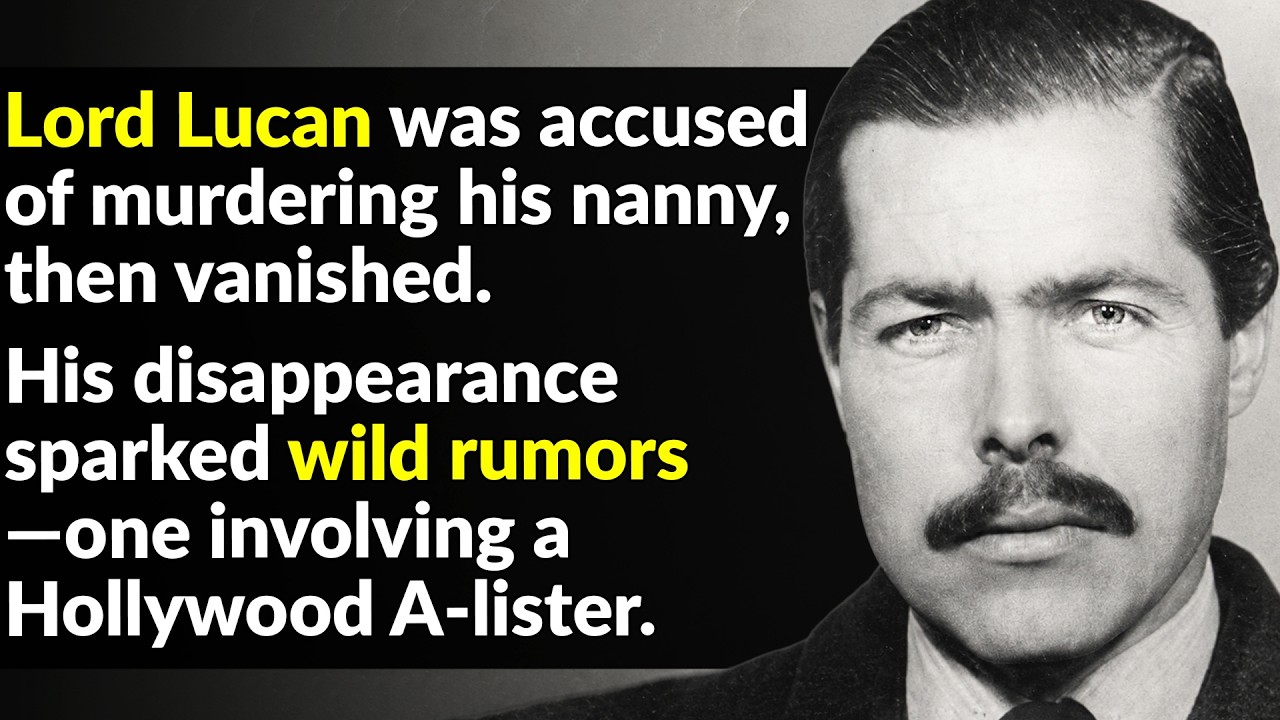
Not long afterward, a woman burst through the same doors, her head bloody, her face swollen, her nightgown soaked in red. She collapsed on the floor and gasped that she had just been attacked in her own home. The woman was the Countess of Lucan, and the man who had just been standing in that pub was her husband. The call he had made was to his mother, telling her there had been a terrible catastrophe and that he had interrupted an assailant.
Richard John Bingham, the 7th Earl of Lucan, was born in London on December 18th, 1934, into one of Britain’s most privileged families. His father, the 6th Earl, had served in the elite Coldstream Guards, and the young Lucan followed the same path. He was educated at Eton and then joined the same regiment, where he was popular enough to be captain of his school boarding house. Beneath the polished surface, however, there was always the gambling.
As a schoolboy, he regularly sneaked off the grounds to place bets at the horse track, opening a secret bank account to keep his winnings and losses hidden from his parents. After graduating in 1953 and completing his national service, he took a job at a London bank, earning 500 pounds a year on top of the roughly 12,000 pounds he received annually from family trusts. He was flush with cash, and he knew how to spend it. In 1960, he befriended a rich stockbroker named Stephen Raphael, who introduced him to the Clermont Club Casino, a private gambling haven in Mayfair that quickly became his second home.
Lucan could afford the water skiing weekends in the Bahamas, the rounds of golf, and the late nights of backgammon and chemin de fer. He drove an Aston Martin, kept powerboats, and flew friends around to racetracks. In 1963, he married Veronica Duncan, a young woman he had met only months earlier. Their honeymoon was a first-class trip across Europe on the Orient Express, thanks to a generous cash gift from his father.
Two months later, the 6th Earl suffered a fatal stroke, and Lucan inherited the title, the estate, and a legacy of 250,000 pounds. The marriage looked glamorous from the outside, but it was deteriorating rapidly. Veronica later said that her husband spoke more to her before the wedding than he ever did after it. He was devoted to his daily routine: breakfast and a walk in the park, lunch at the Clermont Club, an afternoon of backgammon, then home to change into black tie for another night of gambling.
Veronica felt isolated and depressed, and she formed an attachment to one of Lucan’s Clermont friends, a man named Greville Howard. Lucan suspected the affair before anything had happened and warned Howard off, and what Veronica saw as rejection sent her deeper into despair. Lucan tried to have her committed to a psychiatric clinic, but she refused, agreeing instead to a course of antidepressants. In a later documentary, she claimed that her husband would hit her with a cane, vowing to beat these mad ideas out of her.
Meanwhile, his gambling losses mounted, and his investments in thoroughbred racehorses were bleeding money. By the early 1970s, Lucan had become obsessed with one goal: winning custody of his children. He moved into a nearby apartment, but his Mercedes-Benz was often seen parked outside the family home. He began spying on his wife, hiring private detectives and trying to build a case that she was an unfit mother.
He called doctors, hoping one would declare her mentally unstable, but none would support his accusations. He recorded their telephone arguments secretly, trying to catch her saying something incriminating. He told anyone who would listen that Veronica could not keep a nanny because of her erratic behavior, though it was increasingly clear that his own behavior was the problem. One nanny later claimed that Veronica was afraid of him and had told her not to be surprised if he killed her one day.
Lucan’s campaign grew more cruel. He canceled his wife’s grocery orders, delayed payments to the milkman and the child care agency, and sabotaged her household however he could. He befriended nannies, plied them with drinks, and pumped them for information about his wife, then fired them. In one episode, he and two private detectives accosted a nanny while she was out walking with the children and simply drove off with them, after he had obtained a temporary custody order.
By late 1974, he was on the verge of bankruptcy. The custody battle had cost him 20,000 pounds, and he was borrowing money from friends and family. More disturbingly, he had started making open statements about how murdering his wife would solve all his problems. He told his friend John Aspinall and his mother that killing Veronica would save him from bankruptcy.
He told Greville Howard that if he dumped her in some body of water, he would never get caught. In the days leading up to the night of November 7th, many people described Lucan as unusually cheerful. Although he normally slept until noon, he woke early that morning and made plans to meet several friends. He failed to show up for all of them except one, an appointment with his literary agent.
That evening, Veronica and her seven-year-old daughter Frances were in a second-floor bedroom of the family home, watching television. The nanny, Sandra Rivett, usually had Thursdays off, but she had swapped her day off to spend time with her boyfriend earlier in the week. Just before nine o’clock, after putting the other children to bed, Sandra offered to make Veronica a cup of tea and went downstairs to the basement kitchen. She never returned.
Twenty minutes later, with no sign of Sandra, Veronica went to see what was taking so long. She reached the top of the basement stairs and saw that the lights were off below. She called Sandra’s name and then heard a noise behind her. Suddenly, she felt several violent blows to her head.
She fell to the ground and screamed, and a gloved hand clamped over her mouth. A voice told her to shut up. It was her husband. They struggled, and she bit his fingers and grabbed at him, and he fell back.
She saw the weapon: a bandaged lead pipe. He said he had killed Sandra, that she had come down first, and if it had been Veronica, she would have got it instead. Terrified and bleeding, Veronica offered to help him escape. They went upstairs, and Lucan sent Frances to her room.
He brought towels for Veronica to lie on, asked if she had any sleeping pills, and went to the bathroom to wet a towel for her wounded head. The moment he was out of sight, Veronica ran. She fled the house and made it to the Plumbers Arms pub, where she burst through the doors and collapsed on the floor. Officers arrived quickly, took her to the hospital, and forced their way into the family home to check on the children.
In the basement, they found Sandra Rivett’s body, stuffed into a canvas mail bag, killed by a blow from the same lead pipe. They also found an unscrewed light bulb, ensuring the basement would be dark. The evidence began to accumulate against Lord Lucan. At his apartment, investigators found a suit laid neatly on the bed, his wallet, car keys, driver’s license, glasses, and passport all in place, with his Mercedes in the driveway.
But on November 10th, they found the borrowed Ford Corsair he had actually driven that night, abandoned in New Haven. In the trunk were another bandaged lead pipe and a full bottle of vodka. Decades later, a former detective claimed that three cards from the game Clue had also been found there: Colonel Mustard, the lead pipe, and the hall. Lucan had told friends that if his wife were murdered, the prime suspect would be a hired killer, and he had staged his own disappearance to look like a victim.
Lucan had shown up at his friend Susan Maxwell-Scott’s house at around 11:00 p. m. that night, disheveled, claiming he had been walking past his wife’s home when he saw a man attacking her through the basement window and had intervened. He said he had slipped in a pool of blood at the bottom of the stairs.
When the lead investigator later asked Susan why she had not reported the incident, her answer was simply that she did not think it was important. Lucan also called his mother, claiming he had interrupted an assailant at Veronica’s house. The inquest into Sandra Rivett’s death opened on July 16th, 1975, after multiple postponements. Thirty-three witnesses testified before a jury, including Veronica, the landlord of the Plumbers Arms, and forensic specialists.
It became a circus. Lucan’s counsel baited Veronica into admitting she hated her husband, and Susan Maxwell-Scott repeated his claim that Veronica had accused him of hiring a hit man. The jury foreman announced a finding of murder by Lord Lucan, leaving the Crown Court to decide his fate. His defenders complained the inquest was a sham, but the evidence was stacked against him.
He had left no fingerprints, but Veronica said he had worn gloves. The same type of wrapped lead pipe found in his car matched the murder weapon. And blood patterns contradicted his story of a struggle in the basement, supporting Veronica’s account entirely. The lead investigator initially suspected Lucan had taken his own life, and a warrant was issued for his arrest.
Tracking dogs and divers searched the surrounding areas and found nothing. The investigator later changed his mind and came to believe Lucan had fled to South Africa to live near his brother. A former detective on the case reported that a reliable witness had seen him there in the early 1980s. Courts officially declared Lucan dead in 2016, and his son George inherited the title.
George has maintained that the rest of the family still do not know who murdered Sandra Rivett. Neil Berryman only learned in 2008 that he was Sandra Rivett’s biological son. Since then, tracking down Lucan has been his priority. In 2020, his own investigation led him to suspect a pensioner living in a Buddhist commune in Brisbane.
The man, now 87, the same age Lucan would be, denied being the Earl, and authorities ruled him out. But Berryman sought another opinion, and he got one. Professor Hassan Ugail, a respected expert in facial recognition software, claimed the man was a near-perfect match for Lucan. An artificial intelligence algorithm ran 4,000 cross-checks of seven photographs, four of Lucan and three of the mystery pensioner, and the results, Ugail said, were not based on opinion but mathematical fact.
For now, the identity of the man who might be Lord Lucan remains a secret.