The only confirmed photograph of Billy the Kid is a small, scratched tintype of iron and lacquer, roughly two by three inches, and for more than a century it has sustained two enormous myths about the young outlaw. One is that the photograph is not him at all. The other, far more stubborn, is that Billy the Kid was a left-handed, half-mad killer. The truth, as it turns out, rests in a detail most people never stopped to consider: tintypes are mirror images.
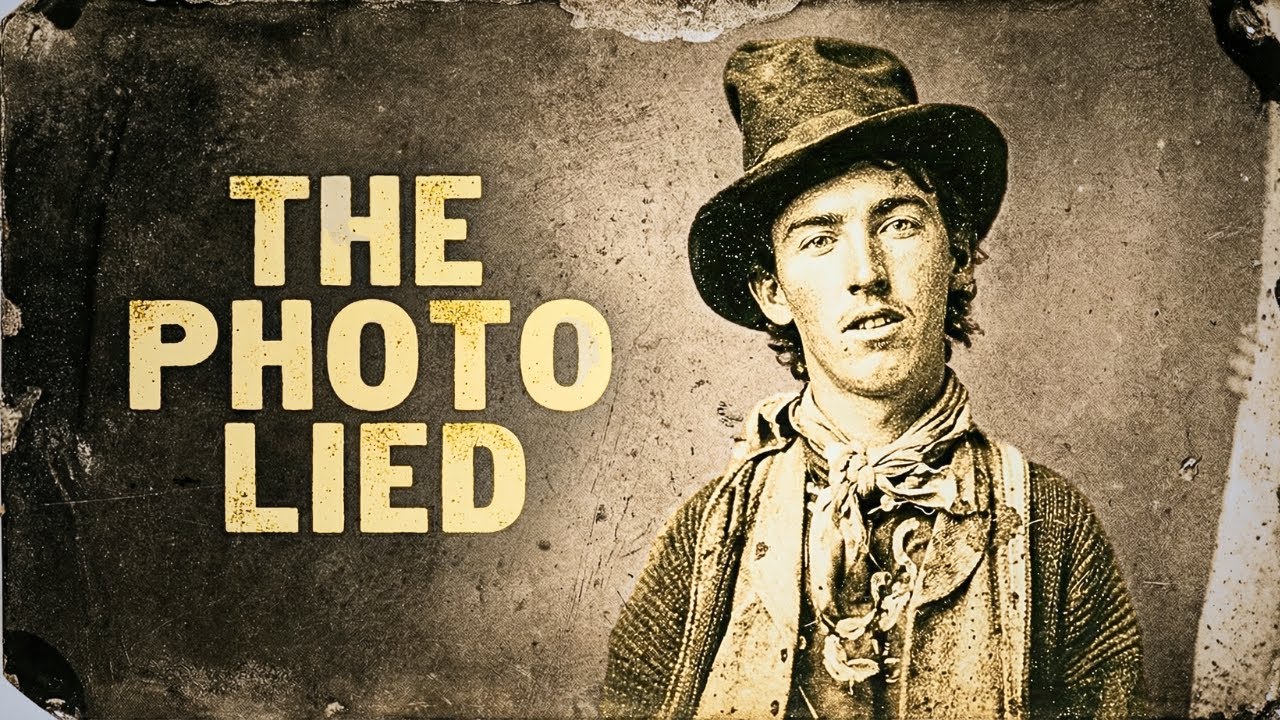
For over one hundred years, this particular tintype, known to historians as the Dedrick tintype, remained in a single family. Billy himself gave it to his friend Dan Dedrick, a man reportedly involved in cattle rustling and possibly counterfeiting alongside the outlaw. Dedrick kept the photograph his entire life. When he died in 1938, he passed it to his nephew Frank Upham, and the Upham family held onto it for decades.
In the 1980s, they loaned it briefly to the Lincoln County Heritage Trust in New Mexico, but it was not until 2011 that the world truly took notice. That year, the family offered the tintype for auction in Denver, and billionaire William Koch, an Old West enthusiast, paid $2. 3 million for it—the most expensive nineteenth-century photograph ever sold, a record that still stands. The face in the image matches the descriptions given by people who actually knew Billy.
Witnesses called him boyish, said he had a good-natured face and prominent front teeth that stuck out like a squirrel’s teeth, and described his slight build. The young man in the photograph has a narrow jaw, slightly prominent front teeth, and a tired, wary expression. He is not the chiseled gunslinger of Hollywood. He appears to be a twenty- or twenty-one-year-old who has not slept much.
His clothing reinforces the identification: a slouch hat, a bandana tied loosely at his neck, a dark practical vest, a cardigan, layered shirts, a Winchester Model 1873 rifle, and a revolver on his hip. This is the working outfit of a gunman in New Mexico in 1879 or 1880, neither wealthy nor destitute, armed and equipped but not polished. The tintype was cheap and fast, the standard form of photography in the 1870s and 1880s. A traveling photographer could produce one for a quarter, fifty cents if you wanted copies.
Billy’s girlfriend, Paulita Maxwell, interviewed in the mid-1920s, said the photo was taken by a traveling photographer who passed through Fort Sumner in 1880. She remembered Billy posing in the street near Old Beaver Smith’s Saloon, and she admitted she never liked the picture because it made him look rough and uncouth, unlike the man she knew. The weapon placement created the myth. In the photograph, the revolver appears on Billy’s left hip, his right hand resting on the rifle, his left side turned toward the camera.
Hollywood seized on the detail. The left-handed killer was too memorable to resist, a trait that made him different and vaguely sinister. There was only one problem. The chemistry of the ferrotype process flipped whatever the camera captured.
When the image is mirrored, the gun moves to the right hip, the rifle shifts to his left hand, the way a right-handed person would naturally hold it, and even the vest buttons line up correctly. Witness accounts agree. Men who rode with him, fought against him, and jailed him described Billy as right-handed. Pat Garrett, the man who killed him, said Billy drew with his right hand, and contemporary newspapers never once mentioned left-handedness.
Western historians James Horan and Paul Sann announced as early as 1954 that Billy was right-handed and carried his pistol on his right hip. The photograph itself offers another clue: the Winchester Model 1873 in the image has its loading gate on the left side, but Winchester only ever manufactured that rifle to load on the right. The photo had to be reversed. The myth spread because people trusted what they saw without understanding how the image was made.
Pat Garrett, or someone working with him, used an engraving based on the tintype as the frontispiece of his 1882 book, The Authentic Life of Billy the Kid. By then, Billy had been dead a year, and few who had known him well remained to object. The image was reprinted in dime novels, magazine articles, and early histories of the Lincoln County War, and nobody mentioned that tintypes were reversed. Repetition turned assumption into fact, until by the 1930s and 1940s the left-handed outlaw was carved in stone.
Paul Newman played him left-handed in The Left-Handed Gun in 1958, and dozens of films and television shows followed. The photograph reveals more than the position of a gun. Every piece of Billy’s equipment cost real money. A Winchester cost about twenty-five dollars in 1880, a Colt revolver another fifteen or twenty, and the hat, vest, cardigan, and boots brought the total to nearly seventy or eighty dollars.
A cowboy in that era earned about thirty dollars a month. Billy either had savings, was well paid for his work, or was supplementing his income in ways that were not legal. The photo shows him in the middle of the frontier economy, a man with means enough to arm himself properly. Perhaps the most revealing detail is his expression.
Billy is not looking directly at the camera. His gaze is slightly upward, dazed, uncomfortable. In the 1870s and 1880s, having one’s photograph taken was a significant event; subjects had to stand perfectly still for several seconds while the exposure was made, and most people stared straight into the lens as instructed. Billy did not.
He looks tired and wary, like someone who did not want to be there. That makes sense given the timeline. By early 1880, he had already been through the Lincoln County War and had killed at least a couple of men. People were actively trying to kill him.
That December, Sheriff Pat Garrett would capture him. Sitting for a photograph while wanted was a genuine risk; the image could be used to identify him or circulated to lawmen elsewhere. Why did he do it? The source offers possibilities without certainty.
He may have wanted the picture to send to someone, perhaps Paulita Maxwell or family, a common practice in the 1880s, a way of saying this is what I look like now, proof that I am still alive. Or he may simply have been young and vain enough to want a portrait despite the danger. He was only twenty or twenty-one. According to one account, Billy posed for four identical tintypes that day.
The photographer’s camera had multiple lenses that produced four images on a single metal plate, later cut apart so each person received a copy. Of those four, three are accounted for. One went to Dan Dedrick and survived to sell for millions. Another went to Pat Garrett, either confiscated at Billy’s capture in December 1880 or acquired after his death; Garrett used it for the engraving in his book.
A third reportedly went to Deluvina Maxwell, a Navajo woman who worked for the Maxwell family and was a devoted friend of Billy’s. Author Emerson Hough saw that copy in Fort Sumner in 1904, and then it vanished. The fourth tintype is unknown, likely lost, destroyed, or forgotten in an attic. What the surviving tintype proves is simple.
It almost certainly is Billy the Kid. The facial features match contemporary descriptions. The dating aligns with his presence in Fort Sumner. The chain of custody from Billy to Dan Dedrick and then through the Upham family is well documented, and the photo was confirmed by people who knew him, including Paulita Maxwell.
A forgery would have had to get every period detail right and then fail to account for the mirror image, an unlikely combination. The left-handed outlaw was never more than a photographic illusion, believed for decades because it made a better story. And the photograph itself shows a real young man at a specific moment, not the devil of dime novels or the Robin Hood of romantic legend, but a twenty-one-year-old who had already killed men and would be dead within eighteen months. He looks neither evil nor heroic in the image, just caught in circumstances he may not have fully controlled, aware that his life was dangerous and uncertain.
That scratched, oxidized piece of metal is the most honest thing that survives about Billy the Kid, a young man who had no idea he would still be famous a hundred and forty years later.