On August 9, 1985, a maintenance worker at a Maui resort finished his shift, clocked out at 4:47 PM, and walked toward his truck in the employee parking lot. A coworker saw him reach for the door handle. A delivery truck crossed the line of sight for a few seconds. When the view cleared, the man was gone.
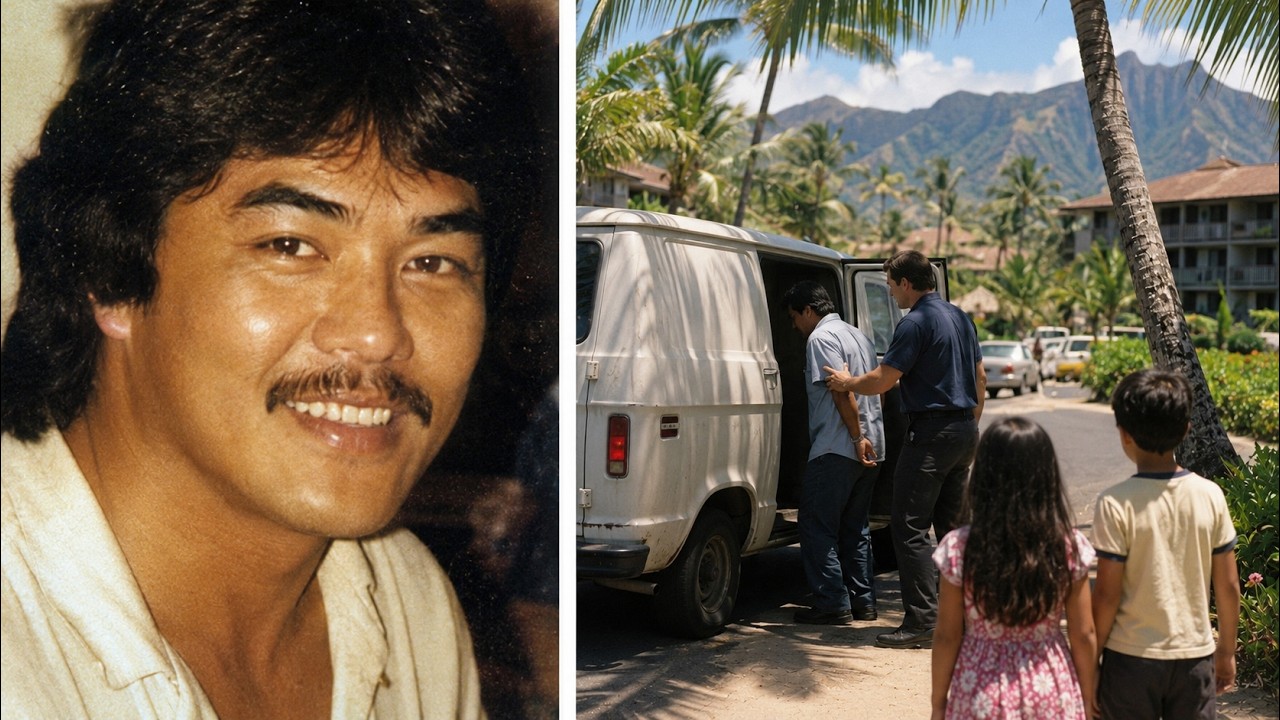
His truck was found the next morning, engine cold, keys on the seat. Raymond Dana, 38, was never seen again. Raymond was born and raised on Maui, the son of a fishing family from a small community on the island’s north shore. He had turned to resort work in his late twenties because it offered steady income, and he had a daughter, Leilani, age 8, whose school fees and medical bills drove his financial life.
Her mother had moved to Oahu in 1983, leaving Raymond with full custody. He picked Leilani up from school every day. His shifts never ran past three in the afternoon; when he worked late, his sister Malia stepped in without complaint. He was reliable, promoted twice, and studying for a licensed electrician certification through a correspondence course he reviewed after his daughter went to bed.
On the evening he vanished, the parking lot held no surveillance cameras. Resort security was oriented toward guests, the lobby, the pool, beach entrances, not the employee lot. But the lot was busy that Friday in peak season. Detective Frank Aiona, 44, who had grown up on the island and understood the intertwined resort economy, counted 112 people in or near the lot during a 90-minute window around Raymond’s disappearance.
Among them, unknown for 37 years, was a family from Tucson, Arizona, on the second day of a two-week vacation, walking the path connecting the resort lot to the beach access. The husband, Gerald C. S. , carried a camera and photographed everything, a habit his wife Barbara found excessive at the time.
Aiona spent three months building a precise picture of Raymond’s life. There were no identifiable enemies, no financial complications. His former partner was interviewed and cleared in the first week. But in the weeks before his disappearance, Raymond had mentioned to Malia that he noticed a light-colored truck following him twice on the route home from the resort.
Aiona pulled records for light commercial trucks registered on Maui, over 300, then narrowed them against suppliers with active delivery accounts at the resort. One name appeared on both lists: Stuart Bailey, who ran a small equipment supply company making weekly deliveries to the resort’s maintenance department. His truck was white. His delivery log placed him at the resort on the afternoon of August 9, with a departure time of 4:55 PM.
Aiona interviewed Bailey, 41, calm and cooperative. He said he had been in the maintenance area from about 4:15 to 4:50, loading empty boxes, then drove directly to his warehouse on the south side of the island. Two warehouse employees confirmed his arrival by 5:30. The timeline was tight.
Aiona could not break the alibi with the means available in 1985. He could not find a body, or a witness, or a motive that rose above speculation. The case was reclassified from missing person to probable homicide in November 1985 and moved to the cold case unit. Raymond was never legally declared dead; it took Malia’s paperwork in 1996 for Leilani, then 19, to gain that measure of resolution.
Leilani grew up in Malia’s home, finished school, became a dental hygienist in Kahului. She never stopped searching. She submitted her father’s case to every advocacy organization she could reach and contacted the cold case unit every two years, sending new contact information with every move so she would be easy to find when someone had something to tell her. By 2005, Bailey had expanded his equipment supply business and sold it in 2001 for enough to retire comfortably on the island’s east side.
He remarried in 1992. His second wife knew him as precise and methodical, fond of fishing from rocks on the south shore on weekend mornings before anyone else woke. In the spring of 2022, Barbara C. S.
, a retired fourth-grade teacher in Tucson, was organizing a storage closet as part of settling her late husband’s estate. She found a shoebox of slides from their 1985 Hawaii vacation. Most were as expected: children on the beach, the resort pool, sunsets. Then she reached a slide of the path between the parking lot and the beach.
The children were turned half toward the camera. She saw the background. In 1985, she had not noticed it. The children were the focus; the background was just background.
Now, at 71, with 40 more years of life experience, she saw a white truck at the edge of the lot, a partial license plate, and two men near the passenger door. One, smaller, in maintenance uniform, with the posture of a person who did not want to be where he was; the other, taller, one hand on the smaller man’s arm in a way she had no difficulty describing at all. She called the Maui Police Department non-emergency line. The officer who took the call transferred her to a cold case supervisor, Detective Anela Hega, who had held the Dana file for three years.
Hega asked Barbara to send the slide, then changed her mind. She told her not to mail it. Someone would come to Tucson to collect it. The slide was digitally processed by the department’s forensic imaging unit over six weeks beginning in August 2022.
The partial plate, three characters visible with the rest obscured by the truck’s angle, was matched against the 1985 vehicle records Aiona had preserved in the original file. One vehicle matched the visible characters and the truck’s physical description: Stuart Bailey’s delivery truck, registered to his company. The reopened investigation found what the 1985 investigation had lacked: motive. Raymond, preparing for his electrician exam, had been reviewing the resort’s electrical systems in the maintenance area, legally, with Don Kleo’s unofficial permission, using the space as a study environment.
In March 1985, five months before he vanished, he noticed wiring in the maintenance supply room that did not match the resort’s filed electrical diagrams. He made a note and told Kleo, who said he would look into it but was absorbed by other problems and did not follow up. What Raymond had found was an unauthorized electrical bypass, a modification diverting power from the resort’s system to an adjacent property without the resort’s knowledge. The adjacent property was a storage facility leased through a shell company for Stuart Bailey.
Bailey had been stealing electricity for his equipment warehouse for three years. The financial gain was modest, but the legal liability, if a resort employee with the training to document it properly reported it, was significant. The bypass had also damaged a safety circuit in a way that could be attributed to the resort in any subsequent inspection. Bailey, making deliveries to the maintenance area twice a week, had heard enough to understand that Raymond Dana, quietly studying for his electrician certification there every Friday evening, was the most dangerous threat to his business.
He had five months to plan what he did on August 9. Stuart Bailey was arrested on December 3, 2022, 37 years, three months, and 25 days after Raymond Dana reached for his truck door in the resort parking lot. Bailey was 78. Officers arrested him at his home on a Saturday morning before he left to fish.
He was in his kitchen when they arrived. He looked at the arrest warrant, then at the lead investigator. He asked when someone would find the photograph. He had known, always, that a camera had been pointed in that direction.
He had calculated that the image, if it existed, was in the hands of a tourist who would never know what they had, would not care to preserve or dispose of it, and would almost certainly never look at the background again. He had been right for 37 years. He was wrong about the 38th. Leilani Dana was 45 when Detective Hega called.
She was at work, went outside to the parking lot, sat on a concrete barrier in the sun, and listened. When she spoke, she asked one question: did he know why. Hega told her about the bypass, the stolen power, the safety circuit, the five months of planning. Leilani thought for a moment, then said her father would have reported it.
That was what he would have done, she said: recorded it, filed it, done it properly, because that was the right thing. She was right. It was the most Raymond Dana act in the world, and it was exactly what made him dangerous to a man who could not afford exposure. Bailey pleaded guilty to first-degree murder in March 2023 and was sentenced to life without parole.
He made no statement at sentencing. Barbara C. S. did not attend the trial.
She submitted a written statement that was read into the record. She wrote that she had wondered many times whether she had done the right thing in calling, whether her interpretation was correct, whether an elderly woman using a light table in a Tucson kitchen could really see what she thought she saw. She concluded that when you see something, you speak about it. That was the simplest rule, and she was glad she had not found a reason to ignore it.
The slide is now in evidence archives at the Maui Police Department. In it, on a beach path in August 1985, two children turn toward a camera held by their father, the way children do, while behind them something terrible happens in a parking lot no one in that family could have known existed. The truth in the Dana case was always in that box in the closet.
It only required someone to open the box and hold the image up to the light.