On the morning of January 16, 1984, Connie Bennett let herself into her son’s home in Aurora, Colorado, after eleven unanswered phone calls. The front door opened too easily. Inside, she found her twenty-seven-year-old son Bruce dead at the foot of the stairs, his head bloodied by blunt force and his throat cut. In the bedroom lay his wife Deborah, twenty-six, beaten beyond recognition.
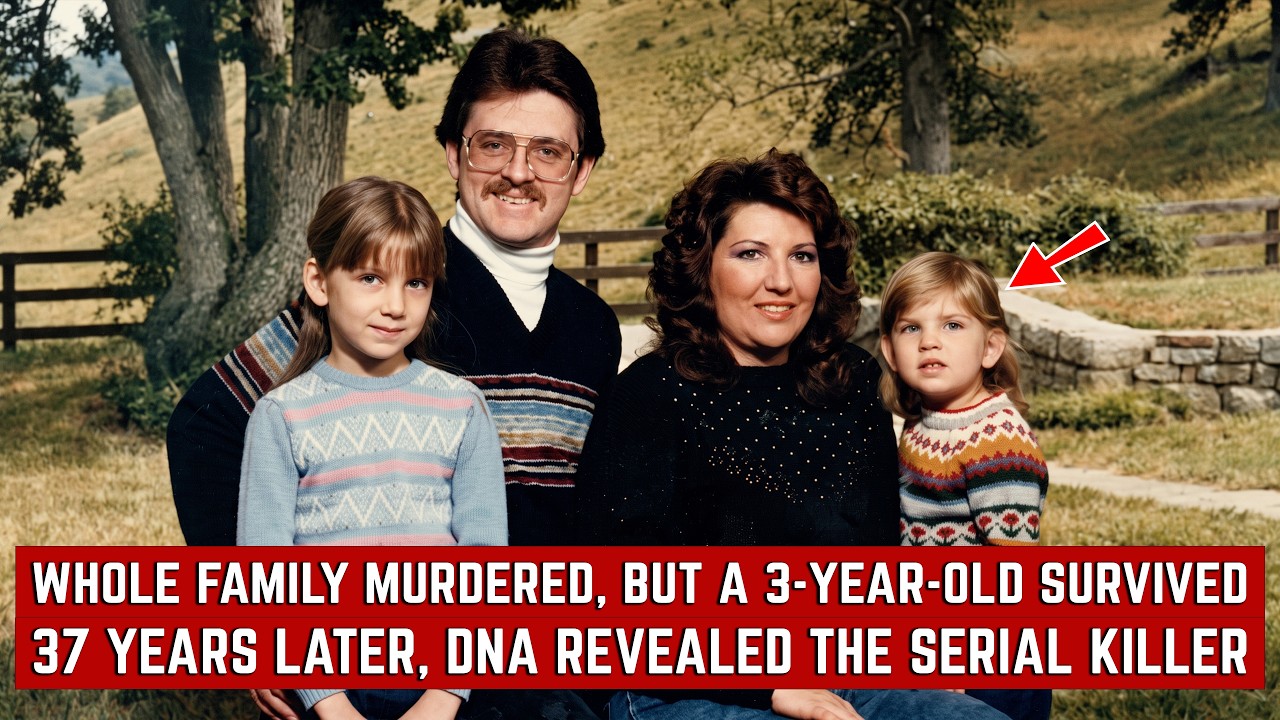
In the girls’ room, eight-year-old Melissa was dead, and the coroner would later determine she had been sexually assaulted. Three-year-old Vanessa was found barely alive in the wreckage, her skull fractured, her jaw broken, her brain injured so severely that trauma doctors paused before beginning surgery. She survived, but only after emergency operations, weeks in a coma, and a recovery no one could guarantee. Bruce Bennett was a former Navy man studying to become an air traffic controller, a job that left no room for guesswork.
Deborah ran the household around his study routine. They had bought their first home on East Center Drive a year earlier, in one of Denver’s rapidly expanding suburbs, a neighborhood of identical driveways and chain-link fences where families rarely locked their doors. That January night, as temperatures dropped across the Colorado front range, no one had thought to close the garage door. Detective Steve Connor was among the first officers on the scene.
He could not have known the case would consume much of the next three decades of his career. Investigators found no sign of forced entry; none was needed. The open garage had been the way in. A hammer was the suspected weapon, but it was gone.
So was any trace of the killer, except for footprints in the fresh snow outside the garage, leading away and fading quickly. Neighbors had heard nothing, seen nothing, remembered nothing. For weeks, the only leads were dead ends. The family’s funeral overflowed with mourners, and cards and flowers piled up on the front porch, but the investigation stalled.
The file went into the stack of unsolved cases, and East Center Drive became a street people walked past silently after dark. What almost no one knew at the time was that the Bennett murders were not an isolated horror. They were the fourth in a series of attacks that occurred over just twenty-three days in January 1984. Eleven days before the Bennetts were killed, Kim and Jim Hencheil were attacked with a hammer in their Aurora home while sleeping.
Both survived, but were changed forever. That same night, across town, Donna Hom was ambushed as she entered her garage returning from shopping. She was brutally beaten and sexually assaulted, and this time the attacker left the hammer behind. Six days later, on January 10, fifty-year-old interior decorator Patricia Smith was attacked in broad daylight in her Lakewood home while eating lunch.
She was beaten to death and sexually assaulted. The hammer was left at the scene, as it had been at Donna Hom’s. Her daughter found her hours later. Five days after that came the Bennetts.
The attacks were escalating. Each one was more violent than the last, and the question of motive only deepened because valuables were left untouched. Investigators were working separately, in different police departments and different jurisdictions, with no shared database and no way to connect the cases. When Patricia Smith’s body was found, Denver media began calling the unknown assailant the Hammer Attacker.
Then, eleven days after the Bennett murders, police in Kingman, Arizona arrested a twenty-three-year-old drifter named Alex Christopher Ewing in connection with the attack on Roy Williams, a man who had been bludgeoned with a twenty-five-pound piece of granite while he slept and somehow survived. Ewing had been in the area, working construction and odd jobs. He had a Colorado driver’s license from the previous summer, but no one in Arizona had any reason to connect him to crimes in Colorado, and the national database that could have made that link did not exist. The one chance to stop Ewing for good slipped away.
On August 9, 1984, deputies were transporting him from Utah to Arizona for a court hearing when they stopped in Henderson, Nevada. Ewing escaped. That same night, he broke into a nearby home and bludgeoned a sleeping couple with an axe handle. He was recaptured two days later by park rangers near Lake Mead.
A Nevada jury convicted him, and the judge sentenced him to 110 years in prison. The Arizona case against him was quietly dismissed. With Ewing lost inside the Nevada prison system, Colorado’s three unsolved cases went cold. The science that would eventually break the case barely existed in 1984.
DNA testing was largely theoretical. By 2002, forensic analysts at the Colorado Bureau of Investigation confirmed that DNA from the Bennett and Smith crime scenes belonged to the same person, but the profile had no name attached to it. It was like having an extremely detailed description of someone who did not exist in any file. Detective Connor, who had carried the case forward on his own initiative through decades and changing supervisors, still had no suspect to compare it against.
In 2013, Nevada made it mandatory for convicted offenders in custody to submit DNA samples. Three years later, the state attorney general extended the rule to older inmates, including those sentenced decades before DNA testing existed. It was an unremarkable policy change, but it would become the most important development in the entire case. Within a day of Ewing’s sample being entered into the national system, it matched the DNA profiles from the Bennett and Smith crime scenes.
Connor received the news in the summer of 2018. When Colorado investigators traveled to Nevada and showed Ewing a photograph of Patricia Smith’s murder scene, he visibly recoiled. Told that his DNA matched the evidence, he said there must be some mistake. In two separate interviews, he admitted living in the Denver area in 1984 and doing construction and plumbing work around the metro, but he offered no explanation for how his DNA ended up at the crime scenes.
There was no confession, only a shrug. Colorado issued an arrest warrant charging Ewing with thirteen counts, including six counts of first-degree murder, attempted murder for the attack on Vanessa, and sexual assault charges. But Ewing’s lawyers fought extradition for nearly twenty months, appealing from Nevada courts all the way to the U. S.
Supreme Court, which refused to intervene. In late February 2020, Ewing was flown to Colorado and held without bail. At his first court appearance, he answered the judge’s routine questions quietly in just five words across an hour-long hearing. The trial began in the summer of 2021 in Arapahoe County.
Prosecutors called twenty-five witnesses, including Vanessa, now an adult with only vague memories of that night. The most important witness was Yvonne “Missy” Woods, a DNA analyst from the Colorado Bureau of Investigation, who testified that genetic material collected from the bedroom quilt in 2001 and again in 2018 matched Ewing’s DNA. The probability it belonged to anyone else on earth, she said, was roughly three nonillion to one. The defense countered with a fingerprint expert who testified that none of the thirty-one fingerprints found in the Bennett home belonged to Ewing, and lawyers argued that decades of storage, handling, and testing had contaminated the evidence.
At one point they moved to dismiss the case over how evidence had been preserved. The jury deliberated for two days. On August 6, 2021, they convicted Ewing on all counts. Eleven days later, the judge sentenced him to three consecutive life terms.
In the spring of 2022, a second jury in Jefferson County convicted him separately for the murder of Patricia Smith. Vanessa, the three-year-old who survived, is now a woman in her forties with a metal plate in her head and years of physical therapy behind her. Standing in court decades later, she told the judge she had lost not only her parents and sister, but her trust in people, her dignity, her sense of self. She addressed the court, she said, not the killer.
Connie Bennett, the mother who found her son’s family dead, told reporters outside the courthouse that a huge weight had been lifted. It was not an ending, she said, but they had learned to live with what happened. The case had waited thirty-seven years for a face and a name. In the end, the thirty-one fingerprints that did not match mattered less to the jury than the three nonillion to one odds of the DNA being anyone else’s.
Alex Ewing died in prison, as the law required. And the answer to who killed the Bennett family and Patricia Smith, a question that outlasted the careers of most of the detectives who first worked it, finally had an answer.