Doris Duke was born on November 22, 1912, in New York City, the only child of James Buchanan Duke, a man who had built two fortunes—one in tobacco and one in electric power. By the time she was 12, her father was dead, and she had inherited an estate widely reported at $100 million. The newspapers called her "the richest little girl in the world," and they counted her money before she could spell it.
Her father left her more than money. According to accounts that recur across her biographies, he told her to trust no one. He warned her that people would want her fortune, that they would come wearing the face of friendship and love, and that no one would ever love her for herself.
She carried that warning for the rest of her life.
The inheritance was structured in stages, reaching her in major portions at ages 21, 25, and 30. From childhood, she was surrounded by trustees, lawyers, and advisers whose livelihoods depended on her fortune. The machinery built to protect the money also enclosed the person inside it.
In 1930, she made her debut into society at Rough Point, the family mansion in Newport, Rhode Island. The event was treated as a national spectacle. But Doris Duke did not want to be measured.
She used her fortune not to buy her way deeper into that world, but to buy her way out of it.
In 1935, she married James Cromwell, a socially ambitious man older than she was, with a taste for politics. The wedding was covered like a royal event. The honeymoon was a journey around the world, and somewhere on that journey, she fell in love with Islamic art and architecture.
It became the great passion of her life.
That passion became Shangri-La, a house she built at Black Point on the shore near Honolulu. Craftsmen were brought in, materials were shipped across the ocean, and over the decades she filled it with thousands of objects—tiles, textiles, ceramics, and whole carved interiors. It became one of the finest private collections of Islamic art in the world.
The marriage to Cromwell did not survive the decade. He had a political career to finance, and her fortune was the fuel. In July 1940, in Honolulu, Doris Duke gave birth to a daughter named Ardan.
The child was born prematurely and died the following day. She never had another child. The loss went underground and shaped her from below for the rest of her life.
The couple divorced in 1943. The first great test of her father's warning had returned the answer he predicted. A man had married her fortune, and when the marriage ended, the fortune remained the central fact of it.
Within a few years, she married again. This time, she married Porfirio Rubirosa, a Dominican diplomat and sportsman whose entire public reputation was built on his conquests of wealthy and famous women. They married in Paris on September 1, 1947.
The tabloids covered it as spectacle and scandal.
The financial choreography of the marriage was stark. To secure an uncontested divorce, Doris Duke reportedly paid Rubirosa's former companion about $1 million. Rubirosa himself left the brief marriage enriched by gifts reported to be worth several million dollars—polo ponies, sports cars, a converted bomber aircraft, and a 17th-century house in Paris.
The marriage lasted about a year.
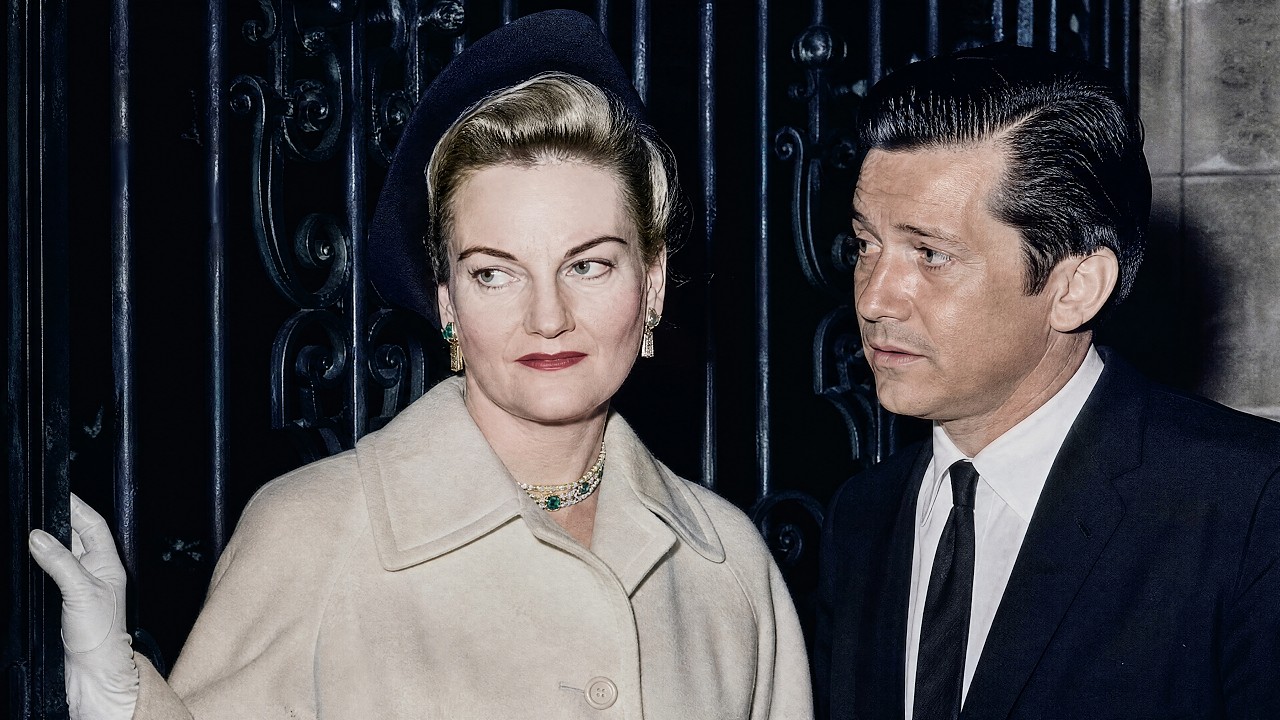
After Rubirosa, she said she would never marry again. She did not. She reportedly said in the years after that she could never know whether a man really meant it.
How could she ever be sure? That question is the whole tragedy compressed into a single sentence.
Freed from the marriage market, she used her fortune to become one of the most independent women of her century. During the Second World War, she worked in a canteen for sailors in Egypt for a token salary of $1 a year. In 1945, she took a post as a foreign correspondent for the International News Service, reporting from a Europe shattered by war.
She later wrote for Harper's Bazaar.
She surfed in Hawaii. She studied belly dancing. She sang jazz and gospel.
She kept exotic animals, including camels, on the great farm in New Jersey. She traveled constantly across her four estates—Duke Farms in New Jersey, Rough Point in Newport, Shangri-La in Honolulu, and later Falcon Lair in the Hollywood Hills, the former home of Rudolph Valentino.
The same independence that let her live freely was also slowly isolating her. She trusted objects because she could not trust people. The people in her life were increasingly people she paid.
The freedom and the loneliness came from the same root and grew together.
Into that guarded life came one man who managed to be something rarer than an employee and rarer than a suitor. His name was Eduardo Tirella. He was an artist, a designer, and a curator, and for roughly 10 years he arranged the art in her homes.
He became one of the very few people Doris Duke seems genuinely to have trusted.
Tirella had ambitions in Hollywood, and by 1966 he wanted to pursue them. He told her he was leaving. For a woman built the way she was built, a trusted friend choosing to go was a heavy thing.
On an October evening in 1966, Doris Duke and Eduardo Tirella were leaving Rough Point together in a 1966 Dodge Polara station wagon. The tall iron gates were closed across the drive. Tirella got out to open them.
The car went forward. It struck Tirella against the iron gates, drove through them, dragged him across Bellevue Avenue, and came to rest after hitting a tree on the far side. Eduardo Tirella was killed.
Doris Duke was at the wheel.
The Newport police investigated and ruled the death an accident. The official account was that the car surged forward when Doris Duke lost control of it. No charge was brought against anyone.
Some years later, Tirella's family brought a wrongful death suit. A civil jury found Doris Duke negligent and awarded damages reported at about $75,000. It was a civil finding of negligence, not a criminal verdict.

Both findings are part of the record, and they are not the same thing.
For decades, the case rested. Then in 2020, investigative journalist Peter Lance published a long re-examination in Vanity Fair, arguing that the death was not the simple accident the 1966 ruling described. In 2021, the Newport police reviewed the matter again and concluded there was no new evidence that would change the original finding.
The case was closed once more as an accident.
The record now holds all of it at once, layered and unresolved. An official ruling of accidental death, a civil jury finding of negligence, a journalistic re-examination, and a police review that left the original finding standing. When a death stands close to a fortune that large, certainty becomes almost impossible to reach.
She lived for another 27 years after that October evening. The questions followed her the whole way.
In the mid-1980s, a woman named Chandi Hefner, a follower of the Hare Krishna movement, came into Doris Duke's life and became a close companion. In 1988, Doris Duke legally adopted her, though Hefner was by then a grown woman of 35. The belief behind the adoption, as it was reported, was stranger and far sadder than the legal oddity.
Doris Duke came to believe that Chandi Hefner was the reincarnation of Ardan, the daughter who had lived for a single day in 1940.
The adoption was in some ways the loneliest act of a profoundly lonely life. A reaching back across half a century to close a wound that had never once closed.
The bond broke down. Accounts describe a falling out in which she came to believe that Hefner was not what she had hoped her to be. Doris Duke cut Chandi Hefner out.
She was removed from the final will and excluded from the trust funds. After Doris Duke's death, Hefner sued the estate, and the estate settled with her for a reported $65 million.
In her last years, the person closest to the richest woman in America was her butler. His name was Bernard Lafferty, an Irish-born butler who rose to a position of extraordinary closeness and influence. He became her attendant, her confidant, and the manager of her daily life.
As she grew frailer, he became the gatekeeper, standing between Doris Duke and the world.
To his defenders, Lafferty was a devoted servant loyal to a difficult and desperately lonely woman. To his accusers, he was a man who deliberately isolated an old woman, encouraged her dependence, and stood to gain enormously the moment she died. She named him executor of a fortune of more than $1 billion.
In 1992 and 1993, she underwent operations, including two knee replacements and, by some accounts, cosmetic surgery. She grew weaker with each intervention. She was medicated.
She was an old and fragile woman, dependent on the people around her for her care and more and more for her only contact with the outside world.
Doris Duke died at Falcon Lair on October 28, 1993. She was 80 years old. The recorded cause was progressive pulmonary edema resulting in cardiac arrest.

Within about 24 hours, her body was cremated without an autopsy, and her ashes were scattered in the Pacific Ocean in keeping with her stated wishes.
The speed was the thing that could not be explained away. A woman worth more than a billion dollars was dead and cremated within a single day with no examination of the body at all. Whatever the true story of her final hours, the one thing that might have settled it was gone almost at once.
The probate fight that followed was long and bitter. It was alleged that Lafferty, together with a physician, had hastened her death. These were grave accusations, and they were investigated.
Prosecutors found no evidence sufficient to bring a criminal charge. No charge was ever brought against anyone. The claims remain exactly that—claims that were made, investigated, and not proven.
What the courts did decide was narrower and certain. Lafferty's fitness to serve as executor was challenged, and he was ultimately removed from that role, reported to have received a settlement to step aside. Chandi Hefner settled with the estate for a reported $65 million.
Twice in her life, a death stood close to her money, and twice the money made the truth impossible to reach. At the gates, it was influence and the slow fading of an old case. At the end, it was a cremation within a single day.
The fortune did not have to be guilty of anything to make certainty impossible. It only had to be present.
When the lawsuits finally settled, Doris Duke's fortune was valued at upward of $1.2 billion. The great bulk of it went into the Doris Duke Charitable Foundation and related philanthropic bodies, funding medical research, the performing arts, the protection of the environment, the welfare of children, and the preservation of her own properties.
Shangri-La is now a museum of Islamic art, culture, and design, open to the public. Rough Point is preserved as a house museum run by the Newport Restoration Foundation, the organization Doris Duke herself founded in 1968, which saved dozens of colonial buildings in Newport from demolition. Duke Farms in New Jersey is now a public nature preserve and environmental center.
The private world she had built to keep people out became in the end a public inheritance that invites people in.
Her only child died after a single day. The adult she adopted and believed was that child returned was cut out and settled with the estate for a check. There are no direct descendants.
The family line ended with her in a locked house on a California hill.
What survives her is the money turned at last toward purpose, and the houses turned at last toward the public, and a set of questions about two deaths that the money will never let anyone fully answer.
Her father was right, and that is the hardest thing in the whole story to carry. He told her that people would want her money. And people wanted her money at the altar and at the gates and at the deathbed.
He gave her the truth as a gift, and it worked in her life as a curse. A person who cannot believe she is loved for herself is alone, no matter how many houses she owns or how many millions she counts.
The girl the newspapers counted was rich in everything the world can sell and poor in the one thing it cannot. And she knew it.