On a cold January morning in 104 BC, Rome was packed with spectators. They crowded the streets between the Forum and the Capitol, climbed onto rooftops and balconies just to see. Trumpets blared over the noise, drums beat a steady rhythm, and wooden wheels cracked against the stone as cart after cart rolled past, laden with African gold, carved ivory, and weapons stripped from the dead. Near the end of the procession, chained behind the chariot of a Roman general, came the man the crowd had waited hours to see.
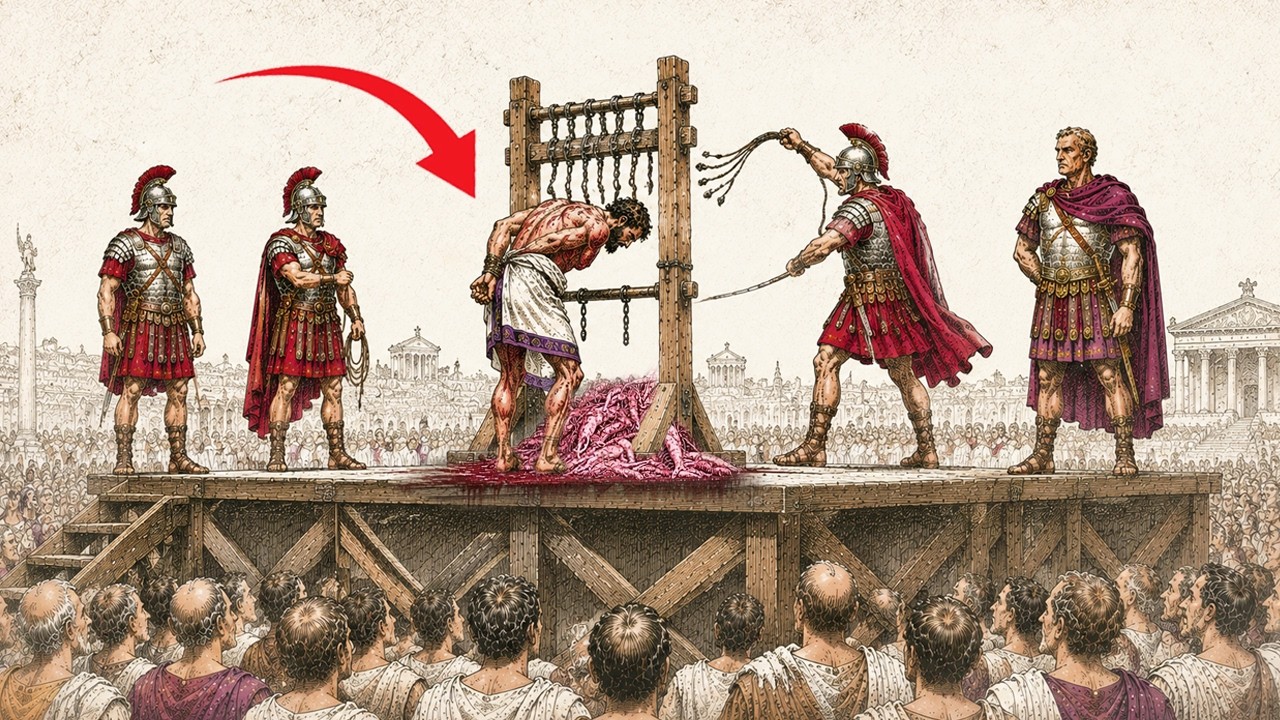
Bare-chested, his beard unkempt, his hands bound tightly behind his back, he was a king. Six years earlier, he had told his friends that Rome was a city for sale. Now Rome would show him what it did to men who bought and lost. In about six minutes, the time it took to walk half a mile, Jugurtha of Numidia would be lowered by rope into a stone pit beneath the Roman Forum.
He would die there, in darkness, cold, and isolation, in less than a week. The remarkable part was that the Romans did not need to keep him alive to kill him. They could have executed him on a Numidian battlefield. Instead, they transported him a thousand miles across the sea for a single purpose, so that half a million people could watch him publicly lose his humanity.
For more than three hundred years, Roman commanders faced a uniquely specific question. When you defeat a king, a crowned ruler, a living symbol of a nation, what exactly do you do with him? The obvious answer might seem simple: you kill him. But Rome rarely did that.
Rome invented something worse, and it did the same terrible thing to daughters, sons, and heirs, even to children as young as four. Only one defeated ruler in the long history of the empire escaped the system. That person was a woman. Her name was Cleopatra, and the choice she made instead stands as one of the most defiant acts in the ancient world.
The system was not invented all at once. It was learned and perfected one defeated king at a time, and the man who truly taught Rome how to do it was not a soldier. He was a sixty-one-year-old aristocrat named Lucius Aemilius Paullus. A twice-elected consul from an old patrician family, Paullus was known for precision, discipline, and a rare humanity.
He had spent his career avoiding massacres of civilians. But in 168 BC, standing on a battlefield in northern Greece, he made the decision that would set the pattern for three centuries of Roman practice. He did not kill the king he had defeated. He kept him.
The king was Perseus of Macedon, forty-four years old, the last legitimate ruler of the dynasty founded by the family of Alexander the Great. He was cautious and thrifty, not a warrior king like his famous ancestors, and he had spent years trying to bribe and negotiate his way out of war with Rome. That caution would be remembered against him. The men he led at Pydna were not conscripts dragged from conquered villages.
They were the last heirs of a two-hundred-year legacy, descendants of those who had marched with Alexander and Philip. Their weapons, the eighteen-foot sarissa spears and the interlocking phalanx formation, had once conquered the known world from Greece to India. On the morning of June 22, 168 BC, they lined up at a place called Pydna, confident that Macedon was invincible. Rome, on the other side of the field, understood what it was facing.
This was not just an army. It was a story, a dynasty, a living link to Alexander himself. Rome had already learned a lesson no other ancient state had turned into a real weapon: story mattered more than killing. Ending Perseus quickly would end the battle.
Ending him slowly, before the public in Rome, would end the idea. The two armies were similar in size but not in strength. Perseus fielded about forty thousand infantry and four thousand cavalry, the largest Macedonian force in a generation. Among them were elite units with bronze and silver shields, descendants of Alexander’s royal guard.
They carried the traditional weapons and marched in steady formation, their spearheads overlapping in five ranks, an iron wall that had never been broken on level ground. But Pydna was not level ground. The battlefield stretched across broken slopes and ravines carved by streams. As the wings advanced slowly and terrifyingly, like a single mass of spears, the terrain began to deform the line.
Gaps appeared, small, not visible from a distance, but the Roman commander saw them. Aemilius Paullus watched from high ground. After decades of campaigning, he understood what the Macedonian officers did not: a phalanx is invincible only as long as it holds together. If it cracks, even a little, the wall becomes a scattering of isolated men, each carrying a spear too long to be useful in close combat.
Paullus gave the order. Roman maniples, small and flexible units armed with short swords, poured into the gaps. The long Macedonian spear was useless there. A man holding an eighteen-foot pike could not draw a knife fast enough to save his life.
The decisive phase of the Battle of Pydna lasted between one and two hours, and it ended a reigning dynasty. The ancient sources do not describe Perseus dying in that battle. They describe him leaving. Polybius uses a word that can be translated as fled or withdrew.
When the phalanx collapsed, its king had already mounted his horse and ridden away. He went first to the city of Pella, then to the sacred island of Samothrace. He carried with him as much treasure and as much of his family as he could, his wife, his two young sons, and his daughter. He believed the ancient protections of the Samothrace sanctuary would shield him.
He was wrong. Roman ships arrived within days. The temple priests did nothing to stop them. Perseus and his children were trapped and isolated, and about two weeks after the battle at Pydna, they were brought to a Roman camp at Amphipolis.
There, the king of Macedon entered the tent of Lucius Aemilius Paullus, not as a king. Polybius tells us he threw himself on the ground in despair. This was the decisive moment, the decision that shaped all subsequent Roman practice. Perseus lay on the ground before Paullus, his sons with him, the youngest a small boy clutching his father’s hand.
Paullus’s officers watched, and a crowd of soldiers gathered outside the tent. According to Polybius, Paullus did something that shocked the men present. He stepped forward and raised Perseus by the hand, addressing him gently in Greek as one nobleman to another. The trembling Perseus pleaded, “I surrender myself and my children to you and the Romans, hoping you will save us.
” The story could have ended in any number of ways. Paullus could have granted him honorable exile, executed him secretly, or returned the children to Macedon. But instead, according to the sources, Paullus’s face darkened, and he spoke words that told Perseus everything about the kind of empire he had become part of: “You should have thought of this earlier, when you were negotiating with the enemies of Rome. Now the decision is not mine, but the Senate’s.
” In that sentence, Paullus told a defeated king that he was no longer a king, no longer a person with a destiny. He had become the property of a state that would decide how to use his body. Perseus was going to Rome. So were his sons.
Roman triumph, the oldest and most sacred celebration of the Roman state, required a general to have killed at least five thousand enemies, ended a foreign war, and received the honor from the Senate. It was the highest reward Rome could offer, and by the mid-second century BC, it had also become the empire’s most precise weapon against defeated kings. Crucially, the triumph was not an execution. An execution ends things.
A triumph displays them. The spectacle gave the crowds time, hours, sometimes an entire day, to walk past a captive king and stare, laugh, spit, and watch a man who had once ruled a nation now wearing chains made by a Roman blacksmith specifically for him. Every detail of the ceremony was designed for maximum humiliation. Prisoners were forced to march.
They wore special clothes, often altered versions of their royal robes, deliberately shabby or torn. They marched near the end of the procession, behind the carts of spoils, so the crowds were already worked up when they appeared. And their position was crucial. They were placed directly in front of the general’s chariot, so thousands of Roman citizens could see in one line of sight the two most important things Rome wanted them to see: the victorious general above his chariot wheels, and the humiliated king who made him look great.
Sixty-three years after Pydna, another Roman general made the same decision as Paullus. His name was Gaius Marius, and his captive was Jugurtha of Numidia. Jugurtha was no stranger to Rome. In his youth he had served in the Roman army in Spain under Scipio Aemilianus, mingling with Roman officers and learning their language, politics, and vices before inheriting the throne of Numidia.
He used that knowledge to kill his rivals and bribe Roman senators to look the other way. During this period, Sallust recorded his famous judgment on the Republic: Rome was a city for sale, and would fall as soon as it found a buyer. Jugurtha was fifty-five when Rome finally caught up with him. He was not defeated in battle.
He was betrayed and handed over by his father-in-law, Bocchus of Mauretania, at a diplomatic meeting arranged for that very purpose. He was put in chains before he realized what was happening. In 52 BC, at the hilltop fortress of Alesia, one of the most famous prisoners in Roman history cemented the pattern forever. His name was Vercingetorix.
He had accomplished what no other Gallic leader had achieved: he united the warring tribes of Gaul against a common enemy, Julius Caesar. Caesar besieged Alesia with double fortifications, a wall to keep Vercingetorix in and another to keep relief forces out. When the relief force came and failed, Vercingetorix knew the end had come. He called a council of his tribe and announced his surrender to save the lives of his men.
Whatever the exact details of the surrender, what followed is undisputed. Caesar did not execute him that day or that year. He kept him alive, chained in a Roman prison for six years, while Caesar fought a civil war and became dictator. Six years so Vercingetorix could march in one triumphal procession.
The pattern was set. Kings were no longer seen as property to be destroyed, but as assets to be preserved. The road to Rome itself was a form of preparation for a defeated king. Each day of the journey stripped away more of his past.
His captors spoke to him in a language he might not fully understand. The food was Roman. The rhythm of his life was controlled by men who kept him alive only until the day he would be used. By the time these kings reached Rome, they had been transformed into something else, not humans, not even prisoners, but symbols, living props whose only purpose was to march on a specific day at a specific pace before specific crowds, and then vanish.
What happened to them after the triumph is what makes the story truly unsettling, because Rome had already answered a question most people never think to ask. If a defeated king is a living symbol, what do you do with the symbol once the show is over? The triumph of Aemilius Paullus lasted three full days. On the first day, captured Macedonian art paraded through the city, statues, paintings, and sculptures plundered from Greek temples, loaded onto two hundred and fifty wagons.
On the second day came the weapons, rows upon rows of captured shields, helmets, and armor stacked so high that Plutarch says the wagons groaned under the weight. On the third day came the money, another two hundred and fifty wagons carrying only coins and silver bullion. The Macedonian treasury alone was enough to fund the state, and Rome temporarily suspended direct taxation on its citizens. Then came Perseus, forced to march at the end of the procession, chained before Paullus’s chariot, but he did not walk alone.
Plutarch describes the scene in precise detail. Perseus’s three young children, bound in heavy chains, walked before him. The eldest was no more than ten. The youngest was so small that Plutarch says the crowd saw him crying and clinging to his father’s hand, unaware of what was happening or why so many strangers were screaming.
A four-year-old child walking in chains through a strange city, surrounded by hundreds of thousands of people shouting at his father. He did not know his mother was dead or that his kingdom was gone. All he knew was that the iron was cutting into his wrist. Some of the crowd, even Roman citizens hardened by decades of war, began to weep.
Paullus himself, according to Plutarch, felt the ambiguity of the situation. Days later, reflecting on the fate of the family he had captured, he was said to have remarked, “I weep for the fate of kings, and yet I must obey the orders of the Roman people. ” That was the logic of the entire system in one sentence. Personal pity had no value.
The state demanded it, and the state got it. After the triumph, Perseus was not executed. He was sent secretly to a small town in central Italy called Alba Fucens, where he lived under guard in solitary confinement. The ancient sources disagree on how long he survived, a few months, some say, others two years.
They agree on how he died. Alone in isolation, possibly starved, possibly killed by disease, or possibly denied sleep by guards who kept him awake for days. The last king of Macedon vanished in an Italian cell, and no one alive today can point to his grave. He was simply erased from existence.
Marius had none of Paullus’s patience. When Jugurtha’s triumph ended after a long day of carts and weapons and staring crowds, Marius did not send his captive to a distant town. He sent him to a pit beneath the Roman Forum. The Tullianum, also known as the Carcer, was Rome’s most dreaded prison.
It was small and old, consisting of an upper chamber and a lower one, which could only be entered by lowering a man on a rope or ladder through a hole in the floor. There were no windows, no light, and at its base ran a spring of foul water. The Roman historian Sallust described it as a place of deep darkness, dampness, and stench. Jugurtha was brought there directly from the triumphal procession.
His clothes, the very royal robes used to display him in the parade, were torn from him. Within minutes, he had gone from symbol to a naked, shivering fifty-five-year-old man. Then he was forced to stand at the edge of the pit. Sallust tells us that as Jugurtha was dragged down into the hole, he cried out, sometimes for days.
His last recorded words in Roman history were: “By your gods, Romans, how can a city like this stand? ” Whether this is a verbatim quote is debated, Sallust wrote decades later and shaped his speeches for moral effect, but the emotional content is unmistakable. Jugurtha, the cynic who once believed everything in Rome could be bought, ended his life in a pit beneath the Forum, astonished that a people so cruel could survive. He lived for about six days.
Some sources say he was strangled, others say he was simply left in the cold and darkness until exposure and hunger finished him. Both accounts agree with what the Romans did to other prisoners in that pit. It was not meant to be quick. It was meant to be the final chapter of a story that began with a triumph.
Forty-eight years later, Vercingetorix died in that same chamber, kept alive for six years for a single afternoon. But in the summer of 30 BC, in a palace in Alexandria, a thirty-nine-year-old woman looked at this entire system, three hundred years of triumphs, prisons, and public humiliation, and spoke the word no other defeated ruler had managed to say: no. Cleopatra VII had ruled Egypt for more than twenty years, spoke between five and nine languages, and had outlived two Roman civil wars, first through her relationship with Julius Caesar, then through her alliance with Mark Antony. After the naval defeat at Actium and the collapse of resistance in Alexandria, Antony was dead by his own hand, her fleet was gone, and Octavian was in her palace.
Cleopatra understood what was coming. She knew about the triumph, the chains, the crowds, the march, and the Tullianum. Plutarch records the message she sent, or perhaps the words she directed to her companions: “I will not be led in a triumph. ” Then, according to the account, she arranged her own death.
The ancient story includes a venomous snake smuggled into her chamber in a basket of figs. Modern historians think it was more likely a prepared poison. In either case, when Octavian’s guards broke down the door, they found her dressed in her full royal regalia, dead on her couch. Octavian was furious.
Every other defeated king had given Rome the ending Rome demanded. Cleopatra gave her subjects and history a different ending. She died a queen on her throne, dressed royally, not in chains, not naked, not shivering in a pit beneath a strange city. Octavian held his triumphal celebration the following year and included Cleopatra in the only way he could.
He commissioned a life-size image of her, some sources say a wax effigy, others a painting, and displayed it in the streets of Rome. It was, in every sense, an admission of defeat. The one thing Rome could never reach was the body of the woman who refused to be touched. The system continued for another century, reaching its most spectacular expression in 71 AD, when Titus and his father Vespasian celebrated their joint triumph over the destroyed kingdom of Judea.
The Jewish War had ended the previous year with the fall of Jerusalem and the burning of the Second Temple after a siege of several months. Josephus, the former Jewish commander who had gone over to the Romans, was present to witness the triumph, and his description is the most complete surviving account of a Roman triumph. What he focuses on is not the gold, though there was plenty, but the spectacle of his own people. He wrote that before them were carried symbols of victory and many Jewish prisoners led in chains, preceded by the great golden lampstand, the seven-branched candelabrum from the destroyed Temple.
Not a replica, but the original, the one that had stood in the Holy of Holies. You can still see it today carved on the Arch of Titus in Rome. But there is another figure in this story who complicates things. Her name was Berenice.
She was a Herodian princess, daughter of King Herod Agrippa and sister of King Agrippa II. In the early days of the Jewish revolt in 66 AD, she did something extraordinary. Josephus tells it. Berenice stood barefoot before the court, pleading with tears for the governor to show mercy to the Jews, but she could not soften the cruelty of that man, a royal woman barefoot and weeping in a public square, trying to convince Rome to back down from a war that would destroy her people.
She failed. When the war ended, Berenice ended up in the arms of the Roman commander who had destroyed her country. Titus brought her to Rome, and by all ancient accounts, he loved her. When he became emperor in 79, the Senate and the Roman people, invoking the memory of Cleopatra, pressured him to send her away.
He did. Suetonius records that he sent Berenice away from the city at once, against his will and hers. She was not led in chains, not thrown into the Tullianum, but simply expelled, cast out, returned to a homeland Rome had erased. She disappeared from history around 79.
No one knows where she died or where she was buried. She was the last royal woman of the Herodian dynasty, and Rome, without a single chain, swallowed her whole. Look at these stories together. Perseus, dead in an Italian prison cell.
Jugurtha, dead in a pit beneath the Roman Forum. Vercingetorix, kept alive for six years and then strangled in the darkness. Cleopatra, the only one who escaped the ritual, and only by dying first. Berenice, allowed to live but exiled and forgotten.
This is the pattern. Roman commanders systematically did this to defeated rulers for over three hundred years. It is a specific answer to a specific question. When your enemy is not just a soldier but a symbol, a king, a queen, a dynasty, you cannot simply kill him.
Killing ends the fight. Displaying him ends the story. That is what is worse than death. It is not physical torture.
It is the erasure of the narrative. And the worst part is yet to come, because the kings eventually died. They died quickly enough. A few days in the Tullianum, a few months at Alba Fucens.
Their humiliation had a limit. But Rome did not stop at the kings. Rome kept the children. Perseus’s three young children were displayed in Paullus’s triumph.
Two of his sons disappear from the historical record entirely. It is believed that his youngest son, the boy who cried and clutched his father’s hand in the procession, was trained as a secretary, a clerk, a Latin scribe in a Roman household. A grandson of Philip V of Macedon, a nephew of Alexander the Great, ended up spending his days copying letters for a Roman magistrate. Cleopatra’s three children by Antony, Alexander Helios, Cleopatra Selene, and six-year-old Ptolemy Philadelphus, were brought to Rome and displayed in Octavian’s triumph in 29 BC, wearing heavy golden chains.
Alexander Helios and Cleopatra Selene were twins, ten years old. The youngest was six. Some of these captive children were, in a strange way, more fortunate than their parents, because Rome had a use for them beyond an afternoon’s display. Juba II was the son of Juba I, king of Numidia and ally of Pompey.
When Caesar defeated Pompey’s African army at Thapsus in 46 BC, Juba I ended his own life on the battlefield. His son was still a small child, perhaps four or five years old. He was brought back to Rome and displayed in a triumph. Then Caesar did something almost no other captor in the ancient world did.
He raised him. Juba II grew up in Caesar’s household, and after Caesar’s death, in Augustus’s. He was educated in Greek and Latin literature, mathematics, and history, and eventually wrote dozens of books. When Augustus needed a loyal king for the province of Mauretania, he found his man.
Juba II was crowned king of a kingdom his father had never ruled. And he married Cleopatra Selene, the same little girl who had walked in Octavian’s triumph in chains, the daughter of Cleopatra. Two children of defeated dynasties, raised in Roman households, married by Augustus’s decision and installed as client kings of a Rome-controlled kingdom in North Africa. Not slaves.
Not free. In every sense, they were Rome’s kings. This is how the system ultimately worked. It was not just triumphs and prisons, but an entire quiet ledger of captive royalty, kings raised in Roman households, princesses married to other captive princes, entire dynasties turned into instruments of the Republic and then the Empire.
Rome collected kings the way other empires collected coins. And now, at the start of the story, Jugurtha, the man who once said Rome was a city for sale, was reduced to a number in an account book. The question is answered. What is worse than death?
This. The systematic, deliberate stripping of royal identity, performed publicly and continued in secret, sometimes for generations. Walking six years in a Roman cell for one day before a crowd. Having your children married to strangers by imperial decree.
Watching your grandson work as a Latin secretary. And why did Cleopatra escape? Because she was the only one who understood, before it was too late, that the ritual was the point. Octavian did not want her dead.
He wanted her displayed. And she denied him the one thing he needed, her living body, by making sure that when the guards broke down her door, they found a queen in full regalia on her throne. Not a possession, not a prop. She lost her kingdom but kept her ending.
The end of the battle is always just the beginning, because the system Rome built, a machine refined over centuries to turn defeated kings into public entertainment, shaped not only the ancient world but the way every European empire that followed thought about a defeated enemy. Rome taught the world that victory in war is measured not in bodies but in the quiet surrender of watching a king walk behind your chariot. This idea did not die with Rome. It moved on.
And at the heart of every subsequent display, there lingers the ghost of Perseus’s little son, holding his father’s hand, walking in chains through a strange city.