In Freeport, Maine, there is a store that never closes, staffed at four in the morning on any of the 365 days of the year. The reason has nothing to do with commerce and everything to do with a promise made by a dead man. L. L.
Bean, the company that owns it, has not sold a single share to the public in over a century of operation. There was never any need to justify the schedule to anyone outside the family. Dozens of the founder’s descendants hold the company’s stock, an arrangement so unusual in American retail that when the Associated Press wrote about it, the agency had to compare the company to Nordstrom and Dillard’s and concede that both of those chains trade on stock exchanges while L. L.
Bean does not. The chairman is Shawn Gorman, a great-grandson of the founder, who joined the company in 1991 as a marketing analyst with no particular ambition to reach that position. The chief executive is Greg Elder, appointed president and CEO in January 2026 after eighteen years inside the company, during which he managed stores, then retail, then served as chief retail officer. The campus they run covers 220,000 square feet, part of which was demolished in February 2025 at the start of a $50 million renovation scheduled for completion in the fall of 2026.
Even during the demolition, the operating principle held that the doors would not close. That principle has a documented origin, which is more than most retail traditions can claim. Company records date it to 1951, when the Freeport store adopted a 24-hour schedule to accommodate sportsmen driving through the night to be on the water at dawn. The founder was quoted as saying they threw away the key to the place.
The line outlived him by nearly sixty years, repeated so often by so many people that it became the company’s constitution. Three times in the twentieth century the store closed its doors, and each closure was a form of mourning rather than a business decision, coinciding with the deaths of President John Kennedy in 1963, the founder himself in 1967, and his grandson Leon Gorman in 2015. The fourth closure came in March 2020, at midnight on the seventeenth, when the pandemic shut every L. L.
Bean branch indefinitely, producing the first period in company history in which the store stayed dark for more than a single day. Stores began reopening in May of that year, and some workers had spent the interval sewing 350,000 face masks. That detail matters because a company generating $1. 7 billion in revenue in 2023 and employing roughly 5,000 full- and part-time workers had no outside shareholders to answer to.
Only that kind of company could convert a sewing line into a mask factory in a quarter when its own revenue had stopped. The boots made by those same stitches are still assembled by hand in Maine with a triple row of thread, and a new worker spends 26 weeks learning that stitch before being allowed to apply it to commercial products. What makes the company worth studying is not the boots, which are acceptable enough products, nor the catalog, once the most persuasive mail in rural America. It is the fact that a family of more than 50 owners has kept the company intact for four generations without anyone being forced to sell.
In a century when nearly every comparable American name went public, joined a conglomerate, or ended up at auction, the Bean and Gorman families remained. They did so by inventing a governance mechanism most family businesses discover too late, including an owners’ council whose stated purpose is to give dissenting relatives a place to be heard before their disagreement becomes a lawsuit. Shawn Gorman described that council as a forum where opposing viewpoints can be heard and taken into account, with the goal of channeling those views to the company through the board. They needed it because arguments were inevitable.
In January 2017, political donations by one board member placed the entire enterprise on a national boycott list and forced the chairman of a company known for silence to issue a statement. They needed it again in February 2018, when the family and management together did the one thing the founder’s legend forbade, and customers noticed within hours. Everything the company has become, including the warranty it no longer offers in its old form, traces back to the summer of 1912, when a store owner in his late thirties sold 100 pairs of a boot he had invented, then watched 90 of them come back through the door. He was not a young man with inherited wealth.
He had buried both parents, worked a series of jobs he disliked, and understood exactly what 100 refunds would cost a storekeeper with no savings. The 26 weeks of training, the roughly 50 owners, the open doors, the billion-dollar revenue, all flow from what he decided to do in the weeks after those boots returned by mail. Leon Leonwood Bean was born October 13, 1872, in Greenwood, Maine, one of six children of Benjamin Warren Bean and Sarah Sweat Bean. The family long maintained a small textual mystery about him, that his middle name may have originally been Linwood and perhaps was changed to Leonwood by mistake somewhere in the records.
The decisive event of his childhood came when he was twelve, when both parents died four days apart and the boy was sent to South Paris, Maine, to live with relatives. At thirteen he shot his first deer. At fourteen he shot another and sold it to two hunters who returned home empty-handed, the first recorded instance of the commercial instinct that later made him wealthy. Those two disappointed hunters were his first customers, and they belonged to the same category of buyer he spent the next seventy years selling to, strangers who wanted their trips into the woods to go well and were willing to pay a local to make that happen.
He spent two years working on his uncle’s farm in West Minot until he turned eighteen, attending classes at Hebron Academy in the winters when the farm did not need him. At nineteen he enrolled in a one-year business course at Kents Hill School and paid for it by selling soap door to door, learning the two skills that would define his life, writing a persuasive pitch and delivering it to strangers who had not asked for it. In 1892 he worked at a creamery in Bangor, then as a clerk in a clothing store in Auburn, and afterward went to Freeport to work in the dry goods and clothing store owned by his brother Otho. In 1898 he married Bertha Porter, born in 1865, and the couple settled in Freeport, her hometown rather than his.
They had three children. Bertha died in May 1939 at 73, having lived to see the boot become a national product but not what her husband did with the store afterward. Through it all he hunted. The problem he faced in the woods was the same one every northeastern hunter faced, footwear.
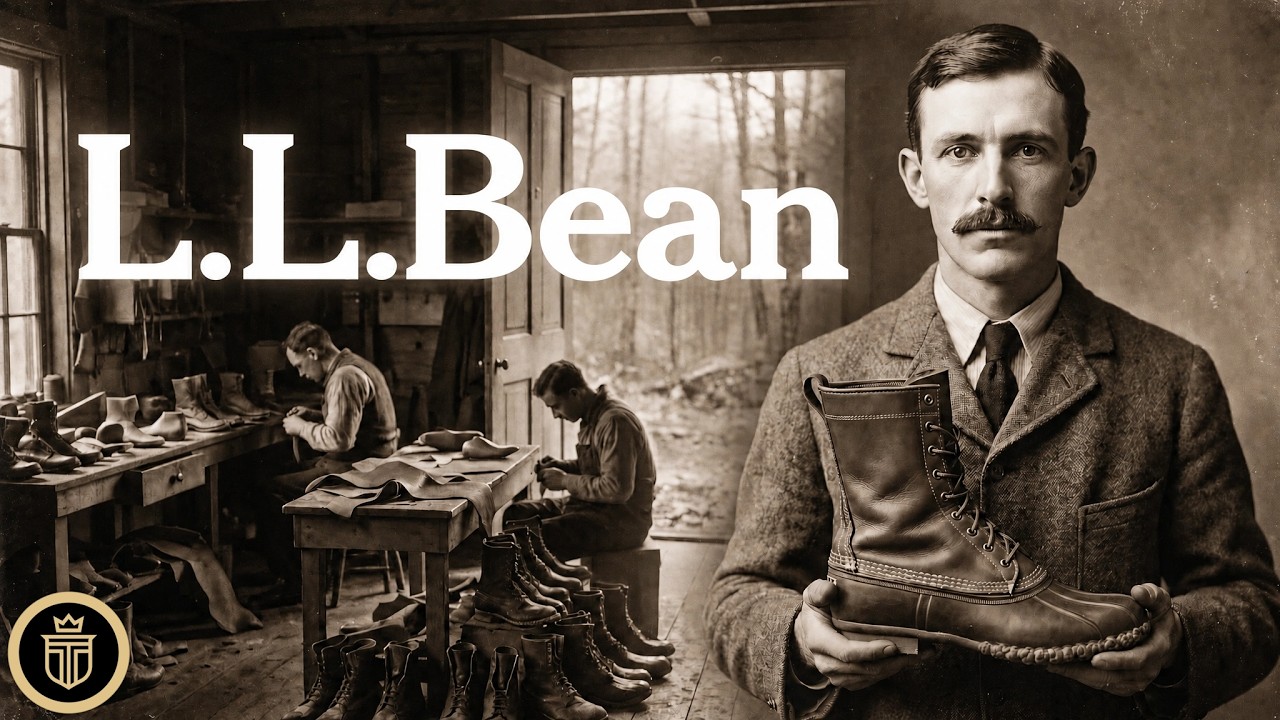
The options were leather boots that got wet and then froze, or heavy rubber boots that kept water out but trapped heat, making a day of walking a day of blisters. Bean’s contribution was not a new material or a new machine but a refusal to accept that those were the only two options. In 1911, after a hunting trip ended with cold, wet feet, he took a pair of rubber boots from the shelves of the store where he worked, had a shoemaker cut a leather upper in size seven, and asked the local cobbler to stitch the two pieces together. The first pair went to a customer named Edgar Conant.
The second problem in the sequence was that Bean had no way of knowing whether anyone outside Freeport wanted such a thing. The solution came from a government licensing office in a form so ordinary that no competitor thought to request a copy. The state of Maine kept records of men who bought nonresident hunting licenses, meaning that somewhere in a government office sat a document containing the names of thousands of Americans who had already proven with money their intention to walk through Maine’s wet woods in cold weather. Bean obtained that list.
In 1912 there was no advertising medium in the United States that could find that audience at any price, and a state licensing office had compiled it for free as a byproduct of collecting fees. A Freeport merchant with no capital and no reputation suddenly possessed the names and addresses of the only Americans guaranteed to want his product. The entire mail-order business he built over the next 55 years was an extension of that single list. He then wrote a four-page descriptive circular and included a promise quoted for the next eleven decades, that any dissatisfied customer could get a full refund.
The guarantee was not a legal instrument and was not calculated by an actuary. It was a sales tool designed to address a specific objection, that there was no reason for a stranger three states away to send money to a Maine merchant he did not know for a boot no one had ever seen. The guarantee answered that objection by transferring the risk from buyer to seller, and it worked. He also unintentionally wrote the terms of his first crisis, because the promise that convinces a skeptical stranger to send money is the same promise under which he is entitled to get it back.
Production was a family and local affair. Company accounts credit Gertrude Goldrup with sewing the first boot, and her sewing machine remains on display in the main store to this day. The Goldrup family stayed connected to the business for decades, and Bean later hired Hazel Goldrup, the daughter of his first customer, as a full-time accountant and treasurer. Bean opened his store in the basement of his brother’s house.
During the summer of 1912 he made and sold 100 pairs of what he called the Maine Hunting Shoe, and the product went out by mail carrying its refund promise on paper. What Bean had not solved was the joint, the place where leather meets rubber. The first version used a single row of stitching, the intuitive choice for a man who solved his problem with a cobbler. Under the stress of walking, the single thread began cutting through the soft rubber like wire through cheese, and the upper and lower parts of the boot separated.
The failure happened in the field, on the feet of the hunters whose names Bean had taken from a government list, in weather harsh enough that a boot coming apart was not an inconvenience but a real danger. Letters arrived, then boots arrived, and Bean, who had spent his capital and his family’s capital on the initial run, sat in his brother’s basement and began counting. Ninety of the first 100 pairs returned. A 90 percent failure rate on a first production run is in most versions of American business history the end of the story, not the beginning.
The company’s own account states the sequence clearly, that the soles separated from the uppers, 90 of the first 100 pairs were returned, Bean sent refunds, corrected the problem, and sent out more mailings. The word doing the heaviest work in that sentence is refunds, because Bean had no legal obligation that any Maine court would enforce against a written guarantee in a four-page circular, and he had every practical reason to argue, delay, or offer replacements instead of money. He paid. He borrowed more from his family to do it, and that loan is the detail separating anecdote from legend, because it means the refunds were not paid from comfortable reserves but from debt he personally assumed at thirty-nine to compensate strangers for a product he had made badly.
Then he went looking for better rubber. He had already borrowed $400 and traveled to Boston in 1911, offering what remained of it to the United States Rubber Company for a better grade of boot sole than anything he could get off a shelf in Freeport. The new design addressed the joint directly, replacing the single stitch line with a triple line and specifying more durable rubber, so the thread was distributed across three seams instead of concentrated in one. That triple stitch remains the boot’s signature, and the company trains its stitchers for 26 weeks before allowing them to execute the stitch that once destroyed the business.
The rubber sole has not changed since. The boots are still handmade in Maine, and the unlined 8-inch brown version remains among the company’s best sellers for both men and women more than a century after 90 of its ancestors came back through the mail. Everything else about the boot has been modified at some point, including hundreds of colors, alternative shapes, canvas and flannel surfaces, and a range of linings. The commercial consequences of the refunds arrived faster than the reputational ones.
By 1917 Bean had sold enough boots to buy a dedicated store building on Main Street in Freeport, the same address the company occupies today. In 1918 he applied for a patent, and in the same year moved into a new building across the street, which he owned outright by 1920. There is a version of this history that portrays the 90 refunds as a charming setback in an inevitable rise, and that version is wrong in an essential way. The refunds were the product itself.
A boot that keeps out water is a manufacturing achievement any competitor with access to rubber and leather could eventually copy, and many did. But a written promise honored despite a 90 percent failure rate is a reputation that cannot be engineered, because it can only be acquired by losing money in public. Every dollar returned in 1912 bought him a hunter in Pennsylvania or New York telling other hunters that the man in Maine paid for his mistake, and that testimony was worth more than the hundred sales he lost. He understood the arithmetic well enough to build the rest of his life on it.
The guarantee became the one feature of the company that no successor was allowed to touch. That is precisely why the day someone finally did touch it, after 160 years, made national headlines. The 1920s turned the boot into a brand and the brand into a catalog. In 1921, Admiral Donald MacMillan equipped an Arctic expedition with Bean boots and wrote back that his men were enthusiastic about their experience with the footwear and found it very practical, the highest possible praise in the language of northern New England.
In 1924 Bean introduced the coat he originally called the Maine Duck Hunting Coat and later renamed the Field Coat, selling a second product to the people who already bought the boot, the least glamorous and most reliable growth strategy in retail. In 1927 the trade magazine Postage ranked his catalog the best in the country and awarded him a $25 prize. In 1933 Eleanor Roosevelt walked into the Freeport store unannounced, resisted the idea of buying hunting boots for her husband, and left with a fishing knife Bean insisted on giving her for the president. In 1934 the zippered bag appeared, described in the catalog as a clasp without a hook, because the zipper was still new enough in rural America to require explanation.
In 1937, in the depths of the Great Depression, L. L. Bean sales passed the million-dollar mark. In 1944 the ice carrier appeared, a canvas bag designed to carry ice and firewood, which the company renamed the Boat and Tote and which generations of Americans adopted without ever carrying ice anywhere.
World War II pulled Bean from Freeport to Washington, where he served as a consultant to the Army and Navy, and his company produced a military version of his main hunting boot. By 1946 total sales reached a million dollars a year, and the boy who sold a dead deer to disappointed hunters had become one of the most famous merchants in the United States. He was 73 that year, an age at which most founders of comparable companies had sold out or handed over management to a professional, and he did neither. In 1951 he made the single gesture that defined the company more precisely than any product it ever sold.
Sportsmen from Boston, New York, and Philadelphia were driving through the night toward the Maine woods, arriving in Freeport at two or three in the morning to find the only store that stocked their needs closed and dark. In 1951 the Freeport store opened 24 hours a day to receive them, and the founder explained his decision with the sentence that became the company’s permanent description, that they threw away the key. What ended the round-the-clock schedule was not commerce but law, because Maine’s blue laws restricted Sunday trading, and a store that never closes cannot comply with a law requiring it to shut on a particular day of the week. The solution came from the town itself in the form of a vote restoring the store’s open-door policy.
That vote is the quiet heart of the entire L. L. Bean story, because it means the 24-hour store exists with the consent of its neighbors. In the same year the store stopped closing, it also acknowledged the existence of half the population.
The women’s department opened in 1951 after his daughter-in-law Hazel and his wife Claire convinced him that women accompanying their husbands needed something to do besides watching a man evaluate hunting gear for an hour. The department they fought for outlasted that argument by decades, and the brown boot that started everything is now listed among the company’s best sellers for women and men alike. In 1960 a 26-year-old named Leon Gorman came to work in the store as a clothing buyer at $80 a week. He was the founder’s grandson, a Bowdoin graduate in the class of 1956 who had spent four years in the Navy before arriving in Freeport with no important position and no guaranteed future.
What he learned included things no one in the family talked about aloud. The store had become shabby, the product line outdated, quality had declined below the standard the guarantee promised, and the workforce had aged until nearly every employee was at or past retirement age, because the company had no retirement policy and thus no mechanism for anyone to leave. In 1965 the catalog introduced the Norwegian sweater, which sold well, an effect that confirmed to the founder that nothing needed fixing. Total sales in 1966 reached about $3.
8 million, a respectable figure that concealed the fact that profits had almost vanished. The founder was 94 and spending winters in Florida, and the company was run on the assumption that he would always be there to reject any change. On February 5, 1967, in Pompano Beach, Florida, Leon Leonwood Bean died. The store closed in his memory, and the company received 50,000 letters of condolence.
His grandson inherited a company with a legendary name, an unlimited guarantee, and books that would not have survived another decade under the same management. Annual sales at the time of his death were about $5 million, less than the value of the goodwill attached to the name and far less than the cost of fixing what that name was selling. The figures Leon Gorman found when he took over in 1967 were worse than the family reputation suggested. Sales had fallen to $3.
5 million and profits to $60,000, meaning America’s most beloved outdoor equipment company was operating on a margin slim enough that one bad season could wipe it out. Gorman spent $12 million on modernization, roughly three times the company’s annual sales when he took over, which tells you how complete his decision to rebuild rather than repair was. He raised the advertising budget and commissioned marketing research. He converted the old mailing list, the direct heir of the 1912 nonresident hunting license registry, into a computerized database.
He modernized manufacturing and distribution facilities, introduced credit card services, and eventually established a customer service operation that took phone calls around the clock, so the store that never closed became a company that never stopped taking orders. He also accomplished the human side of the work, which was harder. He created a retirement policy so employees past seventy who had found no way to leave could finally do so with dignity, and raised wages and benefits to attract workers. The 1970s rewarded all of it, because America discovered backpacking, hiking, camping, and running at nearly the same moment, and the company enjoyed doubled revenue growth throughout the decade.
Total sales reached $20. 4 million by 1974. In 1979 the company launched what became known as the Outdoor Discovery Schools, beginning with a single winter course in Freeport and expanding to dozens of activities at multiple locations, turning a retail store into an institution that taught people how to use what it sold. Then the 1980s gave the company an unexpected windfall no one in Freeport had planned for, the sudden national fashion for looking like a New England hunter without hunting.
The preppy wave turned the practical catalog into a style reference, and sales that were $20 million in 1974 reached $237. 4 million by 1984 and roughly $300 million by 1985. In 1987 the company donated the land around Katahdin Lake to Baxter State Park and unveiled a new logo showing a sunrise over Mount Katahdin. In 1990 the company sponsored and equipped the Everest Peace Climb, a joint ascent by climbers from the United States, China, and Russia.
In 1992 it opened three retail stores in Tokyo after discovering that a large portion of Freeport’s visitor traffic consisted of Japanese travelers who had flown across the Pacific to shop in a Maine town of a few thousand people. The problem with a company founded on a sunrise over mountains is that the sun eventually rises on competitors too. By the mid-1990s the growth that had seemed inevitable for 25 years began to slow. Sales declined in 1996 and grew only 2.
9 percent in 1997, lagging in a sector expanding as rapidly as outdoor apparel. Business Week’s William Symonds described the company as stuck in the past. The specific complaints were consistent, that the khakis, jackets, and sweaters were too conservative for customers who had aged along with them, that the company was slow to enter children’s clothing, and that it had no significant retail presence outside Maine and Japan. Meanwhile, the mail order that had been the company’s great advantage became its great weakness, as the number of catalogs mailed annually in the United States rose from 7.
8 billion in 1982 to 13. 9 billion by 1998. Companies such as Lands’ End and J. Crew caught up and passed L.
L. Bean in aspects of the mail-order business it had practically invented. Operations by that time were enormous. The company sold more than 16,000 products through catalogs, the internet, the Freeport complex, eight retail stores in Japan, and nine factory outlets, and received orders from more than 4.
5 million customers worldwide. Annual sales reached about $1 billion by 1999. In 2000 the company opened its first retail store in the United States outside Maine, a 75,000-square-foot building in McLean, Virginia. In 2001 Gorman handed the CEO position to Chris McCormick, the first person outside the family to lead the company, and moved to chairman, where he remained for another 12 years.
The arrangement he put in place was his answer to the question that destroys most family companies, what to do when the best available manager is not a relative. His summary of family philosophy was quoted from his grandfather, a phrase he repeated for decades, that the way to run a business is to sell good merchandise at a reasonable profit, treat people like human beings, and they will always come back for more. He retired from the board in 2013 at age 78, retaining the title of chairman emeritus and a seat on the board. His last full year presiding was the centennial, celebrated with a 20-foot replica boot the company named the Bootmobile and charitable donations totaling $2.
5 million. He had led the company as president or chairman for 46 years. On September 3, 2015, after months of struggle with cancer, Leon Gorman died at 80, and the Freeport store closed its doors for only the third time in its history in mourning for a family member. More than 500 people gathered in Westbrook, Maine, to pay their respects.
The eulogies focused on the man’s habits more than on the company’s billion-dollar sales, with former governor John McKernan saying years earlier that Gorman’s greatest legacy might be the way he treated everyone as a human being. The family that had just buried its second patriarch in 50 years had already chosen the third, and the choice was announced with a sentence that sounded like reassurance and functioned as a warning. On May 19, 2013, Shawn Gorman was elected chairman of the board of L. L.
Bean, making him the third generation of the founder’s descendants to hold formal authority over the company. He was 47, a great-grandson of the founder and a nephew of the man he succeeded, and he had spent more than 20 years inside the company in a series of roles culminating in his position as senior vice president for brand communications. At that moment the company had 5,000 full-time employees and 2013 sales of about $1. 56 billion.
The transition had been planned carefully and quietly by Leon Gorman over years. The most important element was not the chairman but the mechanism installed beneath him. A family governance committee was created, and an owners’ council made up of family members who would be consulted on major decisions began operating alongside the board. By 2010 ownership of L.
L. Bean had been divided among dozens of the founder’s descendants, and the chairman described the group as more than 50 family members involved in the business. Having 50 owners with varying shares, differing financial needs, and different political orientations is an open invitation to litigation. The owners’ council was promoted as a place for disagreements to be expressed instead of converted into courtrooms.
In January 2017, that design was tested by one of the ten board members. Linda Bean, born in Portland in 1941, was a granddaughter of the founder, held a degree in business administration and accounting from Antioch College, founded a Maine lobster business that eventually handled more than 9 million pounds of lobster annually, and spent decades as an outspoken conservative in a state known for reticence. During the 2016 presidential campaign she donated to a political action committee supporting Donald Trump, reported in different accounts as $25,000, $30,000, or $60,000, with the media coverage agreeing that whatever the amount, it exceeded the committee’s legal limit of $5,000. The consequences were immediate.
A social media boycott campaign called Grab Your Wallet placed L. L. Bean on a list of roughly 75 retailers to avoid, and the company, which had spent 105 years marketing itself as politically neutral, found itself described nationally as a partisan brand. Then the president-elect publicly thanked the company and encouraged people to buy from it, turning an awkward situation into an impossible one.
Shawn Gorman did something the company rarely did and responded publicly, writing that L. L. Bean was deeply disturbed by its depiction as having a political agenda, that the company does not endorse political candidates, does not take positions on political issues, does not make political donations, and simply stays out of politics. He asked the Grab Your Wallet campaign to stand down, pointed to the tens of millions of dollars the company had given to environmental and educational causes, and then offered an argument only a family company could make, that the views of one member of a 10-person board were the views of one person.
Linda Bean did not step back. She told Fox News that the backlash was bullying and un-American and said clearly that she would not resign from the board. She never did, remaining a shareholder and present until her death on March 23, 2024, at 82. What she never did was sell her stake in the company, and neither did any of her relatives who disagreed with her about everything else.
The family absorbed a genuine crisis without a single share changing hands, which was the primary purpose of the mechanism, and it proved that the family name could survive a public disagreement. Thirteen months later, the same board approved a decision no boycott campaign could have forced on them. This time the objecting customers were not activists but the company’s most loyal buyers. On Friday, February 9, 2018, L.
L. Bean sent a letter to customers announcing that returns would henceforth be accepted within one year of purchase with a receipt or other proof of purchase. After that year, the company would consider products shown to have defects in materials or workmanship. The 100 percent satisfaction guarantee that had accepted a coat returned through the store decades after purchase, without a receipt and without questions, ended in a single paragraph.
The reasons the company gave were specific and largely unappealing. Customers were returning goods bought at garage sales and from third parties, treating the guarantee given to the original purchaser as permanently attached to the product. Others were using the guarantee as a lifetime replacement program, exchanging boots and coats that had simply worn out from ordinary use. The company reserved the right to refuse returns from customers who habitually returned products.
In its financial discussions, the company cited fraud and revenue loss as the main reasons for the change. There was a used-goods economy around L. L. Bean at the time, where someone could buy an old flannel shirt at a thrift store for a few dollars and then carry it to an outlet and walk out with store credit toward a new shirt.
The reaction was immediate and personal. NPR began its report by noting that the company’s boots, cherished by campers and fashion-conscious youth alike, were no longer guaranteed for life. Bloomberg columnists predicted the company would regret the decision. The company insisted the change would affect only a small percentage of returns and included a transition provision so any product purchased before February 9, 2018, would remain outside the one-year limit.
Four separate class-action lawsuits were filed in California, Massachusetts, Illinois, and New York, each asking the court to force the company to honor the old terms. A federal judge in Chicago dismissed the Illinois case, ruling the plaintiff lacked standing because he had not shown he suffered a loss or was dissatisfied with the boot he owned. By the following March a California judge had dismissed the third of the four cases. The company won every case whose result reached the records.
What the courts could not decide was whether the family had squandered the only asset the founder considered non-negotiable. The justifications for the change are clear and rest on the same logic the founder used, that a promise the company cannot afford stops being a promise and becomes a slow liquidation, and that 90 refunds paid in good faith in 1912 are a different transaction from permanently subsidizing a resale market. The opposing view is that the guarantee was never really a return policy at all, that customers for four generations were buying a warranty document more than they were buying a coat. Both interpretations remain present in the company’s current position, which enjoys a stability nearly unmatched in American retail.
Revenue reached $1. 7 billion in 2023, the Freeport campus still keeps its doors open around the clock, and the boots are still hand-stitched with three threads in Maine by people trained for 26 weeks to do it. The chairmanship remains with Shawn Gorman, and ownership remains with the family that has never sold to a competitor, never merged into a conglomerate, and never listed a single share on a stock exchange, representing across four generations thousands of individual decisions to refuse easy money. Management, meanwhile, has moved decisively outside the family, with Stephen Smith arriving in November 2015 as the first CEO hired from outside the company in its then 103-year history, announcing in July 2025 that he would step down the following spring.
Greg Elder took the position in January 2026 after nearly two decades managing stores. In February 2025 crews began demolishing parts of the main store for a $50 million rebuild scheduled for completion in fall 2026. The family that approved it will see no profit from it for years, which is almost exactly the time frame this particular company has always operated on. Leon Leonwood Bean built an empire by refunding 90 failures out of 100 and then telling everyone what he had done.
His descendants have kept the store open for 74 years and kept the company unsold for 114. The only key they ever picked back up is the one that opens the cash register when a customer arrives without a receipt.