On March 22, 1962, J. Edgar Hoover walked into the White House for a private lunch with President John F. Kennedy. The FBI director requested the meeting, and Kennedy made time, knowing what such requests tended to mean.
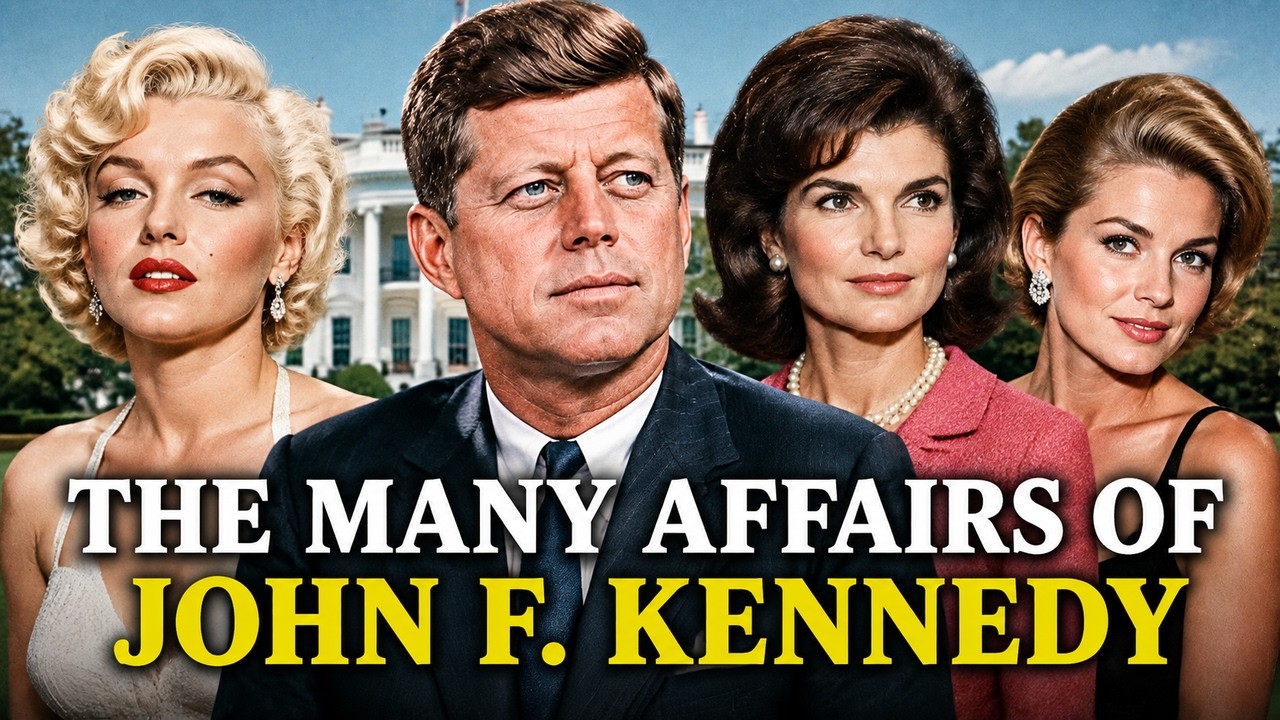
The two men sat together for four hours, and no full record of what passed between them survives. But the outline was clear enough: Hoover let the president know that the bureau had traced the woman Kennedy had been calling straight to Sam Giancana, one of the most powerful mobsters in the country. The president was sharing a mistress with a man the FBI was hunting. Hoover laid out enough to make the point and kept the rest tucked away where only he could reach it.
He did not threaten. He did not need to. He showed Kennedy that he knew and let the silence do the work. The White House phone logs tell the rest.
The calls to Judith Campbell, dozens of them stretching back through the campaign and into the presidency, simply stopped. The last one landed within hours of Hoover leaving the building. A relationship that had run for two years ended essentially over a single lunch. The portrait everyone had been sold was already decades in the making.
The early 1960s needed a leader who looked like the future, and John Kennedy fit the frame. He was young, handsome, and married to Jacqueline Bouvier, a woman of old Newport gentility who spoke flawless French and redecorated the White House until it looked like a design annual come to life. The press called it Camelot without irony, and half the country believed every word. But that portrait did not paint itself.
It was commissioned by two families who spent decades learning how images are made and unmade. The Kennedys were Boston Irish, barred from the clubs where old money held its meetings, so they built a machine of money, discipline, and hunger. Joseph Kennedy made a fortune through stocks, real estate, and the film business. He left Hollywood just before the crash, richer for the timing, but what he carried home was a rule his children learned without it ever being written down: a powerful man took what he wanted, and the family closed ranks around the taking.
He taught his sons by doing. When Gloria Swanson asked a banker to look over her accounts in 1927, Joseph Kennedy became her partner, then her lover, then the man who ran everything she owned. He put both women on the same ship and sailed them to Europe. The children learned there was a difference between what a man does and what the world sees.
Jacqueline Bouvier knew the shape of that world before she entered it. Born in 1929 to a broker the East Coast called Blackjack, a charming, reckless, unfaithful man who drank the way other men spent money, she watched her mother’s heart break. When she married Jack Kennedy on September 12, 1953, in Newport, the wedding was staged like a coronation. Eight hundred guests filled the pews, the Pope sent a blessing, and 1,200 guests crossed the lawns at Hammersmith Farm.
The cameras saw a fairy tale, but the men closest to Jack knew the honeymoon would change nothing. By the time he reached the Senate, the pursuit was routine, as scheduled as any roll call. His aides treated it as a logistical problem, and the solution was usually Dave Powers, who worked corridors, receptions, and hotel rooms near the capital where a quiet hour opened and a room was booked under another name. One of the women had a file on her long before Jack met her.
Inga Arvad, a Danish journalist, had interviewed Hitler, who called her a perfect example of Nordic beauty, and the FBI had a folder open in her name. Agents listened through tapped phones to the young officer’s voice, recorded the endearments and plans, and filed it all with Jack’s name beside hers. Hoover kept files the way other men kept money. The Arvad surveillance was the seed.
From there, the notes multiplied. Hoover did not need proof of a crime. A man’s private life, photographed and filed, was proof enough that he could be controlled. The body underneath the golden image was failing.
Kennedy carried Addison’s disease, which before cortisone was effectively a death sentence. A war injury had crushed his back, and years of surgery and braces left him in a place where standing straight was an act of will. To keep the candidate smiling, someone was injecting him with a chemical cocktail of amphetamines, steroids, and hormones. Max Jacobson, the New York doctor the glittering set called Dr.
Feelgood, supplied what the disease took away. Before debates, before speeches, before any day that required him to be the man everyone believed he was, the needle came out. By 1960, the campaign was run like a movie set. Every photograph was staged around the family tableau.
The press was handled with care, access meant favor, and the image had to be flawless. On September 26, 1960, roughly 70 million people watched the first televised debate in American history. Richard Nixon arrived about twenty pounds underweight, still weak from a knee infection, and turned down the studio’s makeup. Kennedy walked in tanned and rested.
People who could only listen on the radio called it a draw, but the 70 million watching television saw a man who looked ill beside a man who looked born for the camera. Kennedy later admitted he never would have reached the White House without those debates. On January 20, 1961, Kennedy stood on the steps of the Capitol and took the oath as the youngest man ever elected president. He was 43.
In his address, he said the torch had passed to a new generation of Americans. The White House seemed to glow. Inside the residence, the day had a second life. The pool was heated to a constant 78 degrees, and the president liked to swim at noon.
Guests were not screened as they were in the West Wing. Two young interns were on the government payroll, working as secretaries. The Secret Service gave them radio names, Fiddle and Faddle. Neither did much work, and real shifts ended at the residence pool, where the two swam in white t-shirts while an agent listened for word that Mrs.
Kennedy was coming home early. One girl who walked into that building that summer was 19 years old and had no idea what the job really was. Marian Beardsley, called Mimi, took a place in the White House press office. On her fourth day, Dave Powers asked if she would like to slip down to the pool.
That evening, she was invited to see the residence. The affair ran 18 months. She went back to Wheaton that fall and pretended to be an ordinary sophomore. The phone would ring, a man would call himself Michael Carter, and she would pack a small bag and tell no one.
Jacqueline Kennedy was not naive. She had grown up in old money and watched her mother trade beauty for status. She knew what happened in marriages like hers. What she chose was not ignorance; it was strategy.
Her public performance never slipped. Her silence had a price, and she quietly collected it in diamonds, couture, and distance. She took long absences with the children, staying weeks beyond schedule. She was designing a life that could function alongside her husband, not inside it.
The Hollywood connection ran through Peter Lawford, the British actor who married Jack’s sister. Through Peter, the president’s orbit widened to include movie stars and the men who kept them supplied. Frank Sinatra sat at the center, turning charm into transactions. For Jack, Frank arranged introductions and meetings never written down.
Some were women. Some were men with names the FBI kept in files, men who controlled casinos, unions, and votes in states Kennedy needed. For the mob, a president who owed them was a prize beyond money. Marilyn Monroe had spent a decade being looked at by more people than anyone alive, and through Frank’s favors, she drifted into the president’s circle.
On May 19, 1962, at Madison Square Garden, 15,000 people packed into the dark for a fundraiser, and when she sang “Happy Birthday, Mr. President” in a gown so thin it looked like skin, the room went quiet. What they had kept private behind the White House walls was now out loud. The morning papers ran the photographs.
For Marilyn, that song was not a performance. She believed it was a promise. She told the people closest to her that she would be the next woman in the White House. The calls to the White House began and did not stop.
By late summer, the channel closed. Robert Kennedy flew out to see her. The message was unambiguous. On the morning of August 4, 1962, Marilyn Monroe was found dead.
The official report carried the word probable. The toxicology report found barbiturates and chloral hydrate layered together, a pairing no single prescription could explain. Her phone log was missing from the file. On a quiet street in Georgetown lived a woman the president trusted more than almost anyone around him.
Mary Pinchot Meyer was 41, a painter, a divorcée, and a thoroughbred of the American establishment. Her former husband worked for the CIA, and her sister was married to the editor of the Washington Post. Kennedy told those close to him that she was the one he kept, the one he returned to, the one he cared for most. She recorded it all in a private diary.
On the morning of October 12, 1964, she went for her daily walk along the Chesapeake and Ohio Canal towpath. Around noon, two shots ended her life, one to the head, one to the chest. No weapon was ever recovered, and no other suspect was ever charged. Within hours, James Jesus Angleton, the CIA’s counterintelligence chief, was inside her studio hunting for something.
A personal journal said to describe an affair with a murdered president simply ceased to exist. Judith Campbell was 25 years old, dark-haired, poised. The introduction came through Frank Sinatra in February 1960 in Las Vegas. Within weeks, the calls between Judith and Kennedy began.
But Sinatra had made more than one introduction that year. Around the same time, that same circle handed her to Sam Giancana, the boss of the Chicago outfit, and Johnny Roselli, the outfit’s smooth ambassador to Hollywood and Las Vegas. Judith was seeing them at the very same time she was seeing the president. She carried messages.
She flew between them. By her own later account, she carried sealed envelopes between the crime boss and the White House. In August 1960, the CIA reached out to Robert Maheu, who reached out to Johnny Roselli, who brought in Sam Giancana. Their assignment was to help kill Fidel Castro, and the agency was prepared to pay for it.
Poison pills, contaminated cigars, a rifle in the right hands. The White House kept phone logs, and buried in the gatekeeper records from 1960 and 1961 were dozens of calls between the president’s office and Judith Campbell across the months when Giancana was on the CIA’s payroll. The overlap meant a foreign service or a mob boss could reach the president through a woman nobody had cleared. Kennedy cut off the affair the instant Hoover made it clear he was watching.
But the mob was not the only foreign danger in his bed. There was also a woman from the other side of the Iron Curtain. Ellen Rometsch was born in what became East Germany, and by the early 1960s, she was moving through Washington’s party circuit. Investigators began to suspect she might be an East German agent.
The FBI opened a file. Before the press could ever print her name, she was on a plane out of the country. The removal happened in August 1963, flown back to West Germany, accompanied by a trusted aide from Robert Kennedy’s own Justice Department. By the autumn of 1963, investigators were pulling at the finances of Bobby Baker, a secretary to the Senate Democrats, and the inquiry kept brushing against the same rooms, the same parties, the same women brought in to charm powerful men.
A public hearing on Baker could become, with one wrong witness, a public hearing on the president’s private life. At 12:30 in the afternoon on November 22, 1963, the motorcade turned onto Elm Street in Dallas. In a matter of seconds, the presidency of John F. Kennedy ended.
He was 46 years old. The portrait was fixed at its most flattering angle, sealed at the exact moment it was most beautiful and least true. One week after the funeral, Jacqueline Kennedy summoned the journalist Theodore White to Hyannis Port and gave him a single deliberate image: the line about one brief shining moment that was known as Camelot. White’s piece ran in Life magazine that December, and the word attached itself to the administration permanently.
Hoover’s files did not go quiet. The dossier on the affairs, the wiretaps, the names and dates and phone records, all of it remained locked away, outliving the man they described. In 1975, the Church Committee was digging into CIA plots against Fidel Castro when a curious detail surfaced. Judith Campbell Exner was called to testify behind closed doors.
In 1988, dying and tired of the sanitized version, she said the rest out loud: she had carried messages between the White House and Giancana while sharing a bed with Kennedy across those same years. The stories came slowly over decades. The clearest voice came in 2012, when Mimi Alford, the 19-year-old White House intern, published a memoir describing an 18-month affair that began four days into her job. She had told almost no one for half a century.
The image did not collapse in a single afternoon. It came apart slowly, one hairline crack at a time. By the 1970s, the Church Committee had pulled the mob and the CIA into the same sentence as the president’s private life. What replaced Camelot was a man, reckless and charming and gravely careless, who had been sold to a country as something cleaner than he was.
The perfect image was not an accident of good luck. It was manufactured, defended, and finally overwhelmed by its own weight.