On the twentieth of April 1897, a train left Greenwood Station outside Philadelphia carrying 153 people who had not been asked whether they wanted to go. The train crossed Pennsylvania and stopped at Polk State School and Hospital in Venango County, a facility built to hold 800 people. It would one day hold 3,490. Wooden cages, straps on benches, one hundred beds in a single room, and numbers where names should have been.
The story of Polk begins four years before that train arrived, with a book. In 1893, Henry M. Boies, a member of Pennsylvania’s Board of Public Charities, published The Prisoners and Paupers. Boies argued that crime, poverty, and mental deficiency were growing together at alarming rates.
His numbers were stark. Between 1880 and 1890, Pennsylvania’s population grew by 22. 5 percent. During that same decade, the number of people the state classified as disabled rose by 60 percent, prisoners by 35 percent, and the cost of institutional care by more than 35 percent.
In his own county, Lackawanna, jail admissions rose by 86 percent in ten years. The argument folded three separate problems into one and produced a single conclusion: the state was being overrun by its own failures. Boies was not working alone. The Committee on Lunacy, whose secretary was Dr.
Frank Woodbury, had begun inserting long notes about the hereditary causes of insanity and idiocy into its annual psychiatric reports. The theory existed on paper before it became law. And in 1893, there was nowhere to put anyone. Since 1852, the only long-term facility in Pennsylvania built specifically for people with intellectual disabilities was Elwyn, a private training school outside Philadelphia.
Everyone else went to poorhouses or prisons. On June 3, 1893, the legislature acted. The law authorized the governor to appoint five commissioners to select a site and build an institution for children with intellectual disabilities in western Pennsylvania. The commissioners were Norman Hall, Christopher Hydrick, George A.
Jenks, W. Horus Rose, and George W. Guthrie. The law told them precisely what to look for: at least 500 acres, accessible by rail from the western counties, adequate water, natural drainage, and land suitable for farming, in the words of the statute itself, to be occupied and maintained by the inmates.
The children would work the land that fed them. The commissioners bought nearly 773 acres around the Thomas McKeisck farm, flat ground surrounded by streams and located on the railroad line six miles west of Franklin, a position meant to serve the fourteen northwestern counties. The price was never recorded in the accessible records. The Commonwealth recorded the acreage but not the cost.
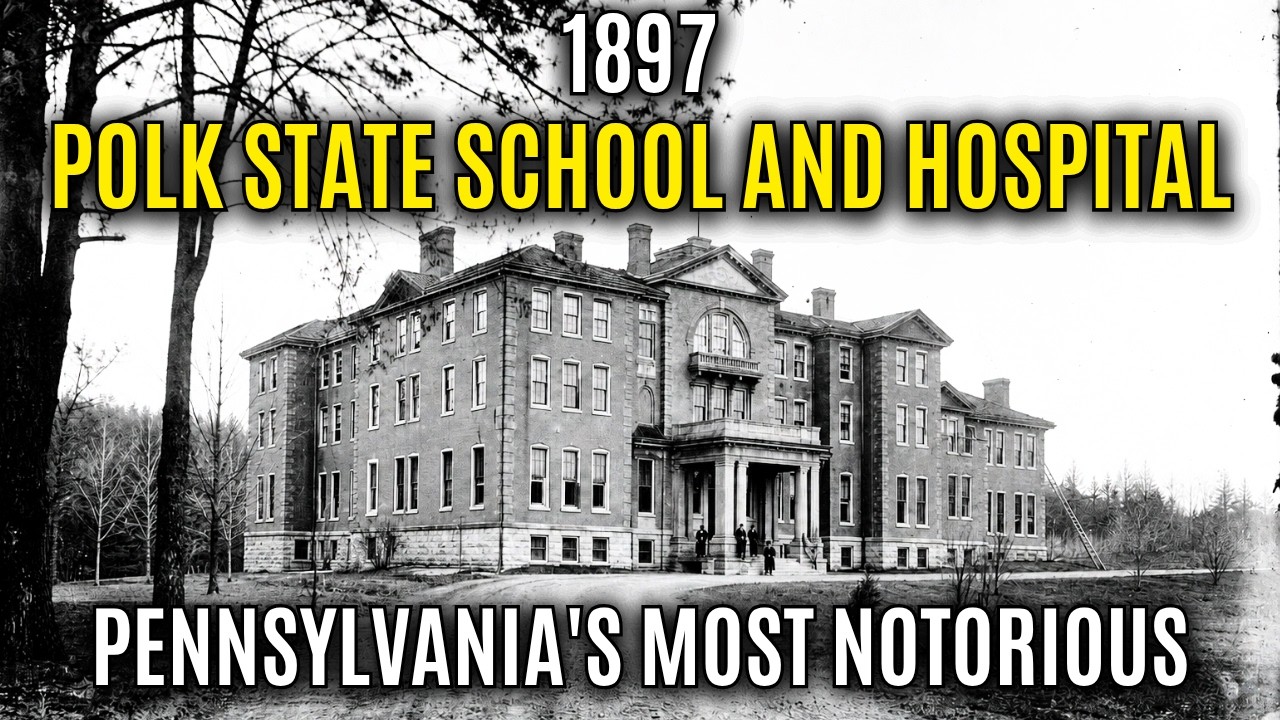
The architect was Frederick J. Osterling of Pittsburgh. According to a 2006 Historic American Buildings Survey, Osterling designed the first generation of red brick buildings. Samuel D.
Brady of Franklin was associate architect for the school hall, the great hall built in 1912, and the building now called Murdoch Hall, erected between 1902 and 1903 as a hospital and nursery. The campus looked like a college. Red brick, round arched windows, thick towers with conical roofs at each corner of the main facade, steep gambrel roofs, Queen Anne, Romanesque, and Colonial Revival details overlapping one another. In the administration building, an ornate portico with a pediment and a central clock tower crowned by a lantern with a bell-shaped roof.
It was designed to look like a place that gave something in return. The main buildings were completed in July 1896. That same month, the trustees appointed their first superintendent, Dr. J.
M. Murdoch, who came from Dixmont Hospital. The doors opened on April 21, 1897. The philosophy was never hidden.
In 1902, Murdoch wrote about the importance of isolating the people in his care so that they would not become irresponsible ancestors of miserable offspring. That was the clearest available statement of why the bricks were laid: not to return people to the world, but to keep them out of it. Polk was not really a school. It was a town.
It had its own spring water supply, its own power plant, its own sewage station, a hospital, a greenhouse, a laundry, a garage, and a farm. That self-sufficiency was the design itself. A place that grew its own food and generated its own power did not need the outside world, and the outside world never had to look at it. Residents worked.
The survey records that they were trained in various skills, including sewing and shoe repair. The Heinz History Center in Pittsburgh now holds clothing made by hand at Polk, indexed as products of what the institution called work therapy, an institutional term for unpaid labor that kept the lights on. The accessible records do not mention whether any resident was paid, what those goods were worth, or who ended up wearing them. Other surviving objects show the operative side of the institution: an adaptive treadmill from about 1910, a blood cell scale from about 1965, a scale for measuring drug doses, and a Merrill-Palmer mental test kit, a box of small tasks used to determine a child’s mental age.
The mental age was the number that decided whether you would leave. In the early 1970s, visiting teams from the Allegheny County branch of the Pennsylvania Association for Retarded Children documented what they found inside Pennsylvania’s institutions: wooden cages, electric prods, straitjackets, and other restraints. At Polk specifically, advocates recorded residents tied to benches and residents drugged, in their words, to make them easier to control. They also recorded overcrowding.
One hundred beds in a single bedroom. Not one hundred people in a building, but one hundred beds in one room, meaning every person in that room slept within reach of ninety-nine others every night for years. In 1902, Polk was described by its own superintendent as a place where residents were trained and where former pupils kept in touch by letters and visits. That was the story the institution told the legislature that funded it.
The numbers tell a different one. In 1897, the capacity was 153. In 1953, there were 3,490 residents spread across 102 buildings, with a staff of nearly 2,000. In the mid-1950s, there were more than 3,400 residents, at least 500 of them children.
In 1958, there were 2,478 residents and 1,137 staff. Sources differ on the exact peak, but the highest documented figure is 3,490, more than four times the design capacity. A town whose entire population in recent censuses numbered between 634 and 703 held 3,490 people. Two forces caused this.
The first was the theory itself. Segregation as policy has no natural ceiling; the goal was containment, not release. The second came after the Second World War, when more families kept their mildly and moderately disabled children at home, leaving Polk to receive an ever-increasing share of the most severely disabled. Polk’s own superintendent predicted where this would lead, writing that it would inevitably result in a purely custodial program.
He was right. The state was warned in writing and kept sending people anyway. The central harm at Polk was not a device. It was a routine.
When a resident was injured and needed stitches, the normal medical procedure is to assess the wound, administer local anesthetic, wait for it to take effect, then close the wound. At Polk, according to a state Department of Health report cited in the Pittsburgh Post-Gazette, one step was routinely omitted. Wounds were sutured and stapled without anesthetic. The same reports describe patients with broken bones left untreated and others not examined in a timely manner.
Investigations began in 1997 following deaths of patients under the institution’s own medical care. In February 1999, the state charged six Polk physicians with crimes ranging from neglect to involuntary manslaughter. Several were accused of using sutures and surgical staples to close wounds without giving patients any anesthetic at all. One defendant, Dr.
Mair, offered a defense more damning than denial. He said hospital and state officials knew that Polk doctors routinely used surgical staples without anesthetic when an injury required immediate treatment, and that there was no policy directing them to do so. It was simply the way things were done. Sources differ on the number of deaths that triggered the investigation.
Some accounts say three patients died; others say four. The outcome of the charges could not be determined from any accessible source. No conviction, no guilty plea, no dismissal, no sentence appears. Six doctors at Pennsylvania’s largest institution of its kind were charged with crimes against people who could not testify for themselves, and the available record simply stops.
In the decades that followed, one human story survives. Danny Favin was born in 1946, one of seven children in an Irish family in a Pittsburgh suburb. He had a genetic condition causing intellectual disabilities. His family raised him at home.
When Danny was sixteen, his behavior became so aggressive that his parents feared for his safety and the safety of others. They looked for help. There was none. The only option was Polk or nothing.
He arrived at an institution holding about 3,000 people and stayed for fifty-six years. Danny Favin died in 2018 inside the place he had been sent to at sixteen, one year before the state announced its closure. His sisters recorded an oral history of him. They spoke of the care he received there, and they also said they had supported keeping state centers open.
Then there is the one person who saw the truth and acted. Helen Wolgemuth was Pennsylvania’s Secretary of Public Welfare. When advocates demanded the removal of cages at Polk, she went to see for herself, unannounced, on April 14, 1973. She later told the Associated Press that she had not believed the reports.
She did not fire the superintendent until she saw the cages with her own eyes. Three days after that visit, she wrote him a letter ending his fifteen-year career. Then hundreds of people wrote their own letters protesting the firing and defending the cages. Two of the parent advocates who exposed the place, Patricia Clapp and Eleanor Ellen, had effigies of themselves hanged in the town square.
The year before, on January 30, 1973, a group of volunteers had entered Venango County unannounced. They were parents of children with intellectual disabilities, accompanied by one paid lawyer. They had no authority to be there. The superintendent resisted; the volunteers insisted on touring the wards, and eventually they did.
Their notes survive. One hundred beds in each dormitory. No education or training. Limited interaction by staff.
Residents tied to benches or drugged to make them easier to control. Severe punishments. A child lying in her own vomit. The place, in their words, an unbearable hell.
They drove home and made four decisions: sue the Commonwealth, force public officials to come and see for themselves, demand the transfer of 1,000 residents to relieve overcrowding, and publicize the whole thing. Weeks later, another visiting team found a woman inside a cage in one ward and a man in a second ward. Wolgemuth demanded the cages be dismantled. The superintendent refused.
Three days later he was fired. Then came the backlash. Hundreds of letters defending the practice. Two effigies hung in symbolic lynching.
In early May, Governor Milton Shapp withdrew two nominations to Polk’s board. Wolgemuth announced a reform plan. No one was prosecuted for the cages. No criminal charge, no fine, no finding of liability in any available source.
One man lost one job. The institution remained open for another fifty years. Polk closed on May 1, 2023, after 126 years. The closure process took nearly four years.
The Department of Human Services announced it on August 14, 2019, when 194 people still lived there. That November, the Senate voted 40 to 9 to stop the closure; Governor Tom Wolf vetoed it. Thirteen residents and family members sued in federal court in January 2020. The pandemic delayed the timeline.
By the spring of 2023, 27 residents remained on a campus built for 800. For most of Polk’s existence, the gravestones in its cemetery bore numbers instead of names. In the 1980s, prompted by Jenny Thornburg, the Commonwealth replaced more than 1,000 numbered grave markers at Polk with markers bearing the names of the people buried beneath them. Thornburg said the numbered graves haunted her.
Polk was an institution for the feeble-minded, then a state school, then a state school and hospital, then a center, then a closure, and now a vacant state property. The markers have not moved. Pennsylvania recovered those names one by one, after a century of delay. The buildings still stand on Main Street and School Drive, empty, with no buyer, no reuse plan, and no protection list.
The only formal record of that architecture is the 2006 Historic American Buildings Survey. Since the closure, maintenance of the vacant campus has cost more than 15. 3 million dollars a year, about 41,000 dollars a day, to keep an empty campus heated and lit. One hearing in January 2025 noted that two other shuttered state hospitals had cost taxpayers more than 115 million dollars before they were finally demolished.
Meanwhile, the agency responsible for the remaining residents received a two-million-dollar grant to build homes in Venango County: four houses, eight people each, thirty-two people in total. The Commonwealth still classifies what it does not name under numbers.