In June 1893, a wooden crate delivered by Adams Express arrived at the Agriculture Building of the World’s Columbian Exposition in Chicago. Inside was a miniature scale model of a Milwaukee brewery, thirteen feet square, made of gold-plated bronze and white metal, said to have cost roughly one hundred thousand dollars to produce. The man who had ordered it was Frederick Pabst, a former Great Lakes steamship captain and the president of what was about to become the largest brewery in the world. The golden brewery stood at the center of his pavilion for six months, seen by the twenty-seven million visitors who passed through the fair.
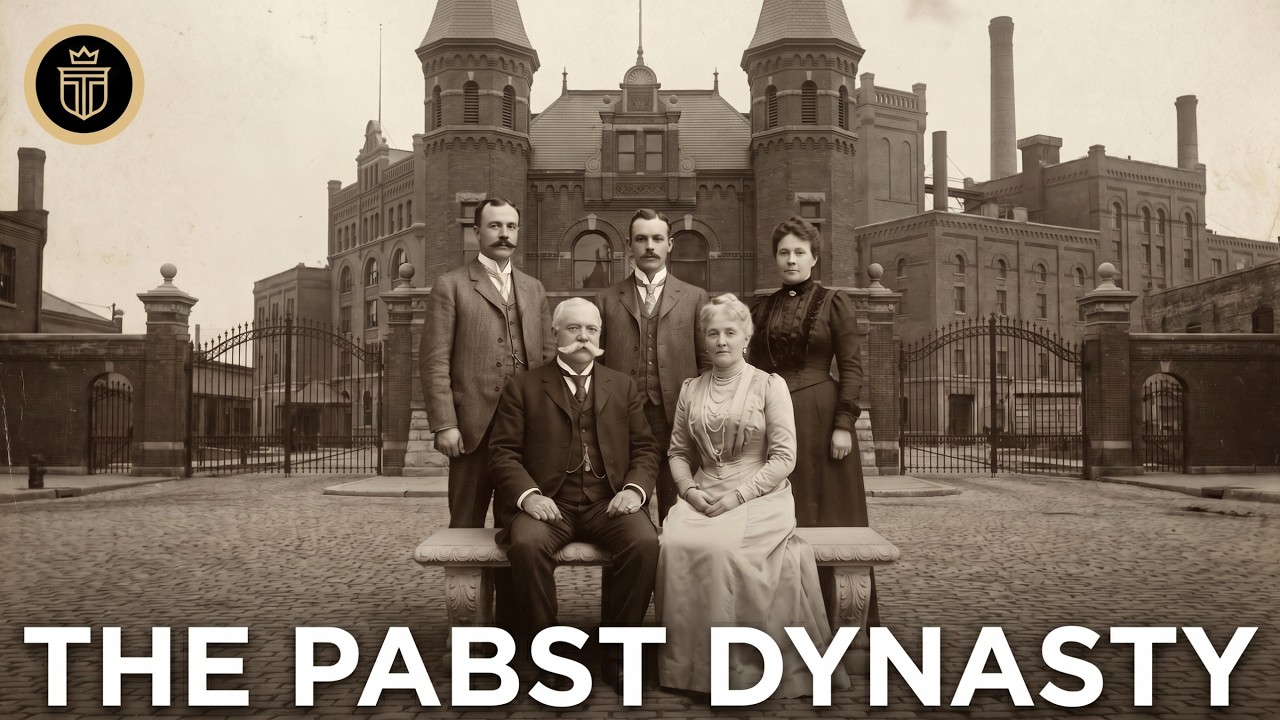
The competition the model was meant to celebrate ended in complete chaos. Judges were accused of administrative errors, lawyers were sent to Europe to track down a witness, and two rival breweries each claimed victory. The blue ribbons that would one day surround the entire legend had nothing to do with that fair. Frederick Pabst was born on March 28, 1836, in the small village of Nikolaus in the Kingdom of Saxe-Meiningen, in what is now the German state of Thuringia.
He emigrated to America in 1848 at the age of twelve, part of the wave of political and economic refugees fleeing Germany after the failed liberal revolutions of that year. His family first settled in Chicago, where young Frederick found work washing dishes in a hotel kitchen. This fact was almost entirely absent from the polished accounts of his life written a generation later. The boy who would one day be called Captain, then President, then the largest brewer in the world, began his American career doing menial labor in a Chicago hotel.
The boy who washed dishes learned lessons about work and money that those who never did would never understand. As soon as he was old enough to choose, he went to sea. In his early teens, he worked as a cabin boy on Goodrich Line steamships on the Great Lakes, running between Chicago, Milwaukee, and Manitowoc. The Goodrich Line was the dominant passenger and freight carrier on Lake Michigan, operating side-wheel steamers of hundreds of tons that carried immigrants, grain, lumber, and manufactured goods across one of the most unpredictable bodies of water on the continent.
He rose rapidly from cabin boy to seaman to officer, earning a ship’s pilot’s license at twenty-one and becoming a full captain by 1857. It was a remarkable achievement for a young man who had arrived in America five years earlier barely speaking English. On one of those ships, the Comet, he first met the woman who would change the course of his life. Maria Best, born May 16, 1842, was the eldest daughter of Phillip Best, a Milwaukee brewer.
She was a passenger on the Comet when the young captain met her, and their courtship lasted two years before they married in Milwaukee on March 25, 1862. Pabst moved into the family home when he was not at sea, increasingly immersed in the world of the family brewery while still commanding ships on the lake. The decisive moment came in December 1863. His steamer, the Seabird, ran aground off Whitefish Bay during a violent winter storm.
In some accounts, the grounding was deliberate, with Pabst driving his ship onto a sandbar to save his passengers from the weather, sacrificing the vessel to protect lives. Whether heroic act or forced accident, the damage to the ship was severe and the repair costs enormous. Pabst could not afford them. Something in that near-disaster made him reconsider everything.
The offer that had sat on Phillip Best’s desk for months suddenly made sense. In 1864, Frederick Pabst bought half the stock of the Phillip Best Brewing Company for exactly $21,057 and became vice president. He was twenty-seven years old, had no experience in brewing, and was joining a company in financial distress after a decade of setbacks. The company was producing about five thousand barrels of beer a year in a frontier town that had not existed as a city when its founder arrived in America.
His father-in-law had built this company. His wife’s uncles had built a separate brewery a few miles to the west, then abandoned it. That brewery would one day become Miller. The story of the Best family itself was one of the strangest immigrant family stories in American industrial history.
The brewery that would one day bear Pabst’s name was not founded by him but by a German immigrant named Jacob Best Sr. , born in Hesse-Darmstadt in 1786 to a family with deep roots in the Rhine wine and vinegar trade. Forced by economic pressures out of Germany in the 1830s, Jacob’s sons Jacob Jr. and Charles crossed the Atlantic first in 1840, settling in the Kilbourntown district of Milwaukee.
The town then had fewer than two thousand residents, but it sat on Lake Michigan with direct access to ice for cold fermentation, rich grain lands inland, and a growing German immigrant population hungry for the comforts of home. By 1844 the entire Best family had joined them, and on September 10, 1844, Jacob Best Sr. purchased two lots on Chestnut Street and established the Empire Brewery. Production in those early years was modest, three hundred barrels annually, and the brewery produced whiskey and vinegar alongside lager as a hedge against an unstable market.
The family enterprise soon fragmented along generational and personal lines. In 1850, Charles and Lorenz Best split from their father’s operation entirely and founded the Plank Road Brewery on the western edge of town. When the Best brothers ran into financial trouble, a German immigrant named Friedrich Edward Johannes Miller bought the brewery in 1855 and turned it into the Miller Brewing Company. The two giants of American beer history, Pabst and Miller, traced their origins to the same immigrant family from the same small German village.
Jacob Best Sr. retired in 1853, transferring the brewery to Phillip and Lorenz. By then it produced 2,500 barrels a year, the fourth largest in Milwaukee. The panic of 1857 hit hard, Jacob Jr.
retired, and Phillip took full control in 1859, renaming the company the Phillip Best Brewing Company. Jacob Sr. died on February 26, 1861, having seen his gamble on emigration pay off beyond all expectations, though the most important chapter in his company’s history was still being written by his sons and their sons-in-law. Phillip Best, born in Mettenheim in 1814, was a skilled brewer and a leading figure in Milwaukee’s German community.
But by the early 1860s his health was failing and his finances strained. He needed new capital and new blood. He found it in two young men who would marry his daughters. The first was Frederick Pabst, who bought his share in 1864.
Two years later, in 1866, Phillip’s younger daughter Lisette married Emil Schandein, a German-born chemist, who bought the remaining half of Phillip Best’s retired stake. The brewery now belonged entirely to the two sons-in-law. Pabst became president, Schandein vice president. Phillip Best died in July 1869 in Bavaria, never seeing the empire his brewery would become.
The partnership was a nearly perfect division of complementary talents. Schandein was the scientist and production manager, methodical and technical, focused on consistency and quality. Pabst was the promoter, the salesman, the visionary, a man with a steamship captain’s instinct for reading currents and knowing which way the wind was blowing. Pabst was not the type to simply manage the brewery he had married into.
His first brilliant strategic move was cold-blooded opportunism. In October 1871, the Great Chicago Fire destroyed much of the city’s commercial infrastructure, including many breweries and saloons. Chicago was the region’s largest beer market, and with its local suppliers suddenly wiped out, Milwaukee breweries had an opening that might never come again. Pabst immediately sent his sales agents south, establishing a dominant foothold in Chicago that remained the company’s leading market for decades.
At the same time, Pabst thought nationally in ways no other brewer of his era was prepared to do. Most American breweries in the 1870s were purely local operations, selling within a few miles. Distrusting railroads and salesmen, Pabst built a national distribution network of between forty and fifty branches across the United States, using the expanding rail system to ship refrigerated beer to markets as distant as Baltimore, New Orleans, and San Francisco. For a time, the company’s exports accounted for nearly a third of all American beer export sales.
Growth was staggering in its speed. The brewery produced 5,000 barrels in 1864, 37,000 by 1870, and 114,000 by 1874, making it the largest brewery in the country. In 1869 Pabst made his first major acquisition, buying the Meilenz brewery, doubling the company’s capacity. The purchase came about through tragedy.
The owner, Charles Meilenz, pricked his hand with a needle and died, likely of tetanus, leaving his widow with a debt-laden brewery and seven small children. She needed a buyer. Pabst was ready. Schandein’s technical contributions were essential.
The company invested heavily in refrigeration science, yeast cultivation, and filtration technology, introducing improved yeast strains suitable for large-scale consistent lager production, installing advanced malt washers and hop extractors, and building bottling equipment that enabled long-distance shipping without quality degradation. In July 1888, Schandein died while traveling in Germany, leaving Pabst in sole control. His widow, Lisette Pabst Schandein, took the position of vice president and managed her late husband’s interests until 1894, one of the few women to hold an executive position in a major American company in the nineteenth century. In 1889, the company was formally renamed the Pabst Brewing Company in Frederick’s honor.
Four years later, in 1892, Pabst achieved something no brewery in the world had done before. His brewery produced more than one million barrels of beer in a single year, becoming the largest lager brewery in the world. The boy who had arrived in Chicago unable to speak English and washing dishes in a hotel kitchen had built the most productive brewery in history. It took him twenty-eight years.
But Pabst understood, more than most of his contemporaries, that the product alone was not enough. The brewery needed a story, an identity, something that could be attached to a bottle neck and recognized across a saloon without reading the label. The American beer market of 1892 was a war between identical products competing for distinct identities. Most lagers tasted largely alike, made with the same German techniques, the same German equipment, by men trained in the same German breweries.
The brewer who could not differentiate his product would sooner or later lose to the one who did. The essential twist in the Pabst legend is that the blue ribbons had nothing to do with the World’s Fair. Pabst had been tying blue silk ribbons around the necks of his finest bottles since 1882, eleven full years before the Chicago fair. The ribbon program began not as a reaction to any single competition but as an accumulated acknowledgment of prizes won by the best beer during the 1870s and 1880s in various regional and national brewing competitions, including a gold medal at the 1876 United States Centennial Exposition in Philadelphia.
The ribbons had a practical function before they became symbolic. In the era before standardized paper labels, bottles were distinguished by their embossed glass and whatever physical ornament was tied to them. Blue was associated with first-place ribbons in American competitive tradition, signaling status immediately at the point of sale. The strategy worked beyond all expectations.
Bar patrons across the country stopped asking for Best Select or Phillip Best Lager and began asking the bartender for the beer with the blue ribbon. An informal brand name emerged naturally, without a marketing campaign. By the turn of the century, the company was consuming more than one million feet of silk ribbon annually, with factory workers cutting each ribbon to length and tying it by hand around the bottle neck. This was an enormous figure, indicating both production volume and the labor intensity of a marketing mechanism that by modern standards seemed illogical.
The ribbon succeeded because it was visible. When an ordinary American walked into an ordinary saloon and ordered a blue ribbon beer, he was ordering something he had seen with his own eyes. The phrase was a description, not a slogan. The bottle on the shelf had a real silk ribbon on it.
It took more than a decade before any major competitor figured out how to cheaply imitate that visual effect, and by then Pabst customers had associated the ribbon with the product for an entire generation. The ribbon was the summary of all those prizes, one tangible signal at the bottle neck. It was a brilliant piece of brand engineering, especially because it began as a simple practical solution to a simple practical problem. In 1893, Chicago hosted the World’s Columbian Exposition, the famous White City, celebrating the four hundredth anniversary of Columbus’s arrival in the Americas and proclaiming Chicago’s complete recovery from the devastating fire of 1871.
Twenty-seven million people paid admission during the six-month fair. Frederick Pabst arrived prepared to spend and to look like a spender. He commissioned Milwaukee architect Otto Strack to design a dedicated commercial pavilion inside the Agriculture Building, constructed of polished terra cotta, decorated with reliefs of hop vines and beer steins. The centerpiece was the golden model of the brewery, thirteen feet square, said to have cost one hundred thousand dollars.
Adolphus Busch, Pabst’s bitter rival from St. Louis, had his own enormous pavilion nearby. The two companies were in a cold war of extravagant spending, each seeking to outdo the other before the largest American audience either would ever address. The problem began with the competition itself.
The fair’s brewing jury consisted of five judges, one each from Canada, Great Britain, Germany, and three from the United States. The original plan was that any brewery scoring eighty points or more out of one hundred, based on criteria including color, clarity, flavor, and chemical purity, would receive the same award: a bronze medal and a certificate of merit. There was to be no single prize for the best beer in America. Pabst and Busch found this deeply unsatisfying.
They did not want the same medal as a modest brewery from a small town in Arkansas. The judges, several of whom had personal and financial connections to the major breweries, responded by creating an additional evaluation tier, a supplementary point system that included twenty points for commercial importance, a criterion no judge could coherently define but which conveniently favored the large companies. When the fair officially closed on October 30, 1893, the first announced results gave Anheuser-Busch the victory, six gold medals against Pabst’s five. Adolphus Busch declared Budweiser the winner and began advertising accordingly.
But the judges had not yet formally met to ratify their final results. The October announcement was premature. When the judges met and issued their findings on November 15, 1893, the outcome changed. Chief Chemist Harvey Wiley presented results that three of the five judges contested, claiming an administrative error in which two points had been deducted from Pabst’s Best Select for chemical purity.
After restoring those two points, Pabst’s total of 291 surpassed Anheuser-Busch’s 290 by a single point. Adolphus Busch responded with characteristic firmness, sending lawyers to locate a judge who had returned to Europe, obtaining his signed statement of objection, and bringing the documents to Chicago to contest the decision. The appeal was heard before a special appeals court held at the Palmer House hotel. In the end, the appeals committee ruled that the November results would stand and that Pabst was the winner, while also affirming the validity of Anheuser-Busch’s six gold medals.
Both companies published advertisements claiming victory. What Pabst actually received in November 1893 was a certificate of merit for brewing. No blue ribbon, no traditional gold medal, no definitive proclamation of superiority. The phrase Blue Ribbon was formally added to the beer’s name in 1895, and by 1899 the product was officially registered as Pabst Blue Ribbon.
The most damning date in the entire legend, the claim that the beer was chosen as America’s Best in 1893, was not added to the packaging until the 1950s, more than half a century after the controversial fair, and decades after everyone who had attended it was gone. At the height of his career, Frederick Pabst decided he needed a home that would announce his status to the world with absolute clarity. By 1890 he was president of the largest brewery in the world and one of the wealthiest men in the American Midwest. The mansion at the corner of Grand Avenue and Twentieth Street was to be his monument of brick and terra cotta.
He commissioned the firm of Ferry & Clas. George Bowman Ferry, trained at MIT, was one of the first academically trained architects in Wisconsin. The Pabst Mansion was the first project of the partnership and is considered its masterpiece. The building permit was issued on June 27, 1890, and construction lasted two full years.
The total cost upon completion in 1892 was just over $254,000, including the house, furnishings, and art collection, the equivalent of roughly $8. 5 million today. The architects chose the Flemish Renaissance Revival style, a radical departure from the Victorian eclecticism then fashionable among American tycoons. Instead of the ornate Queen Anne or the classical Beaux-Arts, they drew from sixteenth-century Flemish merchant culture, from the guild halls and cloth exchanges of Bruges and Antwerp, from the steep-gabled townhouses built by men who had grown rich in trade and wanted to immortalize their wealth.
It was an architectural argument. Frederick Pabst, the German immigrant, was visually claiming kinship with centuries-old traditions of commerce and civic dignity, not American nouveau riche style. The mansion contained sixty-six rooms on three floors, including ten full bathrooms, fourteen fireplaces, two hundred ten windows, and one hundred thirty-seven doors. Hidden safes were built into the captain’s private office.
The wine and champagne cellar held thousands of bottles. A staff of up to fifteen servants managed the household through an electric call system. Every room reflected a different national decorative tradition. The wrought iron work was designed by Cyril Colnik, a master metalsmith trained in the workshops of the Vienna Secession.
One of Colnik’s most striking pieces greeted visitors at the entrance: a massive chandelier in the reception hall made of rows of iron and deer antlers. The house was electrified, one of the first in Milwaukee with forced-air central heating controlled by sixteen separate thermostats, plus an elaborate cooling system, an early elevator, and a built-in silver safe in the pantry. Attached to the east end of the mansion was a domed conservatory in the modern style, originally the commercial pavilion from the 1893 World’s Fair, shipped to Milwaukee by rail after the fair closed and reassembled as a greenhouse and summer house beside the captain’s new home. Frederick Pabst lived in that house only twelve years before he died in his bedroom on the first day of the new century, 1904.
In the final days of December 1903, he suffered two successive strokes. His family gathered in the mansion as his condition deteriorated. He died shortly after noon on New Year’s Day 1904, at the age of sixty-seven. The New York Times reported the news the following morning under the headline Death of Frederick Pabst, describing him as one of Milwaukee’s most prominent citizens, instrumental in the city’s transformation from a village into one of the continent’s greatest cities.
His funeral was held in the parlor of the mansion, intended to be a small private affair. Milwaukee had other ideas. Mourners came in such numbers that the house filled completely, and the sidewalk and street outside filled as well. The city’s German-American community treated the occasion with the solemnity due its unofficial head.
Maria Best Pabst survived her husband by less than three years, dying on October 3, 1906. After both parents were gone, the Pabst children faced the question of what to do with the enormous twenty-thousand-square-foot inheritance. They put it up for sale and waited. The buyer who finally appeared in July 1908 was not an individual but an institution.
The Catholic Archdiocese of Milwaukee purchased the mansion for $97,000, a bargain price for a house that had cost more than twice that to build and furnish just sixteen years earlier. Four archbishops would live in the mansion, holding it for more than sixty-seven years. Their last resident, Archbishop William Cousins, found the house more burden than blessing and sold it in 1974 to a real estate developer for $235,000. In 1975, an investor bought the property with a destructive plan: demolish the mansion entirely and turn the land into a parking lot for an adjacent Holiday Inn.
The house was saved by a coalition of three people, then by the city. H. Russell Zimmerman, John Conlin, and Florence Schroeder, under the banner of the Wisconsin Heritage Foundation, led a grassroots campaign. In 1978, the group secured the mansion’s future through an innovative financing structure: twenty-three separate organizations took out small mortgages, funding the purchase and spreading the financial risk.
Florence Schroeder invested her own money to restore the original furnishings before they vanished into private collections at auction. The mansion opened to the public as a house museum in 1978 and has been under careful restoration ever since. Ghost stories began circulating almost immediately. The curator, Judy Richarts, confirmed that only two people died inside the house during the Pabst family’s residence: Captain Pabst himself and the father of an archdiocesan official.
The most persistent stories concern a worker doing restoration who complained of a curious man watching his work from over his shoulder, and when shown an old photograph of Frederick Pabst, identified him as the man in question. The portrait that the captain disliked still hangs in the parlor, and visitors today stand looking at a man who may or may not be looking back, depending on which museum employee you ask. The Eighteenth Amendment, ratified on January 16, 1919, and taking effect exactly one year later, was not merely a regulatory obstacle for American brewing but an extinction event. Of the nearly 1,300 breweries operating in the United States in 1916, the vast majority were low-capital operations producing a single product with no income other than beer and no diversification strategy.
When the tap was shut off, they went with it. Pabst survived where others failed for reasons tracing directly to Frederick Pabst’s business philosophy. He had never believed the brewery alone was sufficient. Decades of real estate acquisitions, boarding houses in 187 cities, hotels, beer gardens, and commercial properties suddenly became a lifeline unavailable to most brewing companies.
Pabst had begun preparing even before Prohibition was ratified. As early as 1917, the company was producing a near-beer called Pablo, marketed as a refreshing hop-flavored drink, a half-percent alcohol beverage made from water, malt syrup, and Pabst’s own malt extract. When the amendment was ratified, Pabst was already shifting strategy. All the major breweries tried the same thing.
Anheuser-Busch sold Bevo, Miller sold Vivo, Schlitz sold Famo. The market for bad-tasting near-beer was not large enough to support any of them well. Pabst’s malt extract product was more clearly a legal fiction. Sold under the label Pabst Malt Extract as a baking ingredient and health tonic, marketed to mothers as a nutritional supplement for children, with detailed instructions for storage in a cool dark place, plus fermentation schedules and yeast recommendations absolutely useless for baking, customers bought it to brew beer at home.
The government knew exactly what was happening. The product remained technically legal, and Pabst continued producing it throughout the entire thirteen-year dry spell, generating steady revenue through an understanding with its customers that the law could not touch. The company’s strangest and most enduring Prohibition project grew out of a peculiar agricultural story. The Pabst Farm in Oconomowoc, Wisconsin, had originally been purchased to raise massive French Percheron horses to pull the brewery wagons through Milwaukee’s streets.
As delivery trucks replaced horse-drawn wagons in the early twentieth century, the Percherons became unnecessary. The company converted the farm to dairy, purchasing a herd of Holstein cows whose tuberculosis-free status became a valuable marketing asset. When Prohibition arrived and the brewery’s massive industrial cooling sales stopped, Pabst had the infrastructure, the dairy herd, and the urgent financial need to enter processed cheese. Around 1925, the company began producing Pabst-ett, a processed cheese sold in loaves and a spreadable consistency, available in cheddar, pimento, and Swiss flavors.
By 1930 the company was selling over eight million pounds of Pabst-ett. The product’s texture was widely compared to Velveeta, the processed cheese product Kraft had acquired in 1923. Kraft’s lawyers noticed the resemblance before its marketing team. The company sued Pabst for product infringement and won.
The settlement that followed remains one of the strangest events in American corporate history: Kraft won the case, then gave Pabst a free license to continue producing and selling its product, for reasons never officially announced. The company’s real financial lifeline throughout Prohibition was the real estate Frederick Pabst had spent his career acquiring. In perhaps the most bizarre arrangement of the dry years, Pabst leased space inside its main Milwaukee plant to Harley-Davidson, which used the unused industrial space to manufacture motorcycles. When Prohibition ended with ratification of the Twenty-First Amendment on December 5, 1933, Pabst had enough liquidity to restart its breweries immediately.
The thirteen legally dry years had not destroyed the company; they had revealed its true nature. It was never a brewery at all, but a real estate company with a brewery attached. The decades that followed Prohibition were years of careful rebuilding, then a genuine renaissance, then a long competitive struggle. Pabst emerged from the thirteen-year drought with its infrastructure intact and a nationally known brand, advantages most of its competitors had squandered waiting too long.
During the 1940s and 1950s, the company participated in the great consolidation of American brewing, as hundreds of regional breweries disappeared and a handful of national giants competed for a rapidly homogenizing market. It was during this consolidation era, in the 1950s, that the most significant addition was made to the can. The claim America’s Best in 1893 was added to the Pabst Blue Ribbon package more than half a century after the controversial fair, decades after everyone who attended the Columbian Exposition was gone, as a straightforward marketing ploy to boost mid-century sagging sales, linking a nineteenth-century controversy to a twentieth-century branding problem. By the late 1970s, Pabst was still a formidable force.
In 1978 the company produced 15,060,000 barrels of beer annually and employed more than a thousand workers in the Milwaukee complex alone, the same seven-building fortress on West Juneau Avenue where Jacob Best Sr. had produced three hundred barrels in 1844. The brewery was aging, its machinery increasingly outdated compared to the modern facilities Anheuser-Busch and Miller were building. But it worked, and the brand maintained genuine national recognition among working-class consumers who had drunk Pabst since their fathers taught them to.
The destruction of the empire was not gradual. In the early 1980s, Pabst tried to expand defensively, acquiring Olympia Brewing in 1983 in hopes that size and brand diversification would protect it from competitive pressures and discourage takeover attempts. The strategy backfired. The Olympia acquisition burdened the company with debt without meaningfully improving its competitive position, creating a financial fragility that an acquiring investor exploited two years later.
In 1985, Paul Kalmanovitz bought Pabst Brewing for $63 million through his holding company S&P. Kalmanovitz had perfected a specific and ruthless method of extracting value from legacy brands over decades. He bought companies cheaply, cut every expense not generating direct profit, collected the profits, and waited for the remaining brand value to return. Pabst was the crown jewel of this strategy, his largest acquisition.
Under Kalmanovitz, advertising budgets were cut to nearly zero. Capital investment in the Milwaukee plant stopped. The workforce was gradually reduced. Kalmanovitz died in 1987, two years after the acquisition.
But the logic he had instilled continued through the Kalmanovitz Charitable Foundation, which held Pabst stock as its primary asset. Running a foundation managing a brewery as a profit center was a strange legal arrangement, but it proved effective as an exploitation mechanism for nearly a decade. On a December morning in 1996, workers arrived at the Milwaukee brewery for their usual shifts. They were informed that morning, without warning, without transition period, without prior severance negotiations, that the plant would close permanently, effective immediately.
More than a thousand jobs ended in a single morning. One hundred fifty-two years of continuous brewing history in Milwaukee, from Jacob Best’s three hundred barrels in 1844 to over a million barrels in 1892, ended on that unannounced final day with no ceremony. Pabst’s production was entirely contracted out, first to Stroh Brewery, then to other brewing companies, making the company what the industry calls a virtual brewer, an entity that owns brands and collects licensing fees without owning any physical production infrastructure. The old Milwaukee brewery complex sat largely abandoned for years.
Developer Joseph Zilber bought the seven-block site in 2006 for $13 million and began converting the former industrial fortress into a mixed-use neighborhood with apartments, a boutique hotel, restaurants, offices, and event spaces. The site achieved LEED Platinum certification by 2012. After the Kalmanovitz Foundation extracted what value it could from the brand portfolio, the company was eventually put up for sale. C.
Dean Metropoulos and Sons acquired the company in 2010 for around $250 million. Four years later, Metropoulos sold it to entrepreneur Eugene Kashper and TSG Consumer Partners for $700 million, nearly triple the purchase price in four years. This massive increase in value was almost entirely due to a phenomenon no one in the company’s executive management had planned, no marketing department had been aware of, and which was in some ways the strangest turn in the brand’s 170-year history. A group of bike messenger postal workers in Portland, Oregon, decided they liked the beer.
By 2000, Pabst Blue Ribbon sales had been in decline for twenty years with no sign of improvement. The brand’s remaining customer base was an aging slice of working-class men in their fifties and sixties, drinking Pabst out of habit. The company had no meaningful advertising budget, no marketing strategy, no clear path back to relevance in a rapidly growing craft beer market attracting young consumers. By most commercial metrics, it was a dead brand.
What happened next was pure accident. Pabst marketing director Neal Stewart received a report from a Portland sales representative that the beer was selling unusually well among a demographic no one had targeted. The new buyers were bike messengers, skateboarders, artists, and early adopters of what would soon be called hipster culture. The reason was structural and specific.
A cheap local beer called Blitz had gone bankrupt, leaving a gap at the lowest price point. A popular dive bar called Lutz Tavern began selling cans of Pabst Blue Ribbon for one dollar to fill the void. Portland’s alternative culture embraced the beer not for its taste or quality but because it was cheap, sold in cans, and crucially, was not a brand advertising to them. Stewart traveled to Portland and spent time with these new consumers.
He discovered a consumer psychology built entirely on rejection of commercial marketing. These were people who prided themselves on not being swayed by advertising, for whom anti-consumerism was itself a defining trait, and they had adopted Pabst Blue Ribbon precisely because it was invisible, uncool, unmarketed. Any conventional advertising response would have instantly destroyed the authenticity that made the beer appealing in the first place. Stewart’s response was to do almost nothing, very deliberately.
Pabst supported various subcultural events, bike messenger races, beard-growing contests, music festivals, skate competitions, local art shows, and amateur sports leagues, providing modest sponsorships and then disappearing completely. No banners, no brand representatives, no press releases. The company’s presence was absence itself. The results were startling in their speed.
In 2003, sales rose 15 percent, the first significant increase in two decades. Between 2001 and 2006, total sales increased 67 percent. By 2009, a single year saw 25 percent volume growth. By the early 2010s, the brand that had been marginalized in bars was a genuine cultural phenomenon, appearing in films, embraced by musicians, photographed in art gallery openings from Brooklyn to East London.
The irony is obvious. A brand built on a fabricated nineteenth-century prize, marketed for decades with silk ribbons hand-tied around bottle necks at a rate of a million feet per year, survived into the twenty-first century to become an icon for consumers who believed they were escaping commercial manipulation. Their choice of the one-dollar can of Pabst was the product of some of the most sophisticated marketing of the digital age. Today, Pabst Brewing Company is headquartered in San Antonio, Texas.
It produces no beer. The company owns a portfolio of about thirty legacy brands, including Schlitz, Old Milwaukee, Stroh’s, Lone Star, and Rainier, and outsources production to other regional breweries. It has not produced a single barrel of beer in Milwaukee since December 1996. The can still says Milwaukee, Wisconsin, est.
1844. The Pabst Mansion at 2000 West Wisconsin Avenue operates as a house museum, offering regular tours and occasional Halloween events after dark, inspired by the ghostly legends, as well as a portrait of a man who may or may not be present. The Pabst Theater on East Wells Street remains one of Milwaukee’s premier performing arts venues. The brewery complex on West Juneau Avenue, where Jacob Best Sr.
bought two lots on a frontier street in 1844, where Frederick Pabst built the largest brewery in the world by 1892, where Harley-Davidson assembled motorcycles during Prohibition, and where the power went off on a December morning in 1996, is now a residential neighborhood of LEED-certified apartments and offices. The blue ribbon printed on the can is a descendant of a silk ribbon tied by hand a million feet per year for thirty years. The claim America’s Best in 1893 was added in the 1950s by a marketing team in need of a story. The captain may still roam his parlor, dissatisfied with his portrait, depending on which museum guide you ask.
The brewery that produced over a million barrels in 1892 produces nothing today. The empire that survived Prohibition by selling cheese and motorcycle showroom space eventually became a virtual brewery contracting out all its production to other companies.