On the morning of May 3, 1945, the Bavarian town of Cham was quiet. The air smelled of pine and wet earth. A column of jeeps and half-tracks from Patton’s Third Army rolled through the cobblestone streets, past whitewashed houses flying white bedsheets from their windows—the universal sign of surrender.
The American soldiers were exhausted. Their uniforms were caked in dust and mud. These were veterans who had crossed the Rhine, broken through the Siegfried Line, and chased a collapsing Wehrmacht across Germany.
They had seen enough war to be permanently changed by it.
At the front of the column, the commanding officer had received reports from forward scouts. The town administration was still partially intact. A municipal government had not yet formally surrendered to American authority.
At the center of that administration was a man whose name the soldiers had already heard repeated in contemptuous tones among the local population. The Nazi-appointed mayor of Cham was still in his office, and he was still acting like he was in charge.
To understand what happened when the American column reached the town hall—and why the response became one of the most quietly celebrated episodes of the final weeks of the European war—you have to understand the world Nazi Germany had built inside every town it controlled.
The Nazi party did not govern Germany the way a traditional government governs a country. It rebuilt the entire psychological architecture of German society. From 1933 onward, the party inserted its own men into every layer of public life.
Local mayors, school principals, police chiefs—all were replaced by loyal party members or required to demonstrate ideological commitment to keep their positions.
These men were not ordinary bureaucrats. They were ideological enforcers. They controlled food ration cards.
They decided who received heating fuel in winter. They determined which families were politically reliable and which were to be watched, reported, or denounced to the Gestapo.
In the smaller towns of Bavaria, these men wielded absolute, suffocating authority. The mayor of a Nazi-administered town was the living embodiment of the regime’s power at street level. He sat at the center of a web of informants, party functionaries, and local SS contacts.
When he walked through the market square, people stepped aside. When he entered a room, men stood.
These men demanded formal military-style salutes from everyone they encountered. The raised right arm, the sharp “Heil Hitler,” was not merely a greeting. It was a loyalty oath performed dozens of times a day.
Failing to perform it correctly could be reported. It could cost a man his job, his ration card, or his freedom.
By the spring of 1945, most of the military infrastructure of the Third Reich had collapsed. The Wehrmacht was broken. The Luftwaffe had ceased to exist as a fighting force.
Berlin was being reduced to ash and concrete dust. Yet in many smaller towns, the local party machinery continued to function with delusional bureaucratic momentum. Mayors were still in their offices.
Party flags still flew. Administrators were still issuing directives and demanding respect—even as American tank columns were visible from the upper floors of the town hall.
This was not stubbornness. It was a profound psychological phenomenon. The men who had built their identity around the Nazi state found it impossible to accept that the state had ceased to exist.
The mayor of Cham was a product of this system. He had joined the party in the early 1930s, during the years when membership required genuine ideological commitment. He had risen through the local structure by demonstrating absolute loyalty and a willingness to enforce the party’s will without hesitation.
He had administered his town through the war years with the full weight of the party apparatus behind him. He had overseen deportations. He had enforced labor directives.
He had managed rations in a way that favored party members and penalized families suspected of disloyalty. He had been precisely the kind of local tyrant the Nazi system was designed to produce.
The people of Cham had lived inside his authority for years. They had learned to lower their eyes when he passed. They had learned to perform the salute quickly and correctly, because hesitation attracted attention, and attention was dangerous.
They had endured him the way people endure a bad winter—with patience, silence, and the quiet hope that it would eventually end.
By the first days of May 1945, that hope had names and engine sounds. The names were Patton and the Third Army. The engine sounds were the deep rumble of American armor moving through the valley.
When American scouts made contact with representatives of the town administration on the morning of May 3, they encountered something that no longer surprised the veterans of the Third Army, but never failed to astonish them. The mayor had sent a representative—not to surrender, but to communicate a set of expectations.
The mayor was prepared to formally receive the American commanding officer at the town hall. He expected the meeting to be conducted with appropriate ceremony. He expected to be addressed by his official title.
And he expected the American soldiers entering his town to render him the appropriate salute as a sign of recognition of his authority.
The American officer who received this communication was a colonel with nearly three years of combat experience. He had landed in North Africa. He had fought through Sicily.
He had waded ashore in Southern France and driven northeast through some of the most bitterly contested ground in the European theater. He had seen American boys die in the snow at Bastogne and in the mud of the Moselle River Valley.
He listened to the mayor’s representative deliver the message. He let the man finish. Then he asked one question.
He wanted to know whether the mayor understood that the war was over, that Germany had lost, and that the American army was arriving not as a diplomatic delegation, but as a conquering military force.
The representative said that yes, the mayor understood the military situation. But he believed his status as the legitimate administrative authority of the municipality remained valid, and he expected it to be recognized.

The colonel was quiet for a moment. Then he issued his instructions. He told his men to continue the advance into Cham.
He told them that when they reached the town hall, they were under no circumstances to salute anyone they encountered there. And he sent a message back to the mayor through the representative.
The message was simple. The mayor could come outside and surrender, or the Americans would come inside and collect him. The choice was his.
He had approximately 10 minutes to make it.
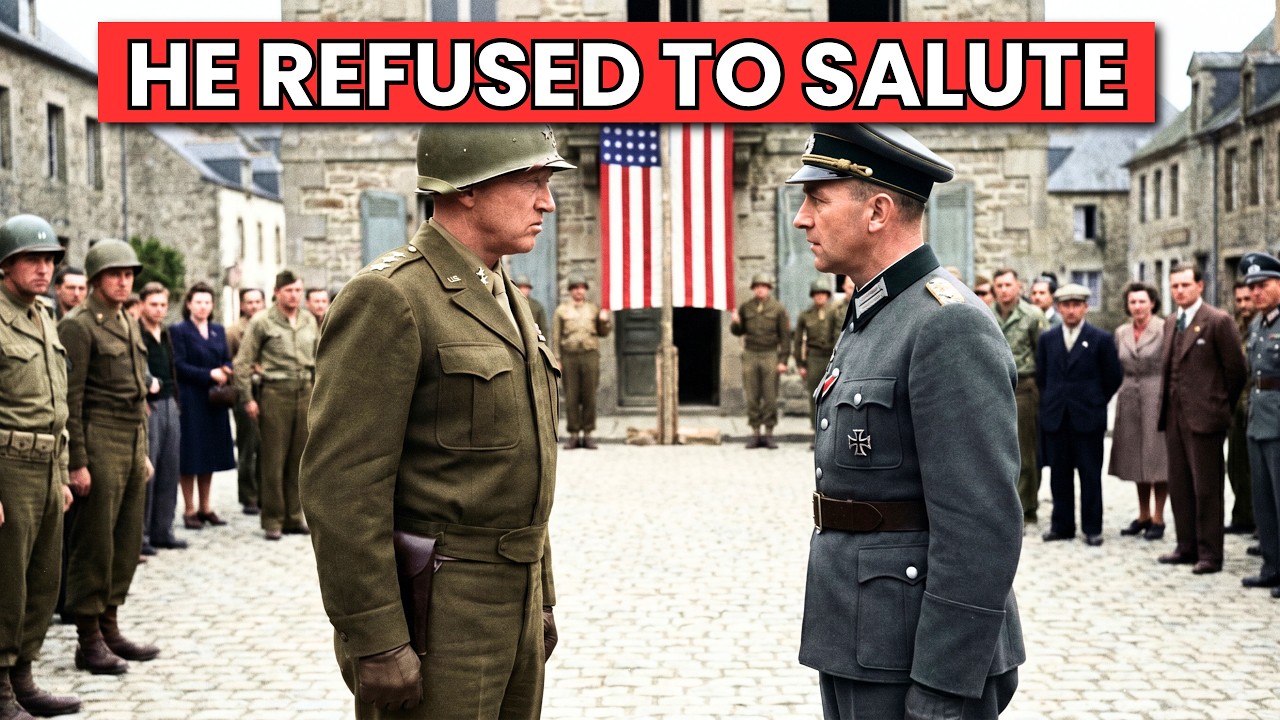
The mayor came outside. He was dressed in his full official regalia—the dark jacket with the party eagle on the breast, the swastika armband on his left arm, the polished shoes. He had taken the time to make himself presentable.
He walked down the steps of the town hall with the deliberate, measured pace of a man who had spent years practicing the performance of authority.
He stopped at the bottom of the steps as the American jeeps pulled into the square. He looked at the American colonel who stepped out of the lead vehicle and walked toward him. And then, with the calm self-assurance of a man who genuinely had not yet understood what world he was living in, the Nazi mayor of Cham raised his right arm in the Hitler salute and waited for the American to respond.
The colonel stopped walking. He looked at the mayor’s extended arm. He looked at the swastika on the armband.
He looked at the party eagle on the jacket. Then he looked at the mayor’s face—the face of a man who had wielded absolute power over thousands of people for more than a decade.
The colonel did not salute. He did not stop walking. He walked directly up to the mayor, stopped 18 inches from his face, and told him in clear, deliberate German—because the colonel, like many of Patton’s officers, had learned enough of the language to communicate directly without an interpreter—that the arm could come down, that the party was finished, that the Reich was finished, and that the mayor was now a prisoner of the United States Army.
The mayor’s arm dropped. The color left his face. The performance of authority, practiced and refined over 12 years, collapsed in approximately four seconds.
What followed was not theatrical in the way some of Patton’s more famous moments had been. There was no revolver slammed on a desk. But it was, in its own quiet way, equally complete as an act of psychological demolition.
The colonel had brought with him a specific instruction from Patton’s headquarters regarding the treatment of local Nazi party officials in captured municipalities. The instruction was clear. Party officials were to be removed from their positions immediately.
They were to be stripped of any insignia of rank or party membership. They were to be held for processing by military government teams. And they were, under no circumstances, to be treated as legitimate authority figures.
The mayor’s armband was removed. The party eagle was cut from his jacket. He was placed under armed guard by two American military policemen—enlisted men, sergeants, men who, by the logic of the Nazi hierarchy, were so far beneath the dignity of a senior party official that their proximity was itself a kind of insult.
He was walked across the square he had once dominated and placed in the back of a transport vehicle to await processing. The American flag went up over the Cham town hall within the hour.

George S. Patton had understood from the beginning of his command that the psychological dimension of the war against Germany was inseparable from the military dimension. The Wehrmacht, the SS, and the party apparatus drew their power not just from tanks and rifles and Gestapo files, but from the belief—carefully cultivated, systematically enforced, brutally maintained—that they were invincible, inevitable, and superior.
Patton’s method of stripping that belief away was characteristically direct. He refused to validate it. When German generals tried to maintain their aristocratic bearing in his presence, he slammed a revolver on a desk and reminded them of the reality of their situation.
When camp commandants tried to perform dignified surrenders after overseeing the systematic starvation of American prisoners, his officers stripped them of their medals and sat them in the mud.
And when a Nazi mayor in a Bavarian town raised his arm in the Hitler salute and waited for an American colonel to respond in kind, the colonel walked past the arm as though it were not there, removed the man’s party insignia, and handed him to a pair of sergeants.
The common thread running through all of these moments was refusal. Patton’s army refused to participate in the theater of Nazi superiority. They refused to perform the rituals that gave the system its meaning.
They refused to shake the hands that had signed deportation orders, and they refused to return the salutes of men who had used those salutes as instruments of terror against their own populations for over a decade.
In refusing, they did something that artillery barrages and tank assaults could not entirely accomplish on their own. They made the men who had built their identities on that system look at themselves clearly, perhaps for the first time, and see what they actually were. Not supermen.
Not masters. Not the inevitable inheritors of a thousand-year empire. Just men in dirty jackets standing in a square with their armbands cut off, waiting for a truck.
The war in Europe ended officially on May 8, 1945, five days after the column rolled into Cham. The military government teams that followed Patton’s combat units spent the subsequent months methodically dismantling the administrative machinery of the Nazi party across Bavaria. Many of the men who had run their towns the way the Cham mayor had run his were eventually tried before Allied military tribunals.
Some received prison sentences. Some were released. None of them were saluted.
What endured was something simpler and more fundamental than any legal verdict. It was the memory held by the people who had watched from their windows on the morning of May 3 of the precise moment when a man who had made an entire town afraid of him walked across his own square in the custody of two American sergeants who had never heard of him and couldn’t have cared less.
That memory was not dramatic. It was not violent. It did not involve heroism in any conventional sense.
But it was, for the people who carried it, the truest and most satisfying answer to 12 years of systematic fear.
These were people who had spent over a decade measuring every word before they spoke it. They had trained themselves to lower their eyes at precisely the right moment. They had learned to clap at the right speeches and remain silent during the wrong conversations.
They had survived by making themselves invisible to the very man who was now being escorted across cobblestones by foreign soldiers who couldn’t even pronounce his name.
For them, that walk across the square was not a footnote. It was the answer to every humiliation they had quietly absorbed and never been permitted to acknowledge.
Because the thing about authority built entirely on intimidation is that the moment the intimidation stops working, there is nothing left. No legitimacy. No respect.
No dignity. The elaborate architecture of fear that had taken 12 years to construct came down in the space of a single morning, dismantled not by a revolution or a tribunal or a historic declaration, but by a colonel who simply kept walking and two sergeants who simply did their job.
Just a man in a dirty jacket standing in a square, his arm finally at his side.