The last man from George Armstrong Custer’s battalion to see him alive rode away with a message in his pocket. Trumpeter Giovanni Martini carried a written note for Captain Frederick Benteen: “Come on big village, be quick. Bring packs. ” Martini delivered it and survived.
Every man who stayed with the five companies of the Seventh Cavalry on the high ground east of the Little Bighorn that afternoon was dead before sunset. Two hundred and ten officers and men under Custer had ridden into the valley on June 25, 1876, certain they were about to deliver a crushing blow. By the time the sun dropped toward the Big Horn Mountains, they had died in fragments, company after company falling back along a half-mile ridge while Lakota and Cheyenne warriors closed in from every coulee and draw. Some men ran and were shot from behind.
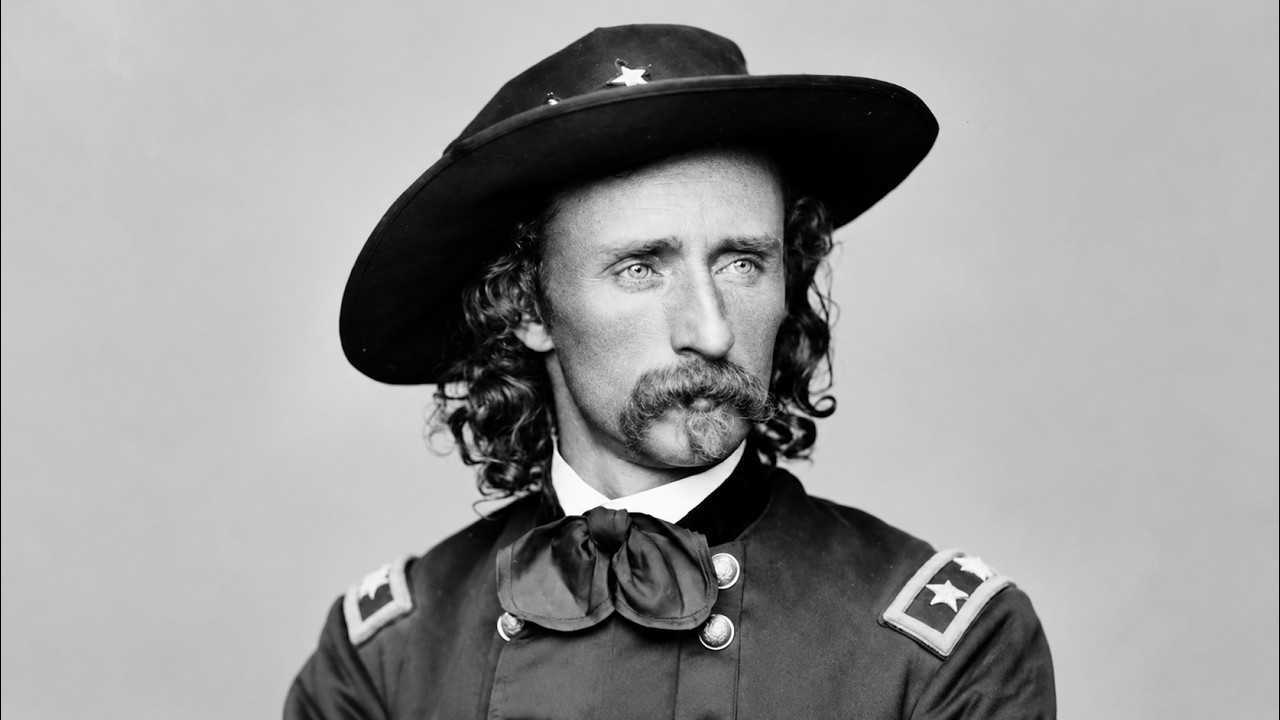
Others killed their mounts and crouched behind the carcasses until the circle closed and the firing stopped. Custer was thirty-six years old that summer. To much of the army and the public, he was still the golden boy: last in his West Point class, yet the youngest general in the Union Army during the Civil War. He had led charge after charge with the Michigan Brigade, saber high, long yellow hair streaming, a figure the newspapers loved.
After Appomattox he kept the reputation alive on the Plains. He fought the Cheyenne at the Washita in 1868, rode through the Black Hills in 1874, and never stopped believing that boldness and speed would carry the day. He dressed the part even on campaign: buckskin jacket, wide-brimmed hat, sometimes a red necktie, though by 1876 the famous hair was cut shorter. He surrounded himself with men who shared his name and his hunger for distinction.
His brother Tom, a two-time Medal of Honor winner and captain in the Seventh, rode with him that day. His civilian brother Boston had tagged along for the summer. His nephew Harry Armstrong Reed, just eighteen, had come out from Michigan for the adventure. His brother-in-law Lieutenant James Calhoun commanded Company L.
That hunger had already cost him once. He had been court-martialed in 1867 for leaving his post without orders, but the army needed aggressive officers on the frontier, and he was restored to command. On the morning of the 25th, Custer’s Crow and Arikara scouts climbed the rocky outcrop called the Crow’s Nest and stared down the valley of the Little Bighorn. They told him the village was the largest they had ever seen.
One scout said there were more Sioux than the regiment had bullets. Custer climbed up himself but claimed he could not make out the full extent through the morning haze. Whether he truly could not see it or simply refused to accept the scale, he chose not to wait for the rest of General Terry’s column. He had been ordered to feel for the enemy and wait for support.
Instead, he pushed forward. Glory, and the chance to end the campaign before the nation’s centennial celebrations in Philadelphia, weighed on him. He divided the Seventh Cavalry into three battalions. Major Marcus Reno would strike the southern end of the village with three companies.
Captain Frederick Benteen would scout the bluffs to the left with three more. Custer himself took five companies, C, E, F, I, and L, roughly 210 officers and men, and swung north along the high ground, planning to hit the camp from the opposite end. He still believed the Indians would scatter once pressed. That had been the pattern in earlier fights.
This time, the village held more than eight thousand people and somewhere between fifteen hundred and two thousand warriors, many of them already furious over broken treaties and earlier attacks. The bands following Sitting Bull, Crazy Horse, and Gall had gathered for the summer hunt and for mutual protection. They were not running. Custer’s column moved along the bluffs after Reno’s attack had already begun.
From a point overlooking the valley, he could finally see the lodges stretching for miles. He sent Sergeant Daniel Kanipe back with a verbal order for the pack train to hurry. Then he dispatched Martini with the written note for Benteen. The five companies continued north along Medicine Tail Coulee.
There, Custer split them once more. Captain George Yates took companies E and F down the dry creek bed toward a ford that looked open enough to reach the river in the heart of the camp. Captain Myles Keogh held companies C, I, and L higher on the ridges, ready to support or to block any countermove. Yates’s detachment pushed toward the water.
A handful of warriors appeared on the far bank and opened fire. The troopers hesitated, then turned and climbed back out of the coulee toward the high ground. That retreat set the pattern for everything that followed. Keogh’s men linked up with them on the southern nose of the long ridge that runs parallel to the river, the ground later called Battle Ridge.
Company L under Calhoun formed a skirmish line across the crest. Company C tried to clear the lower slopes in the ravines. Company I under Keogh took position a little farther north and east. Custer and the headquarters group with Yates’s remaining men pushed farther along the ridge toward the northern tip.
The warriors who had finished driving Reno back across the river now swung north in force. Gall’s Lakota came up from the south through the draws. Others crossed lower down the valley and worked into the deep ravines that cut the western face of the ridge. From those folds, they could fire without being seen.
Arrows dropped in high arcs onto the exposed skirmish lines. Repeating rifles, Winchesters, and Henrys taken from earlier fights and traders, cracked from the cover across the river and the edges of the deep cuts. Calhoun’s line held for a stretch of steady firing, perhaps twenty or thirty minutes. Then the pressure from three sides broke it.
Troopers began falling back along the crest. Spent cartridge cases later mapped by archaeologists show the neat firing positions dissolving into scattered clusters, the clear mark of men no longer in formation. Company C was overrun on the lower slopes. Survivors scrambled toward Calhoun Hill and were cut down before many of them reached it.
Keogh’s Company I tried to form a new line on the eastern face of the ridge. The bodies were later found close together around Keogh himself, as if the men had closed ranks one last time and been swamped. From the north came the decisive blow. Crazy Horse had led a large body of warriors down the valley, crossed the river below the village, and swung wide to climb the ridge from the opposite end.
They hit the northern companies while Gall’s men pressed from the south. The remaining soldiers under Custer and Yates were forced onto the highest point of the ridge, a low knoll that would be remembered as Last Stand Hill. About forty men reached it. They shot the last of their horses and dragged the carcasses into a rough circle.
Behind that barrier, they fired until the ammunition began to run low. Custer was among them, still in the thick of it, with his brothers and nephew close by. Tom Custer fought near him. Boston and young Reed had no military rank but stayed with the headquarters group to the end.
The final rush came in a mass. Warriors rode close enough to strike one another’s ponies with quirts, so no man held back. Low Dog’s call carried across the slope: this was a good day to die. The charge rolled over the dead horses.
Some soldiers threw down their carbines and raised their hands. The warriors took no male prisoners that day. A handful of troopers broke outward and ran on foot or on the few remaining mounts toward the river, sliding into the deep ravine that drops off the western side of the hill. They were hunted down one by one.
Bodies later recovered from that ravine showed most had been shot from behind while still moving. The entire sequence, from the first shots at Medicine Tail Ford to the last man on the ridge, lasted less than two hours. Some native accounts put the final collapse at closer to forty-five minutes once the pressure became continuous. Reno’s and Benteen’s survivors held their hill through the next day under constant fire, short of water, digging with knives and tin cups until the relief column arrived.
The story that grew afterward turned the disaster into a legend of defiance: paintings of Custer standing tall with saber raised, newspapers calling it a martyr’s stand against impossible odds. Elizabeth Custer spent the rest of her long life protecting that image. The ground itself tells a harder truth. A battalion came apart under fire, company after company, until nothing remained but the dead and the wind moving through the grass on a ridge that still carries the name of the man who led them there.
The man remembered for over a century as a martyr riding bravely into an unwinnable fight was, by every piece of physical and testimonial evidence recovered from that hillside, a career officer chasing one last headline to save a reputation already collapsing in Washington, leading exhausted men in stages toward a village nearly ten times larger than the one he expected, in a war started over gold that was never his government’s to take.