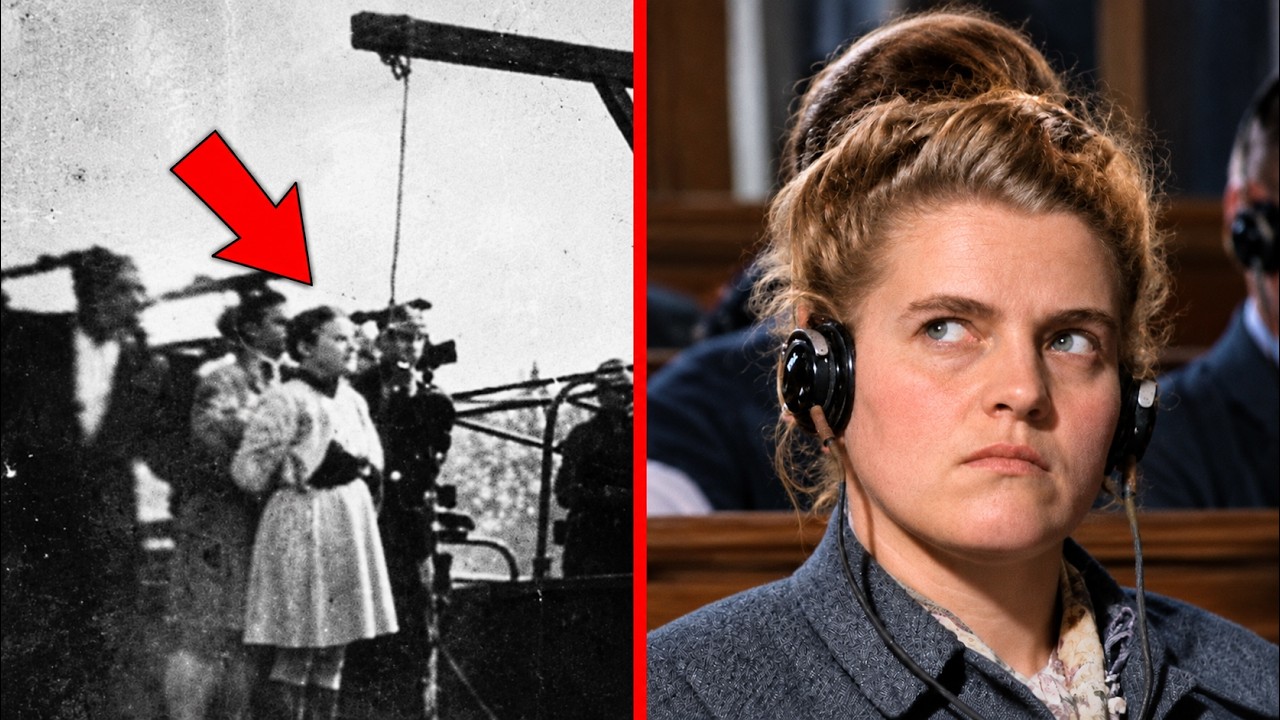
On January 24, 1948, in Montelupich Prison in Krakow, Poland, a 36-year-old woman was dragged down a stone corridor by two guards. She was not calm. She was not composed.
She was screaming, fighting the noose, fighting the drop, fighting the end of a life that had taken half a million others without mercy. Her final words, gasped out before the trapdoor opened, were three words in the language of the people she had spent years destroying: Poland lives.
This was the end of Maria Mandel, the woman prisoners at Auschwitz-Birkenau called the Beast.
Mandel was born on January 10, 1912, in Münzkirchen, a small Austrian village near the German border. Her father was a shoemaker. Neighbors who knew her as a girl later described her the way people so often describe monsters before the world knows what they will become: pleasant, hardworking, nothing special.
A nice girl from a good family.
She grew up in the aftermath of one world war, in a shrunken and humiliated Austria. When the Nazis annexed Austria in the spring of 1938, Mandel, then 26, moved to Munich to find work in the new order. She found it in the worst possible place.
On October 15, 1938, she joined the camp staff as an Aufseherin, a female overseer, at Lichtenburg concentration camp in Saxony. It was one of the earliest Nazi camps and at the time one of the only ones holding women. She worked alongside roughly 50 other SS women, learning a trade that did not yet have a name for what it would become: the systematic administration of human suffering.
On May 15, 1939, when Lichtenburg’s prisoners and staff were transferred to the newly built Ravensbrück camp, a camp built specifically for women, Mandel went with them. And there, something in her sharpened.
Survivors and camp chroniclers later described a woman who oversaw daily roll calls that could stretch for hours in freezing weather, who assigned punishments, who ordered floggings, and administered some herself. She was, by every account, extraordinarily good at her job, if good is a word that can be used for this kind of work.
On April 1, 1941, she formally joined the Nazi Party. A year later, in April 1942, her diligence was rewarded. She was promoted to SS-Oberaufseherin, senior overseer, one rank below the very top of what a woman in the SS hierarchy could achieve.
She had learned the machinery of the camp system from the ground up. Now she was about to be handed the largest and deadliest machine of all.
On October 7, 1942, Maria Mandel was transferred to Auschwitz-Birkenau in German-occupied Poland and appointed SS-Lagerführerin, chief overseer of the women’s camp. It was functionally the highest position a woman could hold anywhere in the machinery of the Third Reich. She answered to only one man: the camp commandant.
Beneath her was an empire of suffering. The entire women’s camp system at Auschwitz and its satellite camps, including Hindenburg, Lichtwerden, and Raisko, fell under her command. Tens of thousands of women were crammed into barracks built for a fraction of their number.
Sanitation was nearly nonexistent. Food was at starvation level. Disease spread unchecked.
And presiding over all of it was Mandel, a woman prisoners came to know by a single nickname spoken in terror: the Beast.
Survivor testimony gathered after the war painted a portrait of chilling contradiction. Auschwitz survivor Hermann Langbein described a woman who could occasionally help individual prisoners but who also ordered beatings and personally delivered them. This was not incidental cruelty.
It was routine. It was policy, and Mandel enforced it with her own hands as readily as with her signature.
Her signature is the most damning evidence of all. Auschwitz-Birkenau did not simply imprison people. It sorted them, deciding day by day who would work and who would die.
Mandel was not a distant administrator signing paperwork in an office far from the killing. She personally participated in selections on the ramp and in the camp itself, deciding who was still fit to work and who was not.
Those deemed unfit, the sick, the exhausted, the elderly, mothers with young children, were sent to the gas chambers. Chroniclers who later interviewed camp doctors recorded conversations in which Mandel complained that too much time had passed without a fresh selection, that overcrowding in the women’s camp had become impossible to manage without one. In the vocabulary of Birkenau, managing overcrowding meant murder, scheduled and signed off in her own hand.

By the time historians finished reconstructing her death lists after the war, they arrived at a staggering figure. Maria Mandel is believed to have been complicit in the deaths of approximately 500,000 people during her time at Birkenau. Half a million lives, run through a system she helped design and personally operate.
And yet, this is the paradox that has haunted every historian who has studied her. Mandel was also known within the camp for something almost unimaginably incongruous: a genuine love of classical music. She personally founded and championed the women’s orchestra of Auschwitz, staffing it with talented prisoner musicians, several of whom later said their musical skill was the only reason they survived at all.
The same hands that signed death lists also gave a handful of women violins, cellos, and a reprieve from the gas chamber. Not out of mercy for humanity, but because she wanted beautiful music to listen to while she walked among the barracks.
She also took a personal liking to Irma Grese, a young guard she mentored and promoted. Grese would go on to earn her own reputation for savagery at Bergen-Belsen and would be executed for it after the war.
This was Maria Mandel in full: capable of building an orchestra and ordering a selection in the same afternoon. Historians and biographers who have spent decades studying her, including biographer Susan J. Eishade, who spent 20 years reconstructing Mandel’s life from archival testimony and interviews, describe her as a study in contradiction.
Turbulent, violent, and impossible to reduce to a single simple villain archetype, which is precisely what makes her so disturbing.
In November 1944, as the Red Army closed in from the east, the SS began dismantling Auschwitz. Mandel was transferred out of Birkenau to Mühldorf, a subcamp of Dachau. Her successor, Elisabeth Volkenrath, inherited a crumbling empire.
Soviet troops liberated what remained of Auschwitz in January 1945.
As the war collapsed entirely in May 1945, Mandel fled Mühldorf into the mountains of Bavaria, eventually making her way toward her own birthplace of Münzkirchen, Austria, the same quiet village where she had been born 33 years earlier as an unremarkable shoemaker’s daughter.
She was not alone. She fled with a lover, camp commandant Walter Adolf Langleist, and a Jewish prisoner. For three months, the woman who once decided the fate of half a million people with a signature managed to evade capture herself.
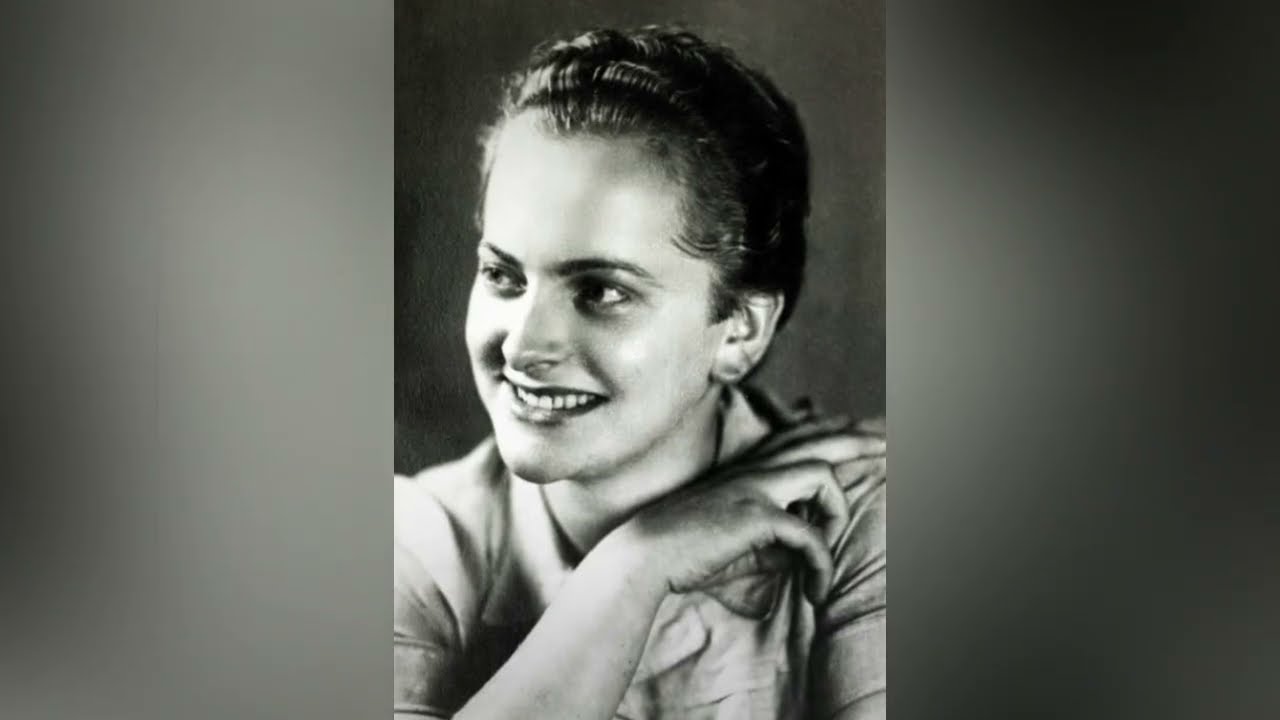
It did not last. On August 10, 1945, American military police tracked Mandel and Langleist to his home in Hof, Bavaria, and arrested them both. The Beast of Birkenau was now a prisoner herself, interrogated by the very Allied forces whose armies had crushed the regime she served.
Interrogators reportedly found her unsettlingly highly intelligent and utterly dedicated, even in captivity, to the work she had done.
In November 1946, the United States handed Maria Mandel over to Poland, the nation on whose soil her crimes were committed and whose people made up the overwhelming majority of her victims.
From November to December 1947, Mandel stood trial in the Auschwitz trial, one of the most closely watched war crimes proceedings of the post-war era, covered by the international press. She sat in the dock alongside dozens of other former Auschwitz staff. The evidence against her was overwhelming: survivor testimony, death lists bearing her own signature, and witnesses to her personal role in selections and beatings.
In her own defense, in writing she penned from her prison cell, Mandel attempted to justify what she had done, framing herself, as so many perpetrators of the Holocaust would, as someone simply following the demands of a system larger than herself.
The tribunal was not persuaded. She was convicted of crimes against humanity and sentenced to death.
While awaiting execution, she shared a wing of Montelupich Prison with fellow condemned guard Therese Brandl. A Polish survivor named Stanisława Rachwałowa, herself imprisoned in the cell next door by Poland’s post-war communist authorities, later recalled a haunting final encounter. Shortly before their executions, both Mandel and Brandl turned to her and asked, in the language of the people they had persecuted, to be forgiven.
On January 24, 1948, at 36 years old, Maria Mandel was led to the gallows. The composed, dedicated, disciplined administrator who had signed away half a million lives without visible hesitation did not meet her own end with the same discipline. Witnesses described her fighting, screaming, resisting to her final moment.
A woman who had spent years enforcing silence and obedience on others was now unable to enforce either on herself.
Her last words were reported as two: Polska żyje. Poland lives.
It is perhaps the final contradiction in a life built entirely out of them. A woman who helped annihilate a nation’s people uttered its survival as she died.
Maria Mandel remains to this day one of the highest-ranking women ever convicted for crimes committed during the Holocaust. She is proof that the machinery of genocide was not staffed by monsters born fully formed but built rank by rank, promotion by promotion, out of ordinary people who chose again and again to climb.
A shoemaker’s daughter from a small Austrian village became the most feared woman in the deadliest place on Earth. And when the reckoning finally came for her in a cold Krakow courtyard, all her discipline deserted her. What was left was simply a woman screaming at the end of a rope she had helped build for half a million others.