Standing on a hillside in what is now Shandong Province in China, roughly 2,500 years ago, a man watches the enemy advance into a narrow defile. Ten thousand soldiers march below, kicking up dust, walking into a trap. The man carries no sword and no spear. He holds something his enemies have never seen.
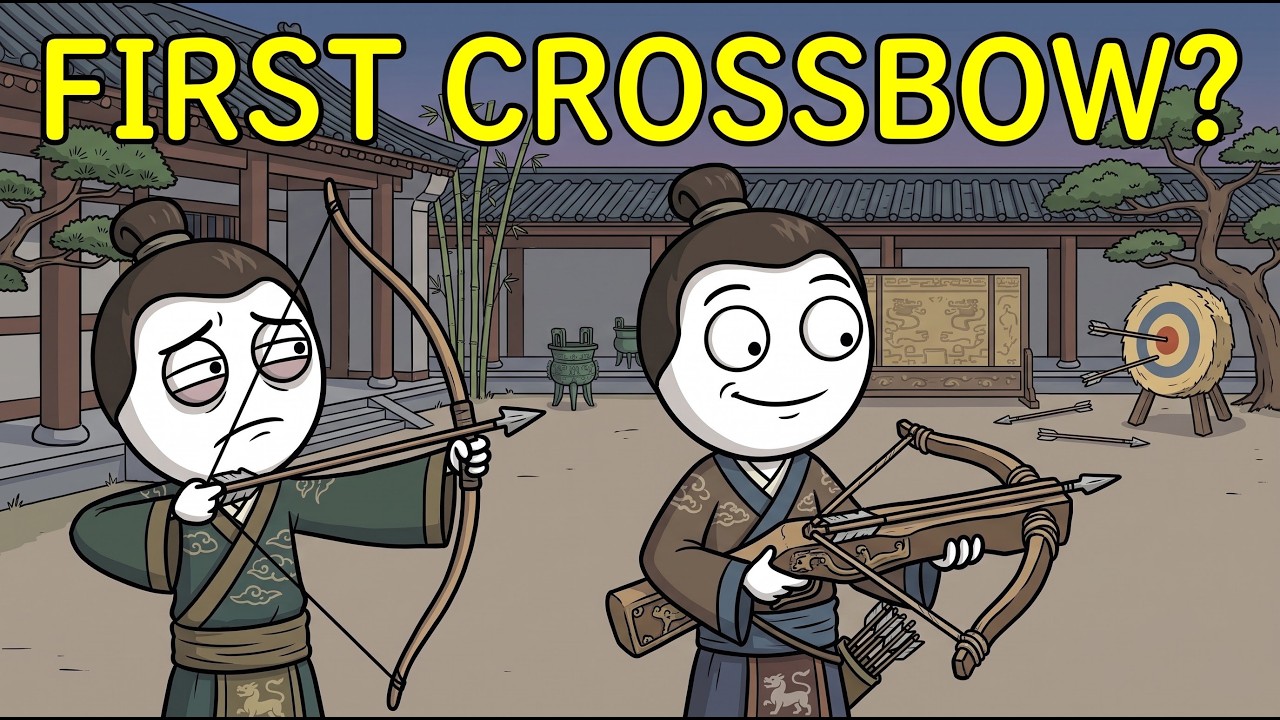
It is a wooden stock with a bow mounted crosswise at the front and a small bronze mechanism at the rear. The bow is already drawn. The string is already under tension. Every ounce of energy his arms poured into the bow three minutes earlier remains locked in place by three interlocking bronze pieces smaller than his fist.
He is not straining. He is not trembling. He is waiting. When torchlight flashes below and ten thousand other men on the ridgeline trip their weapons at the same moment, a storm of bolts will pour into that gorge and change the way humans wage war for the next two millennia.
This weapon is the crossbow. Its invention is not a simple story of someone tying a bow to a stick. It is a story of a mechanical idea so radical that it was independently invented at opposite ends of the planet, banned by a pope, feared by knights, mass-produced by an emperor, and ultimately used to kill a king who had made it his weapon of choice. The crossbow solved a problem every archer had always known.
Drawing a bow is exhausting. A traditional bow stores energy only as long as the muscles keep pulling the string back, and those muscles begin to weaken the moment they start working. A trained English longbowman drawing 150 pounds might hold full draw for three or four seconds before his hand starts to shake. Every bow made before the crossbow shared the same fundamental limitation: the moment of maximum force and the moment of aiming had to happen at the same time.
Pull, aim, release. One continuous motion. No pauses. The crossbow separated those two acts.
Draw the string back, lock it in place, walk away if you like, return an hour later. The energy is still there, frozen in the bent limbs, held by a mechanical grip that does not tire, does not shake, does not hesitate. Aim as long as you need, rest the stock on a parapet, wait for the perfect moment, then press the trigger and transfer all that stored energy into a short, heavy bolt in a fraction of a second. The oldest confirmed crossbow components ever found come from tombs in China.
In Qufu, the ancient capital of the state of Lu in Shandong Province, archaeologists excavating tombs M3 and M12, dating to the late sixth or early fifth century BC, found cast bronze trigger mechanisms. These small components were designed to interlock inside a wooden stock and hold a drawn crossbow string under enormous tension. They are the oldest physical evidence of a crossbow trigger anywhere on Earth. Around the same period, roughly 500 BC, nearly identical technology appeared several hundred kilometers south at Chengqiao in Jiangsu Province, in a tomb belonging to the state of Wu.
Two different states, two different burial sites, the same mechanical solution. By the fifth century BC, the crossbow had already spread across multiple Chinese kingdoms. It was not a prototype. It was a weapon in active military service.
The Chinese trigger mechanism was itself a masterpiece of Bronze Age engineering. Three cast bronze components interlocked on two transverse pins. The first piece, a rotating claw with double hooks, caught and held the string, with a vertical protrusion that also served as a rear sight. The second piece wedged under the claw to lock it in place.
The third piece was the trigger itself, extending down through the base of the stock where the archer’s finger could reach it. The geometry was brilliant. The string pressed forward on the claw with hundreds of pounds of force, yet the contact angle between the claw and the middle piece transferred almost none of that force to the trigger. An archer could hold a 300-pound draw weight in place, then release it with a light finger pressure of only three to five pounds.
This is a mechanical advantage ratio that modern trigger engineers would recognize immediately, achieved by unknown bronze casters who had no written theory of mechanics, no equations, no formal physics. They had trial and error, and dead soldiers whose triggers had failed. The earliest triggers had no outer housing. The bronze parts sat directly in carved recesses in the wooden stock, held by pins piercing the grain.
Under heavy draw weights, the pins split the wood and the whole assembly exploded. So weapons makers invented the guo, a rectangular bronze housing that enclosed the three moving parts. The craftsman carved one rectangular cavity in the stock, placed the pre-assembled bronze frame inside, and secured it with pins. The metal casing absorbed all the mechanical shock.
Draw weights could increase. Field replacements became faster, and the weapon could be mass-produced. That is exactly what happened under the Qin dynasty. When archaeologists began excavating the tomb of Emperor Qin Shi Huang near Xi’an in 1974, they found more than clay soldiers.
They found more than 200 bronze crossbow triggers buried beside the terracotta army, with entire formations of kneeling and standing crossbowmen arranged at the front of the emperor’s silent legions. In March 2015, a team excavating Pit One uncovered the most complete Qin crossbow yet found: a composite bow about 145 centimeters long, its original twisted animal-sinew string still intact, with two wooden bars pierced by holes attached to the limbs. Those bars solved a mystery that had puzzled scholars for centuries. Classical Chinese texts mentioned a device called the cheng used in crossbow maintenance, but no one knew what it was.
The excavation proved it was a storage brace. Ropes passing through the holes held the composite bow limbs under neutral tension during transport, preventing the layers of bamboo, wood, sinew, and lacquer from warping or separating. The Qin army had invented a carrying case for a weapon 2,200 years ago. Popular accounts long claimed that Qin crossbow triggers were the world’s first interchangeable parts, manufactured like nineteenth-century armory weapons.
Modern metrological research on hundreds of these triggers found the truth was more subtle. The triggers fall into distinct subgroups with slight geometric differences between production batches. Components within a single batch were standardized, but each three-piece mechanism was filed and polished by hand as a matched set, with assembly marks carved on the parts so that pieces fitted together in final assembly would not be separated. Many carried inscriptions recording the workshop supervisor’s name.
Qin law required every craftsman to carve his name on the piece he produced. If a trigger failed in combat, the imperial office could trace the defect to the responsible foundry and the individual worker. Quality control through personal accountability, twenty-two centuries before ISO certification. The crossbow also appeared in the literature.
In Sun Tzu’s Art of War, written in the late sixth or early fifth century BC, the crossbow is a central metaphor for tactical momentum. The strategic momentum of the skilled warrior resembles the fully drawn crossbow. His timing resembles the release of the trigger. By the time Sun Tzu wrote those words, the crossbow was so universally understood in Chinese military culture that it had become a metaphor.
Then came the battle that proved what concentrated crossbow fire could do. In 341 BC, the armies of the states of Qi and Wei collided in one of the most studied engagements in Chinese military history. The Qi general Tian Ji, advised by the strategist Sun Bin, had been retreating for days, deliberately reducing the number of cooking fires in his camp each night. One hundred thousand flames, then fifty thousand, then thirty thousand.
The Wei commander Pang Juan concluded from the dwindling fires that the Qi soldiers were deserting. He pushed his cavalry forward in pursuit, racing across unfamiliar terrain to catch a disintegrating army. Sun Bin chose the narrow pass at Maling for the ambush. He selected a large tree by the road, stripped its bark, and wrote seven characters on the white wood: Pang Juan dies beneath this tree.
Then he hid ten thousand crossbowmen on the heights above both sides of the pass and gave them one instruction: when you see fire, shoot. Pang Juan’s cavalry arrived after dark. He saw the stripped tree and the white writing. He lit a torch to read it.
Ten thousand crossbow triggers released at the same moment. The entire Wei column was wiped out inside the pass. According to the historian Sima Qian, Pang Juan took his own life beneath the tree, cutting his own throat and saying that he had made a name for this trickster. The Battle of Maling was not decided by swords, spears, or chariots.
It was won by a weapon that could be pre-loaded, carried indefinitely, and fired with a finger’s tap in total darkness. While China was fielding crossbows by the thousands, the ancient Greeks were independently arriving at the same mechanical principle by a completely different path. The Greek version was called the gastraphetes, literally the belly shooter. It operated nothing like the Chinese crossbow.
It had a wooden trough in which a slider moved back and forth. Iron gear teeth engaged spring-loaded ratchets to form a latching mechanism. To draw it, a soldier placed the muzzle on the ground and pushed his belly against a concave stock, throwing his body weight forward. The slider stepped backward, pulling the string to full draw.
A claw held the string in place. A pin released it. It was heavy, awkward, and slow, but it was the first mechanical projectile weapon the Western world had ever seen. The Greeks did not develop it into an infantry weapon.
They scaled it up into siege artillery. The gastraphetes was a stepping stone toward torsion catapults. The Chinese crossbow went the opposite direction, remaining small, becoming lighter and cheaper, ending up in the hands of every infantryman in the army. The same mechanical vision, two entirely different evolutionary paths.
The scholarly consensus established by E. W. Marsden at Oxford and Joseph Needham at Cambridge is that these two inventions were completely independent. The Chinese used a three-piece trigger mechanism.
The Greeks used a sliding beam with a release pin. Two civilizations separated by thousands of miles solved the same problem with different engineering. Popular tradition attributes the repeating crossbow to Zhuge Liang, the legendary chancellor of the Shu Han kingdom during the Three Kingdoms period around 200 AD. But the Records of the Three Kingdoms, written by the historian Chen Shou in the third century AD, explicitly states that Zhuge Liang modified and improved the repeating crossbow, not that he invented it.
In 1986, archaeologists excavating tomb 47 at Qinjiazui in Hubei Province found a double-shot repeating crossbow dating to the fourth century BC. It had a top wooden magazine holding twenty bolts with two parallel release channels that fired two bolts at once. A push-pull lever drew the string, dropped two bolts into the channels, and released. This device predated Zhuge Liang by six hundred years.
It remains the oldest documented repeating projectile launcher in the world, 2,400 years old. Crossbow technology in Europe appeared centuries later and independently. The Roman military writer Vegetius, writing in the late fourth or early fifth century AD, explicitly distinguished between different types of missile troops, including the arcuballista, literally the bow-catapult, a crossbow. The evidence is confirmed archaeologically.
Gallo-Roman stone carvings in central France dating between the second and fourth centuries AD depict hunters pursuing deer and wild boar with handheld mechanical bows mounted on stocks. Crossbows existed in the late Roman provinces before the fall of the Western Empire, but the European crossbow developed its own trigger mechanism completely different from the Chinese system. Where the Chinese used a three-piece bronze casting, European bowyers carved a rotating nut, usually from dense red deer antler. The nut had two horns upward to hold the string and a lower notch for the release mechanism.
It sat in a semicircular recess in the stock, secured not by a rigid pin but by a flexible lashing that absorbed the violent shock of release. A long iron lever rested on a pin inside the stock. When the rear end was pressed upward, the front end dropped from the notch, the nut rotated, and the string flew forward. This mechanism was simpler than the Chinese design, easier to manufacture from local materials, and capable of withstanding crushing pressures from heavy bows.
By the time of the Crusades, the crossbow had become the dominant missile weapon of Western European warfare and terrified everyone who faced it. When the armies of the First Crusade reached Byzantine territory in 1096, the princess Anna Komnene encountered the weapon the Greeks called the tzangra. She described it in her history the Alexiad with a mixture of horror and admiration, calling it a truly demonic machine and writing that the bolt struck with such speed that the victim did not feel the wound until death overtook him. The Byzantines immediately adopted it and created specialist units called tzangratoroi.
King Richard I of England, known as the Lionheart, was the great royal champion of the crossbow. During the Third Crusade, at the siege of Acre in 1191, Richard was so ill with a scurvy-like disease called arnaldia that his hair and nails were falling out. Unable to stand, he ordered his servants to carry him to the front-line trenches on a silk bed behind a wicker barrier. From that position, Richard personally shot a crossbow inlaid with ivory through a slit in the wall, killing several of Saladin’s guards on the ramparts.
At the Battle of Jaffa in August 1192, Richard had only fifty-four knights and about two thousand infantry, including four hundred crossbowmen from Genoa and Pisa, against thousands of Saladin’s cavalry. Richard organized his infantry into a solid line, spear-men kneeling behind shields planted with spears pointed outward, and between every two spearmen a crossbowman with an assistant reloading a second weapon while the first was being fired, providing continuous shooting. Saladin’s cavalry launched repeated charges and scattered before the armor-piercing crossbow bolts. Saladin withdrew and concluded the Treaty of Jaffa the following month.
Then the crossbow killed its greatest champion. On the evening of 26 March 1199, Richard was inspecting the siege works at the castle of Châlus-Chabrol in the Limousin region of France. He was walking in the castle ditch without armor, holding only a small iron buckler. On the ramparts above, a lone defender named Pierre Basile was using a frying pan as a makeshift shield while working a crossbow.
Basile loosed a bolt that struck Richard in the left shoulder near the neck and penetrated to his chest. Richard withdrew to his tent. A surgeon tried to extract the bolt by torchlight. The wooden shaft broke, leaving the barbed iron head deeply embedded in the muscle.
The surgeon tore at the king’s body trying to remove it. Gangrene set in within days. On his deathbed, Richard asked for Basile to be brought before him and asked why he had targeted him. Basile replied that Richard had killed his father and two brothers.
Richard pardoned him, ordered his chains removed, and released him with a hundred English shillings. Richard died on 6 April 1199 in the arms of his seventy-seven-year-old mother, Eleanor of Aquitaine. Immediately after the king’s death, the mercenary captain Mercadier defied the late king’s order, seized Basile, flayed him alive, and hanged him from the castle walls. The man who did more than any other European king to promote the crossbow as a weapon of war was killed by a peasant’s bolt from a cheap hunting crossbow.
The Catholic Church took note. In April 1139, Pope Innocent II convened the Second Lateran Council in Rome. Its twenty-ninth decree declared that the deadly art of crossbowmen and archers, hateful to God, was forbidden to be used against Christians and Catholics. The ban applied only to wars against other Christians.
Using crossbows against Muslims, pagans, and heretics was perfectly acceptable. No one complied. Kings, including Richard, Philip II of France, and Emperor Frederick II, maintained permanent, paid companies of crossbowmen. Even church officials armed their own castles with them.
The historian Jim Bradbury found in his 1985 study that there is not a single documented case of anyone being excommunicated for using a crossbow. The reason for the weapon’s usefulness was training. The war longbow required a draw weight of 100 to 180 pounds. Training began in childhood.
English law required commoners to practice archery on Sundays and holidays. The hulls of longbowmen recovered from the Mary Rose, which sank in 1545 and was raised in 1982, told the story. Enlarged left arm bones, twisted spines, and overdeveloped shoulder joints. Drawing 150-pound bows for a lifetime had deformed these men’s bodies.
The crossbow required no more than an afternoon of training. Put your foot in the stirrup, hook the belt claw to the string, straighten your legs. The string locks in place, set the bolt, aim, press. A peasant conscript who had never held a weapon could learn the basic operation within hours, and that peasant with a crossbow could kill a knight who had trained since childhood and whose armor and warhorse represented the economic output of entire villages.
Medieval aristocrats regarded the crossbow as a cowardly and dishonorable weapon because it bypassed the test of personal combat. It also destroyed the financial incentive of chivalric ransom. Instead of capturing enemy knights and holding them for profit, crossbowmen killed them at a distance, anonymously. When knights captured crossbowmen, they routinely mutilated them, cutting off their thumbs and forefingers or gouging out their eyes.
The English barons were so afraid of King John’s foreign mercenary crossbowmen that they secured their expulsion in Magna Carta itself. Clause 51 of the original 1215 charter demanded that all foreign-born soldiers, crossbowmen, sergeants, and mercenaries be removed from the kingdom. Crossbowmen are the only weapons operators mentioned by name in Magna Carta. The physics explains why crossbows worked the way they did.
A longbow string is drawn roughly 22 to 28 inches. That long draw distance means a 150-pound bow accelerates the arrow over an extended distance, achieving high speed with great efficiency. A crossbow mounted sideways on a stock has a power stroke of only 4 to 7 inches. To deliver equivalent energy to the projectile over that short distance, the draw weight had to be enormous.
A typical thirteenth-century military crossbow required a draw weight of 300 to 450 pounds. Fifteenth-century heavy siege crossbows reached 800 to 1,200 pounds. No human arm can draw 1,200 pounds, so cocking mechanisms developed alongside the weapon. By the twelfth and thirteenth centuries in Europe, iron stirrups were mounted at the front of the stock.
The crossbowman placed his foot in the stirrup, hooked a belt claw to the string, and straightened his legs and back, handling 250 to 450 pounds. By the mid-fourteenth century, the goat’s foot lever appeared, a hinged steel lever that could draw a 350 to 550-pound crossbow in seconds. By the late thirteenth and early fourteenth centuries, the windlass, a pulley system mounted on the rear of the stock, provided a mechanical advantage of 10:1 or 20:1. The cranequin followed in the fifteenth century, a steel gear box with internal cogwheels turned by a hand crank, offering a mechanical advantage up to 50:1 in a compact, weather-resistant design.
In 1903, Sir Ralph Payne-Gallwey tested an original fifteenth-century siege crossbow from his own collection. The steel bow required a draw of up to 1,200 pounds. Firing a three-ounce bolt, it reached a maximum flight distance of 450 yards, more than four football fields, from a weapon powered entirely by a flexible steel piece and a man turning a crank. Steel crossbows first appeared in central Europe around 1370 to 1390.
They were immune to rain and moisture, unlike composite bows, and could be manufactured quickly. But steel had a terrifying flaw. In sub-zero temperatures, medieval steel underwent a ductile-to-brittle transition. When the trigger was released, micro-cracks propagated at the speed of sound through the metal, and the bow exploded into sharp fragments that could blind or kill the shooter.
Craftsmen wrapped steel crossbows in parchment, leather jackets, or resin-saturated hemp cords, not for structural support, but to contain the shrapnel. A safety cover for a weapon that might kill its own user. The crossbow spread everywhere. In Vietnam, during the third century BC, King An Dương Vương built the spiral citadel of Cổ Loa near modern Hanoi.
Excavations revealed tens of thousands of three-winged bronze arrowheads alongside stone casting molds, proving industrial-scale ammunition production. Vietnamese folklore remembers this era as the age of Nỏ Thần, the divine crossbow, built by the general Cao Lỗ, with a trigger said to be made from a golden turtle’s claw. Legend turned into myth what was historically an organized force of crossbowmen firing standardized bronze bolts against invading armies from the north. In Korea during the Three Kingdoms period, the Silla kingdom developed crossbow technology so advanced that the Tang dynasty wanted it.
In 669 AD, Emperor Gaozong of Tang demanded that Silla send its chief crossbow engineer Gu Jincheong to the Chinese capital. The Koreans complied under diplomatic pressure. Gu Jincheong was ordered to build the legendary thousand-pace crossbow. He deliberately built inferior versions with a range of only thirty to sixty paces, falsely blaming the poor quality of Chinese wood.
He sabotaged his own work rather than surrender a military secret. In the highlands of Yunnan Province, the Miao, Yi, Va, Lisu, and Dai peoples used crossbows as their primary hunting and war weapon into the twentieth century. Their bolts were split bamboo shafts with fire-hardened tips, coated with a boiled paste of monkshood root, a neurotoxin that stopped the heart of large prey within minutes. During the Vietnam War, Montagnard tribesmen recruited by American Special Forces carried traditional poisoned crossbows on long-range reconnaissance patrols along the Ho Chi Minh Trail, valued for their ability to silently eliminate sentries and guard dogs without triggering audible alarms in dense jungle.
A weapon designed 2,500 years earlier, used in twentieth-century warfare, because silence was an advantage gunpowder could never match. In Central Africa, among the Fang, Bulu, and Beti peoples of Gabon, Cameroon, and the Republic of the Congo, an entirely independent crossbow tradition existed. Their crossbow, the mban, used a mechanism found nowhere else in the world. A stock split lengthwise opened like a clothespin.
The bowstring was held in a groove. To fire, the hunter squeezed the two halves together, driving a vertical wedge upward through the groove, forcing the string up and out of the notch. It fired slender raffia palm bolts dipped in cardiac glycoside poisons for hunting monkeys in the high forest. An independent invention using unique mechanisms on a different continent.
The same problem, a different solution. Then firearms appeared, and the crossbow did not die quickly. At the Battle of Cerignola in 1503, Spanish arquebusiers entrenched behind barricades slaughtered France’s attacking cavalry. At the Battle of Pavia in 1525, arquebusiers devastated both French knights and crossbow units.
By the 1540s and 1550s, most European armies had disbanded their crossbow companies. The numbers explain why. A heavy crossbow bolt generated roughly 150 to 200 joules of kinetic energy. A sixteenth-century matchlock musket drove a lead ball generating 1,200 to 3,000 joules.
No wearable armor could stop a musket ball at combat distance. But the crossbow outclassed the firearm in places where gunpowder failed. On Mediterranean galleys until the late sixteenth century, crossbows were carried because sea spray ruined musket match cords and dampened gunpowder. When Hernán Cortés marched into Mexico and Francisco Pizarro crossed the Andes, their campaigns relied heavily on crossbowmen, because when gunpowder ran out in remote regions, crossbow strings could be made from local agave fiber and bolts carved from any straight wood with brass heads melted from regional ore.
The crossbow was the weapon you carried when you could not guarantee a supply line. So how did humans invent the crossbow? They began with the bow, a weapon that stores energy in its bent limbs and releases it through a string. Brilliant and effective, but limited by the fact that every second you held a drawn bow was a second your muscles were burning.
In the sixth or fifth century BC during the Warring States era of ancient China, someone mounted a bow horizontally on a wooden stock, fitted a bronze three-piece interlocking trigger mechanism, and created a weapon that could remain at full draw indefinitely. On the other side of the world, Greek engineers independently built the gastraphetes with a completely different sliding-beam mechanism around 420 to 400 BC. In Central Africa, the Fang peoples invented a third unrelated crossbow design using a clothespin-like release. The crossbow was not a single invention.
It was multiple independent inventions by different civilizations in different centuries and on different continents, all converging on the same mechanical insight: separate the effort from the act of release. China mass-produced it under the Qin dynasty with a standard bronze trigger and imperial quality control. Rome deployed it across its frontiers. Medieval Europe reinvented it with a rotating nut carved from antler.
The Catholic Church tried to ban it. Knights mutilated the bodies of the men who used it. Magna Carta demanded its operators be expelled from England. None of that mattered, because the crossbow did something feudal society could neither tolerate nor prevent.
It made skill irrelevant. A peasant with a crossbow and one afternoon of training could drop an armored knight whose family had spent generations accumulating the wealth, land, and lineage needed to put him on that horse. The crossbow did not simply change warfare.
It undermined the idea that the right to kill was earned by birth.