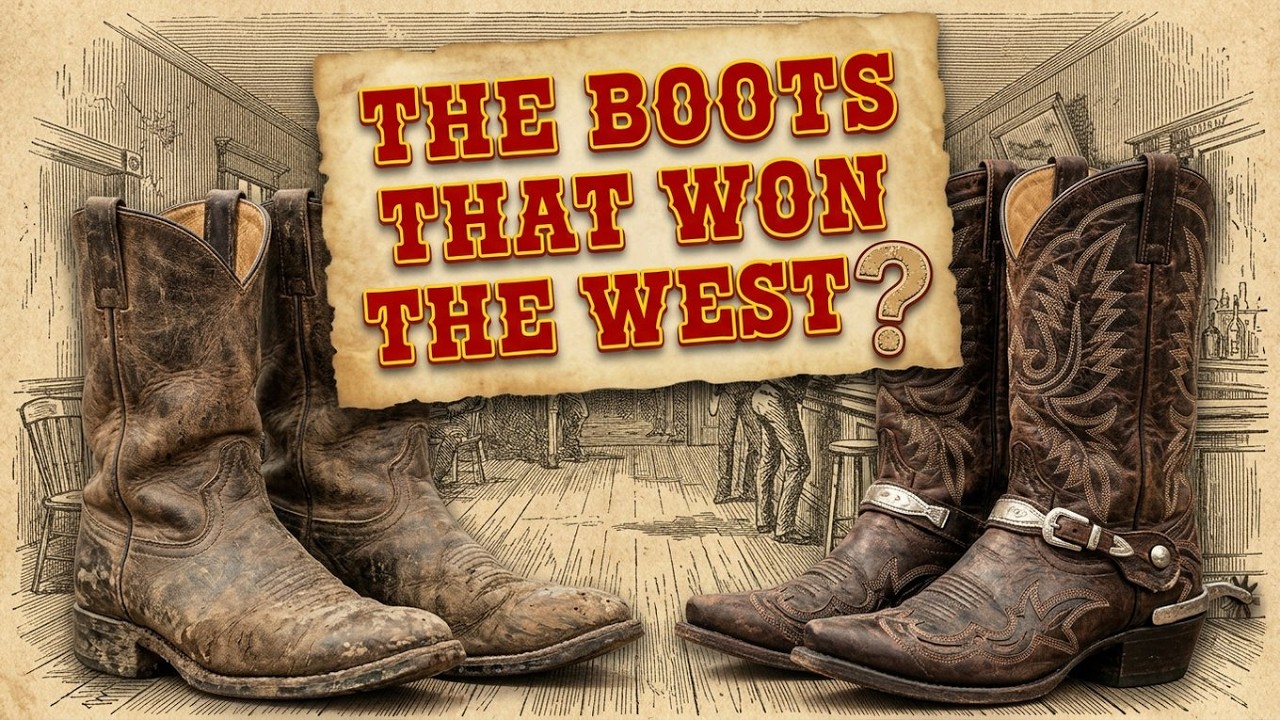
The working cowboy boot was never a fashion statement. Pick one up, and the first thing to notice is the heel, an inch and a half to two inches of stacked leather, underslung and angled forward beneath the arch rather than sitting flat under the foot. To a man who has never worn one, standing in it for the first time feels wrong, off balance, almost precarious. But that heel was not a stylistic choice.
It was the solution to the most specific and most deadly problem a mounted cowboy faced on the cattle trails of the American frontier. The problem was being dragged. Not thrown from a horse, not kicked, not bitten, but dragged. The scenario was specific and almost invariably fatal.
When a man was unhorsed, his foot could drive forward through the stirrup completely, passing the iron and lodging past the widest point. The horse would run, the man would hit the ground, and the foot would stay caught in the stirrup. At the speed of a working horse, survival was not possible. Trail accounts from the cattle drive era document dragging deaths with a matter-of-fact terseness, the language of men recording an occupational hazard they had watched happen and had no effective response to once the sequence began.
The only effective response was prevention, and the only prevention was a boot that could not go through the stirrup completely, regardless of the angle or force applied. That was the mechanical function of the underslung heel. The oxbow stirrup of a working Western saddle, the type favored by most trail hands in the 1870s and 1880s, was a closed loop of iron or wood roughly four inches wide at the base. Under normal riding conditions, a foot rested on that base with the sole sitting flat, and the arrangement was stable.
But a fall, a thrown rider, or a man scrambling to mount a moving horse during a stampede could drive the foot forward through the stirrup. A flat-heeled boot offered nothing to stop that forward drive. The underslung heel changed the geometry. The angled heel, sitting forward beneath the arch, created a mechanical stop at the back of the stirrup opening.
A foot could enter to the correct depth and rest there, but the heel caught on the back edge of the stirrup and held. Mounting in the dark was one of the most dangerous single actions of a cattle drive. A man on the ground near three thousand running longhorns needed to be in the saddle in seconds. He could not see the stirrup; he found it by feel.
The underslung heel gave his foot something to catch on, telling him he was in the right position and holding him there while he came up. It was the difference between a man who mounted correctly in the dark and a man who drove his foot through the stirrup and went down in the path of the herd. The pointed toe confuses modern observers who judge it by comfort rather than function. A pointed toe compresses the front of the foot and was never comfortable for extended walking.
Trail hands who wore their boots off the horse in town walked with the specific gait of men whose footwear had been engineered for a different surface. They wore them anyway, because the pointed toe was not engineered for walking. It was engineered for entering a stirrup at speed in the dark. A four-inch stirrup opening accommodates a pointed toe with room to spare, and the foot enters cleanly and finds the base of the stirrup, the heel catching at the back.
For a practiced hand, the whole sequence takes less than two seconds. A rounded or broad toe enters the same stirrup with more friction and more resistance at the moment when resistance is the last thing available time permits. In daylight with a stationary horse, the difference is minimal. At two in the morning with a stampede running, a horse that has not fully stopped, and thousands of longhorns in the dark behind the man trying to mount, the difference was measurable in seconds.
The pointed toe was time. The tall shaft, sixteen or sometimes seventeen inches, rising from the ankle to just below the knee, was the most visible feature of the boot and the one most consistently misread as vanity. The cattle trails crossed brush country, the dense, thorned, shin-raking scrub of South Texas and the Indian Territory, full of catclaw, mesquite, and blackbrush. A man moving through it on foot encountered that vegetation at exactly the height a sixteen-inch shaft covered.
The shaft was dense, vegetable-tanned leather that moving brush could not penetrate, the thorns catching on the surface and releasing rather than driving into the skin. But brush was the lesser concern. The snakes were the documented one. Trail accounts record rattlesnake strikes on mounted and dismounted cowboys with enough frequency that the hazard required management.
A rattlesnake striking at the lower leg aimed at the ankle, the closest accessible target at strike height. A sixteen-inch shaft of leather was not a guarantee, but it reduced the exposed skin, slowed penetration, and in documented cases deflected strikes that would have reached skin without it. The shaft was armor. The leather itself was not chosen for softness.
It was vegetable-tanned cowhide, made with plant-based tannins rather than the chemical processes that later replaced them, and it produced a stiffness and density that modern boot leather rarely approaches. It was stiff when new and required weeks of breaking in before it conformed to the foot. Trail hands who broke in a new pair on a drive described the process as the primary source of discomfort for the first two weeks. They broke them in anyway, because dense leather held its shape under sustained moisture, through creek crossings, rainstorms, and the dampness of weeks on the trail.
Soft leather saturated and dried repeatedly loses its structure. The heel compresses, the shaft folds, and the geometry that made the boot functional disappears. A trail hand who crossed fifteen rivers on the Chisholm Trail needed his boot to be the same boot at the end of the drive that it had been at the beginning. There are no laces on a working cowboy boot.
Every other serious work boot of the era used lacing for fit and support, and the absence of laces can look like a design omission. It was a deliberate removal of a feature that the working conditions of the cattle drive made dangerous. Laces catch on brush and thorns. A lace caught on a thorn branch while a man was mounted stopped the foot’s movement through the stirrup at the wrong moment.
A lace caught while a man was dismounting held the foot in the stirrup when it needed to come free. More directly, a lace caught on a stirrup iron or saddle rigging during a fall created exactly the dragging scenario the underslung heel existed to prevent, two safety features working in opposition. The bootmakers removed the laces. The pull straps at the top of the shaft, leather loops at the back and sometimes the front, replaced the fitting function of lacing with a mechanism that had no external surface to catch on anything.
When the boot was being worn, they were inside the shaft. The bootmakers who built these boots were not engineers in any formal sense. They did not draw mechanical diagrams or conduct testing. They talked to cowboys.
Trail hands who had experienced a specific failure in a specific boot told the bootmaker what had failed. The bootmaker built the next pair differently, and the next pair went on the trail. The trail reported back, and the next pair was different again. Charles Goodnight, whose trail journals documented what heat did to men and what water did to cattle, wrote about boots with the attention of a man who understood that his crew’s equipment was his crew’s survival.
He was particular about what his hands wore on their feet because he had watched what happened when they wore the wrong thing. That wrong thing was the flat-heeled, broad-toed, laced work boot of the Eastern agricultural tradition, a boot that worked behind a plow on flat ground with no stirrups, no brush, no stampedes, and no snakes at shin height. On the cattle drive, it failed in every specific way the cowboy boot had been designed to prevent. Goodnight did not send men on the trail in those boots after the first season.
The working cowboy boot was not designed by anyone sitting at a drawing table in a comfortable room. It was designed by the cattle drive itself, by the specific failures that specific conditions produced in every boot that was not the cowboy boot, reported back through the men who survived those failures to the men who built what came next. The heel stopped the foot from going through. The toe entered the stirrup fast in the dark.
The shaft covered the shin from brush and fang. The leather held its structure through fifteen river crossings. The absence of lacing removed the feature that caught and held and killed. Five problems.
Five solutions. One boot. The men who wore it did not call it elegant. They called it what it was, a tool, the specific tool that the specific work required, built not by designers but by the accumulated reporting of men who had been on the trail, come back, and told the bootmaker what had failed and what had not.
In the language of the cattle drive, where the only measure that mattered was whether something worked in the specific conditions the work produced, the cowboy boot worked. Every feature of it.