In 1983, Vicki Morgan’s life ended in a Studio City condominium on Laurel Canyon Boulevard. A blood-soaked room and a baseball bat were all that remained. For 12 years, she had been the mistress of Alfred Bloomingdale, the close friend and chief financier of President Ronald Reagan. She had endured his violent sexual demands in exchange for protection and privilege.
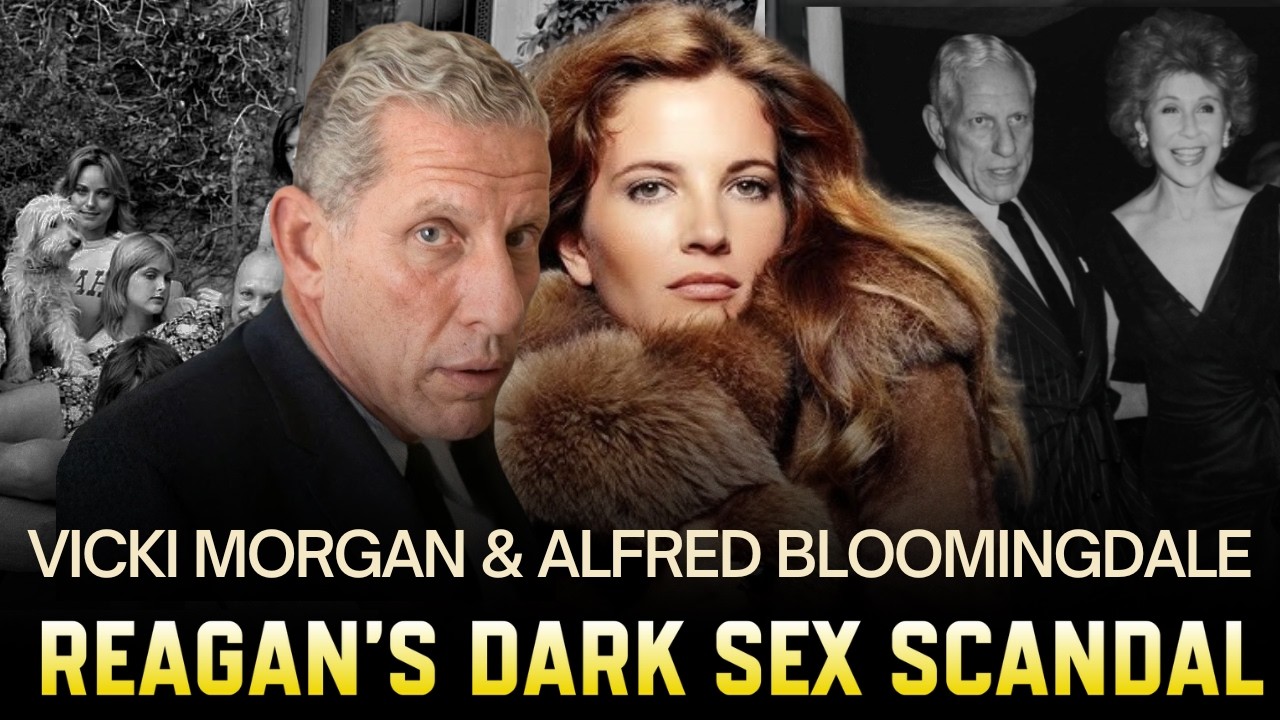
But when she threatened to expose him, she was brutally murdered. Police arrested her roommate, Marvin Pancoast, a mentally unstable 33-year-old, who confessed to the killing. The public, however, saw a different story: a woman silenced before she could release tapes that could have destroyed a presidency. Alfred Bloomingdale was a titan of American industry.
Heir to a retail dynasty and co-founder of Diners Club, he helped invent the credit card industry. But his real power lay in the kitchen cabinet, an exclusive circle of wealthy men who financed and shaped Reagan’s rise to power. Alfred and his wife Betsy were the royalty of Republican society, champions of public morality. Privately, Alfred lived a dark double life, driven by a sadistic compulsion rooted in the writings of the Marquis de Sade.
Vicki Morgan was born in 1952 in Colorado. Her father abandoned the family, leaving her searching for male protection. By her teens, she was stunningly beautiful but deeply vulnerable. Pregnant at 16, she married Earl Lamb, a 47-year-old hustler who used her as bait in forced sexual parties.
She fled the marriage, left her child with her mother, and went to Hollywood, where she worked as an usherette at Grauman’s Chinese Theatre. In 1970, Alfred Bloomingdale found her there. She was 17, scraping together money to eat. He was 54, wealthy, powerful, and accustomed to getting what he wanted.
He saw not just a beautiful girl but a desperate one. After listening to her story, Alfred did not offer legal help or a job. He approached her estranged husband and paid him off, rumored to be around $20,000, to clear the way for her divorce. Vicki was free, but she was not independent.
She had simply been transferred from one exploiter to another. Alfred moved her into a luxury apartment, bought her a Ford Mustang, and provided a monthly allowance equal to a corporate executive’s salary. He hired tutors to teach her to walk, dress, and speak with elegance. Vicki believed she was being prepared for a future together.
Instead, she was being groomed as a possession. The sexual abuse began quickly. According to later court testimony and Vicki’s confessions to friends, Alfred demanded total submission. He bound her, used leather whips, riding crops, and belts, and forced her to play roles of victim and servant.
He brought other women into their bed, high-priced prostitutes and desperate women, paying thousands for a single night while Vicki was forced to participate or watch. She numbed herself with cocaine and Quaaludes. She even found a psychiatrist, hoping to cure him, but Alfred laughed it off, telling her that men of his stature were above ordinary morality. This arrangement lasted 12 years.
In 1982, Alfred was struck down with terminal throat cancer. As he lay dying in Cedars-Sinai Medical Center, unable to speak, control of his fortune and secrets passed to his wife Betsy. She had known about Vicki for years and tolerated it while Alfred contained it. Now the tolerance was over.
The checks stopped. The rent payments were canceled. Vicki was barred from the hospital by private security. She was erased before Alfred had taken his final breath.
At 30 years old, Vicki had no job, no savings, and no skills beyond being a mistress. Facing homelessness, she fought back with the only weapon she had: publicity. She hired Marvin Mitchelson, the celebrity divorce attorney who had invented the concept of palimony. On July 6, 1982, she filed a lawsuit seeking $5 million in support.
The legal documents detailed everything: the whippings, the chains, the paid women. The contrast between the Reagan administration’s crusade for family values and the president’s best friend beating his mistress with a riding crop was staggering. But then came a threat far more dangerous than scandal. During her deposition, Vicki revealed that she possessed audio and video tapes of her time with Alfred.
According to her legal team, the tapes contained Alfred’s candid talk about selling ambassadorships to wealthy donors, covert arms deals, and the personal indiscretions of other Republicans, including those close to the Oval Office. If released, these tapes could trigger impeachments, criminal charges, and the collapse of Reagan’s re-election campaign. The establishment responded swiftly. Vicki reported being followed, hearing clicks on her telephone line, and finding her apartment broken into with only papers rifled through.
She began carrying a . 38 caliber pistol. She told her mother, “If anything happens to me, it wasn’t an accident. ” The judge, Christian Markey, then ruled that because Vicki admitted her duties involved sex, the agreement with Alfred was based on meretricious sexual services, essentially a contract for prostitution.
She was entitled to nothing. Her case was effectively destroyed. By the summer of 1983, Vicki was broken. Alfred had died in August 1982.
Her reputation was ruined. She was forced to move into a cheaper condominium and took in a roommate, Marvin Pancoast, an unstable acquaintance from rehab. She was drinking heavily. Pancoast was erratic.
It was the perfect setup for a tragedy, or, as some believed, for a cleanup operation. Three weeks after the judge threw out her lawsuit, on a humid July afternoon, the baseball bat came down. Pancoast confessed at the police station. But bizarre events followed.
A lawyer named Robert Steinberg claimed that hours after the murder, a mysterious woman handed him a box containing the tapes. He claimed he watched them, saw the orgies, heard the voices of the powerful. Then his story dissolved into smoke. First, he claimed his home was burglarized, and only the tapes were stolen.
Later, he said government agents persuaded him to hand them over. When police searched Vicki’s condo, they found no diaries, no love letters, no cassettes. A woman who had threatened the establishment with evidence had died with nothing in her home. Her history had been scrubbed clean before the blood was dry.
The police closed the case as a domestic homicide. The political dimension was surgically removed. Pancoast was sentenced to 26 years to life. He died in prison in 1991, a casualty of AIDS, taking whatever secrets he held to his grave.
The tapes vanished. The Reagan administration sailed on to a landslide victory in 1984, winning 49 of 50 states. The kitchen cabinet remained in power. Alfred Bloomingdale’s reputation took a brief battering, but his legacy as an industrial titan remained largely intact in the history books.
Betsy Bloomingdale, the woman who had first locked Vicki out of the hospital room, continued her ascent as a matriarch of high society for another 33 years. She never apologized and never retreated. The name Vicki Morgan was never spoken in her presence. The story survived only through fiction.
In 1990, Dominick Dunne, a Hollywood insider who had dined with the Bloomingdales, published An Inconvenient Woman, a novel whose parallels were unmistakable: a wealthy financier close to the president, an icy wife, and a mistress who is discarded, threatens to reveal secrets, and is murdered. Because it was labeled fiction, nothing could be done. The book became a bestseller and later a television mini-series, preserving the emotional truth of the case in a form the censors could not touch. Marvin Mitchelson, Vicki’s lawyer, also fell.
After her murder, the IRS and the California State Bar began investigating him with unusual ferocity. He was convicted of tax evasion, disbarred, and sent to federal prison. Whether he was simply a crooked lawyer who got caught, or was targeted for taking on the president’s best friend, remains an open question. The other women Alfred had exploited never came forward.
The violence of Vicki’s death retroactively silenced them all. Los Angeles, a city that does not seek justice but content, turned her suffering into a cautionary tale and a noir aesthetic. Today, the Reagan Presidential Library celebrates an era of sunny optimism, but Alfred Bloomingdale’s name is absent from its glowing biographies. Vicki Morgan’s grave is modest, her story a footnote.
The man who wielded the whip is remembered as a hero of industry. The woman who bore the scars is remembered, if at all, as a victim of a sordid murder. The tragedy is not just that she died, but that the world Alfred built, where money buys silence and influence buys impunity, is still the one we live in today.