In the autumn of 1928, a family of seven moved into a vast stone manor on a ridge above Beverly Hills. The house, called Greystone, had taken nearly two years to build and had cost more than three million dollars, not a rounded guess but a figure preserved in surviving construction accounts. A father had transferred the property to his only son for ten dollars, the legal price of a gift. Five months later, on the night of February 16, 1929, two men were found dead in a ground-floor guest bedroom.
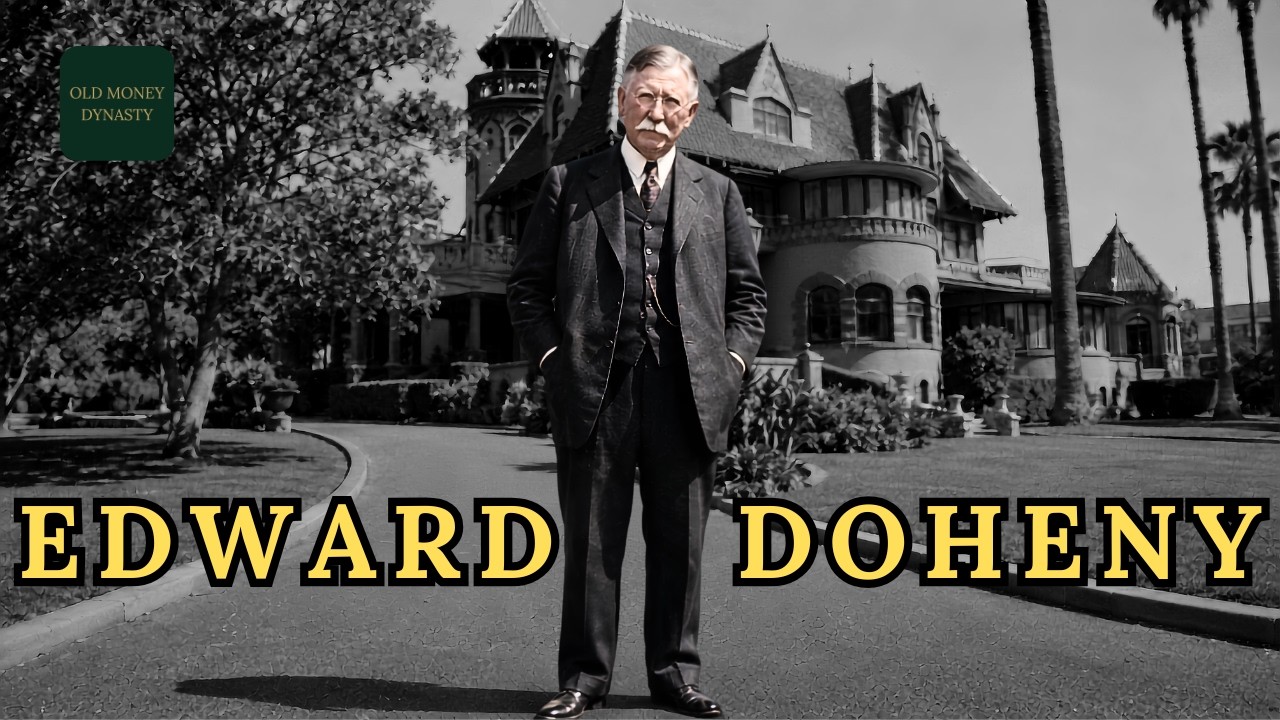
One was the son who had signed for the house, Edward “Ned” Doheny Jr. The other was Hugh Plunkett, who had worked beside him for sixteen years and carried his own key to the front door. The district attorney drove up to the property himself, and within about a day the case was closed. There was no coroner’s inquest, and the story vanished from the newspapers in under thirty-six hours.
The city that had spent two years watching this family build what was reported to be the costliest private residence in California stopped asking about the death of its heir almost immediately. The man who signed the checks was seventy when he gave his son the land. Edward Doheny Sr. had been born to Irish immigrants in a small Wisconsin town and had reached Los Angeles in 1891 with nothing to his name.
Everything between those two facts is the story of how he built a fortune, how he tried to protect it, and what it cost before anyone carried a suitcase through the door of that house. Edward Doheny came to Los Angeles because his old prospecting partner Charles Canfield had done well there. By the spring of 1891, that was no longer true. A land boom had collapsed, and Canfield had lost his silver money.
The city held about fifty thousand people and a great many ruined men, and Doheny was one of them. The following year he could not pay for his room in a boarding house on the edge of downtown. Then he saw a wagon carrying brea, the Spanish word for tar, the black material that seeped out of the ground west of the city. People dug it out of pits and sold it for roofing.
Doheny understood that tar sitting at the surface usually means oil underneath it. He went to Canfield, who was in debt himself, and found four hundred dollars. They leased a lot near the corner of Glendale Boulevard and Second Street and dug with hand tools and a windlass, hauling dirt up in a bucket. At around 155 feet, gas coming off the bottom made it impossible to work.
Doheny cut down a eucalyptus tree, sharpened the trunk, hung it in the shaft, and used it to pound out the rest of the hole. Near 225 feet, it came in. The well produced around forty barrels a day, and it was the first thing that had ever worked for him. What happened next redrew the map of Los Angeles.
Within five years there were hundreds of wells inside the city limits, on residential streets packed so tightly that the derricks nearly touched. By the middle of the decade the field was reportedly producing more than half the oil in California. In December of 1892, while that first well was still new, the Dohenys lost their daughter Eileen, seven years old, to rheumatic fever that had damaged her heart. Eleven months later they had a son and gave him his father’s name.
The marriage ended in 1899, and the boy went with his father. Doheny remarried in August of 1900, to Carrie Estelle Betts, a telephone operator nearly twenty years younger than he was. The Los Angeles wells made him rich, but the scale of his fortune came from Mexico. In 1911, near a place called El Ebano west of Tampico, he brought in the first commercially useful oil well in Mexico.
The crude was heavy and thick, and there was hardly anybody in Mexico to sell it to. He put millions of his own money into keeping it alive. In 1915 he took properties further south and formed the Huasteca Petroleum Company. In September of 1910, a well called Juan Casiano number 7 came in at something like sixty thousand barrels a day, and over its working life produced more than eighty million barrels.
That same year the Mexican Revolution began, and for the next decade Doheny ran an industrial operation inside a country at war with itself, the fields held by armed men on his own payroll. In February of 1916, on a hill called Cerro Azul, a crew drilled the fourth well on the lease. It reportedly threw oil 598 feet into the air, and men working sixteen miles away heard it come in. Cerro Azul number 4 is reported to have produced 260,000 barrels in a single day and more than fifty-seven million across fourteen years.
The Los Angeles well that started everything made forty. That same year he pulled the whole thing together into a holding company called Pan American Petroleum and Transport, which within a few years was reportedly the largest oil company in the United States. Then the ground shifted under him. In 1917, Mexico wrote a new constitution.
Article 27 placed everything beneath the surface of the country in the ownership of the Mexican nation. The largest part of Edward Doheny’s fortune had just become conditional on the politics of a country he did not vote in. That is one reason a private citizen in California came to care a great deal about who sat in the American cabinet and what that person thought of Mexico. Albert Fall, as it happened, had strong opinions about Mexico.
The Navy had converted from coal to oil, and the government set aside fields at Elk Hills in California and Teapot Dome in Wyoming. In 1921, under the Harding administration, the reserves were transferred from the Navy to the Department of the Interior. Once Interior held the fields, one man had authority to lease them, and that man was Albert Fall, now Secretary of the Interior. In 1922, Fall leased Teapot Dome to Harry Sinclair and 32,000 acres at Elk Hills to Doheny’s company.
There was no competitive bidding on either. The cash had reached Fall’s hotel suite the previous autumn. Late in 1921, Ned Doheny went to a bank and withdrew $100,000 in cash. He and Hugh Plunkett took a train to Washington, and at the Wardman Park Hotel Ned handed the bag to Albert Fall.
Fall gave him a promissory note stating that the money was a loan. For two years nothing came of it. Then a senator from Montana started asking where the Interior Department had been getting its money. On January 24, 1924, Edward Doheny sat before the Senate Committee on Public Lands and told them about the money.
His account was simple. It had been a loan, to a man he had known since they were both young and broke in New Mexico. There was a note to prove it, and it had been torn. In June, the grand jury handed down indictments.
In 1927, the Supreme Court threw out both leases unanimously, using the word “faithless” for Fall. But in December of 1926, a Washington jury acquitted Doheny and Fall of conspiring to defraud the government. Doheny took the train home and was met at the station by a welcoming committee of the city’s most important men. Two months after that, they broke ground on a hill above Beverly Hills.
For most of that winter, Hugh Plunkett was in pain. His gums were infected and his teeth were abscessed, and through the early weeks of 1929 a dentist pulled them one at a time, each extraction leaving him worse. The reaction was physical, muscle spasms, hours in which he could not govern his own body. He was staying at Greystone while it went on.
He was taking barbiturates to get through the nights, more of them than any doctor should have been writing for. His marriage had ended the year before, and a court date was coming. Hugh Plunkett had carried a bag of cash to a cabinet secretary, and the federal government now wanted him under oath about it. He had been described as having gone morose with the coming trial constantly on his mind.
Ned was exposed too. A grand jury had indicted him alongside his father back in 1924, and the matter still was not finished. But Ned had the family lawyers and the family money behind him. Hugh had a salary and a room in somebody else’s house.
According to accounts that came out of both families afterwards, the Dohenys had been pressing Hugh to commit himself to a sanatorium. A man held in an institution is a man who does not appear in a courtroom. Saturday, the 16th of February. That afternoon, Ned telephoned the family physician and asked him to come up to the house.
At some point after that, Hugh left. He came back that night. A guard on the property saw him at the garage going through the closet where the family kept its guns and did not stop him. Then he went up to the house and did what he had always done.
He let himself in. Ned met him and walked him along to the ground-floor guest bedrooms. The two men talked. Nobody has ever recorded what was said.
Then Ned picked up the telephone and called the physician a second time. That made two calls to the same doctor in about nine hours. The doctor arrived at around 11:00. He and Lucy Doheny started down the corridor toward the guest rooms.
Before they reached them, the bedroom door came open. Hugh was standing in it. He saw the two of them, shouted at them to stay back, and shut the door. They heard a shot.
That is where the reliable account stops. Everything after it comes from people who had reasons of their own. Nobody telephoned the police for about three hours. When the call finally went out, the man who came was not a duty sergeant.
District Attorney Buron Fitts of Los Angeles County drove up to Greystone himself, with his investigators. The conclusion he announced was that Hugh Plunkett had shot Ned Doheny after being refused a raise and had then shot himself. There was no coroner’s inquest. The newspapers ran it hard for a day and a half and then stopped.
The explanation that circulated among reporters afterwards was that the father was not a man you went after. Seven years later, Leslie White, one of the investigators Fitts had brought, published a book in which he wrote that the scene at Greystone had been altered before the police were allowed to see it and that the weapon carried no fingerprints at all. Plunkett’s relatives maintained that no real investigation had ever been permitted. On the other side, a woman who married into the Doheny family described what had been understood there: the doctor was called before the police, and the doctor did not tell the police everything.
The funerals kept the two men apart the way the city always had. Then there is the question of where they were put. The Dohenys were among the most visible Catholic families in California, and there was a Doheny room waiting at the Calvary Mausoleum. Ned was not placed in it.
He was buried at Forest Lawn in Glendale, which is not a Catholic cemetery. The rule in 1929 was not complicated. A man who died by his own hand did not go into consecrated ground. Hugh Plunkett was buried on the same hillside a few rows down the slope.
A marble canopy taken from the Basilica of Santa Sabina, reported to be more than 1,500 years old, arrived as a gift of sympathy from Pope Pius XI and was set over Ned’s grave. And one smaller thing was quietly settled. Ned and Lucy’s youngest son had been given the middle name Hugh after the man who drove the car and carried the bag and let himself in without knocking. Lucy had it changed.
In October of 1929, Albert Fall went on trial for accepting the bribe. The jury convicted him and recommended mercy, and he was given a year in prison and a fine of $100,000, the exact sum he had taken. In March of 1930, the same judge tried Edward Doheny for giving Fall that money. A different jury heard substantially the same evidence and acquitted him.
One man went to prison for accepting a bribe that in law nobody was ever convicted of offering him. And between those two verdicts in February of 1929, the son who had carried the bag was dead, and so was the man who had gone with him. Fall went to prison in the state where the three of them had met. He served nine months.
He never paid the fine. There was nothing left to take it out of. Edward Doheny held the mortgage on Fall’s New Mexico ranch and foreclosed on it. Edward Doheny did not come back from February of 1929.
Not properly. He withdrew from the company and from public life and became first a recluse and then an invalid. What he kept doing was giving things away, and all of them carried the same name. In 1932 he gave the University of Southern California money for a library, called the Edward Doheny Jr.
Memorial Library after his son. He died on September 8, 1935, at 79, and was placed in the Doheny room at Calvary Mausoleum, the one his son had not been put in. That same year, Estelle went through his papers and burned hundreds of letters and business documents. Nobody knows what was in them.
Greystone took longer to settle. Lucy remarried and stayed in the house until 1955. The ranch land around it went to a developer who cut it into lots; that hillside is Trousdale Estates now. The house itself with about eighteen acres went to Henry Crown of Chicago, who never lived in it but rented it out to film studios.
In 1963 he moved to have it demolished. In 1965, the city of Beverly Hills bought it instead, not for the limestone or the marble in the hall but because a high site holds water pressure. There is a reservoir under that ground now, still the largest the city has. The grounds opened to the public in September of 1971, and five years later the house went onto the National Register of Historic Places.
A house that had cost more than three million dollars to build was saved in the end by the Municipal Water Department. Since then the place has hardly been off a screen. When a production needs a rich man’s house, it comes to Greystone. The house is open, and the grounds are a public park.
The two guest bedrooms are on the ground floor at the east end. Most people who go there have no idea.